

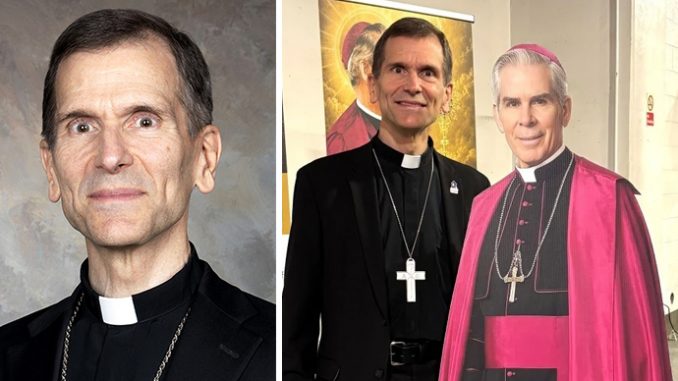
Bishop Michael J. Sis has served as Bishop of the Diocese of San Angelo, Texas, since 2014. He grew up in Bryan, Texas. He was the fourth of five children; his father, Raymond Sis, was a professor of veterinary anatomy at Texas A & M University. They were an observant Catholic family.
He was ordained a priest for the Diocese of Austin in 1986. While the Diocese of San Angelo is small in terms of population with only 120,000 Catholics, it is the largest geographically in the State of Texas. The diocese has 69 priests, with 45 parishes and 21 parish missions.
CWR: Tell us about your upbringing.
Bishop Michael J. Sis: Although I was born in New Jersey, where my father served in the U.S. Air Force, I consider Bryan my hometown as we moved there when I was age six.
We were an active Catholic family. My father was in the Knights of Columbus, and my mother was the coordinator of religious education at our local parish. We prayed in the home, and my parents kept a collection of Catholic books. We had the Catholic Encyclopedia, which was published in the 1960s, as well as Bibles, catechisms, and books on the saints. My mother subscribed to Maryknoll Magazine. I read articles about missionary life, and I was fascinated by it.
Our faith life focused mostly on the parish, which impacted my own calling to the priesthood. I first started thinking about being a priest at age 13. I was walking with my mother outside our parish, St. Anthony Church in Bryan, when the associate pastor approached us and asked my age. I told him I was 13, and he said, “When I was 13, I entered the seminary. I think you should, too. Think about it.”
I did.
CWR: How did you decide to enter the seminary?
Bishop Sis: My freshman year of college, I went to Notre Dame on an ROTC scholarship. I was active in practicing my faith: Mass, retreats, having a spiritual director, and teaching fifth-grade religion at a local parish. I decided to apply to the seminary. I wrote my bishop in Austin and told him I was doing well at Notre Dame and asked him if I could stay and graduate. He agreed, and I moved into the seminary there and earned a philosophy degree. I went in as a lay student, and in my sophomore through senior years, I was in the seminary program as a seminarian for the Diocese of Austin. Once I completed my degree, I moved on to the North American College in Rome.
So, three factors I can point to that led me into the seminary in college were: a good prayer life, a good spiritual director, and teaching religious education on Sundays. It’s been a good fit for me. I love God, I love people, and I can live out both loves as a priest.
CWR: As a seminarian, you did missionary service in Tanzania, in East Africa.
Bishop Sis: Yes, in the summer of 1983, I served with some wonderful Italian Consolata Missionaries. It was a formative experience for me at age 23. I saw their dedication to the people they served, and it inspired me. One of the missionaries got sick while there—it was something he ate or drank—and had to return to Rome, where he died.
CWR: You also volunteered for a halfway house for youth in Houston.
Bishop Sis: Yes, it was the summer of 1981, and it was called the Houston Community Youth Center. It was for young men leaving prison and transitioning to life outside. I was a counselor for young men who, in many ways, were broken by their life experiences. They were wounded human beings because of their experiences growing up. They made bad choices, but they were wonderful people.
You celebrated your 40th anniversary as a priest in 2026. What are your favorite things about being a priest, and what are your biggest challenges?
CWR: Celebrating the sacraments, especially the Mass, brings me the greatest joy in the priesthood. I love hearing confessions. If this is all I did as a priest, that would be enough.
Bishop Sis: I also like being a part of the lives of people in the parish, helping them connect with Jesus in their personal lives. I love the experience of seeing someone fall in love with Jesus, something I’ve seen happen over and over.
The biggest challenges include the high workload of the priest. I find that even if I work really hard, I can only scratch the surface of the good that can be done. This also means that you have to be an effective manager of your time and commitments.
You also have to adjust to being a public person. When I was a student, I did my studies and minded my own business. But once I was ordained, I became a public person, which took an adjustment. People watch you; you are a topic of conversation and gossip. I can merely be pushing a cart through the grocery store, and people look into my shopping basket to see what I’m buying. Or, if you try to help someone, others wonder, “Why is he spending time with them and not me?”
CWR: Your assignments as a priest included serving at St. Mary’s Catholic Center at Texas A&M University, where your father taught. What did you experience there?
Bishop Sis: I was chaplain, director of campus ministry, and pastor of St. Mary’s. I was there 13 ½ years, my longest assignment. The students there were called Aggies; 10,000 of them were Catholic when I was there. It was an exciting time in my priesthood, and an enriching experience for me.
CWR: What did you learn about ministering to young adults?
Bishop Sis: I learned that if you make room for them in the Church, they will work wonders to help the Church grow. If a college student is spending time at the Church, it means that he or she is dedicated to the Faith. The young people there were also smart and capable; so I had a parish full of smart, capable people dedicated to the Catholic faith. It was a privilege to work with people with those gifts. The key is to plug them into roles of leadership and watch them grow. They did amazing things.
CWR: Did you see many pursue vocations to the priesthood or religious life?
Bishop Sis: Yes. When I was there, we had about ten per year entering the seminary or convent. The Center has produced a large number of priests and religious, as well as deacons and committed married couples.
CWR: Your father became a permanent deacon.
Bishop Sis: Yes. Dad was very committed to our Faith. He was a faithful man, and smart. He served in our local parish. Also, for several years, he served at Blessed Virgin Mary Church, a mission church that served the black community, in Washington-on-the-Brazos, Texas. He brought Communion for Sunday services in the absence of a priest. They loved him, and he loved them.
I did his funeral three years ago; my mom, at age 95, is still with us.
CWR: He saw you ordained a bishop.
Bishop Sis: Yes. When a bishop is ordained, two deacons take the book of the Gospels and hold it open, like a tent, over his head. The bishop is kneeling on the floor in prayer in front of the altar with the Gospel suspended over his head. My dad got to do that. I don’t know of any other bishop who had that same experience.
CWR: Tell us about the Diocese of San Angelo.
Bishop Sis: It encompasses 37,000 square miles, which makes us larger than the State of Indiana. 14.8% of the population is Catholic. The land is wide open, rugged, and mostly dry. We have no Catholic health care, no Catholic universities, and only four Catholic schools in the whole territory.
Our two chief industries are agriculture—which is becoming increasingly difficult because of the scarcity of water—and energy. We have oil and natural gas, and because of our expansive space, sun and wind, we have wind and solar energy production.
Of our 69 priests, about half are native born, the rest are from other countries. We have 81 permanent deacons, most of whom are Mexican-American. Our ministries are bilingual.
We have 11 total religious sisters in the entire area, every one of whom was born outside of the U.S. We have 10 seminarians, all of whom were born and raised here.
CWR: Are you pleased with your vocations numbers?
Bishop Sis: I would like to have 15 or 20. But we have a vibrant vocations ministry and a full-time priest as director of vocations. We have many strategies to build a culture of vocations; it is a high priority for me.
CWR: What sort of retreat opportunities do you offer in the diocese?
Bishop Sis: One of our priorities is spiritual renewal, and a way we achieve that is through beautiful retreat movements. These are opportunities for conversion to Jesus Christ, which can make a great impact on retreatants.
These include ACTS retreats, a derivation of the Cursillo model. In Cursillo, you have to be able to receive the sacraments; with ACTS, you don’t have that requirement, so more can go on these retreats.
We also have SEARCH retreats for teenagers. These were popular around the country in the 70s and 80s, but have died out since then. But in our diocese, they are still going strong and are an important part of our youth ministries.
We also have Kolbe retreats for the incarcerated. These retreats are important tools for evangelization.
CWR: You regularly write columns for your parishioners. One recent column, for example, was “Overcoming Your Fear of Death”. How do you select your topics?
Bishop Sis: It’s not easy. I try to write things that will help the people in our diocese to grow in their faith. My columns are based on the struggles that our people face, and I attempt to offer them some bit of guidance, hope, or direction in the struggles they face. Fear of death, for example, is a common human experience. I wrote that column during the Easter season when we especially focus on Our Lord’s death and resurrection.
Another column I wrote recently was about conquering temptations. As I said, I love hearing confessions. One thing that frequently comes up is how hard it can be for people to conquer temptation. After 40 years as a priest, I think I’ve accumulated some knowledge that might be helpful.
My next column will be on Bishop Fulton Sheen. I was one of the 50,000 people present for his beatification in St. Louis, Missouri. We had a good representation from our diocese; it was a joyful celebration of our Catholic faith. I want our people to know about him.
San Angelo has a connection to Bishop Sheen. During his period of retirement from 1969 to 1979, he came to San Angelo to give a retreat for our priests. As part of that, he insisted that there be three public lectures open to the general public. That’s unusual for a priest’s retreat.
CWR: You also wrote a May 8th column on “Just War Doctrine”.
Bishop Sis: Yes. As things were heating up in Iran, I wanted to help my people reflect on just war doctrine. I did so as a pastor when the U.S. went to war in Iraq and Afghanistan. I thought it was my pastoral duty as a pastor. I do not express my opinion as to whether or not it is a just war, but share the principles with readers and let them apply them.
CWR: We have an election coming up in November. What issues are most important to you?
The fundamental issue is the dignity of the human person. This includes the rights of the unborn, the dignity of the poor and immigrants, and the dignity of the elderly threatened by euthanasia.
CWR: Are there any trends in the country that concern you?
Bishop Sis: I worry that we are becoming polarized as a people and that we frequently politicize things.
CWR: Who are some Catholics you admire?
Bishop Sis: My big hero right now is my sister, Susan. She is caring for our 95-year-old mother day and night with patient love. She is living out the corporal works of mercy every day and night. I am grateful for all my sister does for my mom.
I’m also impressed by the example of Korean Catholics. Long before there was an organized Church hierarchy in Korea, lay people went to China, found Catholicism, and brought it back to the Korean peninsula. They lived the Catholic faith before any priests came. Their history of bringing the Catholic faith to Korea is heroic. World Youth Day 2027 will be in Seoul, Korea, and I look forward to attending.
CWR: Do you have any spiritual advice for the laity?
Bishop Sis: Let me recommend two books. The first is The Practice of the Presence of God by Brother Lawrence of the Resurrection. It was written in the 17th century by a French Carmelite lay brother. It is one of Pope Leo’s favorite books, and mine as well.
The second is The Sacrament of the Present Moment by Jean-Pierre de Caussade, a Jesuit priest who wrote in the 1700s. I think that if you apply the techniques that they recommend, living in constant loving relationship with Jesus throughout the day, you will greatly benefit.
CWR: You’re a committed racquetball player.
Bishop Sis: Yes, I play twice a week at 5:30 a.m. with non-Catholic friends at a local gym. I’ve been doing it since my brother taught me the sport in 1977. I’ve been playing it at least once a week since. It is a dying sport, as fewer and fewer people play, but one I thoroughly enjoy.
There’s an old Latin phrase, which translates “a healthy mind in a healthy body.” Playing racquetball has been my way to keep physically in shape, which benefits me in all I do.
CWR: Any other thoughts?
Bishop Sis: As Catholics, we are part of a minority religion in West Texas. But we must strive to be faithful Catholics in a non-Catholic world. When we interact with our non-Catholic neighbors, we should celebrate what we have in common while respecting our differences and collaborating on matters of common interest.
Yet we should not be ashamed of speaking of our faith in love. We should live authentic Catholic lives, not isolating ourselves from the world, but not assimilating into it either. That is what I try to instill. We should let our light shine in the world.
If you value the news and views Catholic World Report provides, please consider donating to support our efforts. Your contribution will help us continue to make CWR available to all readers worldwide for free, without a subscription. Thank you for your generosity!
Click here for more information on donating to CWR. Click here to sign up for our newsletter.


Leave a Reply