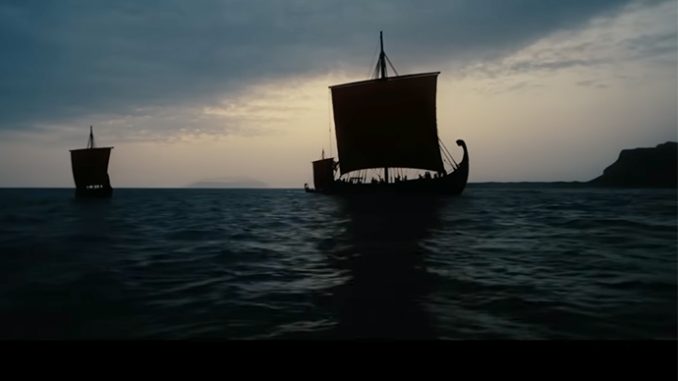
Unless you’ve been living in a cave blocked by a rock (and if so, maybe get out of there), you’ve heard about, and likely have already seen, Christopher Nolan’s The Odyssey.
The adaptation of Homer’s three-thousand-year-old poem caused a considerable stir prior to its release due to some of Nolan’s casting choices. But those debates have largely been quelled by the release of the film itself, which has been a mega-hit at the box office—to the thunderous applause of both critics and audiences.
The massive success of The Odyssey, and the tidal wave of interest and commentary generated by it, is a telling and even pivotal moment for our culture. It demonstrates that, despite all appearances to the contrary, five things often treated as old and outdated—from movie theaters to the moral law—still matter to us, and for us, and matter deeply.
Movie theaters
Fewer people are going to the movie theaters. This year, AMC has seen attendance drop by 26 million compared to 2019 (more than a 25% decline), and already at that pre-pandemic point, the numbers had been falling for nearly two decades.
There could be numerous causes for the decline, but the most obvious is the proliferation of the internet, smartphones, and smart TVs. Movies can now be streamed anywhere, anytime, at the click of a button. Studios have been forced to get creative, releasing films direct-to-TV instead of, concurrently with, or shortly after a theatrical release.
But The Odyssey is on pace to be one of the biggest releases of the year. It’s also the first major film made entirely with IMAX cameras for IMAX viewing—an as anyone who saw it in that mega-screen, mega-audio format can attest, this was not something that could be replicated on a phone or even a TV. (As David Lynch, a cinematic inspiration for Nolan, once put it, “If you’re playing the movie on a telephone, you will never in a trillion years experience the film.”)
Going to the movies, to borrow from the opening line of The Odyssey, is “a time of apparent magic”—a magic that’s only heightened by IMAX. But at the heart of that experience is joining a giant crowd of people to react together in real time to a wild journey like The Odyssey. (The same principle applies, of course, to live theater too—which, though it might lack the audio-visual explosiveness of an IMAX movie, is explosive in its own way.)
Human art
Christopher Nolan, though clearly no Luddite, has drawn some sharp lines with technology: He refuses to own a smartphone, and he advocates “a healthy skepticism” with AI (“a Trojan horse that everybody knows the Greeks are inside it”).
But most remarkably for him as a contemporary filmmaker, Nolan is famously resistant to the use of CGI. He used a massive puppet to help construct the cave-dwelling Cyclops; old-school camera and casting tricks to create the illusion of a race of bloodthirsty giants; and, most memorably, makeup and animatronics reminiscent of 90s-era Jim Henson movies to depict Circe’s “handiwork.” When we look at scenery, we’re looking at real places—from Iceland to Greece to Morocco—and when we watch boats sail in water, we’re watching real boats in real water.
This commitment to the human element in filmmaking—avoiding CGI, AI, and all manner of digital shortcuts—cuts against the grain of just about everything churned out in the entertainment world today. It’s more costly, more difficult, and more time-consuming. But the result, when paired with the care and expertise of an artist like Nolan, is far richer and more rewarding.
Not only does The Odyssey not feel hokey—it feels immersive, visceral, and elevating in a way no computer graphics, however good, ever do. The sacrifice has paid off—and audiences know it. As an actor acquaintance put it to me, “The Odyssey proves people still want human movies.”
Classic stories
Sure, The Odyssey is masterful moviemaking—an action-packed audio-visual powerhouse from a mad scientist of cinema. But how does it fare as a story, especially as an adaptation of one of the foundational stories of Western civilization?
Here, the reaction has been more mixed. Emily Wilson, whose progressive translation of The Odyssey Nolan has referenced, wrote a blistering and much-discussed critique of the film. Wilson emphasizes the deviations from Homer’s original and argues that the movie is shallow and “gimmicky”: “I would be ashamed to have written any part of this script.”
Meanwhile, conservatives, long before the film’s release, have been upset about some of Nolan’s casting choices, arguing that they tarnish the story’s authenticity and promote a liberal agenda.
The critics have raised some fair concerns, but they often fall into a pedantry and politicization that misses the forest for the trees. Nolan’s adaptation is a compelling Hollywood story and, in the main, faithful to the contours of The Odyssey. Yes, he makes some striking changes, but most adaptations do—and this ancient Greek poem is about as far removed from the world of movies as any.
As Jonathan Pageau succinctly put it, “A movie is not a poem. You can’t make The Odyssey into a movie. It’s not possible if you wanted to do it exactly like the poem. And also then, what’s the point?”
And while Nolan could have parted with Homer in more substantial ways, he didn’t. As Tod Worner, a man of the humanities but also of common sense, put it in his on-the-money review, the omissions “do not break the film” and the character debates were ultimately “jots and tittles of little import.” (Pageau even argues, provocatively, that Nolan’s casting is itself a kind of Trojan Horse trickery.) The Odyssey, Worner writes, did “much honor” to Homer, whose works have recently been subjected to attempted bans in schools.
Indeed, the poem is now flying off the shelves thanks to Nolan’s film, introducing countless people, perhaps for the first time, to this classic work.
Moral law
What is the heart of that story in Nolan’s retelling? Another fair critique of Nolan’s Odyssey is that there’s just a lot going on, not only narratively but thematically. For a movie with a runtime of nearly three hours, there’s not much space to process its meaning until the credits roll.
But one could make a strong case that Nolan’s primary aim is what C. S. Lewis in The Abolition of Man called “the Tao”—that universal moral law that can be detected around the world and across the centuries. There’s an objective moral order, a right and wrong, that we either meet or fall short of, both as individuals and as a society. Cultures may disagree about what, exactly, is good and honorable, but they don’t disagree about the value of goodness and honor.
At the heart of that moral law, for Nolan, is xenia, or “Zeus’s law”—an ancient Greek concept of hospitality. The law, which Nolan compares to the golden rule, emphasizes kindness to strangers—foreigners, travelers, even beggars—who could be gods in disguise. Nolan depicts the Trojan War as essentially a series of violations of xenia, and the inevitable cycles of violence and retribution that unfold as a result. It’s the loss of social harmony through the flouting of moral order—the abolition of what makes us human.
But The Odyssey is not just about compassion toward others; it’s also about the personal excesses that threaten to engulf and rend us. Each vignette on the journey becomes a vivid metaphor for some kind of temptation, whether toward theft (as in the cave of the cyclops) or lust (as with the sirens’ song) or a drug-induced state of oblivion (as with the lotus flowers). Indeed, while gluttony is maybe one of the least discussed moral issues of our time, Nolan’s vivid depiction of this vice (and, by extension, any unrestrained appetite) in the cottage of Circe is one of the most impactful and unforgettable in film history.
Christian civilization
Nolan’s moral vision, though, isn’t that of Homer. As Wilson rightly puts it, “Many of the film’s implicit values directly contradict those of Homer’s poem. Deception, warmongering, extramarital sex, cruelty to animals, abusing women and yearning for honour—all perfectly fine in the world of Homer—are, in this version, very bad.” Wilson sardonically lampoons what she takes to be the movie’s “American ideas” about charity and the ideal “American family man.”
But what this all amounts to, at root—whether Nolan intended it or not—is that the ideas are, fundamentally, Christian ideas. The Odyssey assumes a moral framework that the West now takes for granted, but that came to birth through the Catholic Church’s influence. Indeed, in Nolan’s retelling, the invasion of Troy through the deceit of the wooden horse approaches, as Samuel Korb rightly notes, an image of original sin.
A specifically Christian interpretation of the story also becomes, within this adaptation, that much more natural. We can read Odysseus, as Clement of Alexandria does in his second-century Exhortation to the Heathen, as a figure of the human soul journeying through the temptations and dangers of this life toward a higher world: “Sail past the song [of the sirens],” Clement writes; “it works death. . . . Bound to the wood of the cross, you shall be freed from destruction: the word of God will be your pilot, and the Holy Spirit will bring you to anchor in the haven of heaven.”
We can even read the kingly protagonist, especially in the film’s last act, as a Christ figure: God, in the “disguise” of human likeness and the form of a slave (Phil. 2:7), arrives to deal with his enemies, to reestablish justice, and to reclaim his house and his bride and to elevate his child.
But while this double helix of interpretation arguably runs through much of this movie—Odysseus-as-Christian now turning to the fore, now Odysseus-as-Christ—we never quite “get to” Christianity, least of all in the end. This is, after all, still a pagan myth, and the climax of the story, in both the book and the film, is a veritable bloodbath. Indeed, Nolan’s film wrestles with itself morally: Why is the wanton slaughter of the Trojans after hiding in a wooden horse a kind of “original sin,” but the wanton slaughter of the suitors after hiding in a beggar’s cloak a kind of “redemption”? We remain trapped in the same endless cycle of bloodletting—a pre-Christian paganism that pants for the Gospel, a ruthless justice that longs for divine mercy.
Indeed, Nolan’s Odysseus—despite his regular touchpoints with Athena—is consistently skeptical about these pagan gods and their muddled meddling with man. They seem, at best, what Lewis called “good dreams”—the shadowy anticipations of some divine fullness as yet unrevealed.
The film thus seems to strive forward, with remarkable focus and energy, to that which came before us—as if to say, with Chesterton, “Paganism was the largest thing in the world and Christianity was larger; and everything else has been comparatively small.”
If you value the news and views Catholic World Report provides, please consider donating to support our efforts. Your contribution will help us continue to make CWR available to all readers worldwide for free, without a subscription. Thank you for your generosity!
Click here for more information on donating to CWR. Click here to sign up for our newsletter.

Becklo’s research and thought are commendable. Yes, the turning of audiences to the original poem is admirable. Nolan’s factual Catholicism is notable; he apparently does not practice but was raised in the faith. Nolan’s work unsurprisingly contains Christian themes and traces. One friend explains it, “Catholicism is like the song ‘Hotel California.’ You can check out any time you like, but you can never leave.” Give Nolan’s work a little scratch and there we see a cross.
I don’t quite see the horse as representative of original sin. The original sin was Helen’s. The poem does not clearly state that Helen had any active role in her ‘abduction,’ but in it, Helen clearly does state her “regret” at that ‘abduction.’ Hmmm. Why should she regret her action if she were an innocent victim?
She recognizes that she is the cause of the war, the cause of so much suffering and the death of so many. She blames Aphrodite. (Eve blames the serpent.) Euripides’ Helen suggests that the real Helen of Troy is a “phantom” or illusion. His play asks the question: Who exactly is the real Helen? An innocent or an illusion?
In the poem, Helen recognizes Odysseus behind his disguise, while Odysseus’ wife Penelope does not. Helen “knows” and perceives somewhat uncannily.
Helen as an original sinner is a definite possibility.
—These are the virtues OBLITERATED IN THE FILM, VIRTUES that Greek children learned, taught by Homer and that formed their character:
—These virtues allowed the Greeks to beat the invading armies of the despotic Persia (today’s Iran) and fight for liberty or death at Marathon and Platea.
–These virtues taught by Homer allowed the Greeks to stop the huge invading army of Persia (today’s Iran) at Thermopylae and tell the Persian despot who demanded that they surrender their weapons, “Come get them” (Molon Labe!).
–These virtues allowed the Greeks to create a civilization that is absolutely fundamental for Western civilization.
—And these virtues allowed even Greek Orthodox priests to fight and die and kill during the Greek War of Independence against the Muslim Turks oppressors AND WIN.
THESE ARE THE CORE HOMERIC VIRTUES:
• Arete (ἀρετή): Often translated as “excellence” or “virtue,” this is the foundational concept of fulfilling one’s specific potential. For a warrior, arete meant unmatched martial prowess, courage, and skill. In the film, Odysseus’s arete is portrayed not as a source of pride but as a burden linked to guilt, contrasting with the Homeric ideal where expressing arete was the only path to human flourishing (eudaimonia).
• Kleos (κλέος): Meaning “glory” or “fame” that lives on after death, kleos was the primary motivation for Greek heroes, who sought “imperishable glory” through great deeds. Nolan’s Odysseus appears indifferent to or weary of kleos, viewing his legendary deeds (like the Trojan Horse) as moral failures rather than sources of eternal renown.
• Timē (τιμή): This refers to honor, social worth, and public respect received during one’s lifetime, often manifested through prizes and status. The film’s focus on internal guilt overrides the external pursuit of timē; the character is driven by a modern “guilt culture” rather than the ancient “shame culture” where public reputation was paramount.
—This column by Greek journalist John Kass (formerly of the Chicago Tribune) is excellent:
Beware of Greeks Bearing Grifts: Nolan’s Cowardly Betrayal of The Odyssey and the Greek People
By John Kass
https://johnkassnews.com/beware-of-geeks-bearing-grifts-nolans-craven-betrayal-of-the-odessey-and-the-greeks/
Weird how all of these “virtues” you list are antithetical to the follower of Christ and obliterated by His Sacrifice.
The pursuit of excellence is antithetical to Christ?
A good thing about this movie’s screening is that it has motivated many young and old people to read Homer. The translation of the Odyssey by Robert Fagles is excellent and available also in audio.
https://www.amazon.com/The-Odyssey-audiobook/dp/B000OYDLE4/ref=sr_1_10?s=books&sr=1-10
Another good one is by Daniel Mendelsohn with audio available at amazon.
—As Greek journalist John Kass (formerly of the Chicago Tribune) has pointed out, Wilson herself in her translation of the Odyssey obliterates the Greek virtues present in Homer.
—Homeric texts was how young Greeks in Classical Greece learned. Young Greeks in classical Greece learned to read by engaging with Homer, as his works served as the primary educational text. The Iliad and Odyssey were central to early intellectual exercise, often taught through memorization and oral recitation before formal literacy was fully developed.
—It was the basis of character formation.
—These were the Greeks who defeated the huge invading army of the Persians at Marathon. And yes, this battle gave origin to the practice of the marathon race today. Look it up.
—These were the Greeks who created the Olympic Games….
—And the ones who stopped the Persians at Thermopylae, and told the Persian despot who asked them to give up their weapons “come and get them!” ( molon labe!).
— And the tough modern Greeks, also readers of Homer in school, adopted during their War of Independence (1821-1830) from the centuries of domination by the Muslim Ottoman Turks the motto LIBERTY OR DEATH!, Eleftheria i thanatos (Greek: Ελευθερία ή θάνατος!
And the tough Greek Orthdox priests who fought and died and killed in this war AND WON.
—The phrase LIBERTY OR DEATH! is now part of the Greek flag symbolized by the nine horizontal stripes corresponding to the nine syllables of the phrase.
For the history and significance of all this see
https://talkpal.ai/culture/why-is-the-phrase-eleftheria-i-thanatos-linguistically-powerful/
and
https://grokipedia.com/page/Eleftheria_i_thanatos
The audiobook of Daniel Mendelsohn’s translation of the “The Odyssey” is available on the website of its publisher, the University of Chicago Press, as part of an online music streaming and audio sharing platform with a monthly fee. At Amazon, the audiobook is “free with trial membership”. At Apple Books, you can buy the audiobook for $14.99 plus sales tax.
The narration is done by the translator himself, so you hear how the intonation and pacing should be done. Fortunately, Daniel Mendelsohn has a pleasant voice, and the audio engineering is as outstanding as that of the audiobook of Father Carlos Martins’ “The Exorcist Files”.
—Homer is still part of the education of young Greeks. It is still part of the classics major in American universities. It is a foundational work in Western civilization. I read the Odyssey as a child and could not put it down. As Jorge Luis Borges wrote, Western civilization comes from two places, Athens and Jerusalem.
. ΜΟΛΩΝ ΛΑΒΕ!
In reading too many online articles about Homer’s Odyssey, I just came across this book:
The Myth Made Fact: Reading Greek and Roman Mythology through Christian Eyes, by Louis Markos.
“There is no better guide to the panoramic landscape of Greek mythology than Louis Markos. If there’s one book that everyone should read on the relationship between Greek myth and Christian truth, The Myth Made Fact is it.”
—Joseph Pearce
Director of Book Publishing at the Augustine Institute, editor of the St. Austin
Review, and series editor of the Ignatius Critical Editions
Yes, the Ignatius Critical Editions are fantastic. Joseph Pearce is a great scholar and editor. Thank you for the tip on this book.
Oscar,
You are welcome, and I hope the Ignatius Critical Editions will become better known.
I found this article intro another example of something such as someone with a home office suite automatically assuming everyone on the planet having a home office suit….in this case, the movie addict assuming everyone else is also a movie addict, “and likely has already seen” the movie, and if not saturated by media hype on the subject (as a media addict would say), then must be hiding under a rock and that is a BAD thing.
If you divide ticket sales by population, you will find only a small minority have actually seen the movie.
For myself, I watched the trailer and lost all interest when a prince, while talking to a usurper, referred to his father, the king, as “my dad”.
Interesting article. The Odyssey is about soldiers coming home. They are in a war, all they want to do is go home. When they do go home, they are suddenly fighting monsters. My son served in Iraq. His tour in ’07/’08 was chronicled in the New York Times best seller, “the Good Soldiers.” I read the book. Since he came back in ’08 there have been at least a dozen suicides among the soldiers he served with. We’ve been living the Odyssey since he came home.
Where are the great Christian heroes of the past, now that we need them?
—Godfrey of Bouillon, Skanderbeg, King Saint Louis IX of France, King Saint Ferdinand III of Castile, El Cid, Don John of Austria and his fellow soldiers at Lepanto, King Richard the Lionhearted of England, John Hunyadi, Vlad Tepes, the monk Knights Hospitaller, the monk Knights Templar, and so many other Christian heroes who still had THE ANCIENT GREEK VIRTUE OF ARETE (EXCELLENCE, VIRTUE, AS WARRIORS IN THEIR CASE) and who through these virtues of courageous war-making effectiveness—Arete—BY DEFENDING CHRISTIANITY ACHIEVED THE ANCIENT GREEK VIRTUE OF KLEOS—RENOWN, GLORY—AND TIME—RESPECT, SOCIAL WORTH–BECAUSE WE STILL REMEMBER THEM AND HONOR THEM AS GREAT CHRISTIAN HEROES—WHO SHOWED THAT FOLLOWING CHRIST DOES NOT MEAN BECOMING A DOORMAT AND A WIMP AND LETTING ENEMIES TRAMPLE AND WORSE ON ONE’S WIVES, CHILDREN, FAMILY, CHURCHES, NATION, NEIGHBORS, FRIENDS, RELIGION AND CULTURE.
—For King Saint Ferdinand III of Castile see
SAINT FERDINAND III OF CASTILE: WARRIOR KING AND CATHOLIC SAINT
https://www.tfp.org/king-saint-ferdinand-iii-and-his-conquests-for-christ/
—For the famous Don John of Austria and the other famous heroes of Lepanto read G.K. CHESTERTON’S FAMOUS AND GLORIOUS POEM LEPANTO
https://www.poetryfoundation.org/poems/47917/lepanto
—For many others famous and glorious Christian heroes READ THIS BOOK WHICH HAS ACHIEVED FAME—KLEOS– as a No. 1 Best Seller at amazon
DEFENDERS OF THE WEST: THE CHRISTIAN HEROES WHO STOOD AGAINST ISLAM
https://www.amazon.com/Defenders-West-Christian-Heroes-Against/dp/1642938203#averageCustomerReviewsAnchor
The point about critics missing the forest for the trees feels central to any adaptation of a foundational work. Casting and other production choices can be worth discussing, but they should not become the only measure of whether a film engages seriously with the poem’s larger questions. An adaptation does not need to freeze Homer in place to show why the Odyssey still has relevance; it can invite viewers to encounter its themes through the language and scale of another medium.
The debate around adapting Homer seems most productive when it asks what the film makes visible for a new audience, rather than treating every departure as a final verdict on the original. Casting choices can be worth discussing, but they should not eclipse the larger question of whether an ancient story still carries moral and imaginative force. A careful adaptation can invite viewers back to the poem with fresh attention. That broader perspective helps keep criticism from becoming mere pedantry.
A contemporary adaptation can invite a new audience into Homer without requiring every artistic decision to settle a cultural argument. The useful question is whether the film preserves the poem’s large human concerns—homecoming, loyalty, pride, loss, and endurance—while finding a cinematic language of its own. Criticism has a place, but perspective matters when judging a work shaped by a story that has endured for millennia.