

As widely commentated, the most obvious continuity framework for Magnifica Humanitas is Rerum Novarum (1891). The Holy See presented Pope Leo XIV’s encyclical as a document on “safeguarding the human person in the time of Artificial Intelligence,” signed on May 15, 2026, the 135th anniversary of Pope Leo XIII’s Rerum Novarum. That timing matters. Just as Leo XIII addressed the “new things” of his age—including industrial capitalism, wage labor, class conflict, and modern political economy—Leo XIV’s new encyclical, which was born from listening as Leo XIII did, addresses the “new things” of ours: AI, algorithms, automated decision-making, social media, data extraction and technological domination. This continuity is not merely chronological. Rerum Novarum protected the worker from being reduced to labor power; Magnifica Humanitas protects the person from being reduced to data.
Orientalium Dignitas
But a second Leonine continuity deserves attention: Orientalium Dignitas (1894), Leo XIII’s apostolic letter focused on “preserving the integrity proper to the discipline of the Eastern Churches,” published three years after Rerum Novarum.
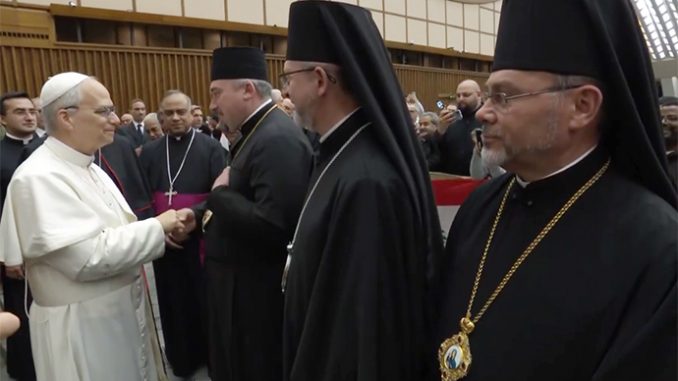
This document is not simply an administrative text about Eastern Churches. It safeguards the Eastern Catholic Churches, which are not ornamental survivals or Latin Catholicism with different liturgies. These churches bear a legitimate and venerable patrimony: liturgy, discipline, spirituality, canon law, theology, and memory. Pope Leo XIV himself recalled this Leonine heritage in his address to participants in the Jubilee of Oriental Churches on May 14, 2025, noting Leo XIII’s insistence on the dignity of the East and on the legitimate variety of Eastern liturgy and discipline.
Placed side by side, Rerum Novarum and Orientalium Dignitas provide an important perspective to reading Magnifica Humanitas. The AI crisis is not only an economic crisis, but also a crisis of human dignity, memory, language, embodiment, imagination, and communion. The danger is not merely that machines will take over human jobs. It is that technology may forget what a human person is; it will level plurality and treat every difference as a problem to be deleted.
In this sense, Orientalium Dignitas is not an anti-Babel document in a direct or historical sense; it is anti-Babel by analogy. It teaches the Church to resist false unity, imposed uniformity, and the reduction of legitimate diversity to administrative inconvenience. That is precisely the kind of theological instinct needed for an AI age tempted by universal scoring, universal profiling, universal translation, universal surveillance, and universal prediction.
The Eastern Catholic Framework
A hermeneutic framework drawn from Orientalium Dignitas does not mean reading Magnifica Humanitas as if it were an Eastern encyclical. It is not; its architecture remains Roman. But an Eastern Catholic framework asks what AI will do to memory, embodiment, liturgy, symbolic life, prayer, attention, and communion. The danger is not only that machines may replace human labor. It is that a technological culture may train human beings to become machine-like: optimized, scored, predicted, imaged, and managed, but not transfigured.
Eastern Catholic theology brings its own anthropological depth and emphasis. It reminds us that the human person is not exhausted by labor, rights, autonomy, productivity, or rational capacity. The human person is an icon, a liturgical being, a unity of body and soul, a creature created by God and called to divine life and divinization, and a member of a communion that cannot be simulated by network connection.
Vatican II’s Orientalium Ecclesiarum teaches that the institutions, liturgical rites, ecclesiastical traditions, and discipline of the Eastern Churches belong to the undivided heritage of the universal Church (1 and 5). John Paul II’s Apostolic Letter Orientale Lumen further insists that the West must know and receive the light of the East if the Church is to breathe with her two lungs (Ut Unum Sint).
If Rerum Novarum teaches the Church to judge AI by labor, justice, and the common good, Orientalium Dignitas teaches the Church to judge AI by another standard as well: whether it preserves embodied, liturgical, plural, and tradition-bearing humanity.
This reading must also be disciplined. It does not claim that Pope Leo XIV has written an Eastern theological treatise. Rather, it argues that the Eastern Catholic patrimony reveals what is already latent in the encyclical: AI is not only a social question or a technical question. It is an anthropological and spiritual question. The central issue is what kind of human being digital culture forms.
Theosis, not optimization
The first tool is theosis, or divinization. Magnifica Humanitas criticizes the transhumanist and posthumanist “futuristic vision” (115-116), which imagines humanity becoming “more than human” through technical enhancement, hybridization, or escape from bodily limits.
Eastern theology sharpens the argument: transhumanism is not too ambitious; it is insufficiently transcendent. It seeks enhancement without grace, power without communion, and transcendence without Incarnation. The Fathers never feared the claim that humanity is called beyond itself. St. Irenaeus (Against Heresies) teaches that the Son of God became the Son of Man so that humanity, taken into the Word and receiving adoption, might become children of God. St. Athanasius gives the classic formulation: “He was made man that we might be made God” (On the Incarnation of the Word, 54, 3). The Catechism of the Catholic Church receives this patristic witness in its teaching that the Word became flesh to make us “partakers of the divine nature.” (460).
The Fathers teach that this ascent to God is received as grace, not engineered as mastery. Thus, the Church’s answer to AI is not simply “remain natural.” It is not to confuse technical amplification with sanctification. A person can become faster, more informed, more connected, and more productive without becoming wiser, freer, or holier. Enhancement amplifies capacity; deification transforms communion. Enhancement asks what the human being can do; theosis asks what the human being is called to become in Christ.
Theosis, not optimization, is the Christian answer to the machine-age fantasy of self-salvation.
The Incarnation: Word made flesh, not algorithm
The second tool is the Incarnation, read through Irenaeus’ doctrine of recapitulation (Against Heresies, Book V, Chapter 21).
AI often invites a disembodied human imagination (transhumanism): intelligence without body, voice without person, image without presence, language without lived memory, and decision without responsibility. Irenaeus’ doctrine of recapitulation and Vatican II’s teaching that Christ reveals humanity to itself, “Christ, the final Adam, by the revelation of the mystery of the Father and His love, fully reveals man to man himself and makes his supreme calling clear” (Gaudium et Spes n. 22).
God does not save humanity by bypassing flesh, history, or vulnerability. The Word became flesh and gathered, summed up, and recapitulated the human story in himself.
This gives Magnifica Humanitas its strongest anthropological claim. The problem is not that AI generates language or images; the problem is that a culture may learn to value language without accountability and images without persons behind them.
A generated face is not an icon. A synthetic voice is not a mother, a teacher, a scholar, or a witness. The Word became human flesh, not data or an algorithm.
The Icon invites veneration
Thus, the third tool is the icon. Pope Leo’s encyclical insists that the quality of a civilization is measured not by the power of its means, but by the care it can offer, by its ability to recognize the other as a real face, not merely as a function (114).
The Eastern Christian theology of icons deepens this teaching. St. Basil’s teaching that honor paid to the image passes on to the prototype (On the Holy Spirit 18.45), St. John Damascene’s defense of holy images, and the Second Council of Nicaea’s vindication of icons focus on the Incarnation: because God became man, clothed in flesh (St. John Damascene, On the Divine Images I.16), the visible/icon is not spiritually irrelevant.
Because God became visible, the visible is not disposable. Because Christ has a human face, the human face cannot be reduced to a function, profile, metric, or manipulable image.
This is a powerful way to critique some uses of AI without rejecting technology as such. AI becomes anti-iconic when it treats the face not as the manifestation of a person before God, but as a surface to be captured, classified, simulated, monetized, or manipulated. The icon invites veneration; the profile invites extraction. The icon reveals presence; the algorithm often converts presence into mere information.
An Eastern Catholic reading, therefore, asks not only whether an AI system is accurate, but whether it is anti-iconic: does it train us to see persons as faces before God, or as mere functions within a system? Does it preserve the irreducible human dignity, or does it make the person legible only as data?
Asceticism in the service of true freedom
The fourth tool is asceticism. In his May 14, 2025, address to Eastern Catholics, Leo XIV praised the Christian East’s sense of mystery, mystagogy, intercession, penance, fasting, and penthos—the weeping of repentance over one’s own sins and for those of humanity. These are not antiquarian practices. They are medicine for the digital age.
AI culture often promises seamlessness: no waiting, no confusion, no boredom, no limits, no ordinary effort. But freedom requires discipline. Eastern asceticism teaches that the person is not made free by satisfying every impulse more efficiently. The person becomes free by guarding the heart, disciplining the passions, receiving limits, and learning desire in communion with God. Regulation can limit what technologies may do to us or what we can do with technologies. Ascetic formation teaches us what we must refuse to do to ourselves.
A Church formed by Orientalium Dignitas would therefore interpret Magnifica Humanitas not only as a call for regulations but also as a call for an ascetic pedagogy. Schools, parishes, seminaries, universities, and families should teach digital fasting, silence, attention, prayer before the use of technology, and practices that restore the human capacity for contemplation. The aim is not fear of AI. The aim is freedom from technological compulsion.
This ascetic reading of Pope Leo’s new encyclical complements Catholic social doctrine. Rerum Novarum asked how modern labor and capital could be ordered toward justice. Magnifica Humanitas asks how digital power can be ordered toward human dignity. Orientalium Dignitas reminds the Church that order is not only juridical or economic. It is also liturgical, spiritual, and ascetic.
In this sense, the Eastern interpretation does not compete with the Leonine social tradition; it helps to complete and complement the horizon within which digital justice is judged.
Communion, not Babel
The deepest danger of artificial intelligence is not that machines may become human. It is that human beings may become machine-like: optimized but not transfigured, connected but not in communion, visible but not truly seen, informed but not wise, efficient but not holy.
Magnifica Humanitas gives the Church a new Leonine social text for a new technological age. Through Rerum Novarum, it teaches us to judge AI by the dignity of labor, justice, and the common good. Through Orientalium Dignitas, it also teaches us to judge AI by whether digital power honors embodied, liturgical, plural, and tradition-bearing humanity.
This Eastern reading also opens an ecumenical path. The tools most needed for interpreting AI—theosis, icon, liturgy, asceticism, and the sanctity of embodied communion—are not exclusively Eastern Catholic theology. They are part of the shared patristic inheritance of Catholics and Orthodox. In that sense, Magnifica Humanitas could become not only a Catholic social text, but also an occasion for renewed Catholic-Orthodox discernment about the human person in a technological age.
The Eastern Catholic contribution is therefore not marginal or merely decorative. It gives the encyclical its most beautiful answer: humanity is not saved by becoming post-human, seamless, disembodied, or optimized. Humanity is fulfilled by becoming truly human in Christ, and therefore capable of receiving divine life, divinization. AI is the new social question, but it is also the new anthropological and spiritual question. To answer it, the Church needs not only the Leonine social tradition of Rerum Novarum, but also the Eastern lung defended by Orientalium Dignitas.
If you value the news and views Catholic World Report provides, please consider donating to support our efforts. Your contribution will help us continue to make CWR available to all readers worldwide for free, without a subscription. Thank you for your generosity!
Click here for more information on donating to CWR. Click here to sign up for our newsletter.

A brilliantly analytical and highly relevant response to the Pope’s timely encyclical.
One of the best – of not THE best – commentaries on Magnifica Humanitas I’ve read so far. Such solid religious insight with background, along with quite thoughtful spirituality. Thanks for sharing your giftedness, Ines. You contribute meaningfully to this needed dialogue. GW
Simple, clean, and informative. Keep it going!