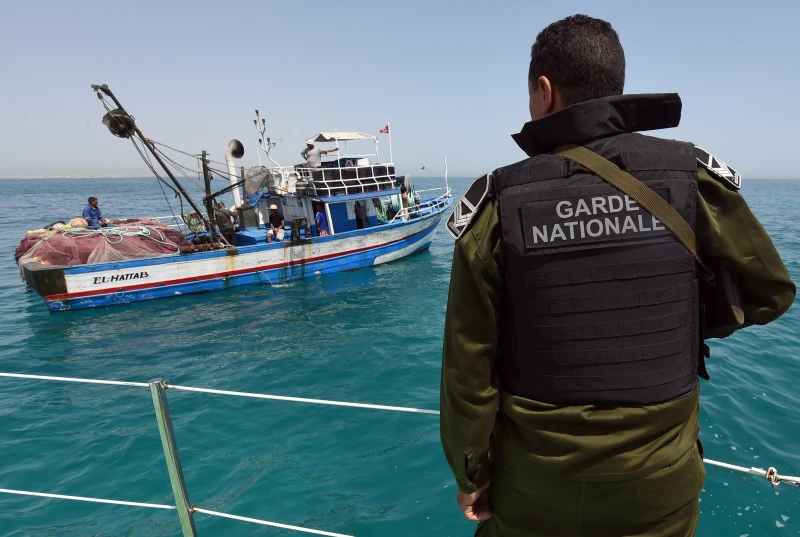
A member of the Tunisia’s national guard stops a fishing boat in the sea bordering Tunisia and Libya as they check vessels for illegal migrants trying to reach Europe, Tuesday, May 5, 2015. / Credit: FETHI BELAID/AFP/Getty Images
EWTN News, Oct 24, 2025 / 10:14 am (CNA).
The sinking of yet another migrant boat off the coast of Tunisia must spur leaders in Europe and Africa to address the root causes of migration that compel innocent people to embark on often deadly journeys, Archbishop Nicolas Lhernould of Tunis said.
In an interview with SIR — the news agency of the Italian bishops’ conference — published Oct. 24, Lhernould said the Oct. 22 sinking of a migrant boat off the coast of Tunisia that killed 40 people, including several infants, cannot be viewed as just “one more shipwreck” but as a loss of “unique people” whose “lives were extinguished.”
“As Pope Francis has said, we must never get used to these things,” the French-born prelate said.
“Unfortunately, shipwrecks have been recurring for years, and this one has had a very high number of victims. But these are not just statistics: They are men, women, and children.”
According to the Associated Press, investigators were still working to determine the cause of the shipwreck. The Tunisian Coast Guard nevertheless rescued 30 survivors who were reportedly attempting to reach Europe.
The migrants hailed from sub-Saharan Africa, AP reported.
Lhernould told SIR that many of those arriving in Tunisia on their way to Europe “have already crossed the Sahara Desert, which has now become the world’s largest cemetery.”
“The reasons driving people to leave are many: poverty, insecurity, lack of prospects,” he said. “Some leave out of desperation, others out of naivety, because someone promises them a better future that does not exist.”
While relieved that rescuers had saved 30 people, Lhernould lamented the pain and fear felt by those who embarked on such a dangerous journey in search of a better life.
“The tragedy is that these departures happen completely clandestinely, and we only become aware of them after the tragedy has occurred. It is painful because no one should be forced to risk their life for a hope that is often just a mirage,” he said.
Acknowledging that the political issues European institutions face in addressing the migrant crisis are “complex,” the archbishop said the situation must be rooted in “the unconditional respect for the human person.”
“It is not enough to be moved by tragedies,” Lhernould said. “We must address the causes that push people to leave, with sincere collaboration between the North and South.”
“We also need to listen to the fears of European public opinion,” he added.
“Only in this way can fear be transformed into a human and rational relationship, oriented toward the common good. Managing the emergency is not enough; we must build a shared future.”
If you value the news and views Catholic World Report provides, please consider donating to support our efforts. Your contribution will help us continue to make CWR available to all readers worldwide for free, without a subscription. Thank you for your generosity!
Click here for more information on donating to CWR. Click here to sign up for our newsletter.
Taliban fighters gather along a street during a rally in Kabul on August 31, 2021 as they celebrate after the U.S. pulled all its troops out of the country to end a brutal 20-year war. / Hoshang Hashimi/AFP via Getty Images)
Lagos, Nigeria, Feb 19, 2019 / 12:13 am (CNA/EWTN News).- Catholic leaders have voiced disappointment at a last-minute delay in Nigerian elections, but called for Christians to remain peaceful and participate in the postponed vote next weekend.
The “Holy Fire” is passed from inside Christ’s tomb to pilgrims gathered inside the Basilica of the Holy Sepulcher in Jersusalem on May 4, 2024, for the annual Orthodox Christian ceremony, held on the day before Easter, according to the Julian calendar. / Credit: Marinella Bandini/CNA
Jerusalem, May 5, 2024 / 09:00 am (CNA).
Pilgrims gathered in Jerusalem Saturday for the annual “Holy Fire” ceremony at the revered site of Jesus’ burial and resurrection, an ancient custom considered by many believers to be a miraculous event that takes place the day before the Orthodox Christian celebration of Easter.
For safety reasons, attendance at the May 4 event was capped at 4,200 people inside the Basilica of the Holy Sepulcher, though the crowds were more manageable and somewhat subdued this year because of a lack of pilgrims from the Palestinian territories and abroad due to the ongoing Israel-Hamas war.
Israeli police man a checkpoint inside the Old City of Jerusalem during the “Holy Fire” ceremony held at the Basilica of the Holy Sepulcher on May 4. 2024. Credit: Marinella Bandini/CNA
Access to the Old City where the basilica is located was restricted beginning on Friday night amid a heavy police presence. Numerous medical personnel and firefighters were present inside the basilica.
Though its authenticity is disputed by some, the “Holy Fire” or “Holy Light” refers to a fire of purported divine origin that ignites inside Jesus’ tomb while only the Greek Orthodox patriarch is present. Pilgrims then light their candles by extending them through a small opening in the tomb, producing a dramatic scene of flickering flames and joyous celebration.
The Orthodox Christian ceremony, which is attended by Catholics and other Christians, as well, has been held continuously since at least 1106, though accounts dating to the fourth century relate that the apostle Peter saw the holy light himself inside the tomb.
Pilgrims carry candles lit from the “Holy Fire” inside the Basilica of the Holy Sepulcher in Jerusalem on May 4, 2024. Credit: Marinella Bandini/CNA
The doors of the Holy Sepulcher were opened at 9 a.m. by Greek Orthodox representatives and again at 9.30 a.m. by representatives of the Armenian Apostolic Church — the two Orthodox communities that serve with Catholic Franciscans as the custodians of the site. Only then did the faithful begin to enter the basilica.
Around 11 a.m., those present began to sing traditional hymns in the loudest voice possible. These chants date back to the Turkish occupation of Jerusalem in the 13th century when Christians were not allowed to chant anywhere but in the churches.
The heart of the ceremony was between 1 and 2 in the afternoon. After the solemn entrances of the other Orthodox patriarchs of Jerusalem, the Greek Orthodox patriarch, Theophilos III, entered the basilica.
Previously, the doors of the Aedicule (the small shrine that houses the tomb of Jesus Christ) had been sealed with a large wax seal — signifying that the tomb had been inspected and that nothing was present that could be used to start a fire. Shortly before the arrival of the Greek patriarch, the seal was removed, and a large oil lamp was carried into the tomb.
After completing three rounds around the Aedicule, leading a procession of monks and priests, Patriarch Theophilos III entered the Aedicule, followed by a delegate of the Armenian patriarch (who could not attend due to an internal dispute) and several bishops from various denominations.
The Greek Orthodox Patriarch Theophilos III exits the Aedicule of the Holy Sepulcher on May 4, 2024, in Jerusalem, showing the faithful the two candles just lit from the oil lamp that is believed to have been miraculously ignited inside Jesus’ tomb. Credit: Studio Sami Jerusalem
Only the Greek Orthodox patriarch is allowed to enter the chamber that houses the tomb of Jesus, while all the others remain in the Chapel of the Angel, a sort of antechamber that commemorates the appearance of a heavenly messenger to the women at the tomb announcing Jesus’ resurrection.
Before entering the tomb, the Greek patriarch was inspected by Israeli authorities to prove that he didn’t carry any technical means to light the fire.
All the lights and lamps in the basilica were extinguished, especially those inside the Aedicule, which was left in darkness.
What believers attest to be a miracle takes place after a brief time of prayer: A holy fire is said to descend from heaven and ignite an oil lamp inside the tomb.
Pilgrims inside the Basilica of the Holy Sepulcher hold their candles aloft after the “Holy Fire” was ignited inside Jesus’ tomb on May 4, 2024, the day before the Orthodox Christian celebration of Easter. Credit: Marinella Bandini/CNA
On Saturday, after the lamp was lit the Greek Orthodox patriarch emerged from the tomb and lit bundles of 33 candles (a number representing the age of Christ at the time of his crucifixion and resurrection.) Meanwhile, pilgrims lit their candles also from the small round windows on the sides of the Aedicule, creating a dramatic scene outside the tomb. It is said that the fire does not burn anything (or anyone) for the first 33 minutes after being lit.
For Orthodox believers, the lighting of the fire is a genuine miraculous event, although voices within the Orthodox world itself have repeatedly questioned the authenticity of the miracle, attributing the spontaneous lighting of the lamp to tricks or chemical methods.
A lamp used to transport the “Holy Fire” from the Basilica of the Holy Sepulcher in Jerusalem to Bethlehem is carried at the lighting ceremony on May 4, 2024. By longstanding tradition, the flames from the purported miraculous fire are brought to the main Orthodox churches in the Holy Land and sent to the main Orthodox churches around the world via specially arranged flights. Credit: Marinella Bandini/CNA
In solidarity with the Palestinian people in Gaza and the victims of the war, the Orthodox Christians have chosen a more subdued celebration this year. To that end, the Holy Fire was not passed hand to hand through the streets of the Old City of Jerusalem, as is the custom, but was brought directly into the homes of the faithful.
Special lanterns transport flames from the tomb to the main Orthodox churches in the Holy Land and around the world (via specially arranged flights). The arrival of the flames from Jerusalem will mark the beginning of the Easter celebrations.






Leave a Reply