


Vatican City, May 6, 2025 / 11:57 am (CNA).
At 89 Via Borgo Pio, located a few steps from Porta Santa Anna leading to the Vatican, is Mancinelli Clergy, the iconic shop that embodies the history and tradition of ecclesiastical tailoring in Rome.
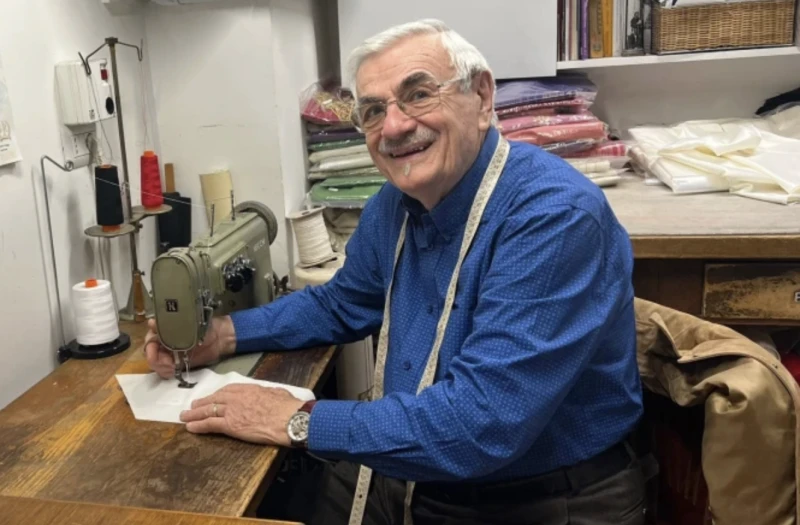
Behind a time-worn wooden counter, surrounded by tall glass cases displaying all kinds of religious articles — cassocks, scarlet caps, skullcaps, embroidered chasubles, and pectoral crosses — stands tailor Raniero Mancinelli, tasked with making the next pope’s habit.
With a measuring tape around his neck, Mancinelli welcomed ACI Prensa, CNA’s Spanish-language news partner, and shared the details of a craft he has been performing for more than six decades. “I’ve dressed John Paul II, Benedict XVI, Pope Francis… and this will be the fourth,” he commented proudly.
“It’s almost ready; there’s very little left, although we still have a few days to go, because I don’t think they’ll choose him on the first day,” Mancinelli assured a few days before the beginning of the conclave.
With a slow but steady pace, he heads toward the workshop, located at the back of the building, where, amid spools of thread, white fabrics, and patterns, the cassock, sash, and skullcap (“zuchetto” in Italian), the small round cap that will crown the head of the next successor of Peter, are all taking shape.
Sitting by his sewing machine and surrounded by photographs capturing his encounters with various popes, Mancinelli explained with a thick Roman accent that he always makes three sizes: “We make a large, a medium, and a small, so the pope has different options.”

With some relief at not having been John XXIII”s tailor, he smiled as he recalled the occasion when new pope Cardinal Angelo Roncalli first appeared before the world wearing a cassock held together by pins, as none of the sizes fitted him properly.
Besides the “pride and honor” Mancinelli said he feels having dressed four popes, he confessed that what he values most about his profession is being able to serve, through his work, those who have consecrated their lives to God.
“What I like most is seeing how priests and bishops find everything they need here to live out their vocation,” the Italian tailor, famous in the Borgo district, humbly stated.
This story was first published by ACI Prensa CNA’s Spanish-language news partner. It has been translated and adapted by CNA.
If you value the news and views Catholic World Report provides, please consider donating to support our efforts. Your contribution will help us continue to make CWR available to all readers worldwide for free, without a subscription. Thank you for your generosity!
Click here for more information on donating to CWR. Click here to sign up for our newsletter.


This is important, how? This is what consumes the minds of the Faithful?
Right. Trump attired as pope causes CNA staff, NY bishops, and some Catholics with no sense of humor or perspective to cry “bad taste” or “bad form.”
Meanwhile, there was Francis, eschewing traditional papal garb by wearing black shoes. One report described him, two years into his reign, saying Mass in a cassock with frayed and tattered cuffs. [YET he was apparently so attached to his little ?Fiat? car, he had it brought with him to the US when he visited.]
At Mass, Catholics commemorate Jesus giving his obediential ALL to His Father for us. Hung upon the cross, publicly, the Roman soldiers stripped Jesus of his clothes so that he hung naked. They stripped him of this last little vestigage of human dignity.
With all of us supporting papal needs, I would hope a Pope would demonstrate a respect for his role and dignified position. I would like my popes to dress their best for Mass.
I require the best dress and dignified behavior of my family when we attend Mass. It absolutely disconcerts me to see flip-flops, dirty sneakers, tight and torn blue jeans, spaghetti straps on young women, graphic T shirts (or sport merchandise) on men. Unkempt. At Mass. People do more talking than praying, more texting or checking phones for messages (or sports scores), picking or scratching faces, fussing or re-arranging hair, etc. At Mass.
Who is right:
1) Roman rhetorician Quintilian famously said nearly two millennia ago, vestis virum reddit, “the clothes make the man.”
Or 2) Shakespeare evoked the medieval saying, cucullus non facit monachum, “the cowl (or the habit) does not make the monk.”
How about we dress for others, not for ourselves? There’s a little notion of sacrifice. Would it kill us?