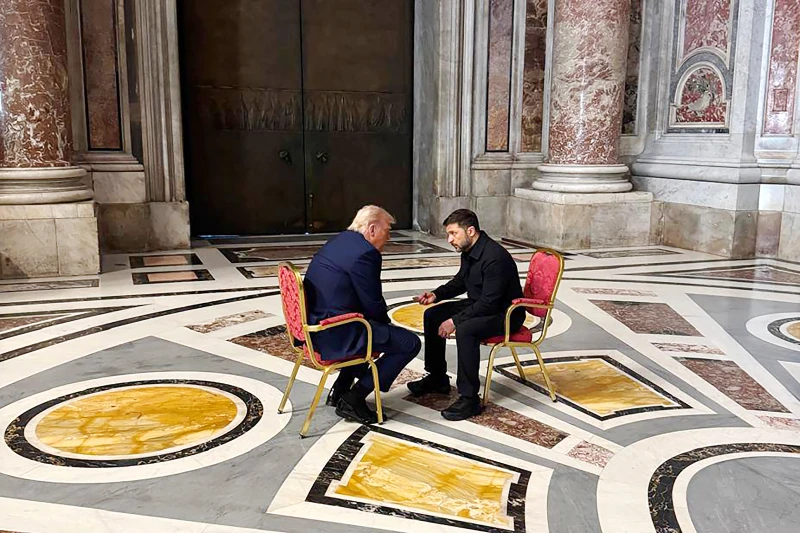
U.S. President Donald Trump and Ukrainian President Volodymyr Zelenskyy hold a one-on-one meeting at the Vatican prior to Pope Francis’ funeral, Saturday, April 26, 2025. / Credit: Office of the President of Ukraine via Getty Images
CNA Staff, Apr 26, 2025 / 10:00 am (CNA).
U.S. President Donald Trump and Ukrainian President Volodymyr Zelenskyy on Saturday held a brief discussion in the soaring halls of St. Peter’s Basilica amid the funeral of Pope Francis, speaking “one-on-one” about possible peace overtures in the Russia-Ukraine war.
“[It was a] good meeting. We discussed a lot one-on-one,” Zelenskyy said in a post on X. “Hoping for results on everything we covered.”
Good meeting. We discussed a lot one on one. Hoping for results on everything we covered. Protecting lives of our people. Full and unconditional ceasefire. Reliable and lasting peace that will prevent another war from breaking out. Very symbolic meeting that has potential to… pic.twitter.com/q4ZhVXCjw0
— Volodymyr Zelenskyy / Володимир Зеленський (@ZelenskyyUa) April 26, 2025
The Ukrainian leader hailed the informal mini-summit as “very symbolic.” The talk took place while the leaders were at the Vatican for the funeral of Pope Francis, who for the last few years of his pontificate was a tireless advocate for peace in the Russia-Ukraine war.
The two heads of state discussed “protecting [the] lives of our people,” a “full and unconditional ceasefire,” and “reliable and lasting peace that will prevent another war from breaking out,” Zelenskyy said.
The discussion “has potential to become historic, if we achieve joint results,” he said.
White House Deputy Chief of Staff Dan Scavino also shared footage of the meeting, including Vatican officials arranging the ornate chairs for the two leaders to sit in.
Behind Scenes, Vatican City—President Trump sat down to meet privately with Volodymyr Zelenskyy of Ukraine this morning in St. Peter’s Basilica… pic.twitter.com/zzC78AgbNh
Pope Francis regularly used his public addresses, especially his Angelus prayers, to call for peace between Ukraine and Russia.
The Holy Father repeatedly urged the two countries to work toward a peaceful resolution of the conflict. In some cases he even sent material goods to Ukraine, dispatching multiple ambulances to help save lives in war zones there.
If you value the news and views Catholic World Report provides, please consider donating to support our efforts. Your contribution will help us continue to make CWR available to all readers worldwide for free, without a subscription. Thank you for your generosity!
Click here for more information on donating to CWR. Click here to sign up for our newsletter.
Vatican City, Apr 1, 2018 / 03:30 am (CNA/EWTN News).- On Easter morning Pope Francis said God’s announcement to his people always comes as a surprise, like the shock of the disciples who found Jesus’ tomb empty after his resurrection, and told Christians not to waste time responding to the good news they’ve been given.
“The announcements of God are always a surprise, because ours is a God of surprises,” the Pope said April 1, on Easter morning. “From the beginning of the history of salvation, from Abraham, who God tells to ‘go, get up and go to the land I send you to,’ there’s always one surprise after another.”
“God doesn’t know how to make an announcement, a proclamation without surprising us,” he said, “and that surprise moves your heart, it touches you. It happens when you don’t expect it.”
Francis also spoke of the haste with which the women and the disciples in John’s Gospel responded when they heard news of the empty tomb and Jesus’ resurrection, and he posed a question to those present for the Mass, asking “what about you?”
“What about me? Is my heart open to God’s surprises?” he said, urging Christians to ask themselves: “Am I able to go with great haste, or do I stay back and say, ‘I’ll go tomorrow’?”
Pope Francis celebrated Easter Mass in St. Peter’s Square after presiding over the Easter Vigil inside the basilica the night before, bringing a close to the Easter Triduum and the events of Holy Week.
The altar during Mass was bedecked with some 50,000 flowers of different varieties, which were a gift from florists in Holland.
Though he usually sticks to his text during formal liturgies, Francis did not prepare a homily for Easter morning, and spoke to pilgrims in brief, off-the-cuff remarks. He did the same thing last year, meaning a spontaneous reflection Easter morning could be a new trend for the Argentine pope.
In his short homily, the pope focused on three aspects of the day’s Gospel passage from John, in which Peter and John run to the tomb after Mary Magdalene tells them she found it empty earlier that morning.
The three aspects Pope Francis focused on are the surprise of the announcement, the haste with which the women and the disciples ran to the tomb, and the personal response of each
Please see below for the full text of Pope Francis’ homily:
After having listened to the word of God, this passage from the Gospel, I want to say three things. First, the announcement: the Lord is Risen. That proclamation, that from the tine of the early Christians they would greet each other this way: the Lord is risen! And the women that were there to anoint the Lord’s body, they found themselves in front of a surprise. The surprise. The announcements of God are always a surprise, because ours is a God of surprises. So from the beginning of the history of salvation, from Abraham, who God tells to ‘go, get up and go to the land I send you to,’ there’s always one surprise after another. God doesn’t know how to make an announcement, a proclamation without surprising us. And that surprise moves you heart, it touches you. It happens when you don’t expect it. It’s a surprise from ‘down low’, it takes you off guard. God’s announcement was a surprise.
The rush, the women ran, they went in a hurry to get to the tomb, to say ‘we found this!’ The surprises of God put us on the path, on the journey right away, without waiting. So they run to see, and Peter and John, they run. The shepherds, the night of Christmas when Jesus was born in Bethlehem, ran…the Samaritan woman runs to tell her people, ‘this is new, I met a man who told me everything I have ever done!’ These people run, they leave what they’re doing. The housewife leaves the potatoes in the pot, and they’ll be burned, but it’s important to run, to see that surprise that announcement. Today this also happens to us in our neighborhoods, when something happens and people go to see it. People go with great haste. Andrew didn’t waste time and he went to Peter to say: ‘we found the Messiah!’ The surprises, the good news, are always given like this, with great haste. But in the Gospel there is a person who takes their time, who doesn’t want to take a risk, but the Lord is good, and he waits for him with great love. This is Thomas, who said ‘I’ll believe when I see his wounds.’ The Lord is patient with those people who do not get up and leave with great haste.
Thirdly, is a question: and me, what? What about me? Is my heart open to God’s surprises? Am I able to go with great haste, or with that chant, do I stay back and say ‘I’ll go tomorrow’? What is the surprise saying to me? John and Peter, they ran to the tomb. John in his Gospel, tells us to believe. Even Peter, believed, but in his own way, with that faith that is a bit mixed with remorse for having denied the Lord. The announcement that has made a surprise, to run and go with great haste, and the question: what about me, today, in this Easter in 2018? What about me? What about you?
Pope Francis embraces a man in a wheelchair at the Wednesday general audience in St. Peter’s Square on June 10, 2015. / L’Osservatore Romano.
Vatican City, Nov 25, 2021 / 10:00 am (CNA).
In his message for the International Day of Persons with Disabilities, Pope Francis said that the Catholic Church needs the participation of everyone, and the disabled must not be excluded from the sacraments.
“As we celebrate your International Day, I would like to speak directly to all of you who live with any condition of disability, to tell you that the Church loves you and needs each of you for the fulfillment of her mission at the service of the Gospel,” the pope said on Nov. 25.
Quoting his 2013 exhortationEvangelii gaudium, he said: “The worst form of discrimination … is the lack of spiritual care.”
“Sometimes, as certain of you have unfortunately experienced, this has taken the form of denying access to the sacraments,” he said in his message.
“The Church’s magisterium is very clear in this area, and recently the Directory for Catechesis stated explicitly that ‘no one can deny the sacraments to persons with disabilities.’”
The theme of Pope Francis’ message for the day is friendship with Jesus, which he said is “an undeserved gift” that all have received and that can help those experiencing discrimination.
Friendship with Christ “redeems us and enables us to perceive differences as a treasure. For Jesus does not call us servants, women and men of lesser dignity, but friends: confidants worthy of knowing all that he has received from the Father,” he said.
Antonietta Pantone, 31, a Rome resident who uses a wheelchair, told journalists it was clear to her from the pope’s message that he considers it important that people with disabilities be part of the Church and not leave the Church.
She shared her personal journey of faith, which included finding a community in the Christian disability group Fede e Luce.
Pope Francis meets with Foi et Lumière members on Oct. 2, 2021. Vatican Media/CNA
Fede e Luce is the Italian branch of the French association Foi et Lumière (known as Faith and Light in the English-speaking world), which began 50 years ago with a pilgrimage for people with disabilities to the Sanctuary of Our Lady of Lourdes in France. The movement has now expanded to five continents.
“I always say: In the eyes of God, we are all equal,” Pantone said, noting that in her journey of faith, friendship has been fundamental.
Friendship with others “demonstrates the closeness of God,” she said.
Pantone also explained how losing physical contact with friends because of the COVID-19 pandemic has been very hard for her and other disabled people, especially her friends who live in residences and not with family.
In his message, Pope Francis addressed the difficulty of the coronavirus outbreak for the disabled.
“I think, for example, of your being forced to stay at home for long periods of time; the difficulty experienced by many students with disabilities in accessing aids to distance learning; the lengthy interruption of social care services in a good number of countries; and many other hardships that you have had to face,” he wrote.
He mentioned in particular those who live in residential facilities, separated from loved ones. “In those places, the virus hit hard and, despite the dedication of caretakers, it has taken all too many lives,” he said.
He also emphasized the importance of confronting these challenges by finding consolation in prayer and friendship with Jesus.
“I would like to speak personally to each of you, and I ask that, if necessary, your family members or those closest to you read my words to you, or convey my appeal,” he said. “I ask you to pray. The Lord listens attentively to the prayers of those who trust in him.”
“Prayer is a mission, a mission accessible to everyone, and I would like to entrust that mission in a particular way to you. There is no one so frail that he or she cannot pray, worship the Lord, give glory to his holy Name, and intercede for the salvation of the world. In the sight of the Almighty, we come to realize that we are all equal,” he stressed.
Pope Francis also noted the continued presence of discrimination, ignorance, and prejudice at all levels of society, assuring people with disabilities that through baptism they are “a full-fledged member of the Church community, so that all of us, without exclusion or discrimination, can say: “I am Church!’”
“The Church is truly your home!” he said.
At a Nov. 25 press conference, Fr. Alexandre Awi Mello said that the Vatican’s Dicastery for Laity, Family, and Life is trying to do more to improve pastoral care for those with disabilities.
“This message, in recognizing that people with disabilities have their place in the holy faithful People of God, is a great invitation, for us in the dicastery, but above all for parish, diocesan and associative realities to take new paths with pastoral creativity,” Awi Mello said.
Fr. Alexandre Awi Mello, secretary of the Dicastery for Laity, Family, and Life, speaks at a Vatican press conference, May 18, 2021. Gianluca Teseo/CNA.
“It is a door that opens to think of pastoral care no longer for, but with…”
On Dec. 6, the dicastery will launch a video campaign with the hashtag #IamChurch. In five videos, Catholics with disabilities from different parts of the world will share about their experiences in the Church.
Pantone, who participated in one of the Vatican’s videos, told CNA that she would like to see the Catholic Church do more to develop courses that allow people with all kinds of disabilities to participate in parish life, such as formation courses to become a catechism teacher.
“I still had some ways to study [to become a catechist],” she said, “but it depends on the type of disability, so if another disabled person wants to be a catechist, the Church should give him all the appropriate tools.”
Pantone said that the Church can do a lot for the disabled, but the recently begun Synodal Journey “is already a step forward which the world of disability sees positively.”
Pope Francis said in his message that “having Jesus as a friend is an immense consolation. It can turn each of us into a grateful and joyful disciple, one capable of showing that our frailties are no obstacle to living and proclaiming the Gospel.”
“In fact, a trusting and personal friendship with Jesus can serve as the spiritual key to accepting the limitations that all of us have, and thus to be at peace with them,” he said.
Vatican City, Mar 29, 2019 / 02:09 pm (CNA).- Pope Francis called for the Sacrament of Confession to be elevated in the pastoral life of the Church during a Lenten penitential liturgy in St. Peter’s Basilica Friday.
Leave a Reply
