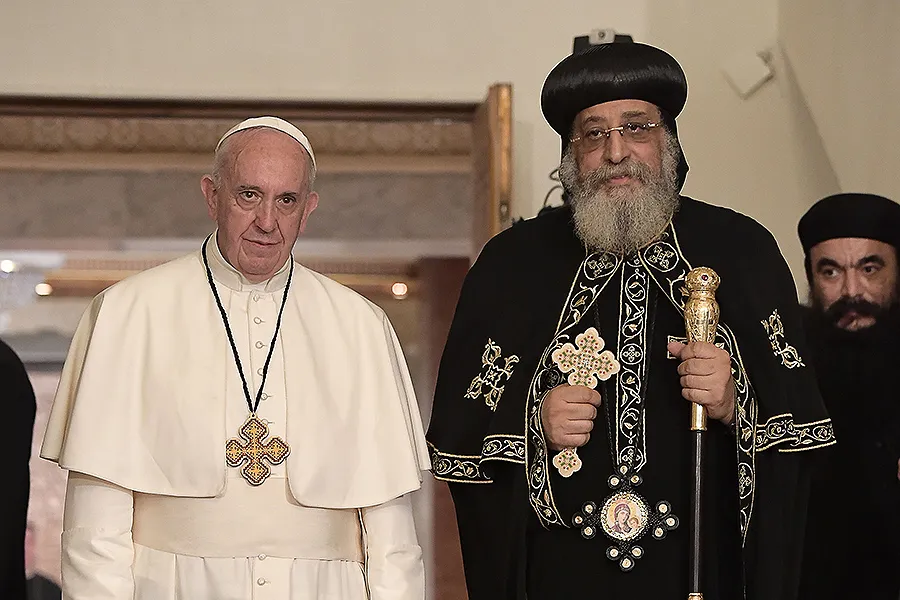
Cairo, Egypt, Apr 28, 2017 / 11:39 am (CNA/EWTN News).- Pope Francis closed his first day in Egypt with a visit to Coptic Orthodox Patriarch Tawadros II, telling him their Churches are bonded by the blood of their martyrs, and are called to further cement this bond with acts of charity.
In his April 28 address to the patriarch, Francis said their ecumenical journey is sustained “in a mysterious and quite relevant way, by a genuine ecumenism of blood.”
Noting how Saint John the Evangelist wrote that Christ came “with water and blood,” Francis said this image serves as a symbol that “by living a new life in our common baptism, a life of love always and for all, even at the cost of the sacrifice of one’s life.”
“How many martyrs in this land, from the first centuries of Christianity, have lived their faith heroically to the end, shedding their blood rather than denying the Lord and yielding to the enticements of evil, or merely to the temptation of repaying evil with evil!”
The Pope noted that this has tragically been the case even in recent days, when “the innocent blood of defenseless Christians was cruelly shed.”
“Their innocent blood unites us,” Francis continued, telling the patriarch that just as the heavenly Jerusalem is one, “so too is our martyrology; your sufferings are also our sufferings.”
“Strengthened by this witness, let us strive to oppose violence by preaching and sowing goodness, fostering concord and preserving unity, praying that all these sacrifices may open the way to a future of full communion between us and of peace for all.”
Pope Francis spoke in an audience with Tawadros II, the Coptic Orthodox Patriarch of Alexandria, on his first day in Egypt. He is on an official April 28-29 visit to the country, aimed largely at interreligious and ecumenical dialogue.
After arriving at Cairo in the afternoon, Francis made his way to Egypt’s prestigious al-Azhar University and adjunct mosque, considered one of the highest authorities in Sunni Islam, where he met with Grand Imam Ahmed el-Tayyeb and addressed participants in the International Peace Conference.
He then met with the country’s authorities, including President Abdel Fattah el-Sisi, before heading to the Coptic Orthodox Cathedral for his meeting with Tawadros, the last official appointment of the day.
Tawadros is head of the Coptic Orthodox Church, which is an Oriental Orthodox Church, meaning it rejected the 451 Council of Chalcedon, and its followers had historically been considered monophysites – those who believe Christ has only one nature – by Catholics and the Eastern Orthodox, though they are not considered so any longer.
Like the Bishop of Rome, the Coptic Orthodox Patriarch of Alexandria is known as “Pope” to his followers.
Francis’ words to the patriarch bear special significance considering his visit comes against the backdrop of recent attacks against Christians in the area, which are part of a general increase in the persecution of Egypt’s 9 million strong Coptic community.
The Islamic State and other Islamists have carried out a series of attacks on Egypt’s Christians in recent years, including the beheading of 20 Coptic Orthodox faithful in Libya in 2015, and a series of church bombings.
However, in his speech Pope Francis noted that the “impressive history of holiness” in Egypt isn’t limited to the witness of the martyrs, because “no sooner had the ancient persecutions ended than a new and selfless form of life arose as a gift of the Lord: monasticism originated in the desert.”
“Thus, the great signs that God had once worked in Egypt and at the Red Sea were followed by the miracle of a new life that made the desert blossom with sanctity,” he said, explaining that given this shared patrimony, he comes to Egypt “as a pilgrim.”
Francis noted that while the two Churches haven’t always gotten along given both theological and non-theological differences, their 1973 joint declaration, signed by Blessed Paul VI and Patriarch Shenouda III, allowed them, “with God’s help, to acknowledge together that Christ is perfect God with respect to his divinity and perfect man with respect to his humanity.”
Equally important and timely, he said, “are the words that immediately precede this statement, in which we acknowledge Jesus Christ as our Lord and God and Savior and King.”
The strengthening of this bond between their Churches, Francis said, means they can no longer move forward with the idea that each can go their own way, because this would “betray” Christ’s prayer that his disciples “all be one.”
While the journey isn’t always easy, the Lord exhorts them to persevere, he said, explaining that “we are not alone. We are accompanied by a great host of saints and martyrs who, already fully one, impel us here below to be a living image of the Jerusalem above.”
Quoting the Gospel of St. Mark, founder of the See of Alexandria, Pope Francis pointed out Christ’s question to St. Peter: “who do you say that I am?”
Even today “many people cannot answer this question,” Francis said, noting that “there are even few people who can raise it, and above all few who can answer it with the joy of knowing Jesus, that same joy with which we have the grace of confessing him together.”
Because of this, Coptic Orthodox and Catholics are called to bear witness to Christ together and “to carry our faith to the world, especially in the way it is meant to be brought: by living it, so that Jesus’ presence can be communicated with life and speak the language of gratuitous and concrete love.”
As both Coptic Orthodox and Catholics, “we can always join in speaking this common language of charity,” he said, explaining that before completing some charitable task, “we would do well to ask if we can do it together with our brothers and sisters who share our faith in Jesus.”
“Thus, by building communion in the concreteness of a daily lived witness, the Spirit will surely open providential and unexpected paths to unity,” he said, praising the patriarch for his support of the Coptic Catholic Church in Egypt, particularly through his establishment of the National Council of Christian Churches.
Francis closed his speech praying that the two of them would be able to “set out together as pilgrims of communion and messengers of peace,” under the special care and guidance of Mary, the Mother of God.
At their meeting, Francis and Tawadros signed a joint declaration indicating their gratitude for the chance “to exchange a fraternal embrace and to join again in common prayer.”
Notably, they declared that they “will seek sincerely not to repeat the baptism that has been administered in either of our Churches for any person who wishes to join the other. This we confess in obedience to the Holy Scriptures and the faith of the three Ecumenical Councils assembled in Nicaea, Constantinople and Ephesus.”
“We ask God our Father to guide us, in the times and by the means that the Holy Spirit will choose, to full unity in the mystical Body of Christ.”
 […]
[…]





Leave a Reply