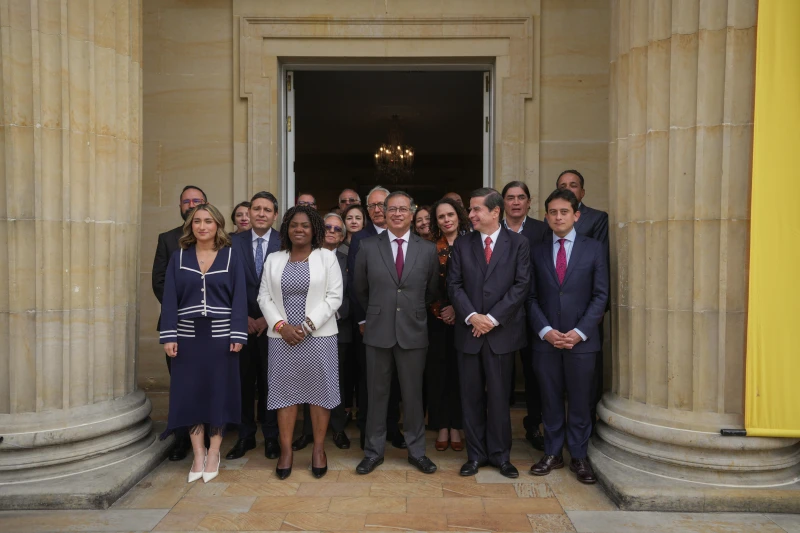
Colombian President Gustavo Petro and his Cabinet. / Credit: Official photograph of the Office of the President of Colombia. Public domain, via Wikimedia Commons
ACI Prensa Staff, Oct 12, 2024 / 07:00 am (CNA).
The Unidos por la Vida (United for Life) platform in Colombia has called a nationwide march for Oct. 19 in opposition to a memorandum from the Colombian Health Superintendency in support of sex changes for children.
The National Health Superintendency (Supersalud) issued External Memorandum 115 on Sept. 21 that provides “general instructions for inspection, oversight, and control to guarantee the right to health of trans people in Colombia.”
The demonstration’s slogan is “Don’t Mess with Children” and is against, among other things, Section H of the memorandum dedicated to “trans children and adolescents who are in the process of development.” The document states that the objective is to ensure this population has “healthy development and support in the affirmation of identity and/or gender expression in these stages of the life cycle.”
In support of this, the Supersalud document cites in footnote 26 rulings by the Constitutional Court in favor of sex change for minors.
For example, it points out that “judgment T-447 of 1995 established that sex reassignment requires the direct consent of the ‘patient,’ since minors are the only ones who can decide on their life and freedom, which include sex as a relevant element of identity.”
Likewise, it cites ruling T-218 of 2022, which, arguing “the need to ensure the autonomy of minors,” establishes that “in cases of intersexuality” the consent of the person responsible for the minor will only be necessary when the minor is under 5 years old. Furthermore, without making any distinction between patients, Supersalud requires in its instructions to “verify that the right of trans people to access health services in treatment for surgical sexual reaffirmation or sex change is guaranteed.”
March will demand policy change
In a statement to ACI Prensa, CNA’s Spanish-language news partner, the president of United for Life, Jesús Magaña, said the goal of the Oct. 19 march is to demand the revocation of Memorandum 115 and the resignation of the superintendent of health, Luis Carlos Leal.
Leal has held the position since Feb. 23, appointed by President Gustavo Petro.
Magaña said Leal “has issued this memorandum to promote hormone therapy and sex changes, in accordance with his ideology, his own way of life. He is a homosexual activist, promoter of this entire LGBTIQ ideology.”
He also said this is “a very clear project of President Petro, through his superintendent of health.”
“They don’t care about destroying the family, destroying children, they don’t care about respecting the rights of parents because they want to do it to minors,” he added.
The march, to be held in Bogotá, the country’s capital, will begin at 10 a.m. in the National Park and will head to Plaza de Bolívar in the downtown area.
This story was first published by ACI Prensa, CNA’s Spanish-language news partner. It has been translated and adapted by CNA.
If you value the news and views Catholic World Report provides, please consider donating to support our efforts. Your contribution will help us continue to make CWR available to all readers worldwide for free, without a subscription. Thank you for your generosity!
Click here for more information on donating to CWR. Click here to sign up for our newsletter.
Rodrigo Iván Cortés, president of the National Front for the Family, described Claudia Sheinbaum’s victory as “very bad news for life, family, and freedoms.” / Credit: EWTN Noticias/Screenshot
ACI Prensa Staff, Jun 5, 2024 / 18:50 pm (CNA).
Various pro-life, pro-family, and lay leaders of the Catholic Church in Mexico have reacted with concern to the election of Claudia Sheinbaum as president of the country.
Rodrigo Iván Cortés, president of the National Front for the Family, described Sheinbaum’s victory as “very bad news for life, family, and freedoms.”
For the pro-family leader, Sheinbaum represents continuity with the same progressive agenda of the outgoing administration of President Andrés Manuel López Obrador. Citing the growing legalization of abortion and use of gender ideology throughout the country, Cortés explained that “the López Obrador regime culminated in a culture of death, of ideology, not only of gender confusion but also of socialist populist indoctrination.”
However, in an interview with “EWTN Noticias,” EWTN’s Spanish-language news program, Cortés emphasized that just as people didn’t vote for López Obrador because of his position on abortion, gender ideology, or for freedoms to be canceled, people didn’t vote for Sheinbaum for those same reasons. What happens, he indicated, is that “when they come to power, they implement [that agenda].”
For Juan Dabdoub, president of the Mexican Family Council (ConFamilia), there are “two important factors” that would explain Sheinbaum’s victory in the presidential elections.
The first, he told ACI Prensa, CNA’s Spanish-language news partner, is that in Mexico there is “a poor political culture, which makes a large majority of the people manipulable.”
A second factor, Dabdoub noted, is that “Mexican Catholicism has failed in something extremely important that Pope St. John Paul II already pointed out: ‘A faith that does not create culture is a useless faith.’”
In a Jan. 16, 1982, speech, John Paul II said: “A faith that does not become culture is a faith that is not fully accepted, not entirely thought out, not faithfully lived.”
For the president of ConFamilia, “Mexico has stopped being a country of practicing Catholics and has become one of simply baptized people; and when a Catholic doesn’t live his faith in the outside world, that is, outside his home and his parish, those who dominate the world take control.”
Dabdoub considered Sheinbaum’s victory to be “a brutal threat” to the defense of life, family, and freedoms, since she has “a radical progressive agenda.”
‘Formation and serious work are needed’
For Father Hugo Valdemar, who for 15 years headed the communications office of the Primatial Archdiocese of Mexico when Cardinal Norberto Rivera led the archdiocese, “Catholics must learn that social media are not enough to really influence; serious formation and work are needed, otherwise everything remains up in the air.”
“The big problem is that we haven’t been seriously forming the laity, and nothing is being done to do so,” he told ACI Prensa. However, he noted that with a Sheinbaum administration, “the Church is not in danger. I don’t see an adverse climate, much less persecutory, and Christian values have been violated for a long time.”
What’s next in the battle for life and family?
Pilar Rebollo, director of the Steps for Life platform, pointed out that Sheinbaum’s election “means much more work” for pro-lifers: “It requires us to be united, it requires us to be coordinated,” anticipating possible “frontal attacks on what we know as our values that are foundational.”
Rebollo also emphasized the importance of serving underserved and vulnerable populations, which, she considered, were key to Sheinbaum’s victory. This, she said, must be done “not out of a desire for numbers but zeal for souls, a desire to [heal] wounds, zeal for humanity, to see Christ in others.”
It should be noted that all three candidates for president — Sheinbaum, Xóchitl Gálvez, and Jorge Álvarez Máynez — backed the legalization of abortion and the LGBTQ policy agenda, so Mexican voters had no real alternative to vote for a pro-life and pro-family candidate.
Sheinbaum is the first person of Jewish ancestry to be elected to Mexico’s presidency. In February of this year, she visited Pope Francis at the Vatican, where she asked him to bless a rose wrought in silver by a Mexican artisan. She later presented it to the rector of the Basilica Shrine of Our Lady of Guadalupe in Mexico City.
Jason Poblete of the Global Liberty Alliance anticipates that Claudia Sheinbaum will govern under the shadow of the current president and his leftist party. Credit: EWTN News Nightly/Screenshot
During her campaign, Sheinbaum was seen wearing a skirt bearing the image of the revered Virgin of Guadalupe. According to Jason Poblete of the Global Liberty Alliance, Sheinbaum also wore a rosary around her neck at a public event. He and others suggested that this was an act of demagoguery intended to appeal to Catholics, who comprise approximately 78% of the country’s population.
Sheinbaum, 61, holds a doctorate in physics specializing in energy and taught at Mexico’s National Autonomous University. Her political militancy began during her student years, joining a group that became the founding youth movement of the socialist Party of Democratic Revolution. She later joined the ruling Morena party. She has been described as a climate activist, having been part of a Nobel Prize-winning commission advising the United Nations on climate change.
Sheinbaum’s tenure as Mexico City mayor was marked by progressive initiatives. For example, the World Economic Forum, led by Klaus Schwab, noted that as mayor she ended public school policy requiring gender-appropriate uniforms for children. Sheinbaum said: “The era when girls had to wear a skirt and boys had to wear trousers has been left behind; I think that’s passed into history,” and added: “Boys can wear skirts if they want and girls can wear pants if they want.”
While she did not raise the issue during her campaign, Sheinbaum’s Morena party is a firm supporter of abortion. The newly-elected congress will be seated in September, one month before Sheinbaum’s inauguration, thus allowing incumbent president López Obrador an opportunity to push through his legislative initiatives.
Poblete told “EWTN News Nightly” that the 2024 election may have led to a Morena majority in Mexico’s Congress, which has vowed to amend the constitution in order for Mexican Supreme Court justices to be elected by popular ballot, thereby confirming partisan control of the heretofore independent judiciary, which would rule on issues such as abortion and matters of gender ideology. He fears that Sheinbaum will govern under the shadow of the current president and his leftist party.
This story was first published by ACI Prensa, CNA’s Spanish-language news partner. It has been translated and adapted by CNA.
Pope Leo XIV greets the faithful in St. Peter’s Square shortly after his election to the papacy, Thursday, May 8, 2025. / Credit: Daniel Ibáñez/CNA
Lima Newsroom, May 9, 2025 / 14:49 pm (CNA).
In some of his first words to the world on May 8, newly-elected Pope Leo XIV recalled the land where he worked as a missionary from 1985 to 1998.
“And if you will allow me a word, a greeting to all those… in a particular way to my beloved Diocese of Chiclayo, in Peru,” he said.
Known as the “city of friendship,” Chiclayo is located in northern Peru, about 500 miles from the capital, Lima. Pope Francis appointed him apostolic administrator and then bishop of the Diocese of Chiclayo in 2014 and 2015 respectively. As bishop of Chiclayo and later as apostolic administrator of Callao, he also served as vice president of the Peruvian Bishops’ Conference (CEP by its Spanish acronym).
Father Guillermo Inca Pereda, deputy secretary of the CEP who worked closely with Pope Leo, shared with ACI Prensa, CNA’s Spanish-language news partner, that “the excitement of hearing Cardinal Robert Prevost’s name called as pope, pastor of the universal Church, was truly indescribable, an unforgettable moment.”
“We worked with him, we shared many moments of decision-making in my role at the general secretariat. We have had many opportunities to converse, and I have been able to discover his prudence, his perseverance, his tenacity, and that simplicity that characterizes him, but always with great depth to resolve any issue, any situation, no matter how sensitive,” he added.
“He particularly helped me make decisions that were necessary in my daily work,” the Peruvian priest emphasized.
Pope Leo in Peru
The Augustinians in Peru serve in the vicariates of Iquitos in the Amazon region, San Agustín de Apurímac in the Andes, and San Juan de Sahagún de Chulucanas in northern Peru. The new pope came as a priest to San Juan in 1985, four decades ago.
He remained there until 1986, when he returned to Chicago. In 1988, he returned to Peru, this time to Trujillo — also in the north — where he worked as director of the common formation center for Augustinian aspirants from all of the three aforementioned vicariates.
For 11 years, he worked in various parishes and in various positions with the Augustinians, until he returned to the United States in 1999 to assume the position of prior provincial of the Augustinians in Chicago. He then served as prior general of the Augustinians from 2001 to 2013.
After returning from Rome to Chicago in 2013, Pope Francis appointed him apostolic administrator of Chiclayo, marking his return to Peru.
“I believe that his experience in Peru will give him the nuanced understanding that every pope can have in his heart, because he knows our people, he knows our country, he has experienced the people’s public expressions of faith, which is such a great asset we have among us, he has also seen situations where people are living in poverty, but even in the midst of these difficulties, he saw that hope was never lost,” Inca told ACI Prensa.
In January 2023, when then-Bishop Provost was chosen by Pope Francis to be prefect of the Dicastery for Bishops in the Vatican, he thanked the Peruvian prelates.
“We have walked together for more than eight years. I have felt welcomed, a very fraternal spirit with everyone, and the fraternity we share, the unity, and the witness from here to the entire Church in Peru and to all Peruvians have been a blessing.”
“I came as a missionary to Chulucanas almost 40 years ago, then 11 years in Trujillo and eight years in Chiclayo. I thank God for so many things the Peruvian people have shared with me. We have walked together and shared our faith,” he added.
The deputy secretary of the CEP told ACI Prensa that he is “sure that the heart of Pope Leo XIV, our beloved Cardinal Robert Prevost, will greatly help the world grow and improve.”
This story was first published by ACI Prensa, CNA’s Spanish-language news partner. It has been translated and adapted by CNA.
Led by the bishops in Colombia? Doubtful.
Novos Ordo Seculorum advances at a frenetic pace, fearful that Catholics might publish the Gagnon Report* and regain control of their institution.
* Fr Charles Theodore Murr, Murder in the 33rd Degree: the Gagnon Investigation into Vatican Freemasonry