St. James Cathedral in Seattle. / Credit: DarrylBrooks/Shutterstock
CNA Staff, May 10, 2024 / 11:30 am (CNA).
Washington state Attorney General Bob Ferguson this week announced legal action against the Archdiocese of Seattle over what the prosecutor said was a refusal to cooperate with the state’s ongoing investigation into an alleged cover-up of clergy abuse there.
Ferguson’s office said in a Thursday press release and at an accompanying press conference that it was “initiating legal action against the Seattle Archdiocese” over the archdiocese’s alleged refusal “to comply with Ferguson’s investigation into whether the three Washington dioceses of the Catholic Church used charitable funds to cover up allegations of child sex abuse by clergy.”
The attorney general’s office said that pursuant to that investigation it had sent subpoenas to Washington’s three Catholic bishoprics — the Seattle Archdiocese as well as the Dioceses of Spokane and Yakima — but that the Seattle Archdiocese “refused to cooperate.”
Ferguson subsequently filed a petition in King County Superior Court demanding that the attorney general’s office be allowed to “enforce its investigative subpoena” and that the court “require the archdiocese to respond in full.”
“Washingtonians deserve a public accounting of how the Catholic Church handles allegations of child sex abuse, and whether charitable dollars were used to cover it up,” Ferguson said this week.
“As a Catholic, I am disappointed the Church refuses to cooperate with our investigation. Our goal is to use every tool we have to reveal the truth and give a voice to survivors.”
In a response to the announcement, the Archdiocese of Seattle in a Thursday statement said that it disagreed with the attorney general’s characterization of the dispute.
The archdiocese “welcomes this investigation because we have a shared goal of abuse prevention, healing for victims and transparency,” the statement said.
“We have been collaborating with the attorney general’s legal team on the shared legal analysis, which is common for investigations like this,” the archdiocese said.
The attorney general’s Thursday press conference “was a surprise to us since we welcome the investigation and have been working closely with the attorney general’s team for months now.”
“The attorney general’s claim that we have not ‘shared a single document that is not public’ is not how we see it,” the archdiocese continued.
The statement said that earlier this week the archdiocese “offered to submit a series of private deposition documents” but that Ferguson’s office was “not interested in these private documents.”
The archdiocese also disputed an allegation made at the press conference that the archdiocese is not meeting abuse victims “face-to-face.”
“[E]ach victim is offered pastoral care, which includes an invitation for a face-to-face meeting with the archbishop and victim assistance coordinator, among other options to facilitate healing,” the statement said.
The archdiocese said it “share[s] the common goal to prevent abuse and provide a path for healing for victims and their families.”
The Seattle Archdiocese is currently led by Archbishop Paul Etienne, who has served there since 2019.
If you value the news and views Catholic World Report provides, please consider donating to support our efforts. Your contribution will help us continue to make CWR available to all readers worldwide for free, without a subscription. Thank you for your generosity!
Click here for more information on donating to CWR. Click here to sign up for our newsletter.
Buenos Aires, Argentina, May 12, 2021 / 13:50 pm (CNA).
On the 29th anniversary of the first Eucharistic miracle that took place in the Archdiocese of Buenos Aires’ Santa María parish, the community received a … […]
St. Paul, Minn., Sep 19, 2018 / 04:56 pm (CNA/EWTN News).- In a column in The Catholic Spirit last week, Auxiliary Bishop Andrew Cozzens of Saint Paul and Minneapolis reflected on the light being shone on sins committed by members of the Church, and God’s ability to bring good out of evil.
“As the psalms teach us, we should not be afraid to acknowledge our deep feelings to God in prayer,” Bishop Cozzens wrote Sept. 13. “Acknowledging our feelings is the first step to bringing them into the light of God, so we can begin to see with his eyes. As we keep praying, we will begin to see how God is bringing good. We will receive from God his way of seeing.”
The bishop prefaced his column with St. Paul’s exhortation to a virtuous life from his epistle to the Ephesians, and he then said that “All of us have felt the pain of the “works of darkness” which have once again come to light in our Church.”
The Saint Paul-Minneapolis archdiocese’s bankruptcy is coming to an end, he wrote, as the Pennsylvania grand jury report was released and “we were horrified by … the widespread corruption that seems to surround the life of former Cardinal Theodore McCarrick.”
“Now the accusations of cover-up have enveloped the Holy Father himself. I know many of you, like me, have felt shaken and overwhelmed.”
While anger, hurt, and discouragement “are justified and need to be acknowledged, we also need to remember how God works,” Bishop Cozzens wrote.
“God always brings good out of evil. The truth is that the clouds always seem darkest when the light shines on them, and the only way the healing of this cancer of sexual immorality in our Church can ever come is through the light shining on it.”
The shame of sexual abuse can now be carried by everyone in the Church, he said. “I willingly stand in the darkness of this shame because I want the healing of victims and the purification of the Church. I believe that this shame coming into the light is a great good, because I want the Church to face her own darkness so that she can heal.”
Bishop Cozzens wrote of the need for practical reform in the Church, including accountability structures for bishops, and reiterating his belief “that there needs to be independent lay-led means developed to investigate these issues and review them.”
“But we also need holiness, which always comes through repentance and spiritual purification. Only when we repent for our sins, and do the penance necessary to heal the wounds, can new life come.”
The wisdom of the cross is instructive in this time, he said, writing: “The cross was a great evil. When the Son of God came to earth to reveal the love of the Eternal Father, we human beings hung him up on a tree to die. Yet he turned this great act of evil into the greatest gift for us. Through the suffering love of Christ, through his self-gift, the cross became a source of love and redemption for us. The cross teaches us that God’s greatest power is the ability to bring good out of evil. If we learn to receive God’s love in our darkness, even darkness can become a source of life.”
“All things,” even “our own sins,” even “the sins of bishops” “work for good for those who love God,” he wrote, quoting St. Paul.
“This is the profound truth Jesus teaches us through his death and resurrection: There is nothing so evil that it cannot be taken up by God and turned into a potential good,” Bishop Cozzens wrote.
“All evil brought into the light of the merciful love of God can become a good. This is the truth of healing, healing for victims/survivors, healing for our Church. The healing begins to happen when we are not afraid to bring the shadows into the light and try to see with God’s merciful eyes.”
Bishop Cozzens noted the good of the 90 men whom he is serving as interim rector of St. Paul Seminary. They are pursuing priesthood “in the face of this shadow over the Church because they desire to live holiness and give an authentic witness to the truth of Christ’s love. They inspire me to do the same. I see this same inspiration in the holy lives of many of our lay people.”
“If there are more shadows to be exposed, may they be exposed,” the bishop concluded. “I would rather live in a Church that is humbled and purified than one that is happy and numb.”
“The Shroud of Turin: An Immersive Experience,” a $5 million, 10,000-square-foot museum on the chancery campus of the Diocese of Orange in Southern California opened to visitors on Nov. 19, 2025. / Credit: Everett Johnson, Diocese of Orange
Los Angeles, California, Nov 19, 2025 / 16:53 pm (CNA).
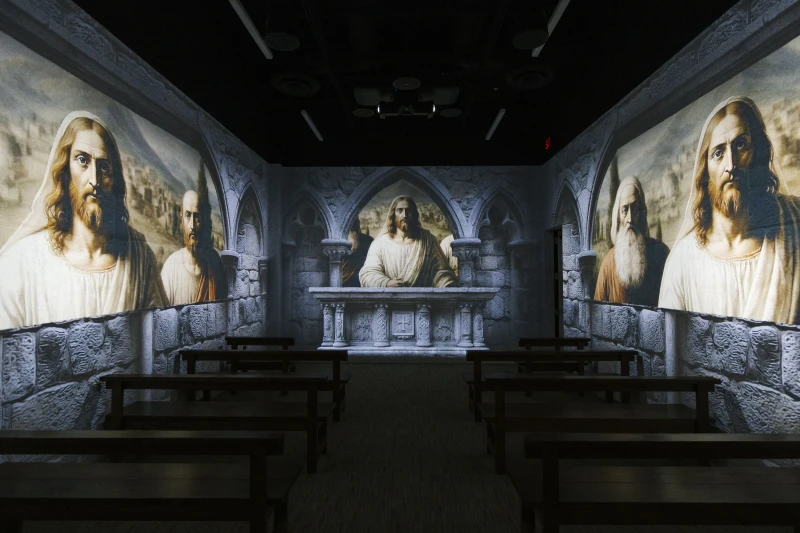
“The Shroud of Turin: An Immersive Experience,” a $5 million, 10,000-square-foot museum on the chancery campus of the Diocese of Orange in Southern California, opened to visitors Wednesday.
The museum is presented by Papaian Studios in partnership with the Diocese of Orange and Othonia Inc., an international team of specialists dedicated to exploring and sharing the mystery of the Shroud of Turin.
The 90-minute experience introduces visitors to the life, death, and resurrection of Jesus Christ, with a special focus on the Shroud of Turin, which many believe to be the burial cloth of Christ.
The 90-minute experience at the new Shroud of Turin museum on the chancery campus of the Diocese of Orange in California introduces visitors to the life, death, and resurrection of Jesus Christ, with a special focus on the Shroud of Turin, which many believe to be the burial cloth of Christ. Credit: Diocese of Orange
Inspired by the advanced technology incorporated in “Van Gogh Exhibition: The Immersive Experience” and the “Immersive King Tut,” the museum features 360-degree projection-room theaters as well as shroud replicas, interactive kiosks, a life-sized corpus, and a variety of artwork.
Jason Pearson of FiveHive Studios, which offers AI special effects and animation services, is a Catholic convert who worked with Othonia, a team of shroud specialists, to design the museum. Among his movie credits is Mel Gibson’s 2004 “The Passion of the Christ.” He has long had an interest in the shroud and has been a volunteer guide at the Shroud Center of Southern California located at the Santiago Retreat Center, also in the Diocese of Orange.
“Using technology on display like that of the Van Gogh or King Tut exhibits, we’re doing things that have never been done before,” Pearson told CNA.“Whether it be Jesus walking on water or through the streets of Jerusalem, or in the tomb at the moment of the Resurrection, we make use of sound and projections so that the visitor feels like he’s going back into a time machine and experiencing these things himself.”
“The Shroud of Turin: An Immersive Experience” located at the Christ Cathedral campus in the Diocese of Orange, California, opened to visitors on Nov. 19, 2025. Credit: Everett Johnson, Diocese of Orange
The museum is designed for everyone, Pearson continued, even those who have no religious background at all.
Located on the second floor of the campus’ Richard H. Pickup Cultural Center, the museum has three theater rooms. Using surround sound and images, including on the floor, the first room introduces the visitor to the person of Jesus Christ through presentation of 12 stories from his life, but each one is selected to show Christ’s connection to the supernatural (e.g. the Transfiguration). The next introduces the visitor to the shroud itself, including proof of its authenticity and what it tells us about the sufferings of Christ. The third is devoted to the Resurrection leading the viewer to ponder a pointed question: Who do you believe the man on the shroud is?
The third theater exits into the museum area, which includes displays of reproductions of items that were part of the passion of Christ, including a flagellum (whip), the crown of thorns and nails, as well as a reproduction of what the tomb of Christ might have looked like.
The new Shroud of Turin museum uses AI and 360-degree tech to explore Christ’s life and resurrection. Credit: Everett Johnson, Diocese of Orange
Other exhibits include an AI presentation of Secondo Pia (1855–1941) who, while photographing the shroud in 1898, discovered that its negative image offered a clearer image of the man on the shroud with a detail in his face that could not been seen by the naked eye. Another traces the history of the iconography of Christ, demonstrating how accurate, when comparing it to the shroud image, many of the icons were. And, one compares the Sudarium of Oviedo, or the facial cloth that covered Christ’s face after his death, to the image on the shroud.
Pearson hopes that the museum will be a prototype for additional shroud museums in different regions of the country. Inquiries have been made about establishing shroud museums from places as far away as Kuala Lumpur in Malaysia.
One portion of the museum is dedicated to the science of the shroud, and two kiosks allow visitors to ask questions of a digital Father Robert Spitzer, who has extensively researched the shroud over the past 20 years. Credit: Everett Johnson, Diocese of Orange
One portion of the museum is dedicated to the science of the shroud, and two kiosks allow visitors to ask questions of a digital Father Robert Spitzer, who has extensively researched the shroud over the past 20 years. Spitzer, who has an office at Christ Cathedral, noted that he was pleased with the museum’s opening. “It gets the pedagogy right, it’s biblically accurate, and they tell me the visual imagery is amazing.” (Spitzer has gone blind in recent years.)
He continued: “And while we welcome anyone, we especially hope many young people will come to learn about the shroud and lead many to come to know more deeply the person of Jesus Christ.”
Nora Creech is on the leadership team of Othonia and helped develop content for the museum. “We want people to come with an open mind, explore, and ask questions. We want them to ask, ‘Who is the man of the shroud?’” she said.
One special target group of the museum, Creech said, is younger people, “many of whom have not been brought up with knowledge of who Jesus is. That is why we seek first to introduce people to Jesus so that they will become interested in his burial shroud.”
Pearson agreed and related the story of two young women who visited the Shroud Center and began weeping, asking: “Why hasn’t anyone told us about him?”
But while the shroud is important in showing us what Jesus suffered, Creech continued, we also need the Church and the Scriptures “to learn why he suffered.”
Auxiliary Bishop Timothy Freyer blesses the new Shroud of Turin museum on the chancery campus of the Diocese of Orange in Southern California, opened to visitors Wednesday, Nov. 19, 2025. Credit: Kaylee Toole, Diocese of Orange
Orange Auxiliary Bishop Timothy Freyer, who played a key role in bringing the museum to Christ Cathedral, noted that his favorite feature was the reproduction of the crown of thorns, which, contrary to most artistic renditions, was actually shaped like a helmet or cap. He continued: “I’ve been impressed with the entire exhibition. It is very engaging, and I believe it will be an important tool in helping visitors come to know Christ better.”
Also among those excited to see the opening of the museum was Gus Accetta, a physician who has devoted much of his free time to studying the shroud. In 1996, he founded the Shroud Center in Huntington Beach, since relocated to the Santiago Retreat Center and welcoming 25,000 visitors annually.
“It’s a wonderful exhibit,” he said. It not only looks at the shroud but the whole life of Christ, of which the shroud is just a part.”
A crown of thorns from the “Shroud of Turin: An Immersive Experience,” a $5 million, 10,000-square-foot museum on the chancery campus of the Diocese of Orange in Southern California. The museum opened to visitors on Nov. 19, 2025. Credit: Diocese of Orange
The Shroud of Turin experience will be on display at Christ Cathedral at least through 2030. The museum is located on Christ Cathedral campus, 12141 Lewis St., Garden Grove, California, a few miles away from Disneyland and the Anaheim Convention Center. For more information, visit the website www.theshroudexperience.com.





Leave a Reply