


Fiction can often convey the human texture of a time and place better than scholarly works of history.
Herewith, and in honor of the national semiquincentennial, some novels that help tell the Catholic story in these United States through a fictional lens.
The Pre-History: Through the life of one of my native state’s notable daughters, Margaret Brent, Lucia St. Clair Robson’s Mary’s Land recounts the initial settlement and later struggles of the only English colony founded as a refuge for Catholics. In Shadows on the Rock, the great Willa Cather limpidly describes the extraordinary labors of Catholic settlers in the 17th-century proto-Canadian wilds of North America, while in Black Robe Brian Moore limns the spiritual as well as physical hardships borne by French missionaries of that era, who worked in what is now Upstate New York as well as Canada.
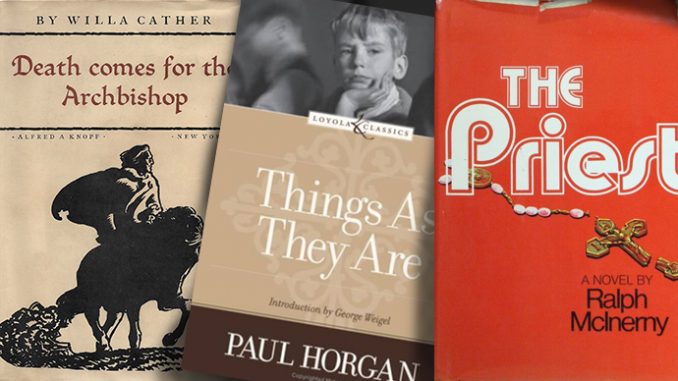
Settling a Continent: There are very few novels I read time and again for the elegance of their language and richness of their insight. Willa Cather’s Death Comes for the Archbishop—a fictional telling of the story of Archbishop Jean-Baptiste Lamy of Santa Fe and his friend and co-worker, Joseph Machebeuf, latterly the first Bishop of Denver—is on that short list. The canonical work on the great archbishop is Paul Horgan’s epic biography, Lamy of Santa Fe, which won the Pulitzer Prize when that was worth winning, but for emotional depth, start with Cather and move on to Horgan.
Speaking of the unjustly unremembered Mr. Horgan, his novel of the settlement of the Southwest, A Distant Trumpet, was for many years my standard Confirmation and Bar Mitzvah gift to young men, as it powerfully traces a young cavalry officer’s sometimes stony path to maturity as a soldier, husband, and citizen. Full of memorable characters and written from within that sacramental sensibility that runs like a gossamer thread through Horgan’s work, the novel (not the dreadful movie of the same title) is both an unsparing look at the good and evil found in white settlers and indigenous peoples alike, and a wonderfully drawn telling of two great marriages, one of them intensely if never cloyingly Catholic.
The Immigrant Experience: The Catholic Church was arguably the greatest institutional immigrant assimilator in American history. Two novels limn that experience in different literary keys.
Oscar Hijuelos, who died far too young in 2013 and to whom I remain grateful for a cover blurb for Witness to Hope, the first volume of my John Paul II biography, became the first Hispanic to win the Pulitzer for fiction with The Mambo Kings Play Songs of Love, which follows the adventures of two Cuban immigrant musicians seeking their American dream through the dance halls of 1920s New York. Hijuelos crafted another masterpiece, this time about forgiveness and redemption in the sometimes-violent ethnic Mixmaster of modern Gotham, in Mr. Ives’ Christmas, which brings the second petition of the Lord’s Prayer to life in an achingly beautiful way.
Immigrant Catholicism often meant big city machine politics, and that gritty reality was never better captured than by Edwin O’Connor in The Last Hurrah, which one reviewer called the greatest novel about Irish Americans ever written.
Settled Catholicism in the East: Paul Horgan again, this time with Things As They Are, which is one of the best renderings of a boy growing up since Huckleberry Finn. Set in the 1920s along the Niagara Frontier, the novel is a series of vignettes that traces the protagonist’s first encounters with guilt, pride, self-delusion, overwrought piety, ambition, and the mysteries of sex, all rendered with a graceful realism that avoids both the saccharine and the cynical.
Post-Conciliar Controversies and Confusions: Ralph McInerny was a distinguished philosopher who, while teaching at Notre Dame and directing its Maritain Center for decades, pursued a sideline as a prolific novelist.
In The Priest, a huge bestseller when first published in 1973, McInerny explores the travails of a Church engaged in a fractious and sometimes disorienting implementation of the Second Vatican Council through the tribulations of newly ordained Frank Ascue, whose many challenges eventually lead to a deepened vocational commitment. McInerny was also a great wit, and his satirical talents are on full, if discrete, display in his send-up of the U.S. bishops’ conference in the 1980s, The Noonday Devil, in which the models for certain characters are not hard to identify for Those Who Were There. Extra credit to those Domers who can identify the real people behind the fictional Notre Dame personalities in the thirteen McInerny campus mysteries titled with outrageous puns like On This Rockne.
If you value the news and views Catholic World Report provides, please consider donating to support our efforts. Your contribution will help us continue to make CWR available to all readers worldwide for free, without a subscription. Thank you for your generosity!
Click here for more information on donating to CWR. Click here to sign up for our newsletter.

What? No J.F. Powers on ecclesiastical culture in the Midwest before (Morte D’Urban) and after Vatican II (The Wheat That Springeth Green).His short stories are also great.
I totally agree the articule of Mr.Weigel is terrific good but i missed some named for instance “The Cardinal” by Henry Morton Robinson inspired freely in the life of the Cardinal Spellman translated into Spanish and also the William Edmund Barret’s novels as “The left’s hand of God” or White lilies.
May I recommend”The Good Shepherd,” by Thomas Fleming as an intensely realistic look at the Church after Vatican II