An Indiana Catholic husband and wife are petitioning the Supreme Court to hear their case after the state government removed their child from their home after he began identifying as “transgender.”
Mary and Jeremy Cox refused to accept their son’s self-declared female identity in 2019, instead seeking therapy to address what they saw as underlying mental health concerns.
The Indiana government in 2021 began investigating the Cox family after learning that they refused to address their son by his chosen identity. The government subsequently removed their son from their home, placing him in another home that “affirmed” his transgender beliefs.
The state government subsequently dropped abuse allegations against the couple, though it still argued that the “disagreement over gender identity” was distressing to the child and was contributing to an ongoing eating disorder. Subsequent court decisions upheld the decision to keep the child out of the Coxes’ custody.
On Thursday the Becket Fund for Religious Liberty announced that Mary and Jeremy Cox had filed a petition with the Supreme Court, asking the high court to “hold the state accountable for keeping their child out of their home.”
“This is what every parent is afraid of. We love our son and wanted to care for him, but the state of Indiana robbed us of that opportunity by taking him from our home and banning us from speaking to him about gender,” the parents said in the release.
“We are hopeful that the justices will take our case and protect other parents from having to endure the nightmare we did.”
In their filing, the petitioners noted that Indiana “found the parents fit but still removed the child over an ideological dispute.”
“Although Indiana found all allegations of abuse and neglect unsubstantiated, it refused to return [the child] home, substituting the judgment of the state for that of admittedly fit parents,” the filing said.
“If this can happen in Indiana, it can happen anywhere,” Lori Windham, vice president and senior counsel at Becket, said in the group’s press release. “Tearing a child away from loving parents because of their religious beliefs, which are shared by millions of Americans, is an outrage to the law, parental rights, and basic human decency.”
“If the Supreme Court doesn’t take this case, how many times will this happen to other families?”
The filing called the dispute one of “nationwide importance,” arguing that Indiana’s actions conflict with Supreme Court precedent on free speech and religious liberty.
“Amid this fraught landscape, with the lives of real children and families hanging in the balance, this court should grant this petition and affirm its precedents on the right of fit parents to custody of their children,” the filing says.
If you value the news and views Catholic World Report provides, please consider donating to support our efforts. Your contribution will help us continue to make CWR available to all readers worldwide for free, without a subscription. Thank you for your generosity!
Click here for more information on donating to CWR. Click here to sign up for our newsletter.
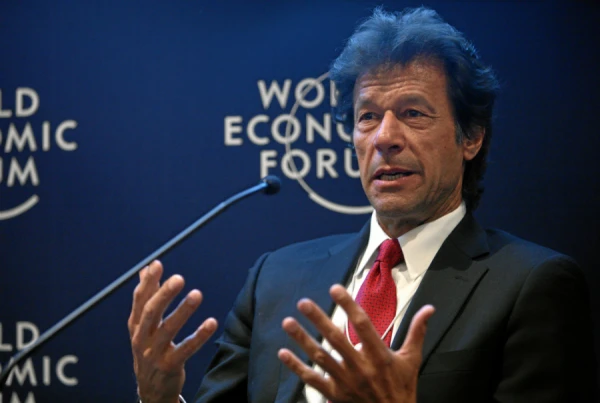
Philadelphia, Pa., Jan 22, 2020 / 04:01 pm (CNA).- On behalf of Philadelphia’s Pakistani Catholic community, Archbishop Charles Chaput encouraged the Pakistani prime minister Tuesday to shape a culture of religious freedom in the country.
“I urge you to make every effort to secure the full rights of Pakistan’s citizens of every religion. And please understand that I will be pressing this issue vigorously in the American public square on behalf of Philadelphia and other Pakistani Catholics,” the Archbishop of Philadelphia wrote Jan. 21 to Imran Khan, prime minister of Pakistan.
The letter, published in First Things, highlighted the Pakistani Catholic community in the Philadelphia area, whom Archbishop Chaput said “are grateful for their Pakistani heritage” and “whose Catholic faith was nourished in Pakistan.” He added, however, that “the hardships now faced by Christians in Pakistan profoundly concern them.”
The archbishop encouraged Khan to “work urgently to assure true religious liberty for all citizens of Pakistan, especially for members of minority faiths.”
Pakistan’s state religion is Islam, and around 97 percent of the population is Muslim.
The country was designated, for the first time, a “Country of Particular Concern” in December 2018 for its religious freedom record by the US Department of State. The designation had been recommended by the US Commission for International Religious Freedom in 2017 and 2018.
Archbishop Chaput noted that despite this designation, Sam Brownback, US ambassador at large for religious freedom, had in February 2019 “indicated that your nation shows a sincere ‘desire to change’ for the better on this issue. I thank you for your willingness to pursue that positive change.”
“I believe in the honest intentions of many in the Pakistani government to assure full religious freedom for their nation. But Pakistan still does not fully protect the religious liberty of all of its citizens,” the archbishop pointed out.
He cited reports that religious minorities in Pakistan face “chronic hostility, harassment, and persecution,” and that the government “seems to do little to ensure their personal safety and their
full participation in public life.”
This situation, he said, is both unjust and it “aggravates misunderstandings and resentments of Islam among American Christians and other concerned U.S. citizens.”
Archbishop Chaput noted in particular the abuse of Pakistan’s blasphemy laws; economic inopportunity for religious minorities; and attacks on minority houses of worship.
Pakistan’s blasphemy laws impose strict punishment on those who desecrate the Quran or who defame or insult Muhammad. Although the government has never executed a person under the blasphemy laws, accusations alone have inspired mob and vigilante violence.
The laws, introduced in the 1980s, are reportedly used to settle scores or to persecute religious minorities; while non-Muslims constitute only 3 percent of the Pakistani population, 14 percent of blasphemy cases have been levied against them.
Many of those accused of blasphemy are murdered, and advocates of changing the law are also targeted by violence.
Citing such problems, the archbishop said that “a reform of Pakistan’s blasphemy laws, and its investigation and prosecution procedures, is thus urgently needed.”
Turning to economic problems, he said that the government has long “promised to provide quotas for public and education sector jobs for Christians and other religious minorities … but such promises have not been fulfilled, and members of religious minorities in Pakistan still face job and opportunity discrimination.”
In 2013 the then-governing party, the Pakistan Muslim League (N), promised a quota for jobs in the educational institutes and the public sector for members of religious minorities. The Pakistan Peoples Party discussed an Equality Commission to monitor job quotas in Sindh.
Both parties are now in the opposition in the national parliament, and the proposed safeguards have not been put into action.
Finally, Archbishop Chaput said, “police too often fail to protect non-Muslim sacred spaces,” which have been frequently attacked.
“Little effort is made to prosecute and bring to justice the perpetrators of this religious hatred,” the archbishop stated.
“I do believe in the good will of many citizens of Pakistan and many members of your government,” Archbishop Chaput told Khan.
“I also know that Pakistan faces many economic and social challenges, and you have the difficult task of managing them. I respect the demands of your office, and I gladly pray for both justice and success in your public service.”
Denver Newsroom, May 5, 2020 / 04:41 pm (CNA).- The U.S. bishops’ conference has responded to charges that it might have knowingly facilitated illegal campaigning by the White House and the campaign of President Donald Trump when it notified Catholic leaders of an impending phone call with the president.
A spokesperson for the bishops’ conference told CNA May 5 that when it notified Catholic leaders about an April phone call with the president, its goal was to promote advocacy for Catholic education, and that the call had no connection to the president’s reelection campaign.
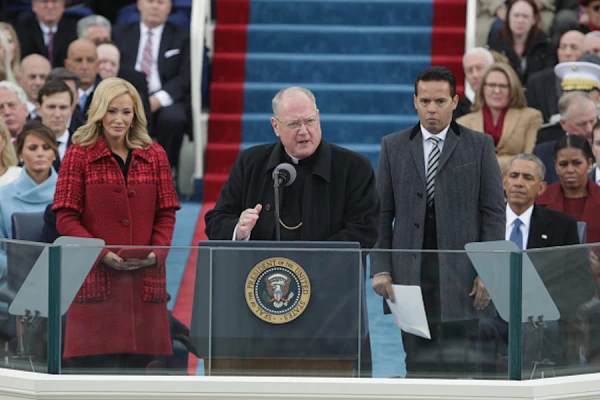
On April 24, White House officials invited “Catholic Leaders and Educators” to participate in an April 25 call with Trump about the needs of Catholic schools during the coronavirus pandemic. More than 600 people participated in the call, including USCCB president Archbishop Jose Gomez and Cardinal Timothy Dolan of New York.
During the call, bishops and schools superintendents outlined the work of Catholic schools during the pandemics, and their needs, especially for funding.
The call soon became a matter of controversy.
On April 26, the Crux news website reported that Trump had declared himself the “best [president] in the history of the Catholic Church” during the call, and that when Dolan was identified by the president as a “great gentleman” and a “great friend of mine,” the cardinal responded by saying that “the feelings are mutual.”
Critics in Catholic media complained that the bishops on the call did not raise points of disagreement with the president, who has been widely criticized by the U.S. bishops at other times for his stances on immigration and social assistance programs.
Also controversially, Trump appeared during the call to tout his reelection bid, warning that conditions could worsen for Catholics and Catholic schools if a Democratic administration were to take office.
The day before the call took place, Lauren McCormack, head of government relations for the bishops’ conference, notified by email some Catholic leaders that the call would take place, and forwarded to them a White House invitation to register for the call.
On May 5, Crux reported that McCormack had warned leaders that “email addresses used to register for the call will be captured by White House and used for additional communication in the future, possibly including from campaign.”
In response to that report, National Catholic Reporter blogger Michal Sean Winters said McCormack’s email was “evidence that Dolan, and at least some key staffers at the bishops’ conference, knew that the call was partly a campaign rally.”
Winters alleged it was possible the conference might have aided the White House in illegal or unethical campaign activity, if it knew Trump was planning to campaign from the White House, or that the White House was planning to share with campaign staffers email addresses it had obtained from the call.
But Chieko Noguchi, a U.S. bishops’ conference spokesperson, told CNA May 5 the conference had not colluded with the Trump campaign, or been told by anyone that email addresses might be shared with a campaign. Instead, Noguchi said, McCormack’s warning was speculation.
“A small part of a confidential briefing to bishops was a warning: because they would have to provide an email address to register for the call, they might later receive unwanted email messages from the White House, and possibly the campaign. This warning was based on cautious speculation, not on any communications with the White House,” Noguchi told CNA.
In fact, before McCormack notified leaders that that campaign might obtain their email addresses, USCCB general counsel Anthony Picarello speculated in an email to state Catholic conference directors about the same possibility, calling the chance that email addresses could be shared a “nuisance factor” of which they should be aware.
In their emails, which were obtained by CNA, neither Picarello nor McCormack encouraged Catholic leaders to sign up for the call. And Noguchi told CNA that participation in the call was not about politics.
“The purpose of USCCB’s participation in the April 25 call was to advocate directly with the highest government officials on behalf of U.S. Catholic schools, which face an unprecedented crisis because of COVID-19,” Noguchi said.
“USCCB does not support or oppose any candidate for elective office,” she added.
President Trump is well known to mix official business with campaigning.
During his frequent media briefings on the coronavirus pandemic, the president has mixed information about the government’s response with aspersions cast toward Democrats, especially his likely presidential campaign opponent, Joe Biden. But participants said that while Trump mentioned his reelection during the call, Catholic leaders focused their remarks on their concerns about the pandemic.
Bishop Michael Barber of Oakland, the USCCB’s education committee chair—along with several Catholic diocesan superintendents, noted the importance of the Paycheck Protection Program loans for Catholic schools to continue operating, and asked for tax deductions for parochial schools and direct tuition aid for parents, according to accounts from leaders on the call.
Archdiocese of Denver school superintendent Elias Moo told CNA last week that he spoke to Trump “about the long history of Catholic education in our country, and how our nation needs schools that provide an educational experience that forms the whole child and values the primacy of parents and of the soul of the human person.”
Sources on the call said the president responded with indication that he would find ways to help Catholic schools during the pandemic, and support efforts to find Congressional funding for education assistance.
Since the call, bishops have received criticism for their engagement with Trump. More than 1,500 people have signed online a letter to Dolan that criticizes the cardinal for “aligning” with Trump, and claims the cardinal has given the impression of endorsing Trump.
Among the signatories are Catholic intellectuals, priests, religious, laity, along with representatives from the “Association of Roman Catholic Women Priests” and the “American National Catholic Church,” a group founded, according to Trenton’s Bishop David O’Connell “by schismatic leaders who deny the unity of the Roman Catholic Church and its leadership and laws.”
Dolan has responded by telling reporters that he is committed to working with civic leaders of all parties for the good of the Church.
For his part, Moo, who participated in the call, told CNA that dialogue with civil leaders is a part of Catholic leadership.
“Regardless of one’s political affiliation or preference, it is important for the Church to engage with public officials to discuss the issues that are central to our Catholic faith and mission. In this case, it was the importance and value of Catholic schools as a critical part of the educational fabric of our nation.”
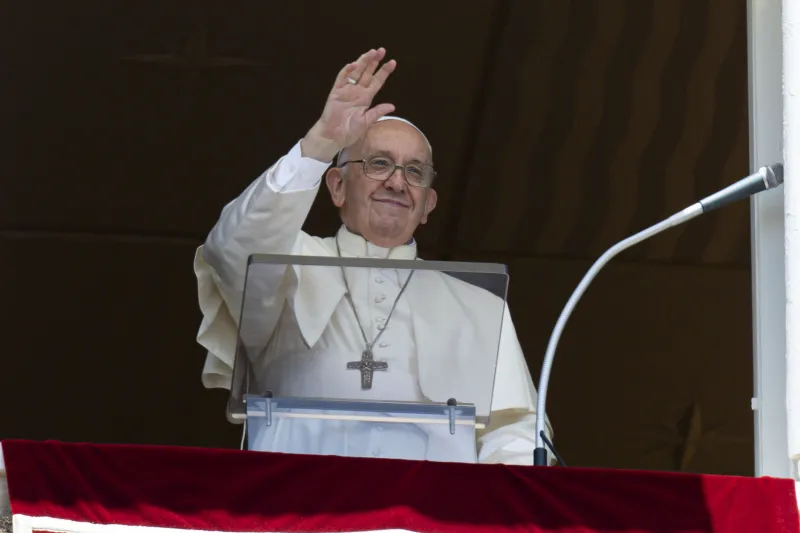
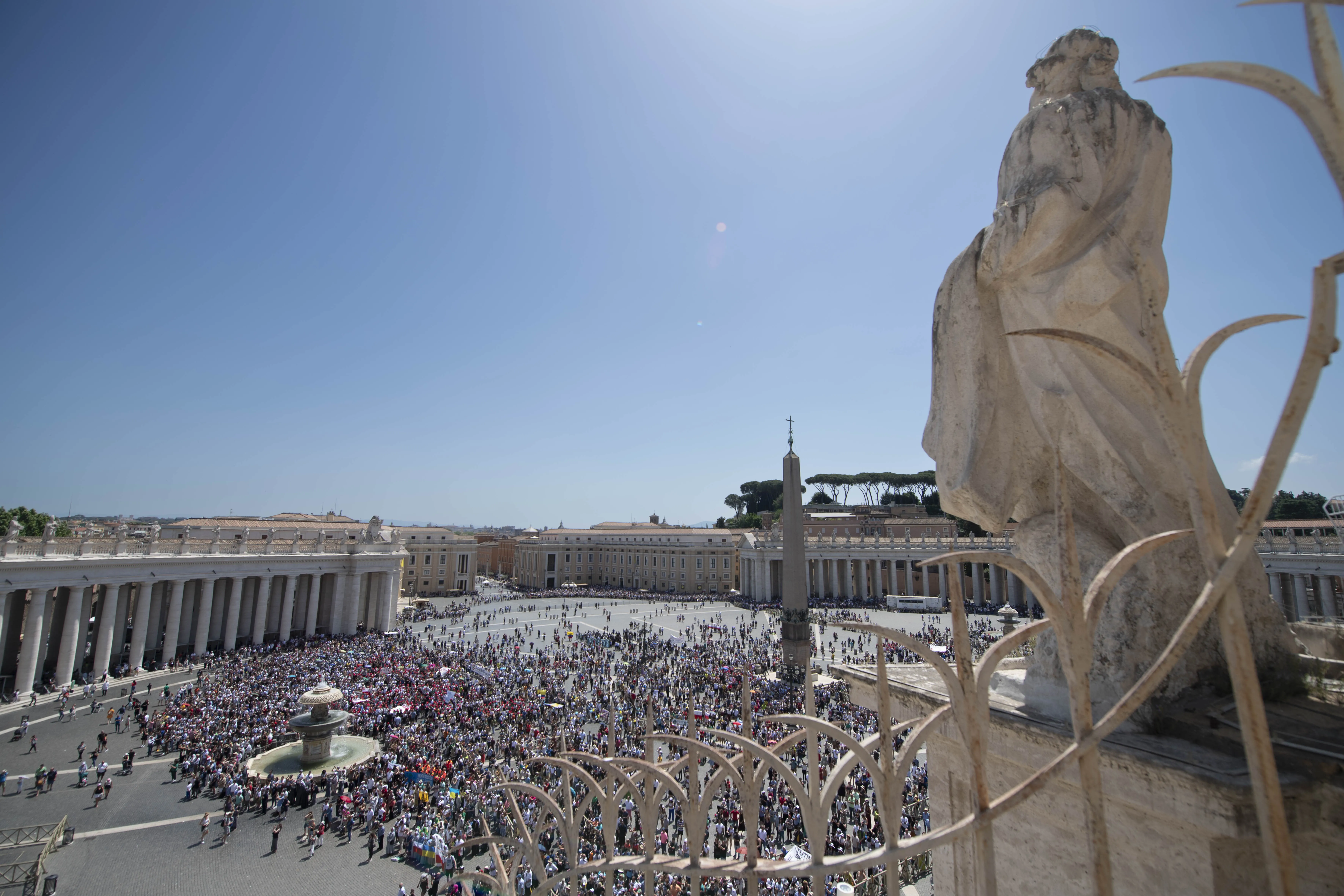
Pope Francis greets a crowd of an estimated 25,000 people gathered in St. Peter’s Square in Rome for his Regina Caeli address on May 22, 2022. / Vatican Media
Vatican City, May 22, 2022 / 07:33 am (CNA).
In his Sunday Regina Caeli address, Pope Francis reflected on Jesus’ words to the disciples at the Last Supper in the Gospel reading from John: “Peace I leave with you; my peace I give to you.”
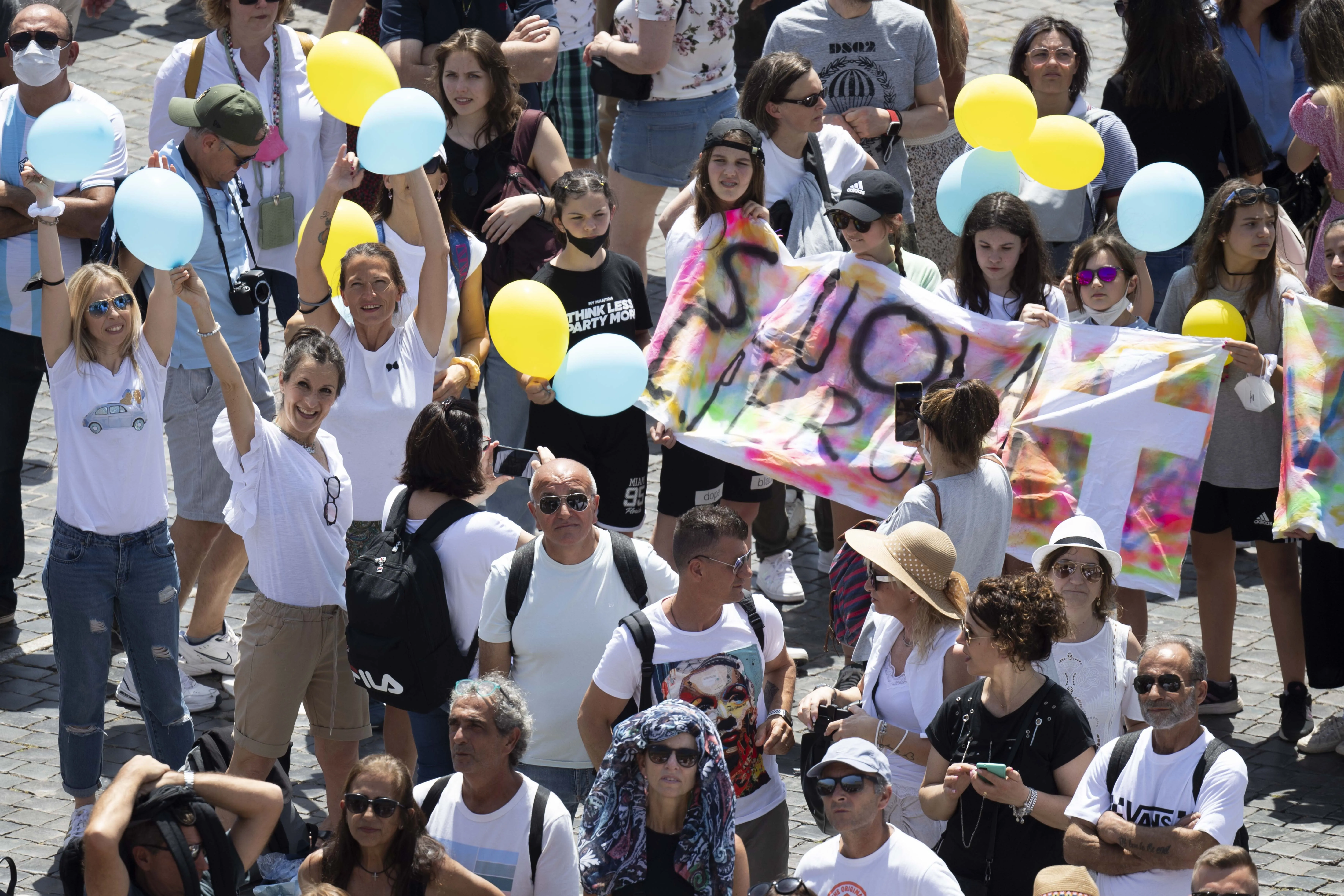
Speaking to an estimated 25,000 pilgrims gathered on a bright day in St. Peter’s Square in Rome, the pope noted that Jesus also makes a point to add, “Not as the world gives do I give it to you” (John 14:27).
“What is this peace that the world does not know and the Lord gives us?” Pope Francis asked.
“This peace is the Holy Spirit, the same Spirit of Jesus. It is the presence of God in us, it is God’s ‘power of peace,'” he explained. “It is He, the Holy Spirit, who disarms the heart and fills it with serenity. It is He, the Holy Spirit, who loosens rigidity and extinguishes the temptations to attack others. It is He, the Holy Spirit, who reminds us that there are brothers and sisters beside us, not obstacles or adversaries.
“It is He, the Holy Spirit, who gives us the strength to forgive, to begin again, to set out anew because we cannot do this with our own strength. And it is with Him, with the Holy Spirit, that we become men and women of peace,” Pope Francis said.
“This is the source of the peace Jesus gives us,” he added. “For no one can leave others peace if they do not have it within themselves. No one can give peace unless that person is at peace.”
Pilgrims at St. Peter’s Square in Rome on May 22, 2022. In his Regina Caeli address, Pope Francis spoke about the peace of Christ. Vatican Media
Pope Francis said, “Let us learn to say every day: ‘Lord, give me your peace, give me your Holy Spirit.’ This is a beautiful prayer. Shall we say it together? ‘Lord, give me your peace, give me your Holy Spirit.’”
Again encouraging the crowd to pray with him, he said, “I didn’t hear it well. One more time: ‘Lord, give me your peace, give me your Holy Spirit.’”
Focusing on the context of Gospel reading, Pope Francis observed that Jesus’ words to his apostles are “a sort of testament.”
The pope said, “Jesus bids farewell with words expressing affection and serenity. But he does so in a moment that is anything but serene,” referring to Judas’ unfolding betrayal and Peter’s imminent denial that he even knows Jesus.
“The Lord knows this, and yet, he does not rebuke, he does not use severe words, he does not give harsh speeches,” Pope Francis said. “Rather than demonstrate agitation, he remains kind till the end.”
He continued, “There is a proverb that says you die the way you have lived. In effect, the last hours of Jesus’ life are like the essence of his entire life. He feels fear and pain, but does not give way to resentment or protesting. He does not allow himself to become bitter, he does not vent, he is not impatient. He is at peace, a peace that comes from his meek heart accustomed to trust.”
In so doing, “Jesus demonstrates that meekness is possible,” the pope observed.
“He incarnated it specifically in the most difficult moment, and he wants us to behave that way too, since we too are heirs of his peace,” he said. “He wants us to be meek, open, available to listen, capable of defusing tensions and weaving harmony. This is witnessing to Jesus and is worth more than a thousand words and many sermons. The witness of peace.”
Pope Francis invited all disciples of Jesus to reflect on whether they behave in this way.
“Do we ease tensions, and defuse conflicts? Are we too at odds with someone, always ready to react, explode, or do we know how to respond nonviolently, do we know how to respond with peaceful actions? How do I react?” he asked.
“Certainly, this meekness is not easy,” while adding ,“How difficult it is, at every level, to defuse conflicts!”
Jesus understands this. He knows “that we need help, that we need a gift,” the pope explained.
“Peace, which is our obligation, is first of all a gift of God.”
Pope Francis said that “no sin, no failure, no grudge should discourage us from insistently asking for this gift from the Holy Spirit who gives us peace.”
“The more we feel our hearts are agitated, the more we sense we are nervous, impatient, angry inside, the more we need to ask the Lord for the Spirit of peace,” he said.
Pilgrims gather at St. Peter’s Square in Rome on May 22, 2022, for Pope Francis’ Regina Caeli address. Vatican Media
Pope Francis invited the crowd to pray with him, “Lord, give me your peace, give me your Holy Spirit.” He added, “And let us also ask this for those who live next to us, for those we meet each day, and for the leaders of nations.”
After praying the Regina Caeli at noon, Pope Francis commented on the beatification in Lyon, France, later on Sunday of Pauline Marie Jericot, who founded the Society of the Propagation of the Faith for the support of the missions in the early 19th century. The pope called her “a courageous woman, attentive to the changes taking place at the time, and had a universal vision regarding the Church’s mission.”
Pope Francis continued: “May her example enkindle in everyone the desire to participate through prayer and charity in the spread of the Gospel throughout the world.”
Pope Francis also noted that Sunday marked the beginning of “Laudato Si’ Week,” a weeklong reflection inspired by his 2015 encyclical on the environment. He called the observance an opportunity “to listen ever more attentively to the cry of the Earth which urges us to act together in taking care of our common home.”
Pope Francis also mentioned that May 24 marks the Feast day of Mary Help of Christians, who is “particularly dear to Catholics in China.”
He added that Mary Help of Christians is the patroness for Chinese Catholics and is located in the Shrine of Sheshan in Shanghai in addition to many churches and homes throughout the country.
“This happy occasion offers me the opportunity to assure them once again of my spiritual closeness” to believers in China, he said.
“I am attentively and actively following the often complex life and situations of the faithful and pastors, and I pray every day for them,” he said.
“I invite all of you to unite yourselves in this prayer so that the Church in China, in freedom and tranquility, might live in effective communion with the universal Church, and might exercise its mission of proclaiming the Gospel to everyone, and thus offer a positive contribution to the spiritual and material progress of society as well.”
Pope Francis also greeted participants in Italy’s annual pro-life demonstration, titled Scegliamo la vita, or in English, “Let’s Choose Life.”
“I thank you for your dedication in promoting life and defending conscientious objection, which there are often attempts to limit,” Pope Francis said.
“Sadly, in these last years, there has been a change in the common mentality, and today we are more and more led to think that life is a good at our complete disposal, that we can choose to manipulate, to give birth or take life as we please, as if it were the exclusive consequence of individual choice,” the pope said.
“Let us remember that life is a gift from God! It is always sacred and inviolable, and we cannot silence the voice of conscience,” he concluded.
This is one of the reasons, not the only one, but one, why I am very sympathetic to adults who do not want children: the State can, and will, take a child (or children) away very highly suspect reasons.



This is one of the reasons, not the only one, but one, why I am very sympathetic to adults who do not want children: the State can, and will, take a child (or children) away very highly suspect reasons.