


 By
By 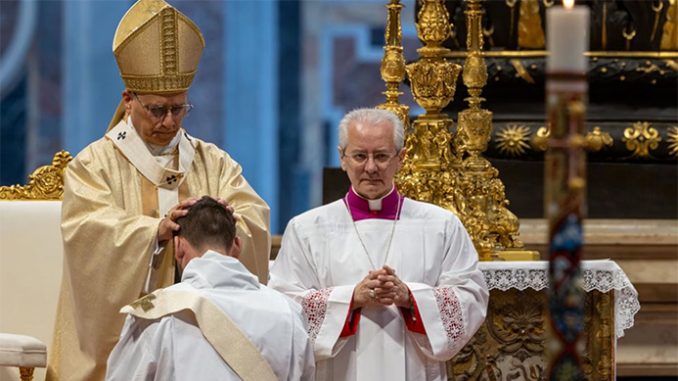
VATICAN CITY, April 26, 2026 — Pope Leo XIV ordained 10 new priests in St. Peter’s Basilica on Sunday, urging them to keep the doors of the Church open and to remember that their mission is to welcome, not to exclude.
“Today more than ever, especially when statistics seem to indicate a divide between people and the Church, keep the door open! Let people in, and be prepared to go out,” the pope said in his homily for the Mass on the Fourth Sunday of Easter, also known as Good Shepherd Sunday.
“This is another secret for your life: you are a channel, not a filter,” he told the ordinands.
Eight of the new priests were ordained for the Diocese of Rome, of which the pope is bishop: Guglielmo Lapenna, Giorgio Larosa, Jos Emanuele Nleme Sabate, Giovanni Emanuele Nunziante Salazar, Antonino Ordine, Yordan Camilo Ramos Medina, Daniele Riscica, and Cristian Sguazzino.
The pope also ordained Armando Roa Núñez, born in Mexico and incardinated in the Diocese of Miao in India, and Selwyn Pinto Loyce, born in Saudi Arabia and incardinated in the Institute of Christ the Redeemer, Idente Missionaries.
Reflecting on the Gospel in which Jesus says, “I am the gate,” Leo told the new priests to see themselves as servants of a suffering humanity that awaits abundant life.
“Never hide this holy door. Do not block it; do not be an obstacle to those who wish to enter,” he said. Quoting Jesus’ rebuke in Luke’s Gospel, he added: “You did not enter yourselves, and you hindered those who were entering.”
The pope said priestly ministry should be marked by communion and openness. “You belong to everyone and are for everyone!” he said. “Let this be the fundamental purpose of your mission: to keep the threshold open and direct others to it, without using too many words.”
Leo also urged the ordinands not to reduce Christian life to parish structures or ecclesial groups.
“The Church’s doors are open, but not to cut us off from life: life does not end in a parish, in an association, in a movement, in a group,” he said. “Whoever is saved can ‘go out and find pasture.’”
“Dear brothers, go out and discover culture, people and life!” the pope continued. “Marvel at the things that God makes grow without our having sown them.”
The pope also spoke about celibacy, comparing it to the love of spouses.
“Certainly, like the love of spouses, the love that inspires celibacy for the Kingdom of God must also be guarded and constantly renewed, for every true affection matures and becomes fruitful over time,” he said.
He told the new priests that the deeper their bond with Christ, “the more radical” their belonging to humanity becomes, adding that they are called to be “not only good priests but also honest, helpful citizens, builders of peace and social friendship.”
The pope warned against fear and the search for scapegoats, saying that the need for security today can make people aggressive and cause communities to close in on themselves.
“May your security not lie in the role you hold, but in the life, death and resurrection of Jesus as well as in your participation, along with your people, in the story of salvation,” he said.
The communities to which the priests will be sent, he said, are already places where the risen Christ is present.
“These communities will also help you to become saints!” Leo said. “For your part, help them to walk together, following Jesus, the Good Shepherd, so that they may become places — gardens — of life that rise anew and share themselves with others.”
He added: “Facilitating encounters, helping to bring together those who would otherwise never meet, and conciliating division is one and the same as celebrating the Eucharist and Reconciliation. Coming together always means planting the Church anew.”
Later on Sunday, before leading the Regina Caeli from the window of the Apostolic Palace, Pope Leo returned to the image of Jesus as the Good Shepherd and the gate of the sheepfold.
“Jesus does not come as a thief to take away our life and our freedom, but to lead us along the paths of righteousness,” he said. “He does not come to ensnare or deceive our conscience, but to illuminate it with the light of his wisdom. He does not come to taint our earthly joys, but to open them to a fuller and more lasting happiness.”
“Those who entrust themselves to him have nothing to fear,” the pope said, “for he does not deprive us of life, but comes to give it to us in abundance.”
Leo urged the faithful to be vigilant about who or what enters “the gate” of their hearts.
“‘Thieves’ can take many forms,” he said, citing those who “suppress our freedom or fail to respect our dignity,” as well as “beliefs and biases,” “mistaken ideas,” and “superficial and consumeristic lifestyles” that leave people empty inside.
He also pointed to those who harm humanity by “pillaging the earth’s resources, waging blood-thirsty wars, or fueling evil in any form,” saying they “do nothing but rob each of us of the possibility of a future marked by peace and serenity.”
The pope invited the faithful to examine their consciences: “Who do we want to guide us in life? Which ‘thieves’ have tried to break into our fold? Have they succeeded, or have we managed to ward them off?”
After the Regina Caeli, Leo recalled the 40th anniversary of the Chernobyl nuclear disaster, calling it a warning about the risks of powerful technologies.
“Let us entrust those who died and all who still suffer from the aftermath of the disaster to God’s mercy,” he said. “I hope that discernment and responsibility will always prevail at every level of decision-making so that all use of atomic energy may be placed at the service of life and peace.”
The pope also offered a special greeting to the relatives and friends of the new priests of the Diocese of Rome.
“Please continue to accompany these young ministers of the Gospel with your prayers,” he said.
This story was first published in two parts by ACI Prensa, EWTN News’ Spanish-language news partner. It has been translated and adapted by EWTN News English.
If you value the news and views Catholic World Report provides, please consider donating to support our efforts. Your contribution will help us continue to make CWR available to all readers worldwide for free, without a subscription. Thank you for your generosity!
Click here for more information on donating to CWR. Click here to sign up for our newsletter.

We read: “Certainly, like the love of spouses, the love that inspires celibacy for the Kingdom of God must also be guarded and constantly renewed[!], for every true affection matures and becomes fruitful over time.”
With synodalism now in the rearview mirror, a renewed pitch for the celibate priesthood…! And, for what is “fruitful over time,” rather than for the gradualism of “time is greater than space.”
“[….]The bond that binds the celibate and the virgin to the Lord is so total, so exclusive, that its only equivalent on the human level is when a man marries a woman” (Raniero Cantalamessa, OFM Cap, [Preacher of the Papal Household 1980-2024], “Virginity: A Positive Approach to Celibacy for the Sake of the Kingdom of Heaven,” Alba House, 1985).
True to his predecessor’s vision of the Church as a channel of love, Pope Leo pronounces to all that they may simply entrust themselves to God. Trust replaces the notion of the Church as a filter, an oblique reference to those Catechetical doctrines that regulate Christian behavior.
Although placing aside knowledge and commitment to revealed doctrine makes the Christian experience a personal encounter with God as the individual perceives him. Whereas Christ’s universal command at the Ascension was to go out to the nations and teach them all that I have taught you.
This approach to Catholic Christianity may sound kinder and gentler, more inviting to all. Leo XIV requires awareness that what’s at stake is not a buttered hot bun rather our salvation or eternal disaster
What PL says is contrary to what Our Lord said “Repent and believe in the Gospel”. St John the Fortuner/Baptist urged everyone to prepare the way for the Lord. This is not just because Izrael was sinful but because a human being cannot properly relate to God unless he is humbled by realization of own insufficiency and flows which he cannot “sort out” by himself. Very often, people come to know God via des profundis experience of hell on earth. I will give a very modern example: Dr. Marsha M. Linehan, the American psychologist and professor who developed Dialectical Behavior Therapy. She had her mystical experience of God’s love in the chapel of the hospital where she was a hopeless young patient, after many attempts of self-harm and suicide. She was extremely ill and hated herself. While sitting in the Chapel, she suddenly experienced God’s Love for her, in a form of light enveloping her. That was her first experience of real love. As a result, her self-hatred stopped and later she developed one of the most effective treatments for a borderline personality disorder/cPTSD.
Now, if Dr. Marsha M. Linehan perceived herself and her future patients as “good, nothing to change” she would not develop her therapy which is based on 1) self-acceptance (stopping self-hatred) 2) a need to change 3) learning new skills to tolerate stress and pain, the result of profound childhood trauma/abuse, and to cope with those emotional experiences.
I deliberately gave this secular example to highlight what is missing in PL’s words. He says “open the gates, connect with people, be channels for God’s love… etc” – but for which purpose? God’s Love is incomparable in its magnitude to human love yet God still wants a person to change. Anyone who doubts it, read the Scriptures! God is very merciful and forgiving but he demands metanoia. To be with God means to change, to let Him to uproot all the darkness of the soul – simply because one cannot endure God without letting the dirt within go. But PL is silent about what ALL saints and mystics of the Church have been speaking about since the Ascension and until recently – a transformation which God demands of every human being. Thus, as usual, PL’s words are nothing else but a call “to be nice” i.e. empty. It is more like a drill of workers in the hospitality industry “to be welcoming”.
PF/PL “school of thought” is very fond of the story of a prodigal son. “This is why you should accept everyone!” they preach. The chronically forget the prodigal son repented; he was returning feeling himself unworthy even to be a servant of his father. This is why he was forgiven and restored – he realized he sinned, and sinned grossly.
There is also something very disturbing in that “open all the doors, do not be filters”. It is, in fact, a hidden self-love under the cover of being “welcoming = nice”. Imagine a narcissist mother who feeds her child with chips non-stop because it is the easiest way to buy his allegiance and “manage” him. A child is fattening, a father is angry, but the mother’s defense is impeccable “I love him so much and so I want him to be happy”. In reality, she ruins a child’s mental and physical health because she is unwilling to deal with the tedium of disciplining him – so it is herself she really loves, at the expense of her child’s true needs. And so, in her selfish mind, to love means to permit everything.
So, not only PL’s calls are unsound theologically, they are also unsound psychologically.
Anna, as a retired psychologist, I applaud what you write. I wasn’t aware of Linehan’s experience that you’ve referred to.
Anna, keep on writing. You add much common sense to these pages.
“What PL says is contrary to what Our Lord said “Repent and believe in the Gospel”.
True, as unrepentant sin is an obstacle to Salvation.
“You cannot Be My Disciples, if you do not Abide In My Word.” – The Charitable Anathema Of Jesus The Christ.
It should also be noted that Jesus, at the start of his formal ministry, began with the words, “Repent, for the kingdom of heaven is at hand.” He called people to repent, an uncomfortable but absolutely necessary message that seems to be lost in the progressive wing of the church.
Fr Peter wrote “Catechetical doctrines that regulate Christian behavior.” You mean like the rosary, devotions and frequently attending the sacraments?
Painting the churches doctrines as a pain point to be avoided by pastoral acti will only end in the church becoming another Protestant sect.
Edit: “St John the Forerunner/Baptist”.
Anna. A form of ideological schizophrenia has roots in the German philosophical theological professors at the Gregorian Pontifical University during the Sixties led by Jesuit Josef Fuchs appointed to the Gregorian in 1954.
Fuchs lectured on a duality. A progression of revealed truth based on his conceptual Christ the Word in contrast to Christ the Redeemer. The Word having created the world establishing natural law, whereas the Redeemer Word made flesh presenting a soteriological love that surpassed natural law.
Jorge Bergoglio, like many notable Jesuits, was a graduate of the Gregoriana who studied under Fuchs. We find that identity with Fuchs in Bergoglio’s diminishing of rules, in instances intrinsic laws of good and evil in favor of mercy.
Thanks for that Fr. which I can reason with and consider. Some things Pope Francis did, stand to defy. That is to say if we go by what got put in the news. The one for example where after Benedict had died, Pope Francis asserted and made it public that Benedict had come to see things his way for “legalizing homosexual civil union”. And then as well the whole thing “legalize homosexual civil union” itself that is not Christian mercy and has no “becoming mercy” to it; but is counter-witness.
Anna in continuum of my reply here which begins: ‘A form of ideological schizophrenia has roots in the German philosophical theological professors at the Gregorian Pontifical University during the Sixties led by Jesuit Josef Fuchs appointed to the Gregorian in 1954’ – attached are your opening words in reply to my question to you in the article German cardinal instructs priests to facilitate same-sex couple blessings: “Christ cannot denounce Himself because He is truthful, as the Scriptures say. The absolute Good and Truth cannot be untruthful or tainted. Whoever calls himself a Christian, cannot deny Christ = the only and absolute Measure of good; from here follows that a Christian cannot also deny the absolute values made known by/in His Person”.
As Christ cannot deny himself, Man also cannot deny himself regarding the inherent truth of the natural law God has embedded within his heart. In my response here I reference Jesuit Josef Fuchs ideological premise of a duality in the Person of Christ. The creator Word who reveals the natural law and Christ the Redeemer whose soteriological love surpasses natural law, the ‘rules’ referenced by Jorge Bergoglio.
Since God embedded within the heart of Man the natural law, which is a reflexion of the Eternal law, why would Christ contradict himself by refuting the natural law and provoke a confliction with the human heart? [natural law is prescient knowledge within Man realized in the act of knowing as the rule for reason, reason its measure]. As you say, “Christ cannot denounce Himself because He is truthful, as the Scriptures say. The absolute Good and Truth cannot be untruthful or tainted”.
Hi Father, I have a question about the 10 men who ordained.
Our Holy Father said that 8 of the priests were assigned to Rome, but maybe I missed it, where were the other Two assigned to? I would very much appreciate your response.
In Christ’s Name and Respectfully,
So what exactly does the Church stand for then? Unbridled openness to everyone and anything? What’s the point of that? What are priests inviting people into as channels not filters? Just open doors for weekly group affirmation meetings? “Hey, great to have you here! You’re welcome, you’re always welcome to be here!” No wonder so many people have left. The Church has become a pathetic, hollow, meaningless, pointless community of communitymindedness. How far the Church has strayed from the authentic Gospel!
What does the Church stand for? Where have you been? The Church is the Body of Christ for our salvation and redemption. What did Jesus do? Every day He went out to the people to teach and heal.
The post-concilliar church has become boring, banal and irrelevant.
Agreed, but I’d phrase it “the post-Conciliar Church *has been made* boring, banal, and irrelevant.”
“Leo urged the faithful to be vigilant about who or what enters “the gate” of their hearts.”
Yes. Keep out Jimmy Martin and Reinhard Marx.
And Sin. Would have been nice if the Pope mentioned that.
Christ referred to Himself as both a Shepherd and a Gatekkeper.
Gates are passageways i.e. channels but, as gates, are also filters. They allow some to pass through but others who are out to harm the sheep, gates filter and do not allow evil-doers passage.
Pope Prevost needs to go deeper in his thinking.
Unfortunately, our hierarchy is given to cheap sentimentality instead of the authentic and complete Gospel truth.
That’s a gross generalization, Deacon
James Connor: Prove me wrong.
Congratulations. New priests – they are all saints in the making. Their best is yet to come. God bless.
I don’t know, it seems to me that that Gospel from yesterday says that Christ’s gate *is* a filter and not all are worthy to use it. People must choose to be worthy and make the effort.
The thing about a gate is that there’s a sheepfold. One discovers the open fields of “everyone, everyone” upon going out from the sheepfold, not upon entering. Isn’t this the meaning of Vatican II with its two distinct Constitutions: Dei Verbum and Gaudium et Spes?
How to be “build bridges” without forgetting that a bridge is not a place, but leads from one place to another?
Pope Francis and Pope Leo consistently exhort that we should be welcoming to all. I keep coming back to the thought, and maybe the rest of you can assist me, but I am unaware of any Catholic Church that was not welcoming to all that wanted to enter. The invitation to Christ’s church is universal, it is to all sinners. However, if the welcome Pope Leo is talking about is to enter into the discipleship of Jesus Christ and never feel the need to repent, to change, or to strive to align our thoughts and actions to Christ, then no – that is another gospel that has nothing to do with Jesus Christ, his teachings, or Tradition. Pope Leo, please tell us how we are not welcoming and how we better align ourselves with the gospel of Jesus Christ. You confuse me with the language you use which makes it seem that there is a problem with how I/we welcome all to come unto Christ. I will pray for you and for the Church.
The Pope is unwilling to meet with Fr. Davide Pagliarani (sp?), SSPX, as the Society is on the brink of schism. Rather than search after the straying sheep on the precipice, we hear: no, I will not meet with you — I’m busy meeting with David Axelrod and telling new priests not to do anything that could be misinterpreted and cause a soul to leave the Church, especially not teachings as unimportant as sexual in nature. What has the world come to? Also, if the Holy See continues over several months of 2026 to warn that the future consecration of new bishops in the SSPX would result in excommunication, then all Catholics who’ve very publicly attacked the SSPX for being schismatics need to repent publicly since the SSPX is only at risk of becoming in schism after the summer of 2026 consecrations. This is basic logic: we don’t warn the Orthodox that they’re at risk of schism because we know they are already schismatics. Yet the Supreme Pontiff meets seemingly regularly with the Orthodox. Hard to believe.
Please help me…: you pose some very poignant questions. I happen to agree; Church hierarchy speaks without the level of clarity one might expect. The standards of orthodoxy are quite fungible so it seems.
I have certainly adjusted my thinking about the SSPX. Even the allegation of being schismatic has a different perception for me. Francis become such a strong influence for confusion that it was hard to maintain an appropriate degree of respect for the Chair of Peter. I could not and do not understand why he so consistently embraced those that stand in direct conflict with Tradition and just as consistently attacked those who were striving to follow Truth. The fact that Leo appears determined to be just as confusing leads me to resist getting too close to Rome. Rome is toxic, divisive, and clearly teaches a different set of priorities than the Church has taught from its first days. It is better to ignore him rather than try to understand him.