Following his release, Bishop David O’Connell (third from left) joined Father Jean Felicien, Monsignor Thomas N. Gervasio, and Monsignor Sam Sirianni at their hotel in Rome. / Credit: TrentonMonitor.com staff photo
CNA Staff, Jan 9, 2024 / 17:40 pm (CNA).
Bishop David M. O’Connell of the Diocese of Trenton, New Jersey, was released from a hospital in Rome on Tuesday, five days after suffering a heart attack, a spokesman for the diocese said.
He was taken to Santo Spirito hospital last Thursday, where he had surgery to open the completely blocked left anterior descending artery, which is the largest cardiac artery in the body, according to the diocese. The type of heart attack the bishop sustained is known as a “widowmaker.”
O’Connell, 68, told other diocesan officials by email that he feels “very lucky” to have gotten medical care quickly after the heart attack, according to TrentonMonitor.com, the news website for the diocese, which consists of four counties in central New Jersey.
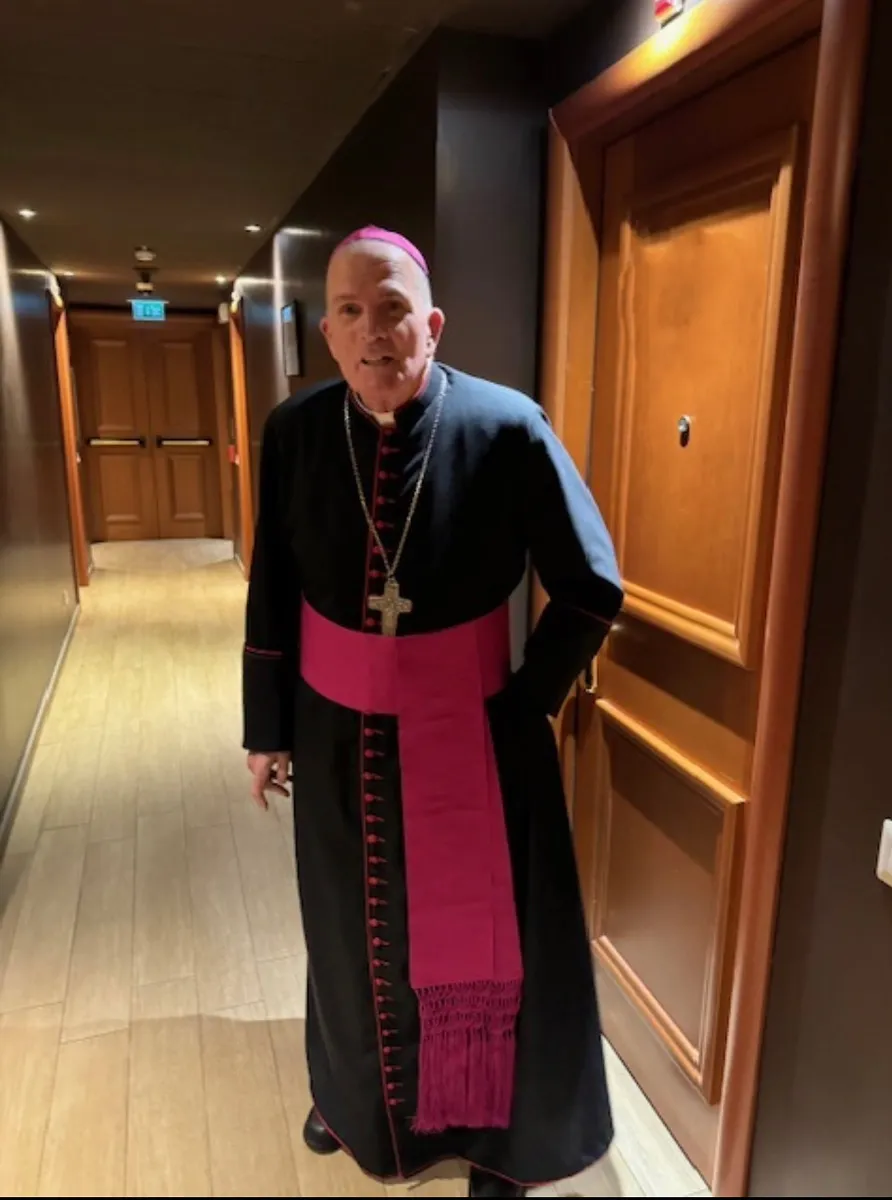
Bishop David O’Connell after his release from the hospital. Credit: TrentonMonitor.com staff photo
“He also gratefully acknowledged that he has received hundreds of get well wishes from throughout the diocese and the wider Church. He again thanked everyone for their support and prayers,” TrentonMonitor.com reported Tuesday.
O’Connell grew up not far from Philadelphia. He is a member of the Congregation of the Mission, which is more commonly known as the Vincentians, after its founder, St. Vincent de Paul.
He served as president of The Catholic University of America from 1998 to 2010. He has served as bishop of Trenton since 2010.
In December 2014, O’Connell had the lower part of his left leg amputated because of recurring infections caused by diabetes.
The bishop went to Italy recently to lead a pilgrimage of 20 priests and two lay diocesan staff members to holy sites in Rome and Assisi.
He plans to return to New Jersey later this week with the other pilgrims and there continue his recovery and rehabilitation.
If you value the news and views Catholic World Report provides, please consider donating to support our efforts. Your contribution will help us continue to make CWR available to all readers worldwide for free, without a subscription. Thank you for your generosity!
Click here for more information on donating to CWR. Click here to sign up for our newsletter.
A Vatican flag, with the incorrect design likely drawn from Wikipedia, and the dome of St. Peter’s Basilica. / Bohumil Petrik/ACI
St. Louis, Mo., Apr 8, 2023 / 13:00 pm (CNA).
The flag of Vatican City, with its distinctive yellow and white, is instantly recognizable to many Catholics. Likely far fewer people, though, have scrutinized the papal coat of arms on the right-hand side, instead taking the intricate design — which includes famous crossed keys — for granted.
As it turns out, there’s a good chance that the coats of arms on many of the Vatican flags you’ve seen out in the world are rendered incorrectly. And it took until 2023 for the internet to start taking notice.
Imagine you wanted to print your own version of the Vatican flag. Where would you go to find a high-quality picture of one? If you’re like most internet users, your first stop would probably not be the Vatican’s official (but admittedly outdated) vatican.va website. You’re probably going to pull up Wikipedia, one of the world’s most visited websites and an endless storehouse of free image content. Flagmakers the world over appear to have done so over the years.
Imagine many people’s surprise, then, to discover that the image of the “Flag of Vatican City” displayed on Wikipedia has been wrong several times over the years, most recently from 2017 to 2022. (It was also wrong from 2006–2007.)
What is “wrong” about these flags, you might ask? It’s a small detail in the grand scheme of things but easy to spot once you know about it. The erroneous Wikipedia file includes a red disk at the bottom of the papal tiara as well as a different shade of yellow on portions of the coat of arms.
The anonymous Wikipedia editor who changed the look of the flag in 2017 wrote that he or she did so for “color correction” purposes, noting that the Vatican’s coat of arms includes the red at the bottom of the tiara. The only problem? The Vatican’s official flag design renders the coat of arms differently, with the circular bottom of the tiara in white.
The image was reverted to the correct one in 2022, but the damage was done. A casual internet search will turn up dozens of Vatican flags for sale that clearly used the incorrect image downloaded from Wikipedia. The incorrect flag has even made its way into emojis. (This whole situation gained attention last month after a Reddit user made a post about it.)
An inexpensive Vatican flag available for sale on Amazon that makes use of the incorrect Wikipedia flag design. Amazon/Screenshot
Father William Becker, pastor at St. Columbanus Parish in Blooming Prairie, Minnesota, read the Reddit post with interest and amusement. Becker, a self-described “flag guy,” has studied the Vatican flag for years and even wrote an entire book about it. He has fond memories of raising the yellow and white colors over his alma mater, the North American College in Rome.
Becker told CNA that the saga of the Vatican flag on Wikipedia demonstrates a need for the Vatican to step in and clarify exactly what its flag should look like, especially considering the fact that Catholic churches all over the world display the Vatican flag.
It was precisely this lack of clarity on the official design of the Vatican flag that led Becker to create a website detailing, as best as he could, the correct design for the flag.
“Cultural communities in general have turned to flags in a stunning way,” Becker commented, citing in part a proliferation of cheaply made, mass-produced flags. And, anecdotally, there seems to be an ever-increasing interest in the Vatican flag as a way for Catholics to claim an identity, whether by flying a flag at home, waving it at a papal event, or by putting one in their social media profile picture.
The Vatican flag. Bohumil Petrik/CNA
Perhaps surprisingly, the Vatican flag is less than 100 years old, as is Vatican City itself. For more than a millennium before 1870, the pope ruled over the Papal States, large regions mainly within present-day Italy. After the Vatican lost control of the Papal States, it found itself a tiny island surrounded by an acrimonious Italy. It took nearly 60 years until the ratification of the Lateran Accords of 1929 ushered in harmony between the Vatican and Italy, and the creation of the world’s smallest sovereign country.
In the days of the Papal States, many different flags were used, but the yellow and white color scheme was a common feature. Becker said the modern design was first used by the merchant fleet in the Papal States from 1825 to 1870. In 1929, that design was chosen as the new flag of Vatican City, the sovereign country.
“It took a while in 1929 to get some flags made. The techniques of mass production weren’t available yet, and so it would have been a matter of sewing up some flags and fitting out buildings with flag staffs,” Becker noted, saying that during this time and for years afterward there was quite a bit of variation between the Vatican flags people flew, perhaps even more so than today.
“That’s kind of common with other countries too, especially those that don’t really take pains to standardize their design. [Nowadays] a flagmaker is likely to go to a source like Wikipedia, and it may vary in its accuracy,” Becker told CNA.
The same flag chosen in 1929 was reconfirmed in a revised Vatican constitution, issued by Pope John Paul II in 2000. The original Vatican flag was actually square, as indeed the official version is today. Since roughly the 1960s, though, buildings began to fly oblong state flags that followed Italy’s flag proportions, probably because most Vatican flags at the time were mass-produced there.
The flag has special significance beyond the walls of Vatican City as a marker for the Vatican’s extraterritorial properties, of which there are more than a dozen. These properties, which include major basilicas such as St. Paul Outside the Walls and St. Mary Major, are marked as the Vatican’s through their flying of the papal flag.
Becker said he hopes his website will serve as a helpful resource for anyone looking for the exact Vatican flag design, at least until the Vatican issues some kind of clarification on what exactly the flag should look like.
“The papal flag is interesting because on the one hand, the Vatican is such a small state, but the papal flag is seen all over the world. Anywhere there’s a Catholic church, you might be likely to run into a papal flag,” he said.
“It would be nice if somebody at the Holy See could, through their website or wherever, make some design specifications more available … design specifications that manufacturers could rely on a bit more.”
Cardinal Joseph Zen. / Yung Chi Wai Derek/Shutterstock.
Washington, D.C. Newsroom, May 22, 2022 / 11:08 am (CNA).
Pope Francis on Sunday said he is praying for the Church in China and “attentively and actively following the often complex life a… […]
Pilgrims pray in front of St. Peter’s Basilica / Hannah Brockhaus/CNA
Rome, Italy, May 26, 2022 / 08:37 am (CNA).
When St. Philip Neri came to Rome from Florence in 1533, he encountered a city in upheaval. The Sack of Rome six years prior had left famine and plague in its wake. The Protestant Reformation was in full swing and the Church was rife with corruption.
The young Philip, who would spend around 16 years in Rome as a layman before becoming a priest, soon dedicated himself to caring for the city’s sick and poor.
The saint, whose feast day falls on May 26, also realized that Rome’s people were suffering from a spiritual sickness and tiredness as well, and so he set out to reinvigorate Catholics with the joy of the faith through song and dance — and jokes.
A historic illustration of the seven churches. Hannah Brockhaus/CNA
Part of St. Philip’s outreach was the revival of the Seven Churches visit. He may not be the originator of the idea of the pilgrimage to some of Rome’s most important churches, but he is credited with renewing its popularity.
After it fell out of use once again, St. Philip’s congregation of secular priests, the Oratory, revived it in the 1960s, including holding the walk one night each year, as close as possible to the way the saint would have done it.
Fr. Maurizio Botta, who led the pilgrimage, speaks at the start in front of Chiesa Nuova. Hannah Brockhaus/CNA
After a two-year pause, on the evening of May 13 into the morning of May 14, around 800 people walked 15 and a half miles in the footsteps of the saint and his followers.
Police officers in cruisers drove ahead of the urban pilgrimage to block traffic as a sea of Catholics from around Italy crossed busy intersections and passed Friday night diners while praying the rosary in unison and singing the Taizé chant “Laudate Dominum,” whose words say in Latin, “Praise the Lord, all people, Alleluia.”
Pilgrims, including scouts, walk through Rome’s Ostiense neighborhood. Hannah Brockhaus/CNA
The rosary was prayed four times during the pilgrimage, which took almost 10 hours to complete, including stops for a sack dinner at midnight and short lessons on the virtues led by priests of the Oratory.
Pilgrims, including scouts, walk through Rome’s Ostiense neighborhood. Hannah Brockhaus
The seven basilicas were chosen by the saint for their importance to Christianity, and the walk on May 13-14 followed the path laid out in a 16th-century document almost certainly seen and used by St. Philip — and likely even written by him.
This document, recreated and printed into a booklet for use on the annual pilgrimage today, gives St. Philip’s guidance for those making the Seven Churches visit.
Eating a sack dinner in the courtyard of a church. Hannah Brockhaus/CNA
“Before setting out to make this holy Pilgrimage, each of the Brethren must lift up his mind to God, offering him the sincerity of his heart, with the purpose of desiring the sole glory of his divine Majesty in all actions, and especially in this one,” it says.
Those participating can also earn an indulgence under the usual conditions, and are asked to pray for specific intentions. These include praying for the penance of sins, the amendment of lukewarmness and negligence in the service of God, in thanksgiving for the forgiveness of sins, for the pope and the Church, for sinners still in the darkness of an evil life, for the conversion of heretics, schismatics, and infidels, and for the holy souls in purgatory.
Pilgrims stop to pray on the way to St. Peter’s Basilica. Hannah Brockhaus/CNA
The pilgrimage began at Chiesa Nuova, the church built by St. Philip for the Oratory, and proceeded to St. Peter’s Basilica, reaching the site of St. Peter’s martyrdom at sunset.
Pilgrims walk on a path next to the Tiber River. Hannah Brockhaus/CNA
Each of the seven churches is associated with a moment of Christ’s Passion and Crucifixion. At each stop, an Oratory priest preached on a virtue and its opposing vice, before everyone joined in a prayer for an increase in that virtue and for the gifts of the Holy Spirit.
The virtues and vices were abstinence against gluttony, patience against ire, chastity against lust, generosity against avarice, fervor of spirit against acedia, charity against envy, and humility against pride.
A street sign marking Seven Churches Way. Hannah Brockhaus/CNA
After the Basilica of St. Paul, the pilgrimage followed an ancient street still called Seven Churches Way to arrive at the catacombs and the Basilica of St. Sebastian, a third-century Christian martyr.
As a layman in Rome, St. Philip Neri used to visit the catacombs of St. Sebastian to pray. One night in the catacombs, about 10 years after moving to Rome, as he prayed, a mystical ball of fire entered his mouth and went down into his chest, exploding his ribs and doubling the size of his heart with love of God.
St. Philip was changed, both physically and spiritually, by this event, which he only revealed shortly before his death.
Pilgrims outside the catacombs of St. Sebastian. Hannah Brockhaus/CNA
Pilgrims next arrived at the Domine Quo Vadis Church after a silent, moonlit walk through the ancient Appian Way Park, flanked by the silhouettes of Italian cypress trees.
The small church of medieval origin marks the spot where, according to tradition, Jesus appeared to St. Peter as he was fleeing Rome to avoid martyrdom.
Peter asked Jesus, “Domine quo vadis?” (“Lord, where are you going?”), to which Christ said, “Venio Romam iterum crucifigi,” (“I am coming to Rome to be crucified again.”) This rebuke caused Peter to turn around and face his own martyrdom.
Pilgrims walk along the ancient Aurelian Wall on their way to the Basilica of St. John Lateran. Hannah Brockhaus/CNA
The Basilica of St. Lawrence Outside the Walls was the penultimate stop. The church, which has the tomb of St. Lawrence, is located next to Rome’s Verano Monumental Cemetery, and was included among the Seven Churches by St. Philip Neri, Father Botta said, as a reminder of mortality.
Almost 2 weeks ago I went on St. Philip Neri’s 7 Churches Walk in Rome.
800 people walked over 15 miles during the 10-hour night pilgrimage.
During the last stretch, at 5:15am, we passed through Termini train station, and Francesco caught this video of the moment. pic.twitter.com/C2SPHn5yoR
— Hannah Brockhaus (@HannahBrockhaus) May 26, 2022
The final stretch of the walk passed through Rome’s main train station, Termini, where pilgrims sang the Marian antiphon “Salve Regina.”
Pilgrims walk through Termini train station singing the “Salve Regina”. Hannah Brockhaus/CNA
The pilgrimage finished shortly before 6:00 a.m. at the Basilica of St. Mary Major, the traditional end of the walk, where the “Salve Regina” hymn was sung again in honor of the Virgin Mary.
Pilgrims sing the “Salve Regina” outside the Basilica of St. Mary Major. Hannah Brockhaus/CNAA baby and his mom enjoy a moment with a new friend at the end of the pilgrimage. Hannah Brockhaus/CNAA statue of Mary on a column outside the Basilica of St. Mary Major. Hannah Brockhaus
Leave a Reply
