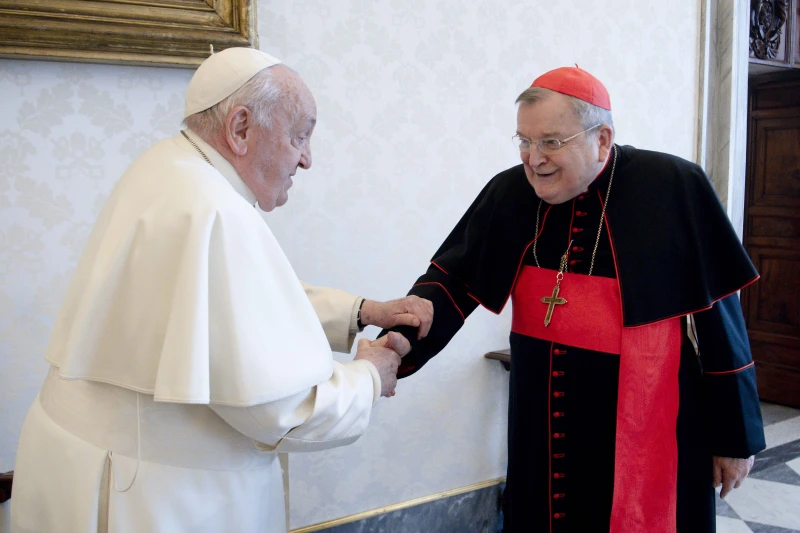
Pope Francis meets with Cardinal Raymond Burke on Dec. 29, 2023, at the Vatican. / Credit: Vatican Media
CNA Staff, Dec 29, 2023 / 09:20 am (CNA).
Pope Francis on Friday had an audience with Cardinal Raymond Burke, the Vatican said, several weeks after a flurry of reported controversy involving the pontiff and the 75-year-old U.S.-born prelate.
A release from the Holy See Press Office briefly mentioned that the pope had met with Burke in an audience on Friday morning. No reason was given for the meeting, nor were details of the audience shared by the press office.
The cardinal on Friday declined to comment on the meeting.
The meeting comes weeks after reports that Pope Francis had stripped Burke of his Vatican housing and salary privileges, with the Holy Father allegedly claiming that Burke was a source of “disunity” in the Church and that he was using the privileges afforded to retired cardinals against the Church.
Pope Francis meets with Cardinal Raymond Burke on Dec. 29, 2023, at the Vatican. Credit: Vatican Media
Francis at the end of November reportedly confirmed that he was planning to take away the prelate’s apartment and salary. The Holy Father at that time allegedly denied that he referred to Burke as his “enemy.”
Papal biographer Austen Ivereigh had written in late November that Pope Francis had told him the news concerning Burke wasn’t meant to be a public announcement but that it had been leaked to the press.
Burke has been known for his periodic disputes with some of Francis’ decisions and directives. In 2021 the cardinal released a 19-point statement regarding Pope Francis’ motu proprio Traditionis Custodes in which Burke called the Holy See’s restrictions on the Traditional Latin Mass “severe and revolutionary” and questioned the pope’s authority to revoke use of the rite.
Burke was also among the five cardinals who sent a list of dubia to the pope expressing concerns and seeking clarification on points of doctrine and discipline ahead of the October Synod on Synodality at the Vatican.
The prelates had submitted a previous version of the dubia to Francis in July, but the pope responded in full answers rather than in the customary form of “yes” and “no” replies, which prompted the cardinals to submit a revised request for clarification. The responses “have not resolved the doubts we had raised, but have, if anything, deepened them,” they said at the time.
Burke later stressed the dubia were not meant as an attack on Francis himself, stating that the queries were concerned “exclusively with the perennial doctrine and discipline of the Church, not a pope’s agenda.”
If you value the news and views Catholic World Report provides, please consider donating to support our efforts. Your contribution will help us continue to make CWR available to all readers worldwide for free, without a subscription. Thank you for your generosity!
Click here for more information on donating to CWR. Click here to sign up for our newsletter.
Members of the Sts’ailes First Nation at Holy Rosary Cathedral last year for the first Mass to integrate a First Nation language. A Cardus report presents the voices of Indigenous Canadians speaking about their faith and distinguishing it from the traditional spirituality they’re often associated with. / Photo courtesy Nicholas Elbers, 2022
Vancouver, Canada, May 17, 2023 / 14:15 pm (CNA).
A groundbreaking report published by the Ottawa-based Cardus Institute has given voice to Indigenous Canadians who are frustrated by secular society’s unawareness of — or unwillingness to accept — the fact that almost half of them are Christian.
“I find that insulting to Indigenous people’s intelligence and freedom,” Catholic priest Father Cristino Bouvette said of the prejudice he regularly encounters.
Bouvette, who has mixed Cree-Métis and Italian heritage and now serves as vicar for vocations and Young Adults in the Diocese of Calgary, was one of 12 individuals interviewed by Cardus for the report “Indigenous Voices of Faith.”
Father Deacon Andrew Bennett, left, leads a post-production discussion by Indigenous Voices of Faith participants. Photo courtesy of Cardus
Prejudice against Indigenous Christians has become so strong, even inside some Indigenous communities, “that Indigenous Christians in this country right now are living in the time of new martyrdom,” Bouvette said.
Although that martyrdom may not cost them their lives, “they are ostracized and humiliated sometimes within their own communities if they openly express their Christian or Catholic faith.”
Statistics Canada reported last year that the 2021 census found that 850,000, or 47%, of Canada’s 1.8-million Indigenous people identify as Christian and that more than a quarter of the total report they are Catholic. Only 73,000, or 4%, of Indigenous people said they adhere to traditional Indigenous spiritual beliefs.
In a new report, Cardus wants to “amplify the voices of Indigenous Canadians speaking for themselves about their religious commitments, which sometimes clash with the typical public presentation of Indigenous spirituality.” Photo courtesy of Cardus
Ukrainian Catholic Deacon Andrew Bennett, program director for Cardus Faith Communities, conducted the interviews for the think tank last fall. He published his report in March at a time when Canadian mainstream media and many political leaders continued to stir division and prejudice through misleading commentary about abandoned cemeteries at Indian Residential Schools.
The purpose of the report, he writes, “is to affirm and to shed light on the religious freedom of Indigenous peoples to hold the beliefs and engage in the practices that they choose and to contextualize their faith within their own cultures.”
Too often, however, “the public narrative implies, or boldly declares, that there’s a fundamental incompatibility between Indigenous Canadians and Christianity or other faiths,” Bennett said. “[M]any Indigenous Canadians strongly disagree with those narratives.”
Father Bouvette is clearly one of those.
“We did not have Christian faith imposed upon us because of [my Indigenous grandmother’s] time in the residential school or her father’s time in the trade school that he was sent to,” Bouvette said. “No, it was because our family freely chose to receive the saving message of Jesus Christ and lived it and had continued to pass it down.”
Bouvette said his “grandmother was not tricked into becoming something that she didn’t want to be, and then tricked into staying that way for 99 years and 11 months of her life. She was a Christian from the day of her birth, and she remained a Christian until the day of her death. And so that was not by the consequence of some imposition.”
Nevertheless, Canadians continue to labor under a prejudice holding the opposite view. “I do believe that probably the majority of Canadians at this time, out of some mistaken notion of guilt for whatever their cultural or ethnic background is, think they are somehow responsible for Indigenous people having had something thrust upon them that they didn’t want,” Bouvette said.
“We did not have Christian faith imposed upon us,” Father Cristino Bouvette says in a Cardus report on Indigenous faith. Photo courtesy of Cardus
“But I would say, give us a little more credit than that and assume that if there is an Indigenous person who continues to persevere in the Christian faith it is because they want to, because they understand why they have chosen to in the first place, and they remain committed to it. We should be respectful of that.”
The executive director of the Catholic Civil Rights League, Christian Elia, agrees and says society should grant Indigenous Catholics the respect and personal agency that is due all Canadians.
“Firstly, I am not an Indigenous person, so I cannot speak for our Indigenous brothers and sisters, but neither can non-Indigenous secularists who choose to ignore that Indigenous people in Canada continue to self-identify as Christian, the majority of these Catholic,” Elia said in an interview with The B.C. Catholic.
He said his organization has heard from many Indigenous Catholics who are “growing weary of the ongoing assumption that somehow they have been coerced into the faith, that it is inconceivable that they wish to be Catholic. This condescending attitude must stop.”
Deacon Rennie Nahanee, who serves at St. Paul’s Indian Church in North Vancouver, was another of the 12 whom Bennett interviewed. A cradle Catholic and member of the Squamish First Nation, Deacon Nahanee said there is nothing incompatible with being both an authentic Indigenous person and a Catholic.
“I’m pretty sure we had a belief in the Creator even before the missionaries came to British Columbia,” he said. “And our feelings, our thoughts about creation, the way that we lived and carried out our everyday lives, and the way that we helped to preserve the land and the animals that we used for food, our spirituality and our culture, were similar to the spirituality of the Catholic Church.”
“I believe that’s why our people accepted it. I don’t think anybody can separate themselves from God, even though they say so.”
Interviewed later by The B.C. Catholic, Nahanee said he is not bothered by the sort of prejudice outlined by Bouvette. “People are going to say or do what they want,” he said.
Voices of Indigenous Christianity
Bennett, program director of Cardus Faith Communities, interviewed 12 Indigenous Canadians, most of them Christian, about their religious commitments, “which often clash with the typical public presentation of Indigenous spirituality.” Here is a selection of some of their comments:
Tal James of the Penelakut First Nation in Nanaimo spoke about the relationship between Indigenous culture and his Christian faith:
Tal James and wife Christina. Photo courtesy of Project 620 – James Ministry
“I think … that our [Indigenous] cultures were complete, and in Jesus they’re more complete. I think that’s a big thing and a big step for a lot of us. You’re going to have a lot of non-Indigenous people look at you and question your actions based on your Aboriginal heritage. Don’t take that to heart. They’re the ignorant ones who don’t want you to flourish. Those of you who are Christians, First Nations Christians, you come to the table with the same gifting that non-Aboriginal people have. For them to say, ‘We want to make room for you at the table,’ correct them. You are already at the table, and encourage them to step back and allow your gifts to flourish. Because it’s one in the same spirit.”
Rose-Alma McDonald, a Mohawk from Akwesasne, which borders New York, Ontario, and Quebec, talked about re-embracing her Catholic faith:
Rose-Alma McDonald. Photo courtesy of Cardus
“I surprised everybody, including myself, in terms of embracing Catholicism after 20 years away. So I’ve had a few epiphanies in the sense that this is why my mother made me do so much in the church growing up. When I’m working, volunteering, and doing stuff in the church, I remember that. I keep remembering I’m Catholic and I’m still Catholic. I will stay Catholic because of the way I was raised.”
Jeff Decontie, a Mohawk from the Algonquin First Nations who lives in Ottawa, talked about being a person of faith in a secular world:
Jeff Decontie. Photo courtesy of Cardus
“Secular worldviews can sort of eat up everything around them and accept a whole wide range of beliefs at the same time. For example, you have the prevailing scientific thinking alongside New Age believers, and people in society just accept this, saying, ‘Oh, whatever it is you believe in, all religions lead to the same thing.’ No one questions it. How can these contradictions coexist? … Then we ask an [Indigenous] elder to lead prayer? Any other religion would be a no-no, but you can ask for an elder who’s going to pray a generic prayer to some generic Creator, and it’s not going to ruffle any feathers. I think that’s the danger of secular thought creeping into Canada: It goes unnoticed, it’s perceived as neutral, but at the same time it’s welcoming a whole wide range of beliefs. And it doesn’t just influence Indigenous thought. It’s influencing Christianity.”
Rosella Kinoshameg, a member of the Wikwemikong Reserve on Manitoulin Island in Ontario, spoke about being Indigenous and Catholic:
Rosella Kinoshameg. Photo courtesy of the Catholic Register
“Well, I can’t change being Indigenous. That’s something that is me. I can’t change that. But to believe in the things that I was taught, the traditional things, the way of life and the meanings of these things, and then in a church, well, those things help one another and they make me feel stronger.”
This article was originally published May 10, 2023, in The B.C. Catholic, a weekly publication serving the Catholic community in British Columbia, Canada, and is reprinted here on CNA with permission.
CNA Staff, May 8, 2020 / 10:25 am (CNA).- Archbishop Carlo Maria Viganò has accused a Vatican cardinal of causing him “serious harm” in a bitter war of words over a controversial open letter regarding the coronavirus crisis.
In a statement published May 8, the archbishop criticized Cardinal Robert Sarah’s decision to distance himself from the letter, titled “Appeal for the Church and the World,” which argues that the coronavirus pandemic has been exploited in order to create a one-world government.
The statement details Vigano’s account of his interactions with Sarah beginning May 4. Viganò claims that on the evening of May 7, the prefect of the Vatican’s Congregation for Divine Worship and Sacraments asked him to remove him from the list of signatories to the letter, which had by that time already been published.
“With surprise and deep regret,” he wrote, “I then learned that His Eminence had used his Twitter account, without giving me any notice, to make statements that cause serious harm to the truth and to my person.”
Viganò was referring to a series of three May 7 tweets from Sarah, which said: “A Cardinal Prefect, member of the Roman Curia has to observe a certain restriction on political matters. He shouldn’t sign petitions in such aereas [sic].”
“Therefore this morning I explicitely [sic] asked the authors of the petition titled ‘For the Church and for the world’ not to mention my name.”
“From a personal point of view, I may share some questions or preoccupations raised regarding restrictions on fundamental freedom but I didn’t sign that petition,” Sarah added.
Viganò’s statement continued: “I am very sorry that this matter, which is due to human weakness, and for which I bear no resentment towards the person who caused it, has distracted our attention from what must seriously concern us at this dramatic moment.”
After Viganò issued his rebuke, Sarah tweeted May 8: “I will not speak to this petition, which today seems to occupy a lot of people. I leave to their conscience those who want to exploit it in one way or another. I decided not to sign this text. I fully accept my choice.”
In his statement, Viganò said he had chosen to publicize his private conversations with Sarah because he had a duty to tell the truth, and “also for the sake of fraternal correction.”
Vigano said Sarah had initially told him: “Yes, I agree to put my name to it, because this is a fight we must engage in together, not only for the Catholic Church but for all mankind.”
He confirmed that Sarah’s signature has now been removed from the open letter.
Vigano, a former papal nuncio made headlines in August 2018, for a letter that alleged Vatican officials had ignored warnings about the sexual abuse of disgraced former cardinal Theodore McCarrick. Since that time, Vigano has released numerous letters expressing his viewpoints on matters in the Church, which include criticisms of Pope Francis and other curial officials.
The appeal argued that as a result of the pandemic centuries of Christian civilization could be “erased under the pretext of a virus” and an “odious technological tyranny” established in its place.
It said: “We have reason to believe, on the basis of official data on the incidence of the epidemic as related to the number of deaths, that there are powers interested in creating panic among the world’s population with the sole aim of permanently imposing unacceptable forms of restriction on freedoms, of controlling people and of tracking their movements. The imposition of these illiberal measures is a disturbing prelude to the realization of a World Government beyond all control.”
Several bishops and cardinals are alleged to have signed the letter. Bishop Joseph Strickland of Tyler, Texas told CNA May 7 that he had signed it.
A press release on the appeal’s website May 8 claimed that Robert Kennedy Jr, son of the slain US. Presidential candidate Sen. Robert Kennedy, had signed the letter.
To date, nearly 4 million people have tested positive for the coronavirus, and at least 272,000 have died.
Marcin Bogacki of Warsaw, Poland (far right) prays before walking through the Holy Door of St. Peter’s Basilica with his mother and 4-year-old son on Feb. 21, 2025. / Credit: Hannah Brockhaus/CNA
Vatican City, Feb 21, 2025 / 11:20 am (CNA).
Local Catholics and jubilee pilgrims in Rome are praying for Pope Francis’ recovery as he marks one week in the hospital for treatment for pneumonia.
Pilgrim groups and individuals from around the world continue to travel to Rome for the 2025 Jubilee Year, and though they won’t catch a glimpse of the pontiff, he is close to their hearts.
As they prepared to walk through the Holy Door of St. Peter’s Basilica, a group of about 50 pilgrims from Our Lady of Nantes Parish in France told CNA they are praying for the pope’s full recovery.
A group of pilgrims from France pray for Pope Francis on Rome on Friday, Feb. 21, 2025, as the pontiff remains in the hospital battling pneumonia. Credit: Hannah Brockhaus/CNA
The group was planning to attend the Angelus with the pope on Feb. 23, but now, “we pray for him and we hope that everything will be OK,” seminarian Aymeric Dor said.
Dor recalled that one of the conditions to receive the Holy Door plenary indulgence is to pray for the pope’s intentions, which he said they are doing: “We are praying for his health too.”
Agata Eccli, who is part of a pilgrimage of 57 people from different parishes and towns in Poland, said her group is not only praying for Pope Francis during their visit to St. Peter’s Basilica but also at each of the stops they make on an Italy-wide pilgrimage, including the tomb of St. Anthony in Padua, St. Francis in Assisi, St. Peter in Rome, and St. Pio of Pietrelcina in San Giovanni Rotondo.
A group of Polish pilgrims prays for Pope Francis as he marks one week in the hospital in Rome on Friday, Feb. 21, 2025. Credit: Hannah Brockhaus/CNA
Families are also keeping the ailing pontiff in their prayers, including Italian couple Andrea Paradisi and Chiara Costa, who brought their 4-month-old baby Margherita on a pilgrimage to Rome over the weekend for the jubilee.
Marcin Bogacki of Warsaw, Poland, told CNA he has fond memories of visiting Rome as a child during the Jubilee Year in 2000 and wanted to have the same experience with his own young family.
Though his wife is expecting their second child and was unable to fly at this time, Bogacki brought his mother and his 4-year-old son. He said they are praying for Pope Francis, for the Church, for a private family intention, and for his wife and their unborn baby.
Rome prays
Across Rome, local Catholics are offering Masses and special prayers for Pope Francis’ health.
The chaplain of Gemelli Hospital — where the pontiff is receiving treatment — is offering Mass for Francis every day at 1 p.m. in the hospital’s chapel.
On Feb. 22, the feast of the Chair of St. Peter — a day that commemorates the authority Jesus gave to the pope — a group of Catholics will gather outside Gemelli Hospital to pray a rosary for the pope’s health.
At the Basilica of St. Mary Major, every Mass is being offered for the pope, the basilica’s communications director told CNA, including Masses celebrated in the chapel of the ancient Salus Populi Romani image of Mary — a favorite of Francis, who spends time in prayer in the chapel before and after every international trip.
One can only hope and pray the meeting was more than just for show, that Burke could talk some sense into him, but I doubt it. Probably just another calculated act to give Francis apologists ammunition to say, see, you can’t claim he doesn’t listen to his critics.
Mm. Very interesting. Of course nothing to do with blowback to FS.
I’ll stay tuned.
One can only hope and pray the meeting was more than just for show, that Burke could talk some sense into him, but I doubt it. Probably just another calculated act to give Francis apologists ammunition to say, see, you can’t claim he doesn’t listen to his critics.
