The Vatican Observatory together with the University of Padua have investigated eternity from new scientific perspectives. / Credit: Vatican Media
Madrid, Spain, Aug 30, 2024 / 07:00 am (CNA).
“Eternity Between Space and Time: From Consciousness to the Cosmos” is the title of an upcoming report to be released by the Vatican Observatory, where “unpublished reflections” on eternity studied from different disciplines will be presented.
The University of Padua in Italy together with the Vatican Observatory have investigated eternity from new scientific perspectives thanks to 24 contributions from some of the world’s greatest scholars in different disciplines such as physics, psychology, philosophy, and theology.
Contributors include Nobel Prize winners Gerard ‘t Hooft and Roger Penrose, joined by Federico Faggin, Mauro D’Ariano, Gabriele Veneziano, Massimo Cacciari, Giulio Goggi, and Kurt Appel.
Questions about God and consciousness are addressed alongside quantum theory, black holes, cosmic inflation, and the Big Bang and string theory, considering the contributions of neuroscience and artificial intelligence.
The report, which will be released on Sept. 6, is the result of the international conference on the theme of eternity held in May 2022 at the University of Padua.
The conference was attended by the world’s leading scholars in the fields of physics, philosophy, theology, and psychology.
The presentation of the report will take place at the headquarters of the Curia General of the Society of Jesus in Rome and will be attended by Father Gabriele Gionti, a member of the Vatican Observatory Research Group; Fabio Scardigli, Polytechnic University of Milan; Ines Testoni, University of Padua; and Father Andrea Toniolo, faculty of theology of Triveneto, Padua, Italy.
This story was first published by ACI Prensa, CNA’s Spanish-language news partner. It has been translated and adapted by CNA.
If you value the news and views Catholic World Report provides, please consider donating to support our efforts. Your contribution will help us continue to make CWR available to all readers worldwide for free, without a subscription. Thank you for your generosity!
Click here for more information on donating to CWR. Click here to sign up for our newsletter.
St. Louis, Mo., Dec 17, 2022 / 09:00 am (CNA).
This Saturday, Dec. 17, is a special day in the Catholic Church, though relatively few Catholics probably realize it. Saturday is an ember day, a day traditionally set … […]
Men ride mules in Via della Conciliazione as they take part in the feast of San Antonio Abate (St. Anthony the Abbot), the patron saint and protector of animals, in Piazza Pio XII in front of the Vatican, in Rome on Jan. 17, 2025. Italian farmer… […]
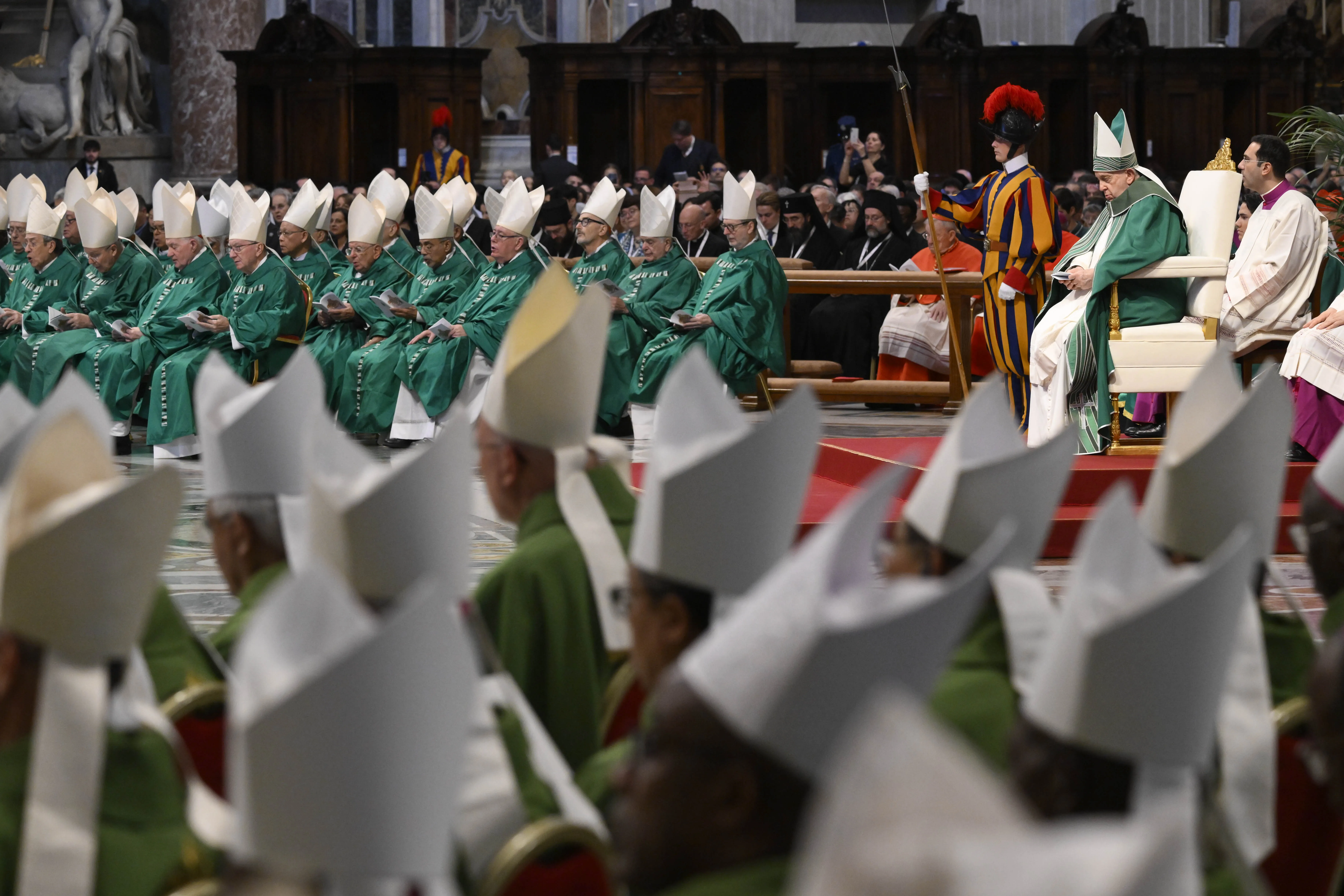
Bishops process into St. Peter’s Basilica for the closing Mass of the first assembly of the Synod on Synodality on Oct. 29, 2023. / Vatican Media
Vatican City, Oct 29, 2023 / 07:30 am (CNA).
At the Synod on Synodality’s closing Mass, Pope Francis said that God’s love cannot be confined “to our own agenda” and that those who truly want to reform the Catholic Church should follow Jesus’ greatest commandment: to adore God and love others with his love.
“We may have plenty of good ideas on how to reform the Church, but let us remember: to adore God and to love our brothers and sisters with his love, that is the great and perennial reform,” Pope Francis said in St. Peter’s Basilica on Oct. 29.
“We are always at risk of thinking that we can ‘control God,’ that we can confine his love to our own agenda. Instead, the way he acts is always unpredictable, it goes beyond, and consequently, this action of God demands amazement and adoration,” he added.
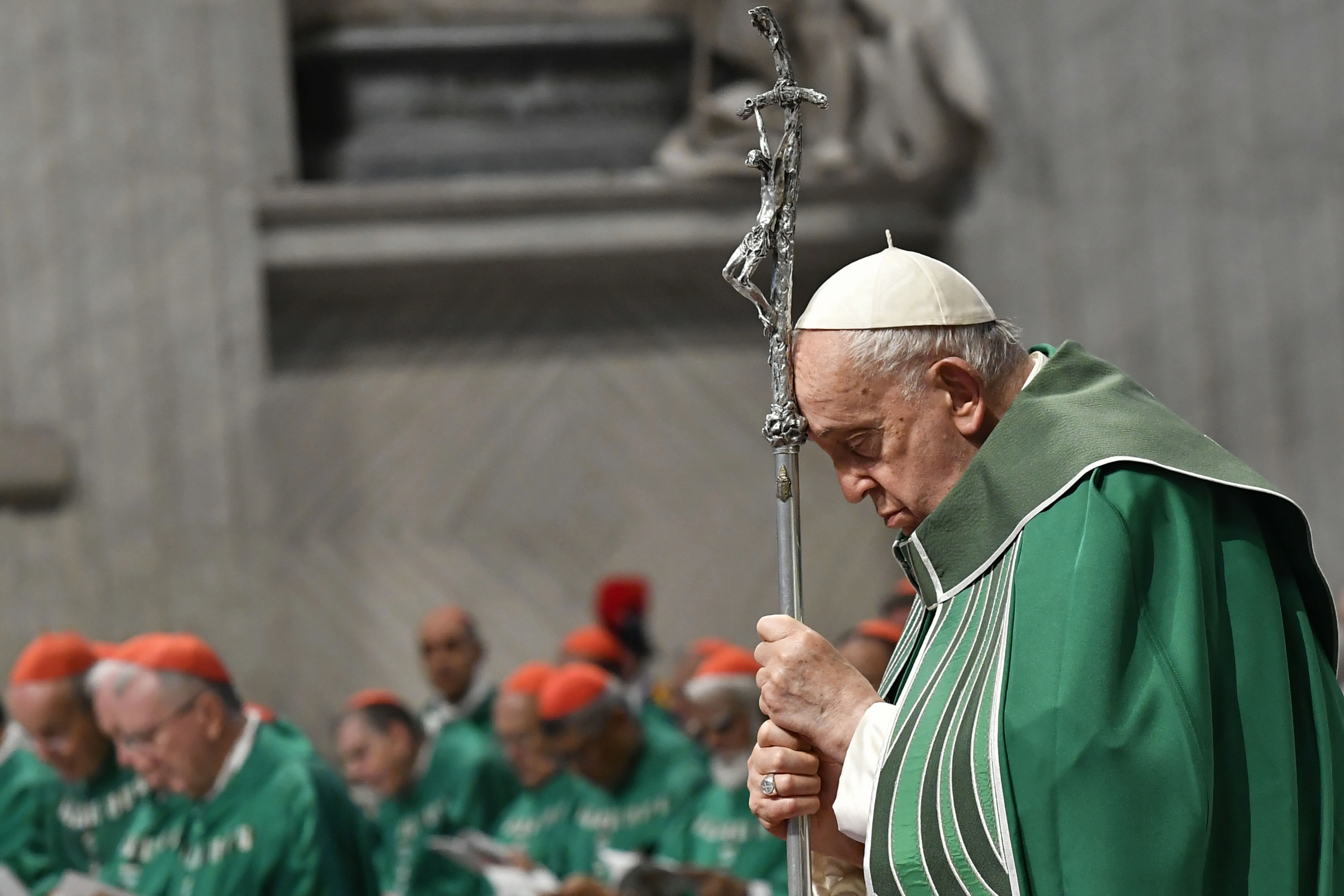
Pope Francis at the Synod on Synodality’s closing Mass in St. Peter’s Basilica on Oct. 29, 2023. Vatican Media
The pope underlined that worship of Jesus in the tabernacle “in every diocese, in every parish, in every community” is necessary in the “struggle against all types of idolatry” in today’s world.
“Let us be vigilant, lest we find that we are putting ourselves at the center rather than him. And let us return to worship. May worship be central for those of us who are pastors: let us devote time every day to intimacy with Jesus the Good Shepherd in the tabernacle. Adoration,” he said.
“Only in this way will we turn to Jesus and not to ourselves. For only through silent adoration will the Word of God live in our words; only in his presence will we be purified, transformed, and renewed by the fire of his Spirit. Brothers and sisters, let us adore the Lord Jesus!”
Pope Francis at the Synod on Synodality’s closing Mass in St. Peter’s Basilica on Oct. 29, 2023. Vatican Media
“Brothers and Sisters, the General Assembly of the Synod has now concluded,” he said. “In this ‘conversation of the Spirit,’ we have experienced the loving presence of the Lord and discovered the beauty of fraternity.”
“Today we do not see the full fruit of this process, but with farsightedness, we look to the horizon opening up before us. The Lord will guide us and help us to be a more synodal and more missionary Church, a Church that adores God and serves the women and men of our time, going forth to bring to everyone the consoling joy of the Gospel,” Francis added.
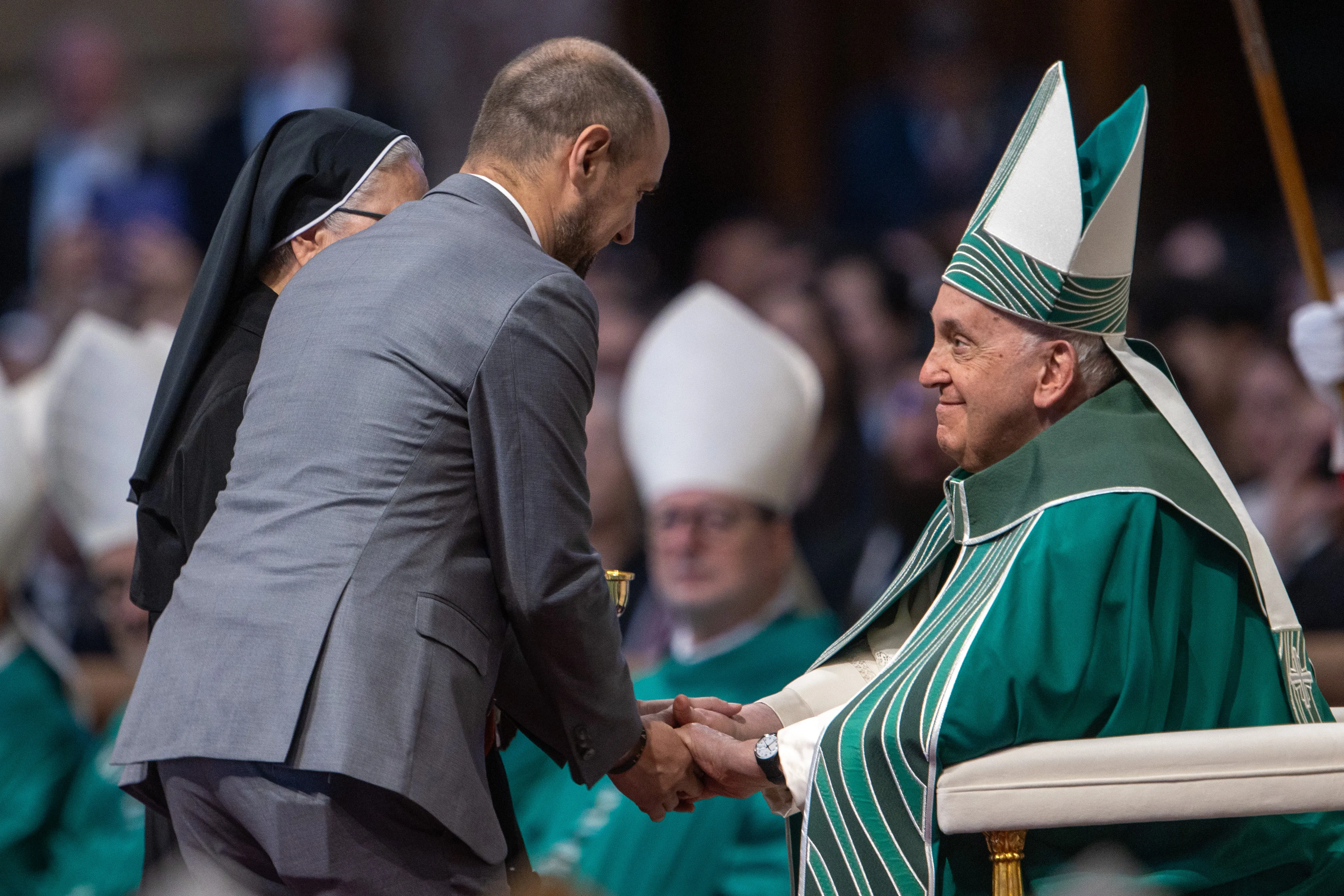
Pope Francis at the Synod on Synodality’s closing Mass in St. Peter’s Basilica on Oct. 29, 2023. Daniel Ibanez/CNA
In his homily, Pope Francis said that he believed that the conclusion of this stage in the Synod “it is important to look at the ‘principle and foundation’ from which everything begins ever anew: loving God with our whole life and loving our neighbors as ourselves.”
“Not our strategies, our human calculations, the ways of the world, but love of God and neighbor: that is the heart of everything,” he said.
Pope Francis emphasized that adoration and worship are “essential in the life of the Church.”
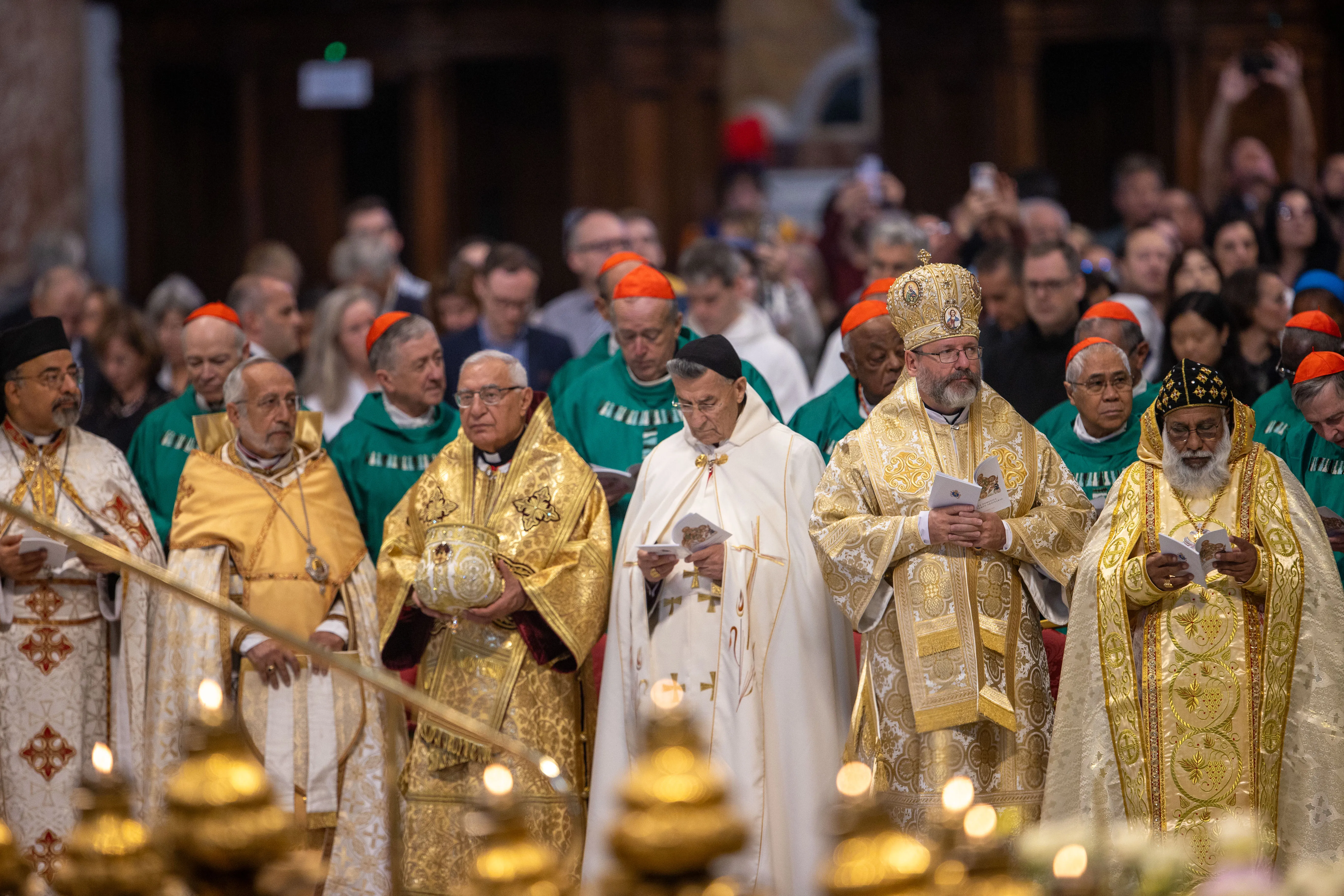
Patriarchs of the Eastern Catholic Churches at the Synod on Synodality’s closing Mass in St. Peter’s Basilica on Oct. 29, 2023. Daniel Ibanez/CNA
“To adore God means to acknowledge in faith that he alone is Lord and that our individual lives, the Church’s pilgrim way, and the ultimate outcome of history all depend on the tenderness of his love. He gives meaning to our lives,” he said.
“Those who worship God reject idols because whereas God liberates, idols enslave,” he added.
“We must constantly struggle against all types of idolatry; not only the worldly kinds, which often stem from vainglory, such as lust for success, self-centredness, greed for money — the devil enters through our pockets let us not forget — the enticements of careerism; but also those forms of idolatry disguised as spirituality: my own spirituality, my religious ideas, my pastoral skills.”
Pope Francis at the Synod on Synodality’s closing Mass in St. Peter’s Basilica on Oct. 29, 2023. Daniel Ibanez/CNA
Pope Francis said that being “a worshiping Church and a Church of service” entails “washing the feet of wounded humanity, accompanying those who are frail, weak and cast aside, going out lovingly to encounter the poor.”
Quoting St. John Chrysostom, he said: “The merciful man is as a harbor to those who are in need; and the harbor receives all who are escaping shipwreck, and frees them from danger, whether they be evil or good; whatsoever kind of men they be that are in peril, it receives them into its shelter. You also, when you see a man suffering shipwreck on land through poverty, do not sit in judgment on him, nor require explanations, but relieve his distress.”
Pope Francis at the Synod on Synodality’s closing Mass in St. Peter’s Basilica on Oct. 29, 2023. Vatican Media
About 5,000 people attended the closing Mass for the Synod on Synodality’s 2023 assembly, according to the Vatican. The Mass concluded with the congregation singing the Marian hymn “Salve Regina.”
Pope Francis thanked all of the cardinals, bishops, priests, religious, and lay people from around the world who traveled to Rome to participate in the Synod. Next year, the delegates will return to the Vatican in October 2024 to take part in the second assembly to advise the pope on the theme: “For a Synodal Church: Communion, Participation, Mission.”
“In expressing my gratitude, I would also like to offer a prayer for all of us: may we grow in our worship of God and in our service to our neighbor. Worship and Service. May the Lord accompany us. Let us go forward with joy,” Pope Francis said.
So, now, do we have another sort of synodal roundtable, this time limited to “consciousness and cosmos”?
What if human “consciousness” is never quite equivalent to the ex nihilo/radical existence (!) and reality of substantive stuff (Leibniz: “why is there anything rather than nothing?”); and what if the space-time “cosmos” is never quite equivalent to the different reality of eternity? Hopefully real metaphysics is made fully present by those versed in philosophy (which philosophy?) and theology (whose theology?). And, not simply reduced to one outnumbered chapter “alongside” two-dozen others.
Or, instead, a subliminal drift toward monism? A blurring of the reality of a self-subsistent Other known as “God” versus only our cosmic “ideas” of God?
Eternity between space and time intriguing, that it isolates the eternal as distinct from either yet in our experience the platform for both. More philosophical. A meta physical truth that is inferred by human understanding from the physical. Whereas consciousness and cosmos can lead to different venues of understanding.
Consciousness and the cosmos again pits our apprehension of the spiritual, an inference of the mind acquired by analogy. We can see the cosmos. The spiritual we cannot. It tells us the human mind is the measure of things, that which exists whether matter or spirit, and that the human mind, unlike anything it directly apprehends, speaks to eternity [in consequence immortality]. It is not subject to the essential transitions it perceives in the cosmos, rather it lasts.




So, now, do we have another sort of synodal roundtable, this time limited to “consciousness and cosmos”?
What if human “consciousness” is never quite equivalent to the ex nihilo/radical existence (!) and reality of substantive stuff (Leibniz: “why is there anything rather than nothing?”); and what if the space-time “cosmos” is never quite equivalent to the different reality of eternity? Hopefully real metaphysics is made fully present by those versed in philosophy (which philosophy?) and theology (whose theology?). And, not simply reduced to one outnumbered chapter “alongside” two-dozen others.
Or, instead, a subliminal drift toward monism? A blurring of the reality of a self-subsistent Other known as “God” versus only our cosmic “ideas” of God?
Just askin’…
Eternity between space and time intriguing, that it isolates the eternal as distinct from either yet in our experience the platform for both. More philosophical. A meta physical truth that is inferred by human understanding from the physical. Whereas consciousness and cosmos can lead to different venues of understanding.
Consciousness and the cosmos again pits our apprehension of the spiritual, an inference of the mind acquired by analogy. We can see the cosmos. The spiritual we cannot. It tells us the human mind is the measure of things, that which exists whether matter or spirit, and that the human mind, unlike anything it directly apprehends, speaks to eternity [in consequence immortality]. It is not subject to the essential transitions it perceives in the cosmos, rather it lasts.