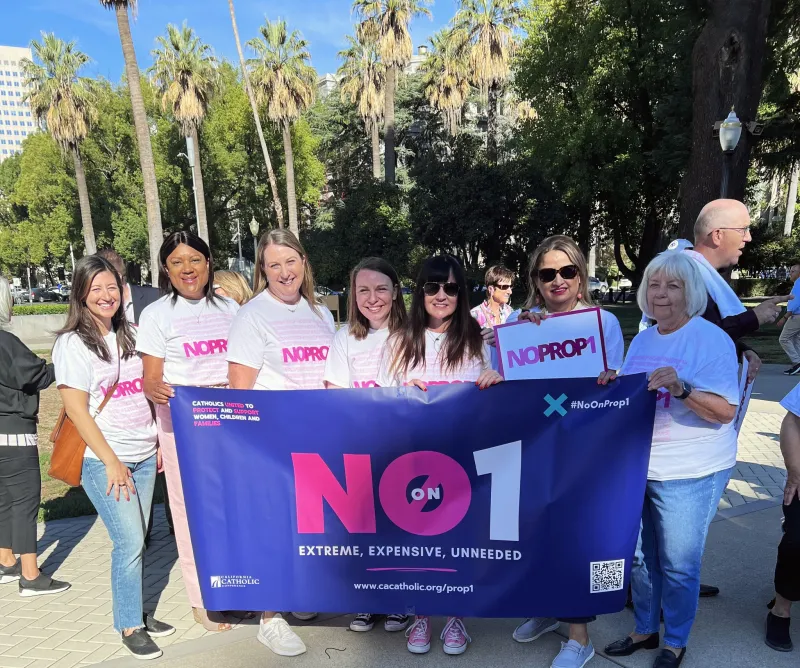
 Participants in a demonstration against Proposition 1 outside the California capitol in Sacramento, Oct. 6, 2022. / Photo courtesy of California’s No on Prop. 1 Campaign
Washington, D.C. Newsroom, Nov 9, 2022 / 09:22 am (CNA).
Ballot initiatives to protect and expand abortion passed across the nation on Election Day.
Americans in five states voted on the issue of abortion during the 2022 midterm elections. Three states — California, Michigan, and Vermont — proposed constitutional amendments to advance abortion. All three passed.
At the same time, citizens in Kentucky weighed a pro-life amendment and Montana voters considered a measure that promises to protect babies who are born alive after attempted abortions. Kentucky voted no to its pro-life measure. Montana’s results are still coming in, with a current majority voting no.
Stephen Billy, who serves as vice president of state affairs at the national pro-life group SBA Pro-Life America, early Wednesday morning stressed that life is still winning.
“Anyone arguing abortion is winning is missing what happened tonight,” he told CNA. “We had strong pro-life candidates at the federal and state level win because they seized on life as a winning issue and exposed the extreme taxpayer-funded abortion until birth policy of their opponents.”
“We know life is a winning issue, we know how to win on life, and we know the American people reject the extreme policy of Planned Parenthood and their candidates,” he added. “Going forward, we have to do better at using our winning strategy and using it to fight back against the millions of dollars Big Abortion puts into ballot initiatives to cause confusion and hide their extreme policy. When the voters see the abortion industry pushing abortion on demand, they reject it — and if we focus on exposing that extreme policy we will win.”
The ballot measures on Election Day follow the Supreme Court’s June decision in Dobbs v. Jackson Women’s Health Organization, which overturned Roe v. Wade and freed states to legislate on abortion. They also come after a pro-life amendment recently failed in Kansas.
California: Proposition 1
Proposition 1 will amend California’s constitution to explicitly protect abortion after citizens voted to pass it.
As of mid-Wednesday morning, the New York Times reported that 65.1% voted yes to Proposition 1 and 34.9% voted no, with 41% of the votes in.
Following the election results, Catherine Hadro, director of media relations for California’s No on Proposition 1 campaign, stressed a disconnect between what Proposition 1 allows and what California voters support.
“We know that more than 80% of Californians reject late-term abortion. They oppose late-term abortion,” she previously told CNA. “And that’s exactly what Proposition 1 would allow.”
The proposition reads: “The state shall not deny or interfere with an individual’s reproductive freedom in their most intimate decisions, which includes their fundamental right to choose to have an abortion and their fundamental right to choose or refuse contraceptives.”
California currently allows abortion for any reason before viability, when a baby can survive outside the womb — generally considered to begin around 24 weeks of pregnancy. After viability, California allows abortion when a woman’s life or health is threatened.
The California Catholic Conference encouraged pro-life voters to say “no” to Proposition 1, calling it “an expensive and misleading ballot measure that allows unlimited late-term abortions — for any reason, at any time, even moments before birth, paid for by tax dollars.”
A campaign for the amendment led by pro-abortion groups, called Yes on Proposition 1, argued that Proposition 1 would “ensure that, in California, people continue to have the power to control their own bodies and personal decisions.”
Michigan: Proposal 3
Michigan’s proposed constitutional amendment, Proposal 3, will advance abortion in that state.
As of mid-Wednesday morning, the New York Times reported that 56% voted yes to the proposal and 44% voted no, with 87% of the votes in.
On the ballot, the amendment is identified as a “proposal to amend the state constitution to establish new individual right to reproductive freedom, including right to make all decisions about pregnancy and abortion; allow state to regulate abortion in some cases; and forbid prosecution of individuals exercising established right.”
In Michigan, women can obtain abortions for any reason before viability. After viability, abortion is permitted to save the woman’s life.
The Citizens to Support MI Women and Children coalition, which includes the Michigan Catholic Conference, advised pro-life citizens to vote no on the amendment. The group said it would “radically distort Michigan’s Constitution to create a new unlimited right to abortion.”
“This poorly-worded amendment would repeal dozens of state laws, including our state’s ban on tax-funded abortions, the partial-birth abortion ban, and fundamentally alter the parent-child relationship by preventing parents from having input on their children’s health,” the group said.
In support of the amendment, Reproductive Freedom for All argued that “in addition to ensuring access to a broad range of reproductive health care, this amendment would make sure no one goes to prison for providing safe medical care.”
Vermont: Article 22/Proposal 5
In Vermont, citizens voted to pass the constitutional amendment Article 22, also known as Proposal 5, which promotes abortion.
As of mid-Wednesday morning, the New York Times reported that 77.4% voted yes to the proposal and 22.6% voted no, with more than 95% of the votes in.
It reads: “That an individual’s right to personal reproductive autonomy is central to the liberty and dignity to determine one’s own life course and shall not be denied or infringed unless justified by a compelling State interest achieved by the least restrictive means.”
Abortion is legal up until birth in the state.
The Roman Catholic Diocese of Burlington, which includes the entire state of Vermont, published a piece in its diocesan bulletin warning that the amendment “promises to enshrine unlimited, unregulated abortion throughout all nine months of pregnancy in our state’s founding document” and “would permanently block any attempt to protect the unborn — even those who can survive outside the womb.”
Vermont Right to Life Committee urged citizens to vote no.
Led by pro-abortion groups, Vermont for Reproductive Liberty Ballot Committee argued: “We need this amendment because important medical decisions should be guided by a patient’s health and well-being, not by a politician’s beliefs.”
Kentucky: Amendment 2
Kentucky voted against a pro-life measure — Amendment 2 — which says the state’s constitution does not protect abortion.
As of mid-Wednesday morning, the New York Times reported that 52.6% voted no to the amendment and 47.4% voted yes, with 88% of the votes in.
It reads: “To protect human life, nothing in this Constitution shall be construed to secure or protect a right to abortion or require the funding of abortion.”
Kentucky currently prohibits abortion with exceptions for saving a woman’s life or preventing serious risk to her physical health.
The Yes for Life alliance, which includes the Catholic Conference of Kentucky, asked pro-life citizens to vote yes. The group said that the amendment’s language “will prevent state judges from asserting their own preferences over the will of legislators and the voters.”
Opposing the amendment, the Protect Kentucky Access coalition claimed that the amendment would “pave the way for the state to ban abortion in all cases.”
Montana: Legislative Referendum 131 (LR-131)
Voters in Montana considered Legislative Referendum 131, which says it will protect babies who are born alive after attempted abortions.
As of Wednesday morning, the New York Times reported that 52.6% voted no to the amendment and 47.7% voted yes, with 80% of the votes in.
It reads: “An act adopting the born-alive infant protection act; providing that infants born alive, including infants born alive after an abortion, are legal persons; requiring health care providers to take necessary actions to preserve the life of a born-alive infant; providing a penalty; providing that the proposed act be submitted to the qualified electors of Montana; and providing an effective date.”
Montana law allows abortion before viability. Abortion is also permitted after viability to save a woman’s life or prevent serious risk to her physical health.
SBA Pro-Life America’s Katie Glenn previously told CNA that she found the ballot initiative in Montana — a state she said has been getting progressively more pro-life — the most interesting.
“I think that one’s different than the other four, which are all very much time-gestational bans, in that this is not a pro-life/pro-choice issue,” she said. “This is about providing lifesaving care to a child who’s already been born.”
Opposing the referendum, Compassion for Montana Families claimed that it “would introduce extreme penalties for medical providers who, at the family’s request, do not take a dying infant away from its parents in order to perform invasive and even painful medical treatments in tragic circumstances where they have no chance of survival.”
[…]






What steps does the Spirit invite us to take in order to grow in our ‘journeying together?
Encourage the Traditional Latin Mass and more Pro Life/Pro Family support from the clergy especially Pope Francis and the Vatican.
We read: “When you think about it being a 41-page document, how are we going to consult people? Are they going to read 41 pages?” Well, a good place to START might be Part I:5, Proposal “o” which reads in part:
“From the work of the Assembly, there is the call for better knowledge of the teachings of Vatican II (…).”
Indeed, this comes nearly forty years after the IDENTICAL CONCLUSION was achieved at the 20-years pulse-check following the Council, the Final Report of 1985 Extraordinary Synod of Bishops: “[Part 1:6] It is suggested […] a new, more extensive and reception of the Council. This can be attained above all through a new diffusion of the documents themselves [….]”
Perhaps, after almost sixty years, actually read the DOCUMENTS, as contrasted with the disembodied and decapitated “spirit of the Council” as marketed by Hans Kung and two generations of freelance theologians, including many lemming synodalizers.
Two other FINDINGS in 1985 were:
“[Part II:6]…from Vatican II has positively come a new style [not exactly a new idea!] of collaboration between the laity and clerics,” AND: “[Part II:3] We cannot replace a false unilateral vision of the Church as purely hierarchical with a new sociological conception which is also unilateral [!].”
Less dense than the inventory compiled in the 2023 Synthesis Report, key themes of the 1985 Final Report might already frame the requested “EXECUTIVE SUMMARY.” Although much of the overlay of current grassroots concerns gives added and valuable definition to engagement in the world. Omitting, of course, Germania’s distracting moral, sacramental and ecclesial novelties.
“Archbishop Timothy Broglio, president of the U.S. Conference of Catholic Bishops, had noted at last month’s synod that only 1% of Catholics participated in the listening sessions.”
Is that 1% of Catholics, or 1% of Catholics who attend weekly Sunday Mass?
~ 17% of Catholics attend weekly Mass, so even if that’s 1% of Catholics, it’s still only about 5% of Catholics at Sunday Mass. And it’s not like there’s enough kids to make that an impressive number.
I am not surprised that only 1% of Catholics listened/paid attention to the Synodal conference. In the U.S., most people are too busy. Yes, some of the busy stuff is “junk”–being on X (Twitter) and other social media sites, being online on sports sites and other “fun” sites, ordering stuff from Amazon and trying to find a place to put the stuff in our homes when it arrives, working (often working overtime or more than one job), driving (can take up a lot of time depending on where you live in the U.S.), taking care of children and keeping up with teens, etc. And frankly, I didn’t want to spend time listening to a conference that seemed basically to be a meeting to talk about stuff that seems to be of little importance to many of us in our daily lives. There are so many wonderful things to learn about Jesus, the Bible, the Church, etc., and so many tasks that need to be done in my home and my parish, and so many things to talk to God about in prayer–I personally think there are better ways to spend my time than listening in on a conference that I don’t really understand the purpose of. I’ll read the “summary” when it comes out, and let the “thinkers” in the Church act (or not act) on the Synodal Way.
Drinking a six pack and staring at a turned off tv screen is a more valuble way to spend time than participating in the evil enterprise of a synod. Christians are oblighed to resist evil.
If the synod was held to hear the voices of Catholic lay people, then in my opinion, it has failed. Why even hold a synod if only one per cent of Catholics participated? Why is Francis insisting on having these synods, if the vast majority of Catholics express little to no interests? How does he know that the Holy Spirit will guide his synod in any way? To me, these synods are a waste of time, energy and money. I understand that the Vatican is not in good shape, financially. Is the Vatican able to afford these meetings?
Synod’s next step. Cancel all future meetings, give those millions of dollars to the poor and all those involved spend one month in a retreat given by Bishop Strickland entitiled: “Caritas in ecclesia”.
Yours truly humbly proposes that the needed EXECUTIVE SUMMARY of the Synthesis Report actually appears within the report itself! Not to diminish the contents of the report, but first an observation, then the very concise summary, and then a concluding question…
OBSERVATION: Curiously, the table of contents for the Report appears at the end rather than the beginning. The first impression is that this is either a formatting error, or a cross-cultural touch toward Hebrew, or Chinese, or even Egyptian hieroglyphic ways of reading, but no…this is a right-brained effort to place the “concrete” process in front and above of any synoptic or disdained “abstract” perspective.
THE SUMMARY QUOTE: Part III, n. 20—The Synod of Bishops and Ecclesial Assemblies: Convergences (a):
“Even though the experience of ‘walking together’ has been tiring, the Assembly sensed the evangelical joy of being [?] the People of God. The new experiences involved in this stage [?] of the synodal journey were generally welcomed [two thirds?]. The most obvious one included the shift [paradigm shift?] of the celebration of the Synod from an event [!] to a process [!]…”
CONCLUDING QUESTION: Event vs Process? As in “…being [?] the People of God?” Does this wording actually propose/impose, broadly and by subliminal suggestion, that experiences together displace being? That ontological being is subordinate to horizontal becoming? That what we are is reducible to what we do? That to do is the sum total of to be?
So, the process IS the message, “aggregated, compiled, synthesized” by “facilitator” bishops, more or less. AND, this message can be summarized: “Do-be-do-be-do-be-do”! The conceptual ambiguity of convergent synodality! The enabled reduction of pluriformity to pluralism. On this “backwardist” journey, which is not so new, the lay theologian Etienne Gilson reminds us:
“Philosophy always buries its undertakers.”
What’s occurring at the Synod is a circumscribed process that is light years away from the comprehension, or practical relevance to the vast sea of Catholic Christians. Mrs Sharon Whitlock’s comment expresses it well. Nor does a summary inform the reader of the rationale for getting there. That alone speaks to an exercise in futility. Unless there is a rationale to further an agenda.
Certainly this pontificate has an agenda to modernize the Gospel contextually, grounding it in cultural differences, scientific advances, anthropological, biological, philosophical, theological [recently proposed to that effect by pope Francis]. What will result is rote indoctrination of material that is otherwise unintelligible to the average Christian. Nor will the average Christian, or any Christian for that matter be able to identify continuity with the revealed Word of God.
The agenda was provided two millennia ago in the Great Commission.
However, That’s hard work, especially in these times and I suspect few if any Bishops can provide any evidence from their particular diocese of increased Mass attendance; reduced pre/non-marital cohabitation, increased conversions; the end of church closures; increased marriages.
Instead we get vainglorious soliloquys from our “Shepherds”.
Instead of looking to Rome for guidance, the bishops might save time (and sanity) by reading The Catholic Thing, Nov. 17.
Why do these bishops feel obligated to act as stupidly as entertainers?
The Bishops have an obsession with material poverty, to the exclusion of the far more pervasive and destructive moral poverty. On well, another verbose document should help.
Good point, and I believe the reason is because the first is a product of the latter which they refuse to acknowledge since it would implicate their failures.
Getting back, again, to the need to “formulate concrete plans to prepare for the final stage of the Synod on Synodality next fall”…The Synthesis is 41 pages, some 21,000 words, and was tweaked by 1,251 amendments (the devil is in the details). The term “LGBTQ+” is deleted. Deleted also is a permanent and content-free synod. The Magisterium is noted ten times rather than four in the draft report (but now whose magisterium?).
One simplifying way of preparing for 2024 might be to focus on the trees rather than the forest. That is, where are the unblended drops of cyanide in the punch bowl?
Two such possibilities:
The proposed “[16 (p)]…ministry of listening and accompaniment,” as potentially eclipsing the guardianship of the Deposit of Faith? And, “[12 (h)] Further reflection is needed on the relationship between episcopal collegiality and diversity of theological and pastoral views,” as possibly contradicting the clarity supplied in Veritatis Splendor, including “The Church [as in ‘episcopal collegiality’] is no way the author or the arbiter of this [‘moral’] norm” (n. 95).
Further, regarding the forced dichotomy (though much amended in the Synthesis) between progressive synodality and what is conservative, reflection reveals that there is no such thing as “conservatism” as a movement, per se, as if to counter the many historical movements of progressivism… Instead, a grounding in the fact of creation by a Creator. That is, the mystery and radical fact of “existence” (the is-ness of things) before “essence” (the thing-ness of things). With Leibniz, too, “why is there something rather than nothing”! Being above becoming, reality before ideas…
Of this conservative VISION, which should pervade any activism and even synodality, yours truly blatantly inserts, here, the vision of an unapologetic and archconservative layman, Frederich D. Wilhelmson (“Citizen of Rome: Reflections from the Life of a Roman Catholic” 1980):
“I repeat the thesis: we conservatives cannot cure the modern world: we do not hold the power, nor is it likely to pass into our hands. But if liberals–and they are in the saddle almost all over the West–will make the descent into the maelstrom of the modern soul, they will find in conservatism a diagnosis of the disease of our time. We conservatives have lost our kings and our chivalry; our craftsmen are gone, and our peasantry is fast disappearing. Our horses have been shot from under us. We have nothing to offer the world but our VISION.” Not a program at all, but a vision! The pre-modern and again awaited sacral nature of creation and of all of reality.
Does our synodal response to the “signs of the times” discount or even reject—or embrace—this broader and deeper and conservative (so-called backwardist?) “vision” …Wilhelmsen’s “rhythm [!] of being and becoming” [both]?
The exercise on discernment offers a constructive road map. “The human voice can never reach the distance that is covered by the still small voice of conscience” – Mahatma Gandhi