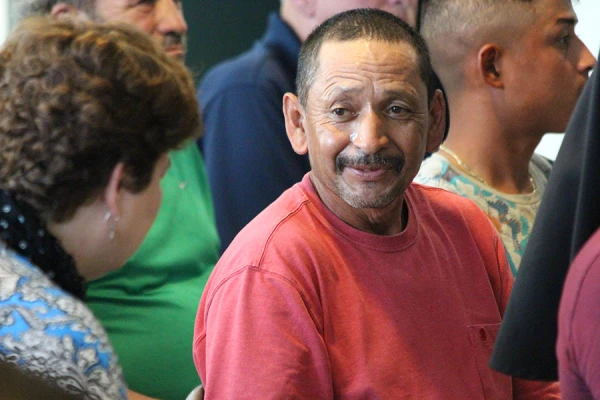
El Paso, Texas, Sep 26, 2019 / 11:15 am (CNA).- At a Mass and press conference held at the US-Mexico border in El Paso, Texas on Wednesday, bishops from the border region emphasized the importance of providing care for migrant families, especially those who share a common faith and baptism with American Catholics.
“These are baptized Christians. From the faith perspective, that’s what we forget sometimes because we’re so focused on the charity part of it,” Bishop Brendan Cahill of the Diocese of Victoria, Texas told CNA Sept. 25.
“But these are baptized Catholics, so these are our brothers and sisters. So respecting national borders, respecting everything else, there’s still a bond there through sacramentality.”
“We know that they’re coming not to take advantage of this wonderful, generous country, but rather to have an opportunity to work and to raise their families in safety and dignity,” Bishop Oscar Cantu said Sept. 25 as bishops prayed at the US border.
Photos: @mckeownjonah pic.twitter.com/F5KYX9zONk
— Catholic News Agency (@cnalive) September 26, 2019
The delegation of bishops, led by Bishop Mark Seitz of El Paso, is visiting the border this week to meet migrants at aid centers and in the fields where many of them work. The visit was designed as a pastoral encounter with migrants and Catholic leaders of the Dioceses of Las Cruces, New Mexico, El Paso, Texas, and Juarez, Mexico. Five bishops were present at the Mass and press conference.
Fr. Robert Stark, Regional Coordinator of the Vatican’s Section on Migrant and Refugees, was also in attendance. Pope Francis has declared Sunday, Sept. 29 as World Day of Migrants and Refugees.
Cahill celebrated the Mass in Spanish on Wednesday evening at the Centro de los Trabajadores Agrícolas Fronterizos, located in South El Paso just a stone’s throw from the border fence. The 8,000 square foot adobe-brown facility has for over 25 years provided aid for the thousands of migrant farmers who cross from Mexico to work in the United States every day.
The bishop related the story of a family he knows: A husband and father drives each day from Mexico across the border to New Mexico to farm, leaving at 3 am and arriving back home around 7 pm. He sleeps, and then does it again the next day.
Most chili farm workers are paid around 79 cents for each large bucket of chilis or onions picked.
“Over these past few days we’ve heard dozens of stories, but to me there’s a similar theme to all of them…it’s really all about family. It’s about parents caring for their children, and I think for any of us that’s our number one concern.”
In Ciudad Juarez, Central American migrants are being treated “very well,” Cahill said, but the threat to the families, and particularly mothers, still has impacted him.
“As I listen to the migrant farm workers’ stories, I hear challenges to keep the family together, opportunities for families because it is work and provides, so I think that has to be admitted that that’s a good, but then to see what we can do even better.”
Though the situation on both sides of the border is “overwhelming,” Cahill emphasized Pope St. John Paul II’s exhortation to pray for the family— not just one’s own family, but for the holiness and wellbeing of all families.
“The experience of being on the border and listening to people’s stories— and these are regular people— is that the family is always the forefront,” he said.
“I want to pray for the family unit, that we protect mothers and fathers and children, and that they can be together. And that’s what I noticed here on the border, a lot of economic forces, a lot of things challenging keeping the family together.”
Seitz said at the press conference that it is unusual to have so many bishops gathered together around one particular theme outside of the regular bishops’ meeting. The special focus of the visit, he said, is on farm workers.
“They’re a quiet reality that have been passing through El Paso, staying in El Paso, moving out from El Paso for many decades here,” Seitz said.
Seitz said the visit was designed to allow those who had not visited the border area before a chance to get a feel for the area, and a border situation that is “changing every day.”
The Mass coincided with a vote taken in Congress Wednesday to block President Donald Trump’s emergency declaration at the southern border, which is designed to divert funds from other projects to build a wall on the border with Mexico. The president is expected to veto Congress’ action.
On Tuesday the bishops visited Ciudad Juarez to visit a large aid facility, as well as a visit to Corpus Christi parish, which is largely serving farm workers and their families. On Thursday, the bishops plan to take a visit to Hatch, New Mexico to meet farmers there who grow and pick the valley’s world famous chilis.
The bishops also met with groups of Central American migrants in Ciudad Juarez who had been waiting in Mexico for a chance to cross the border.
“It’s devastating to see that these dreams that they have, dreams that my own parents had as immigrants to the United States from Mexico some 60 years ago, and people continue with those dreams,” said Bishop Oscar Cantu of San Jose, formerly bishop of Las Cruces.
“We know that they’re coming not to take advantage of this wonderful, generous country, but rather to have an opportunity to work and to raise their families in safety and dignity.”
According to U.S. Customs and Border Protection, apprehensions of “unaccompanied alien children” has risen by nearly 75% from May 2018 to May 2019. The rise in apprehensions is led by El Paso, which has seen a 323% rise in that period.
The rise in apprehensions of families is higher— 463% across the board. El Paso’s rate of apprehension of families rose 2,100%.
Bishop John Stowe of the Diocese of Lexington, Kentucky, formerly a priest of the diocese of El Paso, praised the work of Catholics in the diocese working to welcome migrants.
“The Diocese of El Paso has given an example for the whole country of how to welcome immigrants, how to love immigrants, how to clothe immigrants, how to provide shelter to immigrants, how to treat them as brothers and sisters and receive them here,”
The Department of Homeland Security announced new Migrant Protection Protocols in January, providing that migrants arriving illegally or without proper documentation “may be returned to Mexico and wait outside of the U.S. for the duration of their immigration proceedings, where Mexico will provide them with all appropriate humanitarian protections for the duration of their stay.”
https://www.dhs.gov/news/2019/01/24/migrant-protection-protocols
These policies, Stowe noted, have meant that that tens of thousands of migrants are “stuck” on the Mexico side of the border, as asylum claims can take years to process.
“It was just months ago that thousands of people were coming across the border, flooding this city, and they were received in shelters throughout this city by people of faith who reached out. Not only our Catholic Church but other churches in town, reaching out and serving them. That’s a beautiful example for the whole country; it’s what our nation was founded on, and it’s specifically important for our Catholic Church.”
In terms of practical actions the faithful in El Paso have taken, Seitz told CNA that the diocese in Oct. 2018 opened a shelter at the pastoral center, a “purely volunteer response,” to deal with the large number of people passing through the city. The temporary shelter has since closed due to a drop in the number of migrants passing through.
“Right now, we’ve seen a huge drop off in the number of people coming because of enforcement actions in Mexico,” Seitz noted.
“So what’s happening is there’s kind of a bottleneck in Ciudad Juarez, and we estimate that there are up to 20,000 people that are pretty much stuck there. They’re afraid to go home, because that’s where they’re fleeing from…they’re afraid to stay in Mexico, because most of them have faced violence there.”
Robberies and kidnappings among the migrants waiting in Mexico are common, he said.
The HOPE Border Institute, along with the Diocese of El Paso, in July initiated a Border Refugee Assistance Fund to send money to organizations working with migrants and refugees in Juarez.
“Do we believe there is a usefulness to a border? Absolutely. The Church has not problem with that usefulness. But we also know that there are higher laws than than the law that has to do with a nation’s border.”
“We are Catholic Christians, and we are citizens. If the two ever come into conflict, we need to be Catholic Christians first,” Seitz told CNA.
The majority of the migrants that the Church in El Paso helps have already been processed by ICE and are awaiting their court date for asylum.
“The fact is that most of these people that are crossing, seeking asylum, are not breaking the law. They’re following the law that was established for people like our ancestors who came here seeking refuge…And we need to try and see things through the eyes of Jesus Christ and through the teachings of our Church. And those teachings should be clear when they say that if we encounter someone in need, we need to do what we can to help them.”
 […]
[…]







What steps does the Spirit invite us to take in order to grow in our ‘journeying together?
Encourage the Traditional Latin Mass and more Pro Life/Pro Family support from the clergy especially Pope Francis and the Vatican.
We read: “When you think about it being a 41-page document, how are we going to consult people? Are they going to read 41 pages?” Well, a good place to START might be Part I:5, Proposal “o” which reads in part:
“From the work of the Assembly, there is the call for better knowledge of the teachings of Vatican II (…).”
Indeed, this comes nearly forty years after the IDENTICAL CONCLUSION was achieved at the 20-years pulse-check following the Council, the Final Report of 1985 Extraordinary Synod of Bishops: “[Part 1:6] It is suggested […] a new, more extensive and reception of the Council. This can be attained above all through a new diffusion of the documents themselves [….]”
Perhaps, after almost sixty years, actually read the DOCUMENTS, as contrasted with the disembodied and decapitated “spirit of the Council” as marketed by Hans Kung and two generations of freelance theologians, including many lemming synodalizers.
Two other FINDINGS in 1985 were:
“[Part II:6]…from Vatican II has positively come a new style [not exactly a new idea!] of collaboration between the laity and clerics,” AND: “[Part II:3] We cannot replace a false unilateral vision of the Church as purely hierarchical with a new sociological conception which is also unilateral [!].”
Less dense than the inventory compiled in the 2023 Synthesis Report, key themes of the 1985 Final Report might already frame the requested “EXECUTIVE SUMMARY.” Although much of the overlay of current grassroots concerns gives added and valuable definition to engagement in the world. Omitting, of course, Germania’s distracting moral, sacramental and ecclesial novelties.
“Archbishop Timothy Broglio, president of the U.S. Conference of Catholic Bishops, had noted at last month’s synod that only 1% of Catholics participated in the listening sessions.”
Is that 1% of Catholics, or 1% of Catholics who attend weekly Sunday Mass?
~ 17% of Catholics attend weekly Mass, so even if that’s 1% of Catholics, it’s still only about 5% of Catholics at Sunday Mass. And it’s not like there’s enough kids to make that an impressive number.
I am not surprised that only 1% of Catholics listened/paid attention to the Synodal conference. In the U.S., most people are too busy. Yes, some of the busy stuff is “junk”–being on X (Twitter) and other social media sites, being online on sports sites and other “fun” sites, ordering stuff from Amazon and trying to find a place to put the stuff in our homes when it arrives, working (often working overtime or more than one job), driving (can take up a lot of time depending on where you live in the U.S.), taking care of children and keeping up with teens, etc. And frankly, I didn’t want to spend time listening to a conference that seemed basically to be a meeting to talk about stuff that seems to be of little importance to many of us in our daily lives. There are so many wonderful things to learn about Jesus, the Bible, the Church, etc., and so many tasks that need to be done in my home and my parish, and so many things to talk to God about in prayer–I personally think there are better ways to spend my time than listening in on a conference that I don’t really understand the purpose of. I’ll read the “summary” when it comes out, and let the “thinkers” in the Church act (or not act) on the Synodal Way.
Drinking a six pack and staring at a turned off tv screen is a more valuble way to spend time than participating in the evil enterprise of a synod. Christians are oblighed to resist evil.
If the synod was held to hear the voices of Catholic lay people, then in my opinion, it has failed. Why even hold a synod if only one per cent of Catholics participated? Why is Francis insisting on having these synods, if the vast majority of Catholics express little to no interests? How does he know that the Holy Spirit will guide his synod in any way? To me, these synods are a waste of time, energy and money. I understand that the Vatican is not in good shape, financially. Is the Vatican able to afford these meetings?
Synod’s next step. Cancel all future meetings, give those millions of dollars to the poor and all those involved spend one month in a retreat given by Bishop Strickland entitiled: “Caritas in ecclesia”.
Yours truly humbly proposes that the needed EXECUTIVE SUMMARY of the Synthesis Report actually appears within the report itself! Not to diminish the contents of the report, but first an observation, then the very concise summary, and then a concluding question…
OBSERVATION: Curiously, the table of contents for the Report appears at the end rather than the beginning. The first impression is that this is either a formatting error, or a cross-cultural touch toward Hebrew, or Chinese, or even Egyptian hieroglyphic ways of reading, but no…this is a right-brained effort to place the “concrete” process in front and above of any synoptic or disdained “abstract” perspective.
THE SUMMARY QUOTE: Part III, n. 20—The Synod of Bishops and Ecclesial Assemblies: Convergences (a):
“Even though the experience of ‘walking together’ has been tiring, the Assembly sensed the evangelical joy of being [?] the People of God. The new experiences involved in this stage [?] of the synodal journey were generally welcomed [two thirds?]. The most obvious one included the shift [paradigm shift?] of the celebration of the Synod from an event [!] to a process [!]…”
CONCLUDING QUESTION: Event vs Process? As in “…being [?] the People of God?” Does this wording actually propose/impose, broadly and by subliminal suggestion, that experiences together displace being? That ontological being is subordinate to horizontal becoming? That what we are is reducible to what we do? That to do is the sum total of to be?
So, the process IS the message, “aggregated, compiled, synthesized” by “facilitator” bishops, more or less. AND, this message can be summarized: “Do-be-do-be-do-be-do”! The conceptual ambiguity of convergent synodality! The enabled reduction of pluriformity to pluralism. On this “backwardist” journey, which is not so new, the lay theologian Etienne Gilson reminds us:
“Philosophy always buries its undertakers.”
What’s occurring at the Synod is a circumscribed process that is light years away from the comprehension, or practical relevance to the vast sea of Catholic Christians. Mrs Sharon Whitlock’s comment expresses it well. Nor does a summary inform the reader of the rationale for getting there. That alone speaks to an exercise in futility. Unless there is a rationale to further an agenda.
Certainly this pontificate has an agenda to modernize the Gospel contextually, grounding it in cultural differences, scientific advances, anthropological, biological, philosophical, theological [recently proposed to that effect by pope Francis]. What will result is rote indoctrination of material that is otherwise unintelligible to the average Christian. Nor will the average Christian, or any Christian for that matter be able to identify continuity with the revealed Word of God.
The agenda was provided two millennia ago in the Great Commission.
However, That’s hard work, especially in these times and I suspect few if any Bishops can provide any evidence from their particular diocese of increased Mass attendance; reduced pre/non-marital cohabitation, increased conversions; the end of church closures; increased marriages.
Instead we get vainglorious soliloquys from our “Shepherds”.
Instead of looking to Rome for guidance, the bishops might save time (and sanity) by reading The Catholic Thing, Nov. 17.
Why do these bishops feel obligated to act as stupidly as entertainers?
The Bishops have an obsession with material poverty, to the exclusion of the far more pervasive and destructive moral poverty. On well, another verbose document should help.
Good point, and I believe the reason is because the first is a product of the latter which they refuse to acknowledge since it would implicate their failures.
Getting back, again, to the need to “formulate concrete plans to prepare for the final stage of the Synod on Synodality next fall”…The Synthesis is 41 pages, some 21,000 words, and was tweaked by 1,251 amendments (the devil is in the details). The term “LGBTQ+” is deleted. Deleted also is a permanent and content-free synod. The Magisterium is noted ten times rather than four in the draft report (but now whose magisterium?).
One simplifying way of preparing for 2024 might be to focus on the trees rather than the forest. That is, where are the unblended drops of cyanide in the punch bowl?
Two such possibilities:
The proposed “[16 (p)]…ministry of listening and accompaniment,” as potentially eclipsing the guardianship of the Deposit of Faith? And, “[12 (h)] Further reflection is needed on the relationship between episcopal collegiality and diversity of theological and pastoral views,” as possibly contradicting the clarity supplied in Veritatis Splendor, including “The Church [as in ‘episcopal collegiality’] is no way the author or the arbiter of this [‘moral’] norm” (n. 95).
Further, regarding the forced dichotomy (though much amended in the Synthesis) between progressive synodality and what is conservative, reflection reveals that there is no such thing as “conservatism” as a movement, per se, as if to counter the many historical movements of progressivism… Instead, a grounding in the fact of creation by a Creator. That is, the mystery and radical fact of “existence” (the is-ness of things) before “essence” (the thing-ness of things). With Leibniz, too, “why is there something rather than nothing”! Being above becoming, reality before ideas…
Of this conservative VISION, which should pervade any activism and even synodality, yours truly blatantly inserts, here, the vision of an unapologetic and archconservative layman, Frederich D. Wilhelmson (“Citizen of Rome: Reflections from the Life of a Roman Catholic” 1980):
“I repeat the thesis: we conservatives cannot cure the modern world: we do not hold the power, nor is it likely to pass into our hands. But if liberals–and they are in the saddle almost all over the West–will make the descent into the maelstrom of the modern soul, they will find in conservatism a diagnosis of the disease of our time. We conservatives have lost our kings and our chivalry; our craftsmen are gone, and our peasantry is fast disappearing. Our horses have been shot from under us. We have nothing to offer the world but our VISION.” Not a program at all, but a vision! The pre-modern and again awaited sacral nature of creation and of all of reality.
Does our synodal response to the “signs of the times” discount or even reject—or embrace—this broader and deeper and conservative (so-called backwardist?) “vision” …Wilhelmsen’s “rhythm [!] of being and becoming” [both]?
The exercise on discernment offers a constructive road map. “The human voice can never reach the distance that is covered by the still small voice of conscience” – Mahatma Gandhi