Pope Francis prayed for the repose of the souls of Pope Benedict XVI and the cardinals and bishops who died in the past year during a Mass in St. Peter’s Basilica on Nov. 3, 2023. | Daniel Ibanez/CNA
Vatican City, Nov 3, 2023 / 07:05 am
At a Mass for Pope Benedict XVI and deceased cardinals and bishops on Friday, Pope Francis urged Christians, especially pastors, to be the humble servants of others.
“I like to recall the very first words with which Pope Benedict described himself following his election: ‘a humble laborer in the vineyard of the Lord,’” the pope said in St. Peter’s Basilica on Nov. 3.
“Indeed, Christians, especially the pope, the cardinals, and the bishops, are called to be humble laborers: to serve, not to be served and to put the fruits of the Lord’s vineyard before their advantage,” he added. “What a fine thing it is to renounce ourselves for the Church of Jesus!”
Pope Francis presided on Friday morning at a Mass of intercession for the repose of the souls of Pope Benedict XVI and the six cardinals and 147 bishops and archbishops of the Catholic Church who died since November 2022.
Pope Francis prayed for the repose of the souls of Pope Benedict XVI and the cardinals and bishops who died in the past year during a Mass in St. Peter’s Basilica on Nov. 3, 2023. Credit: Daniel Ibanez/CNA
Cardinal Giovanni Battista Re was the celebrant of the Mass, which took place at the Altar of the Chair, and cardinals and bishops concelebrated.
“Let us pray for our beloved deceased brethren,” Pope Francis said in his homily. “Their hearts were pastoral, compassionate, and humble, for the Lord was the center of their lives. In him may they find eternal peace.”
The Mass for deceased cardinals and bishops is celebrated every year at the Vatican during the week of All Saints’ and All Souls’ Days.
“Benedict XVI, whom we remember today, together with the cardinals and bishops who died in the past year, wrote in his first encyclical that the program of Jesus is ‘a heart that sees,’” Francis said, quoting from Deus Caritas Est (“God is Love”).
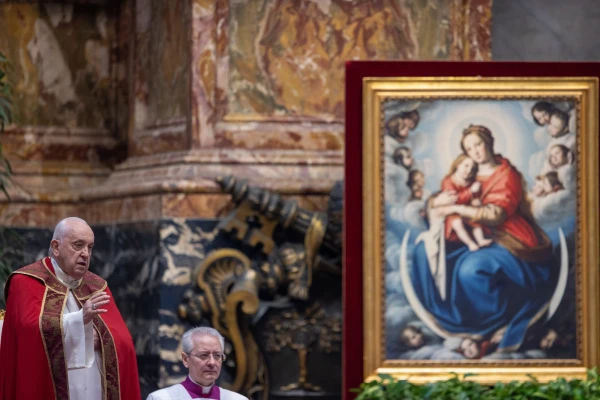
Pope Francis prayed for the repose of the souls of Pope Benedict XVI and the cardinals and bishops who died in the past year during a Mass in St. Peter’s Basilica on Nov. 3, 2023. Credit: Daniel Ibanez/CNA
“How many times did he keep reminding us that faith is not primarily an idea to be understood or a moral precept to be followed but a person to be encountered,” he said. “That person is Jesus Christ, whose heart beats with love for us, whose eyes look with pity upon our suffering.”
In his homily, Pope Francis reflected at length on the virtue of Christian humility, which he said “is not simply one virtue among others, but the basic disposition of life: believing ourselves to be in need of God, making room for him and putting all our trust in him.”
“It is the humble, the poor in spirit, who reveal to us the ‘littleness’ so pleasing to the Lord, the path that leads to heaven. God seeks the humble, those who hope in him and not in themselves and their own plans,” the pope said.
“God loves humility,” he added, “because it permits him to interact with us. Even more, God loves humility because he himself is humble. He comes down to us; he lowers himself; he does not impose himself; he makes room for us.”
Bishops and cardinals process to the Altar of the Chair in St. Peter’s Basilica for a Nov. 3, 2023, Mass with Pope Francis for the repose of the souls of Pope Benedict XVI and the cardinals and bishops who died in the past year. Credit: Daniel Ibanez/CNA
Pope Francis also reflected on compassion as demonstrated by Jesus in St. Luke’s Gospel, proclaimed at Mass.
In Luke 7:11–17, Jesus encounters a widow following behind her only son who had died as he was being carried out of the city: “When the Lord saw her, he was moved with pity for her and said to her, ‘Do not weep.’ He stepped forward and touched the coffin; at this the bearers halted, and he said, ‘Young man, I tell you, arise!’ The dead man sat up and began to speak, and Jesus gave him to his mother.”
“Jesus, as today’s Gospel shows, halts before the tragedy of death,” the pope explained. “Here we see our God, whose divinity shines forth in contact with our sorrow and grief, for his is a heart full of compassion.”
“The raising of that young man, the gift of life that overcomes death, has its source precisely there, in the compassion of the Lord, who is moved by death, the greatest cause of our suffering. How important it is to communicate that same look of compassion to all those who grieve for the death of their loved ones,” he said.
If you value the news and views Catholic World Report provides, please consider donating to support our efforts. Your contribution will help us continue to make CWR available to all readers worldwide for free, without a subscription. Thank you for your generosity!
Click here for more information on donating to CWR. Click here to sign up for our newsletter.
Abuja, Nigeria, Jul 22, 2022 / 15:45 pm (CNA).
Nigeria’s government has everything it needs to stop the ongoing attacks that are targeting Christians, but has refused to help, a Catholic priest in the We… […]
U.S. Supreme Court, Washington, D.C. / Credit: Bob Korn/Shutterstock
Washington, D.C. Newsroom, Jul 17, 2024 / 17:05 pm (CNA).
President Joe Biden intends to announce plans to reform the United States Supreme Court by adding term limits and an … […]
The trailer of the upcoming Russell Crowe movie “The Pope’s Exorcist” indicates that the film might not do justice to the Italian exorcist Father Gabriel Amorth or the rite of exorcism as practiced in the Catholic Church, according to an exorcist organization Amorth himself helped to found.
The International Association of Exorcists on March 7 voiced concern that the film seems to fall under the category of “splatter cinema,” which it calls a “sub-genre of horror.”
The Vatican, the statement said, is filmed with a high-contrast “chiaroscuro” effect seen in film noir.
This gives the film a “‘Da Vinci Code’ effect to instill in the public the usual doubt: Who is the real enemy? The devil or ecclesiastical ‘power’?” the exorcists’ association said.
While special effects are “inevitable” in every film about demonic possession, “everything is exaggerated, with striking physical and verbal manifestations, typical of horror films,” the group said.
“This way of narrating Don Amorth’s experience as an exorcist, in addition to being contrary to historical reality, distorts and falsifies what is truly lived and experienced during the exorcism of truly possessed people,” said the association, which claims more than 800 exorcist members and more than 120 auxiliary members worldwide.
“In addition, it is offensive with regard to the state of suffering in which those who are victims of an extraordinary action of the devil find themselves,” the group’s statement added. The statement responded to the release of the movie trailer and promised a more in-depth response to the film’s April 14 theatrical release.
Father Gabriele Amorth, chief exorcist of Rome, speaks to CNA on May 22, 2013. Steven Driscoll/CNA
Amorth, who died at age 91 in 2016, said he performed an estimated 100,000 exorcisms during his life. He was perhaps the world’s best-known exorcist and the author of many books, including “An Exorcist Tells His Story,” reportedly an inspiration for the upcoming movie.
Several of Amorth’s books are carried by the U.S. publisher Sophia Institute Press. The publisher’s newly released book “The Pope’s Exorcist: 101 Questions About Fr. Gabriele Amorth” is an interview in which the priest addresses many topics ranging from prayer to pop music.
Michael Lichens, editor and spokesperson at Sophia Institute Press, voiced some agreement with the exorcist group.
“The International Association of Exorcists is right to be concerned and I’m thankful for their words,” Lichens told CNA. “My hope is that audiences will remember that Father Amorth is a real person with a great legacy and perhaps a few moviegoers will look up an interview or pick up his books.”
“This was a man who included St. Padre Pio and Blessed Giacomo Alberione as mentors, as well as Servant of God Candido Amantini, who was his teacher for the ministry of exorcism,” he said. “Father Amorth fought as a partisan as a young man and grew to fight greater evil as an exorcist. His life is an inspiration and I know that his work and words will still reach many.”
Amorth was born in Modena, Italy, on May 1, 1925. In wartime Italy, he was a soldier with the underground anti-fascist partisans. He was ordained a priest in 1951. He did not become an exorcist until 1986, when Cardinal Ugo Poletti, the vicar general of the Diocese of Rome, named him the diocesan exorcist.
The priest was frequently in the news for his comments on the subject of demonic forces. In an interview with The Sunday Telegraph in 2000, he said: “I speak with the devil every day. I talk to him in Latin. He answers in Italian. I have been wrestling with him, day in, day out, for 14 years.”
The movie “The Pope’s Exorcist” claims to be “inspired by the actual files of the Vatican’s chief exorcist.” The Sony Pictures movie stars the New Zealand-born actor Russell Crowe as Amorth. Crowe’s character wears a gray beard and speaks English with a noticeable accent.
“The majority of cases do not require an exorcism,” the Amorth character says in the movie’s first trailer. A cardinal explains that Crowe’s character recommends 98% of people who seek an exorcism to doctors and psychiatrists instead.
“The other 2%… I call it… evil,” Crowe adds.
The plot appears to concern Amorth’s encounter with a particular demon. Crowe’s character suggests the Church “has fought this demon before” but covered it up.
“We need to find out why,” he says.
The trailer shows short dramatic scenes of exorcism, including a confrontation between Amorth and a girl apparently suffering demonic possession.
The International Association of Exorcists said such a representation makes exorcism become “a spectacle aimed at inspiring strong and unhealthy emotions, thanks to a gloomy scenography, with sound effects such as to inspire only anxiety, restlessness, and fear in the viewer.”
“The end result is to instill the conviction that exorcism is an abnormal, monstrous, and frightening phenomenon, whose only protagonist is the devil, whose violent reactions can be faced with great difficulty,” said the exorcist group. “This is the exact opposite of what occurs in the context of exorcism celebrated in the Catholic Church in obedience to the directives imparted by it.”
CNA sought comment from Sony Pictures and “The Pope’s Exorcist” executive producer Father Edward Siebert, SJ, but did not receive a response by publication.
Amorth co-founded the International Association of Exorcists with Father René Laurentin in 1994. In 2014 the Catholic Church recognized the group as a Private Association of the Faithful.
The association trains exorcists and promotes their incorporation into local communities and normal pastoral care. It also aims to promote “correct knowledge” about exorcism ministry and collaboration with medical and psychiatric experts who have competence in spirituality.
Exorcism is considered a sacramental, not a sacrament, of the Church. It is a liturgical rite that only a priest can perform.
Hollywood made the topic a focus most famously in the 1973 movie “The Exorcist,” based on the novel by William Peter Blatty.
“Most movies about Catholicism and spiritual warfare sensationalize,” Lichens of Sophia Institute Press told CNA. “Sensationalism and terror sell tickets. As a fan of horror movies, I can understand and even appreciate that. As a Catholic who has studied Father Amorth, though, I think such sensationalism distorts the important work of exorcism.”
“On the other hand, ‘The Exorcist’ made the wider public more curious about this overlooked ministry. That is a good thing that came out, despite other reservations and concerns,” he continued. “Still, I would love it if a screenwriter and director spoke to exorcists and tried to show the often-quotidian parts of the ministry.”
An unhealthy curiosity can be a problem, Lichens said.
“When I work as a spokesperson for Amorth’s books, I am always concerned about inspiring curiosity about the demonic,” he told CNA. “As Christians, we know we have nothing to fear from the demonic but curiosity might lead some to want to seek out the supernatural or the demonic. Father Amorth has dozens of stories of people who found themselves afflicted after party game seances.”
Lichens encouraged those who are curious to read more of Amorth’s writings, some of which are excerpted on the Catholic Exchange website. Sophia Institute Press has published “Diary of an American Exorcist” by Monsignor Stephen Rosetti and “The Exorcism Files” by the American lay Catholic Adam Blai.
“First and foremost, Father Amorth was involved in a healing ministry,” Lichens said. “Like other exorcists, his work often involved doctors in physical and mental health because the goal is to bring healing and hope to the potentially afflicted.”
“Those of us who read Amorth might have been excited to read firsthand accounts of spiritual warfare, but readers quickly see a man whose heart was always full of love for those who sought his help,” he added.
The International Association of Exorcists, for its part, praised the 2016 documentary “Deliver Us,” saying this shows “what exorcism really is in the Catholic Church and “the authentic traits of a Catholic exorcist.” It shows exorcism as “a most joyful event,” in their view, because through experiencing “the presence and action of Christ the Lord and of the Communion of the Saints,” those who are “tormented by the extraordinary action of the devil gradually find liberation and peace.”
The late Pope Benedict XVI served God’s flock with humility and love. May the merciful Creator grant him eternal bliss.
