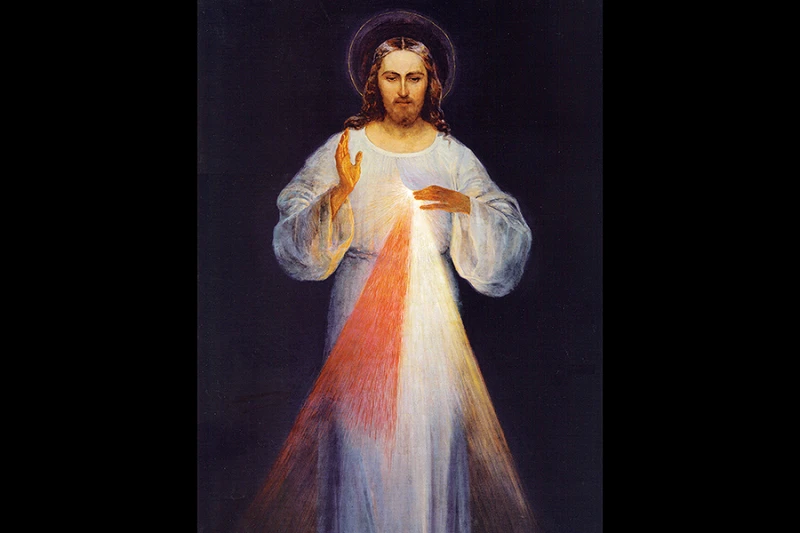
Original painting of the Divine Mercy, by Eugeniusz Kazimirowski in 1934. Wikimedia Commons 4.0. / null
Boston, Mass., Apr 15, 2023 / 06:00 am (CNA).
What do a certain Polish nun and a certain Polish pope have in common? They both became saints and they were both instrumental in the institution of Divine Mercy Sunday, which offers many graces to the faithful.
Be sure to thank St. John Paul II and St. Maria Faustina Kowalska this April 16 because as Divine Mercy Sunday rolls around again this year, the faithful have the opportunity to take refuge in the depths of Christ’s mercy by receiving either a plenary or partial indulgence.
Here are some facts about Divine Mercy Sunday, including the Church’s guidance on how to receive indulgences on the day:
What is Divine Mercy Sunday?
Divine Mercy Sunday is the Sunday after Easter each year. Divine Mercy Sunday was first announced in an April 2000 homily given by John Paul II for the Mass celebrating the canonization of Maria Faustina Kowalska.
St. Faustina Kowalska was a Polish nun who received prophetic messages from Christ. These messages included revelations about the infinite mercy of God — coined the “divine mercy” — and her obligation to spread the message to the world as recorded in her diary, “Divine Mercy in My Soul.”
The late pope said in his homily that “the light of divine mercy, which the Lord in a way wished to return to the world through Sr. Faustina’s charism, will illumine the way for the men and women of the third millennium.”
John Paul II granted plenary and partial indulgences to the faithful who observed certain pious practices on Divine Mercy Sunday each year in a June 2002 decree. He did this in order to inspire the faithful in devotion to the Divine Mercy.
What is an indulgence?
An indulgence is the remission of the temporal punishment due to sins that have already been forgiven, and it can be plenary or partial.
Plenary indulgence
A plenary indulgence can be obtained by going to a church on Divine Mercy Sunday “in a spirit that is completely detached from the affection for a sin, even a venial sin,” and participating in the prayers held in honor of Divine Mercy, the 2002 decree says.
Those practices could consist of devotions such as the divine mercy chaplet, eucharistic adoration, and the sacrament of confession.
The faithful could also visit the Blessed Sacrament either exposed or in the tabernacle and recite the Our Father, the Nicene Creed, and a devout prayer to Christ. The example of a devout prayer that is given in the decree is “Merciful Jesus, I trust in you!”
In order to receive the indulgence, the three usual conditions of going to confession, receiving holy Communion, and praying for the intentions of the Holy Father must also be met. While it is appropriate that the two sacraments be received on the same day, the Church permits them to be received up to about 20 days before or after the day the indulgenced work is performed.
Can’t make it to a church? Be not afraid
For the sick or others who are unable to make it to church that day, a plenary indulgence may still be obtained. One must intend to make a confession, receive holy Communion, and pray for the intentions of the Holy Father as soon as possible, while praying one Our Father and the Nicene Creed before an image of Jesus. In addition, one also must pray “a devout invocation” to Christ such as “Merciful Jesus, I trust in you.”
For those faithful who cannot fulfill those obligations either, it is still possible to earn a plenary indulgence. If “with a spiritual intention” people unite themselves to all the faithful hoping to obtain the indulgence through the prescribed prayers and they offer a prayer and their sufferings to Christ, then they are able to obtain the plenary indulgence. They also must intend to go to confession, receive holy Communion, and pray for the pope as soon as possible.
Partial indulgence
A partial indulgence is granted to the faithful who on that day pray “a legitimately approved invocation” with a contrite heart. As is written in the decree, this invocation could be “Merciful Jesus, I trust in you!”
This story was first published on CNA on April 21, 2022, and was updated April 13, 2023.
If you value the news and views Catholic World Report provides, please consider donating to support our efforts. Your contribution will help us continue to make CWR available to all readers worldwide for free, without a subscription. Thank you for your generosity!
Click here for more information on donating to CWR. Click here to sign up for our newsletter.
Bishop Nicholas DiMarzio, left, and Bishop Robert J. Brennan / Courtesy photos.
Vatican City, Sep 29, 2021 / 05:55 am (CNA).
Pope Francis on Wednesday accepted the resignation of Brooklyn Bishop Nicholas DiMarzio, who was cleared of sexual abuse… […]
Legatus President Stephen Henley is pictured here speaking at the organization’s 2025 annual conference last month in Naples, Florida. / Credit: Courtesy of Legatus
Miami, Fla., Mar 13, 2025 / 07:20 am (CNA).
In today’s culture, often hostile to expressions of faith, many Catholics struggle with how to hold true to their values within the workplace. That’s why, in 1987, Domino’s Pizza founder Tom Monaghan started the Catholic organization Legatus.
From the Latin word for “ambassador,” Legatus aims to empower Catholic presidents, CEOs, and managing partners to become what St. Paul coined “ambassadors for Christ,” explained Stephen Henley, president of Legatus.
Offering peer support groups, networking, speakers, pilgrimages, and an annual international summit, Legatus’s goal is to “inspire members to live out their faith in all aspects of their life.” There are currently about 90 Legatus chapters in North America.
Chapter meetings are held once a month, providing the opportunity for members and their spouses to participate in confession and Mass, the recitation of the rosary, a cocktail reception dinner, and a speaker’s presentation.
“All of this is to help fortify the members’ marriage, the peer support group, the networking of this group, and then embolden them to go out and live their faith,” said Henley. “Tom felt that if we can bring together these Catholic CEOs, how much more can we change society with these people that have high impact and high influence?”
In interviews with Catholic News Agency, Hawkins, Dean Abela, and Henley covered three tips for bringing the Catholic worldview into the workplace.
Commit to your priorities
Dean Andrew Abela’s Catholic faith wasn’t always as important to him as it is now. As a teenager, he even stopped practicing.
“I came back in my mid-20s, funnily enough, while I was in business school,” he recalled. As a student in 1991, he encountered Pope John Paul II’s new encyclical letter Centesimus Annus, and the pope’s reflection on economics changed the trajectory of his life.
“Just a few months after, I returned to the Church,” he said. “When I reverted to the faith, I wanted to know what my newly rediscovered Catholic faith meant for a life in business.”
Andrew Abela is dean of the Busch School of Business at The Catholic University of America. Credit: Legatus
After working for companies including Procter & Gamble, McKinsey & Company, and the Corporate Executive Board, in 2002 Dean Abela eventually began teaching at the Catholic University of America. He is also a consultant to Fortune 100 corporations.
“The reason I left business and switched to academia was that I wanted to dedicate myself full-time to studying questions about what it means to be a faithful Catholic in the workplace,” he explained.
A member of Legatus since 2000, Dean Abela mentioned that members can follow what the organization terms a “spiritual plan” to attend daily Mass, recite the rosary daily, and do monthly confession.
Known as Tres Magna, or the “Big Three,” this plan was inspired by Miami Dolphins head coach Don Shula, who “attributed the perfect season to him going to daily Mass,” explained Stephen Henley. “Tom [Monaghan] thought, well, if he can go, there’s no reason why I can’t go.”
“Daily Mass, daily rosary, and monthly confession will align your life and priorities,” added Henley.
Find a supportive community
When Kristan Hawkins first encountered Legatus, she was not a Catholic. Hawkins was raised an Evangelical. After Students for Life’s 2006 launch, she began speaking at Legatus events.
In 2014, Hawkins decided to visit the Basilica of Our Lady of Guadalupe in Mexico City, “a pilgrimage Legatus had sponsored.” “I was the only Protestant there,” she recalled. “I decided there that I was going to enter RCIA.”
She became a full-fledged member of Legatus soon after becoming Catholic.
“As a pro-life activist who starts a pro-life organization, I want to save babies, I want to end abortion, I want to help as many families and women. You don’t start a non-profit because you’re necessarily a great business leader or have all these skills. You started this non-profit, this mission, because you want to see this mission accomplished,” Hawkins said. “For me, that’s one of the powerful benefits of being in Legatus, is having friends and mentors who were successful in the for-profit world who I can call on and ask questions.”
Students for Life of America President Kristan Hawkins. Credit: Legatus
“It’s very powerful and important to have those relationships. For me, in the work I’m doing, it’s a constant spiritual attack,” she added. “One of the best things about Legatus is I can call any of my Legatus friends at any moment, and they’ll be there for you. They know the power of the work we do and the resistance we face.”
Dean Abela also finds a sense of community in Legatus and also strives to build a supportive Catholic community at the Catholic University of America.
“We share with students the principles of Catholic social doctrine, things like human dignity and solidarity, and try to embed these principles into all of our classes,” he explained. “We’re also increasingly trying to give them opportunities to practice different virtues as part of their studies and schoolwork.”
For instance, Dean Abela explained, “To teach graduate students about decision-making, we go through a couple of survivor simulations, where you crash land in the north of Canada and you have to decide what you’re going to do. We have them go through decision-making exercises explicitly practicing the virtue of prudence or practical wisdom, the habit of making wise decisions. We break apart the components of practical wisdom, which include things like alertness, preparedness, and reasoning, and we have them try to exercise those as part of the decision-making process.”
These skills built in the classroom can be applied not only in business, but also in students’ personal lives.
Model the behavior you expect from others and celebrate your co-workers’ integrity
For Henley, giving authentic witness to the Catholic faith in the workplace can start with a simple “hello.”
“First, live the golden rule,” he said. “When you’re walking down the hall, say hello to the janitor, to the executive, and to everyone in between. It matters a lot.”
He added: “Another practical thing: take the opportunity to pray before meals. If you’re going on business lunches, you’ll be surprised at how many people say, ‘Yeah of course, let’s pray.’ It’s more common than not for people to pray before meals. The fact that you’re doing it shows that you’re a bold leader and that you’re spiritual.”
Dean Abela agrees that these types of habits make all the difference, and were the subject of the presentation he made of his book Superhabits: The Universal System for a Successful Life last month during the 2025 Legatus Summit.
“The main focus of the book is understanding that things like diligence, honesty, and resilience are not genetic characteristics. They are habits that anyone can acquire through practice,” Dean Abela explained. “Companies can focus on one of the most important virtues and give employees opportunities to practice those virtues.”
For instance, Dean Abela explained the GrowVirtue App, an AI-driven app “based on the work of the book,” which organizations can use to evaluate which virtues their company has already made a habit of, which virtues they might target, and tips for how to make progress.
“The important thing is that the company would choose a virtue that they think would be directly beneficial to the company right now,” said Dean Abela. “Although personal results are private, the whole company can see what employees as a whole are weakest in. So, if you’re trying to grow in customer service, you might encourage the virtue of friendship or friendliness.”
Dean Abela discussed the value of recognizing virtue both inside and outside the company.
“See examples in action or read about examples,” he suggested. “You can have employees watch videos or you can share articles that demonstrate examples of a particular virtue in action. And you can make sure senior folks are role models for junior employees.”
“Most importantly, give the employees the opportunity to practice the virtues, and give feedback,” he added. “When companies give awards, they tend to do this more with core values. They should shift to core virtues and give it to people who are exemplars of that virtue.”
Ultimately, the goal for Catholics is to live authentic lives that draw others to Christ.
“Stay true to who you are, don’t give in,” said Hawkins. “They’ll know you by your fruits. I think that’s very important. You don’t have to work in the pro-life movement or specifically in an apostolate to be a good Catholic, a faithful Christian in the workplace. You can do that in any job, in any position you have – in McDonald’s or in a Fortune 500 company.”
Leave a Reply
