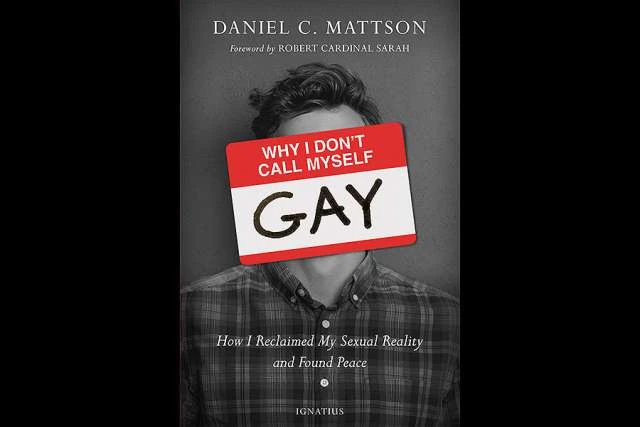
Denver, Colo., Jul 13, 2017 / 03:01 am (CNA).- Chastity actually means fulfillment, not suffering – and labeling people in terms of their sexual inclinations or attractions first is ultimately a reduction of their human dignity.
These ideas form the basis of a provocative new book by Daniel Mattson, a Catholic who finds identifying as “gay” unhelpful in the dialogue on the issue, and who also believes that living the Church’s teaching on sexuality leads to the most profound experience of peace and freedom.
“The Church must truly have a missionary zeal in proclaiming chastity as an invitation to a more fulfilling life for all men and women,” Mattson told CNA.
He said that Catholics need to reach out “to those who identify as LGBT to truly ‘come out,’ and let the masks of the world’s sexual identity labels fall from them, and see themselves as God sees them: solely as men and women, beloved children of God.”
“The dividing line of human sexuality is not between gay and straight, but rather between male and female, as we see in the Creation account of Genesis,” said Mattson.
In his new book, “Why I Don’t Call Myself Gay,” Mattson delves into the story of his upbringing: how he was raised in a Christian family, his experience of sexual confusion and social rejection in his early childhood, an addiction to pornography and an anger towards God. Living out his same-sex desires later in his life only made him more unhappy and lonely, and it wasn’t until he turned to the Church that he found true fulfillment.
Archbishop Jose Gomez of Los Angeles has called Mattson’s book “powerful” and Cardinal Robert Sarah, prefect of the Congregation for Divine Worship and the Discipline of Sacraments, said Mattson’s voice is one “seldom heard” in discussions surrounding same-sex attraction.
Mattson said a major reason why he wrote the book was to take on the notion of people identifying themselves first in terms of straight or gay. When Mother Teresa was asked about “homosexuals” in an interview, he said she refused to refer to anyone with same-sex attraction as anything else but “a child of God.”
“Even though men and women may be living outside of God’s plan for them, their dignity as children of God calls them to love others as Christ loved us,” Mattson said. “As a Christian, that means sex must always be reserved for use only in true marriage, which is always open to life. The Church needs to have enough confidence in Her beautiful vision of human sexuality to help people believe God says no to sex outside of marriage because He loves us.”
In the book, he describes how he can trace the contours of his life that lead to his same-sex attractions, which contrasts with the assumption that homosexuality is innate.
But while understanding where his same-sex attractions came from was helpful for Daniel, he says it’s not necessary for everyone. Though the Church teaches in the Catechism that homosexuality has a “psychological genesis,” how same-sex attractions come into a person’s life is a minor question. The Church, Mattson says, is “more concerned about providing a path to a fulfilling life in the future.”
In his interview with CNA, Mattson emphasized that his adherence to the Catholic view on human sexuality isn’t rooted in moralism or a suppression of desire.
“The biggest reason I have embraced the Church’s teaching as good, true and beautiful is because following the world’s vision of happiness in the realm of human sexuality brought far more suffering into my life,” he said. Today, he finds in the Church’s vision of human sexuality true happiness and liberation.
“The Church recognizes that there is a ‘theology of the body,’ and our bodily reality as male and female points to the path of both what is normal and healthy in human sexuality, as well as to what is moral.”
In his book, Mattson references the self-identified lesbian feminist and scholar Camille Paglia, who agrees that same-sex attraction is not of the norm, but as a self-labeled pagan, says that the fulfillment of man comes with conquering what she sees as the confines of nature. Mattson disagrees with her view of morality, but he finds her acknowledgment of the true nature of sexuality refreshing.
“At least she’s honest about the fact that everyone’s sexuality is truly ordered toward procreation.” Mattson said.
But what Paglia’s view of sexual liberation ignores, Mattson argues, is that “there is far more pain and suffering in the lives of those who live outside of God’s design and ordering for human sexuality than those who choose to live within it.”
He also noted that self-denial is an essential part of chastity, which everyone – not just people with same-sex attraction – are called to. For example, single men and women attracted to the opposite sex “are taught by the virtue of chastity to refrain from any sexual activity, too, and though this can be challenging, there is less suffering – and even more importantly, more peace – in one’s life when one follows the path set before us by God than if we go our own way.”
It’s not an issue of who suffers more but rather a shared connection of “the common human experience of suffering,” which stems from “rejection from other people, dashed hopes and dreams, heartbreak and loneliness.”
Mattson said that one reason he wrote his book is to help pave a path forward for those who have suffered from heartbreak and loss in their own relationships.
These sufferings, Mattson said, are universal to the human experience and not something particular to people with same-sex attraction. He referenced Cardinal Ratzinger’s 1986 “Letter on the Pastoral Care of the Homosexual Person,” which helped him refrain from self-pity and “thinking that somehow my various forms of suffering associated with living out a single and celibate life are more challenging than anyone else’s challenges.”
Through his book, Mattson says he wants to help the Church to, as he puts it, “reclaim sexual reality” and to help the Church and the world move beyond a view of the person which is ultimately “based on a reductionist label of sexual identity rooted in one’s sexual attractions and feelings.”
“In the eyes of the Church, there is no ‘us’ and ‘them,’ there is just us, and this is one of the great gifts of the Church.”
Mattson also offered a key distinction between Catholics being welcoming and shifting on magisterial teaching. He said that often the homosexual community has viewed the Church as ostracizing “for the reason that the Church won’t affirm them in their chosen way of living their lives.”
“The Church must be as welcoming and as loving as possible, but we cannot be more welcoming or loving than Jesus was who does not condemn us for our sins, but always calls us to go and sin no more.”
This call to change one’s moral life can be challenging, but it’s a calling which invites people to conversion and “is a sign of true love and compassion.”
 […]
[…]




A very special man. Articulate, compassionate, having excellent understanding and leadership abilities! God sends us men and women to show the way forward. We know that only our Lord and saviour is perfect, still King brought us humanity and a closer walk with the Lord.
1 Peter 4:10 As each has received a gift, use it to serve one another, as good stewards of God’s varied grace:
2 Timothy 2:15 Do your best to present yourself to God as one approved, a worker who has no need to be ashamed, rightly handling the word of truth.
Romans 12:11 Do not be slothful in zeal, be fervent in spirit, serve the Lord.
Romans 7:6 But now we are released from the law, having died to that which held us captive, so that we serve in the new way of the Spirit and not in the old way of the written code.
Acts 20:35 In all things I have shown you that by working hard in this way we must help the weak and remember the words of the Lord Jesus, how he himself said, ‘It is more blessed to give than to receive.’”
John 12:26 If anyone serves me, he must follow me; and where I am, there will my servant be also. If anyone serves me, the Father will honour him.
Blessings for his family.
We read: “Beyond remembering and quoting Dr. King today, we must act to address racial disparities in the criminal justice system, access to affordable housing and health care, and economic opportunities,” [Archbishop] Broglio wrote. “The USCCB continues to support policy changes in these areas of society.”
Thank you for this observance, and in full agreement…But also a caution about any “policy changes” for society as viewed from inside the Beltway.
Recalling, here, that family income disparities are reportedly correlated much more with single parent families than with race. So, with an eye to “society” as distinct from government, maybe a “policy,” within the Church itself, of preaching the meaning and indissolubility of marriage? And sexual morality? All related to the spousal union between Christ and His Church, and the meaning of ongoing Eucharistic coherence/revival.
Also recalling the global economic recession of 2008! Starting with the collapse of real-estate giant Washington Mutual, and then spreading nationally and globally (an economic pandemic!), and as bad apples, finally infecting bundled financial instruments (called “derivatives”). The meltdown attributed by the establishment to greedy banks, but the little-reported backstory was that banks were threatened with loss of their charters if they refused to issue insecure home loans—a homeownership inclusion (!) policy from good ol’ Uncle Sam (the guy with the $31 Trillion national debt).
The Law of Unintended Consequences….The overall message here is to not be lured into assuming, possibly and ideologically, that the Administrative State is the go-to solution for deeper and systemic pathologies within “society.”
It’s so disappointing to see that all CWR could publish on MLK Jr Day is this news piece and not essays or reflections about the man and his message for us today. It is obvious that CWR like many conservative white Catholics have embraced the hard right agenda in fighting anti-racism which aims to erase MLK Jr’s legacy and perpetuate racism to maintain white supremacy. Consider the anti-woke hysteria of recent times which CWR has editorially taken and promoted. This is indicative of the often misunderstood or forgotten understanding that to be a true Catholic is to be neither conservative nor progressive but to be radical. It is to be rooted (radix) in Jesus Christ whose Gospel is the reconciliation of all divisions that Paul declared to the Galatians (Gal 3:28). In today’s terms this message can be taken to mean that in Jesus Christ there is neither black nor white; Democrat nor Republican; rich nor poor; alien nor citizen; straight nor queer; inmate nor free; housed nor unhoused…. It’s best that more Catholics especially those of the conservative bent to cease the almost second-nature hate towards Pope Francis and read his 2020 encyclical letter, Fratelli Tutti, on Fraternity and Social Friendship.
“It is obvious that CWR like many conservative white Catholics have embraced the hard right agenda in fighting anti-racism which aims to erase MLK Jr’s legacy and perpetuate racism to maintain white supremacy.”
You obviously don’t really know CWR or read it carefully. You certainly don’t me (for the record, I’ve been the Editor of CWR for a decade). I’ll have to share your comments with my children, who are black and Hispanic (they are adopted). I’m sure they’d like to learn more about how I’ve been helping CWR embrace and promote “white supremacy” and racism.
I’ll also mention it to my good friend Deacon Harold Burke-Sivers, who has written about racism for CWR and who has a book coming out soon on the topic.
Of course, your crude rhetorical approach gives you away. In short, you employ politically-loaded language to misrepresent what CWR actually publishes, while complaining about what CWR doesn’t publish (and also while overlooking this other CNA piece we posted on racism in the U.S., etc.) And never mind the numerous pieces CWR has posted over the years on Dr. King and similar figures.
And your misrepresentation of St. Paul’s words and intent in Galatians is just as revealing. You like to smear and slander. How very Christ-like of you.
Dear Mr Brice:
Catholics typically want to support the pope. It makes sense and yet, the incumbent steps outside of the bounds of church tradition, not to mention fidelity to Christ. It is not difficult to touch on recent examples. Should the faithful remain mute?
Titus 2:15 Declare these things; exhort and rebuke with all authority. Let no one disregard you.
2 Timothy 4:2 Preach the word; be ready in season and out of season; reprove, rebuke, and exhort, with complete patience and teaching.
1 Timothy 5:20 As for those who persist in sin, rebuke them in the presence of all, so that the rest may stand in fear.
These guidelines pertain to liberal and conservative followers of Christ. Where there is disharmony it needs to be addressed. If the cause of the problem happens to come from the top, the same rules apply.
God bless you,
Brian Young