Jerusalem to Turin – “The team of Italian scientists who utilized new X-ray dating techniques to date the Shroud to the time of Christ’s death have used the same techniques to chart its probable geographical course afterward.” The Journey of the Holy Shroud of Turin
Theology Transforms – “In theology, the science is no less precise, and the words are no less important, but their significance is all the more grave.” Why Study Theology? (Catholic Stand)
The Order of Philosophy – “Philosophy endeavors to reunite what is eternally united in God. It begins with truth that recognizes the inviolability of life and the justice that life is owed.” Philosophy is Not a Box of Chocolates (Catholic Exchange)
Receiving Reverently – “Receiving communion in the hand was the common practice of the Church in both East and West for the first 800 years of Christianity, and it was certainly considered reverent by the Fathers.” Early Christian Communion in the Hand (Church Life Journal)
Art and Virtue – “The Catholic Art Institute will be hosting its 4th annual conference, this year themed “Art & Virtue.” The event will take place on Sunday, October 30, beginning with High Mass at St. John Cantius at 12:30pm, and moving to the nearby newly refurbished Athenaeum Center for Thought and Culture.” Catholic Art Institute 4th Annual Conference (One Peter Five)
The Synodal Process – “Some things never change. The German synod alone is testimony to that, but the phenomenon now extends far beyond Germany.” A Piecemeal Vatican III (The Catholic Thing)
(*The posting of any particular news item or essay is not an endorsement of the content and perspective of said news item or essay.)
If you value the news and views Catholic World Report provides, please consider donating to support our efforts. Your contribution will help us continue to make CWR available to all readers worldwide for free, without a subscription. Thank you for your generosity!
Click here for more information on donating to CWR. Click here to sign up for our newsletter.
Today the Church honors the memory of St. Ambrose, Bishop of Milan, born in Trier in 340 A.D. He was yet a catechumen, in 374, when he was nominated Bishop by popular acclamation, and so […]
U.S. Capitol Building, Washington, D.C. / Credit: Shutterstock
CNA Newsroom, Jun 21, 2024 / 11:30 am (CNA).
Democrats worried that a new Trump administration may use a 150-year-old federal law to stop abortion pills from being sent through the … […]
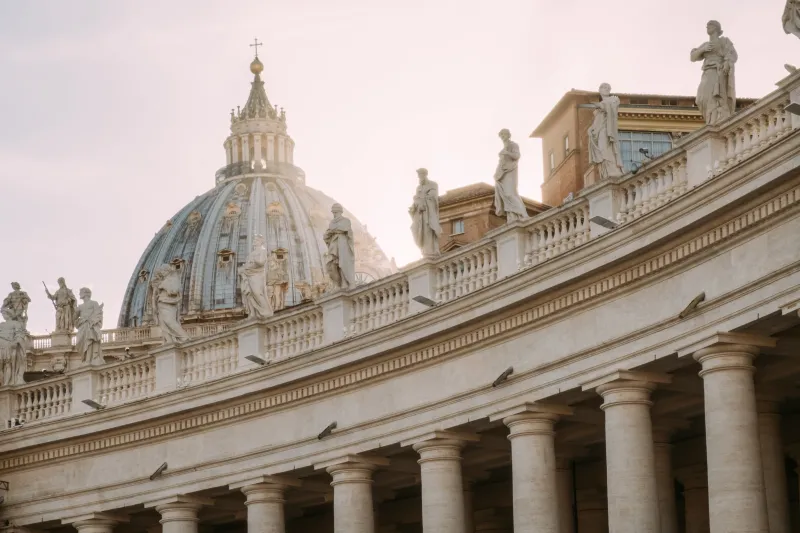
St. Peter’s Basilica / Simone Savoldi / Unsplash (CC0)
Rome Newsroom, Oct 2, 2022 / 03:00 am (CNA).
The world’s newest bishops gathered in Rome last month to learn more about what it means to be a Catholic bishop.
While the week’s presentations spanned a range of topics, three U.S. bishops who attended told CNA that synodality emerged as a key theme.
The Vatican’s annual formation course, sometimes known by the nickname “baby bishop school,” was canceled for two years because of the COVID-19 pandemic — making the 2022 edition the largest yet, with approximately 330 participating bishops across two sessions.
“People kind of picture baby bishop school as nuts and bolts, like ‘how to be a bishop.’ It’s not that at all,” Bishop Erik Pohlmeier of the Diocese of St. Augustine, Florida, told CNA at the end of the course.
“It’s kind of whatever the Church is talking about at that time, bringing that to the bishops that are coming on board,” he said. “The synodal process has been … a hallmark of conversation for the last couple of years, so now as we’re new bishops … the reflections revolved around that.”
The seminar’s first session was primarily attended by bishops consecrated in 2019 and 2020, while the second session was mostly those who joined the ranks in 2021 and the first part of 2022.
Thirty-nine U.S. bishops and auxiliary bishops attended, divided between the two weeks.
Pohlmeier was the freshest U.S. bishop to join. He was ordained a bishop on July 22 — just two days after his 51st birthday and seven weeks before arriving in Rome for the Sept. 12–19 course.
Speaking to CNA in Rome on Sept. 19, Pohlmeier said that as a new bishop, there are many things you do not know, but that’s where one’s fellow bishops come in.
“Every bishop knows other bishops,” he explained, like the bishop of the diocese where they served as a priest. “And they’re always, I mean to a person, helpful.”
Bishop Gregory Gordon, the first-ever auxiliary bishop of Las Vegas, Nevada, told CNA on Sept. 19 that the U.S. bishops’ conference also organizes meetings between bishops of the same ordination year, or “class,” as a way to build fraternity and create a network of support.
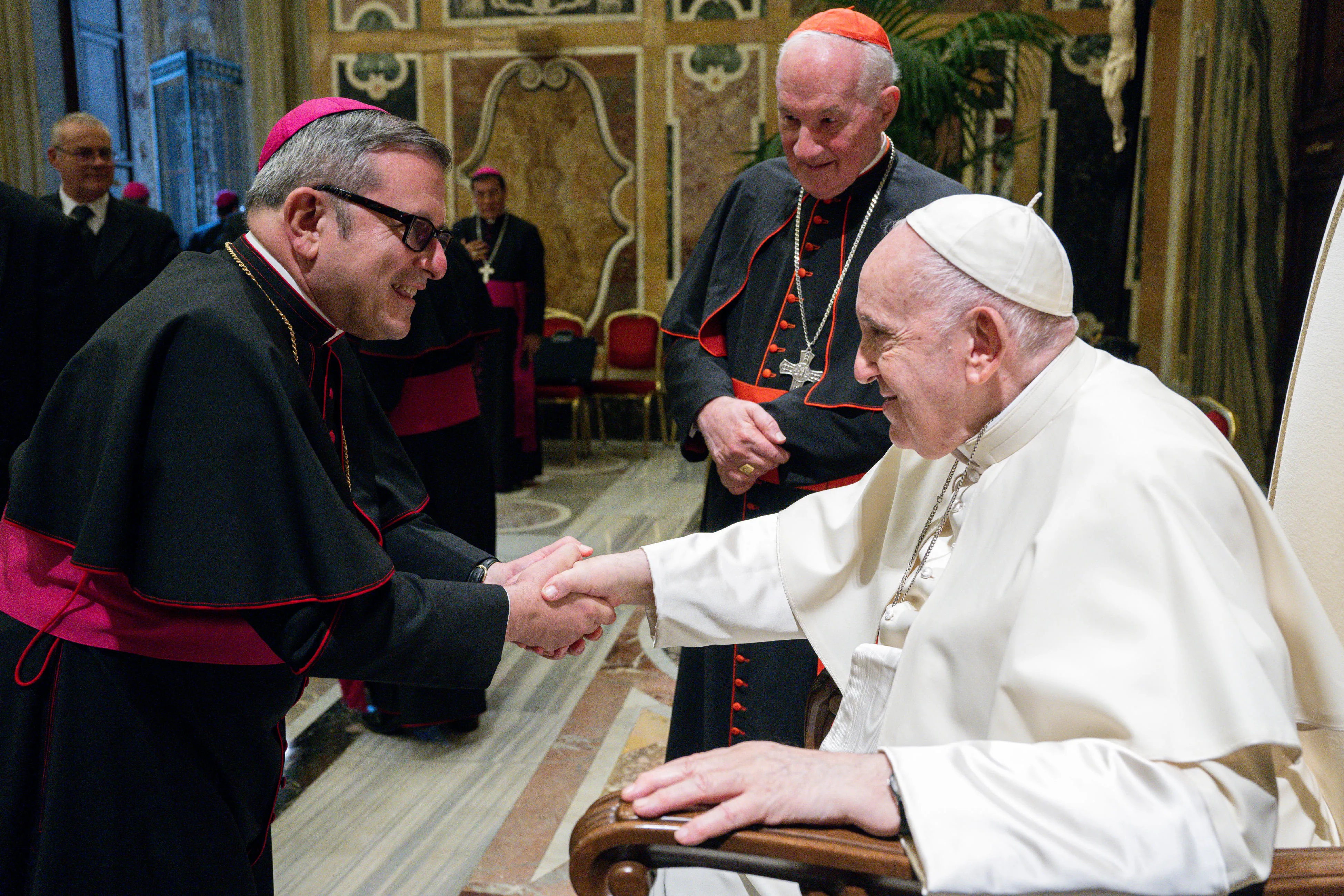
Bishop Gregory Gordon greets Pope Francis at the end of the course Sept. 19, 2022. Vatican Media
While the formal theme of this year’s seminar was how to announce the Gospel in changing times, Pohlmeier, Gordon, and Bishop Louis Tylka of Peoria, Illinois, said the unofficial topic of the week was synodality.
What they talked about
“We’re in the midst of the synod,” Tylka, who attended the seminar Sept. 1–8, told CNA by phone from his diocese. So the course, he added, focused on questions such as: “What does it mean to be a synodal Church? What is the ministry of the bishop in relation to that?”
Care for the planet and one’s neighbor, themes important to Pope Francis’ pontificate, were also a major part of the seminar, Tylka said.
The week’s presentations also covered child protection and the sexual abuse crisis.
“That’s one of those things that I think we will take home, saying we will be very, very careful not to neglect,” Gordon said.
Some talks, Pohlmeier noted, were directly about synodality and what it means. At the same time, those of a more practical nature, such as canon law for bishops, “would always include some comment on the synodal approach.”
“You’re going to get different articulations of what that means depending on who you talk to, but in general, my understanding is that it is more of a listening posture,” the St. Augustine bishop said.
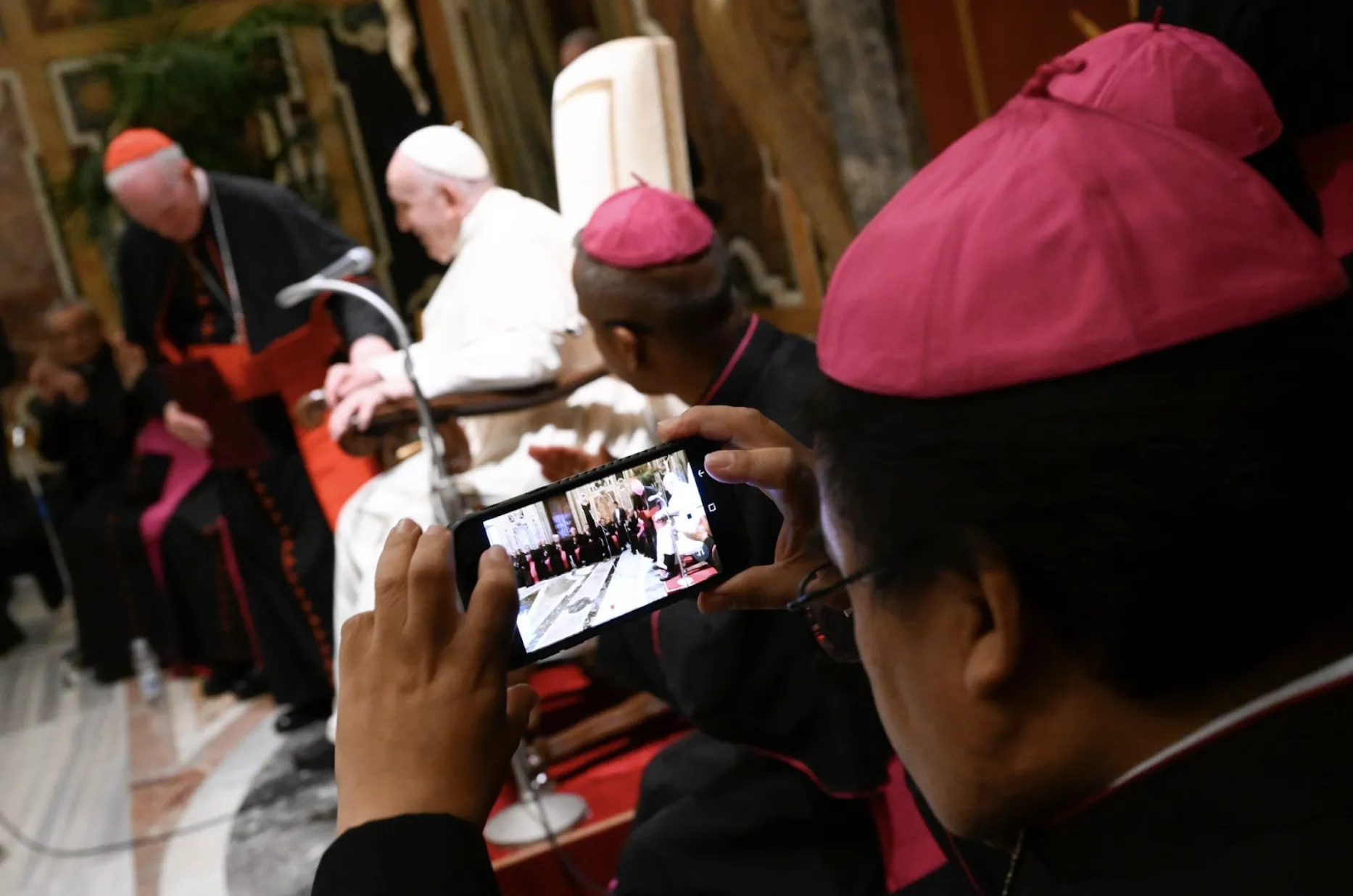
A bishop takes a photo of Pope Francis during their encounter on Sept. 19, 2022. Vatican Media
Bishop Gordon said Pope Francis himself modeled this listening attitude in their meeting with him on the final day of formation.
In the nearly two-hour meeting, he said most of the time was spent with the pope answering the bishops’ questions. “So you finished the course, [the pope] said. You’ve heard a lot already… Now I want to hear from you.”
This was Gordon’s big takeaway from the week: “It has to go back to the Holy Father’s words to us as he was answering our own questions, you know, asking us to exercise that episcopal closeness.”
The week also included time for communal prayer, Mass, adoration, and confession.
Bishop Tylka of Peoria said his personal opinion is that “a big part of synodality is the willingness and openness to create space for people to share their stories, to share their own encounters with Christ, to share their own experiences of how life is going.”
“So I think the role of the bishop clearly is to model that openness and that willingness to engage in dialogue,” he said.
This was my small group for discussion on Synodality! What an amazing group of bishops from around the world. Such a rich discussion on the Church! pic.twitter.com/fIOPLXwnfo
But there is also a lighter side to being a new bishop, as Pohlmeier evidenced with an amusing scene from the end of the week.
“Here we are, brand new and so … we got instructions on what we’re supposed to wear to meet the pope,” Pohlmeier said.
He explained that bishops in the Latin Church have two main styles of a full-length garment called a cassock. The new bishops were told to meet the pope. They should wear a black cassock with red trim, a purple fascia, and a purple zucchetto. (There is also a purple cassock with red trim for special liturgical events.)
Pohlmeier said it was funny to watch the bishops get ready for Mass in St. Peter’s Basilica and, afterward, the meeting with Pope Francis. Many of them were helping each other figure out where each piece of the complicated attire went — including the tall headpiece, called a mitre, which bishops wear to denote their office.
Today I joined the celebration in St Peter’s for the beatification of Blessed John Paul I. The rain did not dampen the joy of lifting up the ‘Smiling Pope.’ Humbled to be with the universal Church for such a celebration. pic.twitter.com/08AtzMUlMd
“Guys are literally opening up bags that haven’t been opened with miters from right there, from Euroclero,” Pohlmeier said, pointing over his shoulder in the direction of a clerical supply store next to St. Peter’s Square.
“You could see everybody that bought one this morning because they all matched,” he chuckled. “There were several people that were literally opening it up and pulling it out of the package and trying to get it on straight, and get things attached right, and not sure what clips go where and what’s right.”
“Those kinds of things are funny,” Pohlmeier said, “but nobody just tells you, ‘OK, buy this stuff, here’s what you need.’”
Another article of similar ilk, from the Oct. issue of First Things, is authored by a Brit, Nigel Biggar. Entitled “A Christian Defense of American Empire”, it is found at https://www.firstthings.com/article/2022/10/a…
The Brit concludes that American Empire (imperfect though it has been and once again may be) offers the greater good to the greater number when the alternative hegemon is China.
As a child reaching adulthood in the industrial powerhouse of fossil-fuel-heavy Pennsylvania (also our country’s birthplace), I suggest we Christians drill and frack and restore our faith till the cows turn green with hope and power and conquest. As the Green Knight in the tale of Sir Gawain and his horse were green, so too can cows and Christian Americans be.
The “synodal process” (second from the bottom), not a “piecemeal Vatican III,” but rather a cancel-culture deconstruction of all former councils, and even the idea of ecumenical councils.
As with the 1960ish Marshall McLuhan (“the medium is the message”), now the plebiscite “process is the message.” The Deposit of Faith faithfully handed on, what’s that? And, who needs successors of the Apostles when we have “facilitators of the fluid and “endless journey” of synodality?
@The Order of Philosophy. “In philosophy, the order of ideas is set not by nature nor by rule, but by wisdom” (Dr DeMarco). While DeMarco correctly seeks to reunite what is eternally united with God, it’s a premise that leans more toward faith than reason. Philosophy by nature, the pursuit of Wisdom, reaches that wisdom by reason.
Aquinas’ premise of the intellectual interface of faith and reason establishes the rules, those self evident principles apprehended by the intellect that reason measures. It’s the true axiom of reasoned research and the nexus of reconciling science with eternal wisdom, the end of philosophy.
I’ll second Meiron’s suggestion of inclusion of Jeff Mirus’ article, “Exclusion – drive out the wicked from among you”, in Catholic Culture.
You can include today’s Mirus article in the next round of Extra, extra!






Recommended inclusion on the list is Jeff Mirus’ Catholic Culture commentary on excluding evil from institutions. Arguing from the premise that evil is the privation or absence of good, excluding it will necessarily allow a greater good to predominate. Very interesting. https://www.catholicculture.org/commentary/catholic-exclusion-drive-out-wicked-from-among-you/
Another article of similar ilk, from the Oct. issue of First Things, is authored by a Brit, Nigel Biggar. Entitled “A Christian Defense of American Empire”, it is found at
https://www.firstthings.com/article/2022/10/a…
The Brit concludes that American Empire (imperfect though it has been and once again may be) offers the greater good to the greater number when the alternative hegemon is China.
As a child reaching adulthood in the industrial powerhouse of fossil-fuel-heavy Pennsylvania (also our country’s birthplace), I suggest we Christians drill and frack and restore our faith till the cows turn green with hope and power and conquest. As the Green Knight in the tale of Sir Gawain and his horse were green, so too can cows and Christian Americans be.
The “synodal process” (second from the bottom), not a “piecemeal Vatican III,” but rather a cancel-culture deconstruction of all former councils, and even the idea of ecumenical councils.
As with the 1960ish Marshall McLuhan (“the medium is the message”), now the plebiscite “process is the message.” The Deposit of Faith faithfully handed on, what’s that? And, who needs successors of the Apostles when we have “facilitators of the fluid and “endless journey” of synodality?
Before you know it, even the Council of Nicaea will be painted as a Chinese sort of “provisional agreement” along the path of historical relativism. About which, some reflections: https://www.catholicworldreport.com/2022/10/18/opinion-yesterdays-council-of-nicaea-and-todays-synodism/
@The Order of Philosophy. “In philosophy, the order of ideas is set not by nature nor by rule, but by wisdom” (Dr DeMarco). While DeMarco correctly seeks to reunite what is eternally united with God, it’s a premise that leans more toward faith than reason. Philosophy by nature, the pursuit of Wisdom, reaches that wisdom by reason.
Aquinas’ premise of the intellectual interface of faith and reason establishes the rules, those self evident principles apprehended by the intellect that reason measures. It’s the true axiom of reasoned research and the nexus of reconciling science with eternal wisdom, the end of philosophy.
I’ll second Meiron’s suggestion of inclusion of Jeff Mirus’ article, “Exclusion – drive out the wicked from among you”, in Catholic Culture.
You can include today’s Mirus article in the next round of Extra, extra!
Oops. Yesterday’s Mirus article, Oct. 18, “He’s back . . .”