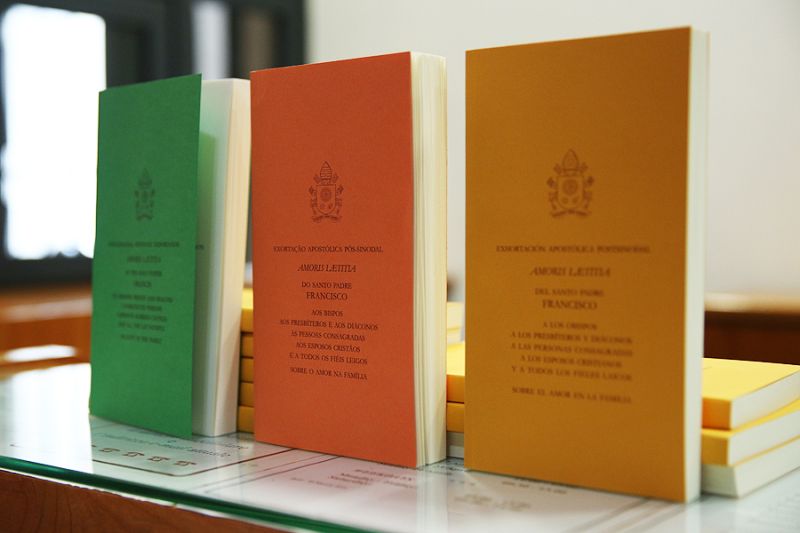
 Post Francis’ post-synodal apostolic exhortation Amoris Laetitia in Vatican City on April 8, 2016. / Credit: Daniel Ibanez/CNA
Vatican City, Oct 3, 2023 / 14:00 pm (CNA).
The Vatican on Monday publicly released responses to 10 “dubia” submitted by Czech Cardinal Dominik Duka regarding “the administration of the Eucharist to divorced couples living in a new union.”
Originally submitted by the archbishop emeritus of Prague on July 13 on behalf of the Czech Bishops’ Conference, the Dicastery for the Doctrine of the Faith’s response — signed both by Pope Francis and new prefect Cardinal Victor Manuel Fernández — had been issued to the Czech cardinal on Sept. 25.
At the heart of Duka’s dubia and the Vatican’s response was the practical application of Amoris Laetitia (“The Joy of Love”), Pope Francis’ apostolic exhortation issued after the 2015 Synod on the Family. The questions submitted focus on pastoral guidance for the reception of Communion by those sacramentally married but “divorced and remarried” to another person other than their spouse.
Read the text of the Dicastery for the Doctrine of the Faith’s response below, translated by CNA’s Matthew Santucci:
Response to a series of questions, proposed by His Eminence Cardinal Dominik Duka, OP, regarding the administration of the Eucharist to divorced couples living in a new union.
On July 13, 2023, a request was received by this department from His Eminence Cardinal Dominik Duka, OP, archbishop emeritus of Prague, on behalf of the Czech Bishops’ Conference, who asks a series of questions regarding the administration of the Eucharist to divorced people living in a new union.
Although some of the questions are not drafted clearly enough and, therefore, may be a harbinger of some inaccuracies, this dicastery intends to respond to help resolve the doubts raised by them.
-
Is it possible for a diocese in a union of the bishops’ conference to make decisions completely autonomously, referring to the facts cited in questions 2 and 3?
The apostolic exhortation Amoris Laetitia, a document of the ordinary pontifical magisterium, towards which all are called to offer the homage of intelligence and will, states that “priests have the duty to accompany [the divorced and remarried] in helping them to understand their situation according to the teaching of the Church and the guidelines of the bishop.” In this sense, it is possible, indeed it is desirable, that the ordinary of a diocese establishes some criteria which, in line with the teaching of the Church, can help priests in the accompaniment and discernment of divorced people living in a new union.
-
Can Pope Francis’ response to the question from the pastoral section of the diocese of Buenos Aires, given that the text was published in the Acta Apostolicae Sedis, be considered an affirmation of the ordinary magisterium of the Church?
As indicated in the rescript accompanying the two documents on the Acta Apostolicae Sedis, these are published “velut magisterium authenticum,” that is, as authentic magisterium (teaching).
-
Is it a decision of the ordinary magisterium of the Church based on the document Amoris Laetitiae?
As the Holy Father recalls in his letters to the delegate of the pastoral region of Buenos Aires, Amoris Laetitia was the result of the work and prayer of the whole Church, with the mediation of two synods and the pope. This document is based on the magisterium of previous popes, who already recognized the possibility for divorced people in new unions to access the Eucharist, as long as they assume “the duty to live in complete continence, that is, by abstinence from the acts proper to married couples,” as it was proposed by John Paul II or to “commit (themselves) to living their relationship … as friends” as proposed by Benedict XVI. Francis maintains the proposal of full continence for the divorced and remarried in a new union, but admits that there may be difficulties in practicing it and therefore allows in certain cases, after adequate discernment, the administration of the sacrament of reconciliation even when it is not possible in being faithful to the continence proposed by the Church.
-
Is it Amoris Laetitiae’s intention to institutionalize this solution through a permit or an official decision for individual couples?
Point 1 of the document “basic criteria for the application of chapter VIII of Amoris Laetitia” expressly states: “It is not appropriate to speak of ‘permissions’ to access the sacraments, but rather of a process of discernment accompanied by a pastor. It is a ‘personal and pastoral’ discernment” (AL, 300). It is therefore a question of pastoral accompaniment as an exercise of the “via caritatis,” which is nothing other than an invitation to follow the path “of Jesus: of mercy and reinstatement.” Amoris Laetitia opens the possibility of accessing the sacraments of reconciliation and the Eucharist when, in a particular case, there are limitations that attenuate responsibility and culpability (guilt). On the other hand, this process of accompaniment does not necessarily end with the sacraments, but can be oriented towards other forms of integration in the life of the Church: a greater presence in the community, participation in prayer or reflection groups, or involvement in various ecclesial services.
-
Who should be the evaluator of the situation given the couples in question, any confessor, local parish priest, vicar forane, episcopal vicar, or penitentiary?
It is about starting an itinerary of pastoral accompaniment for the discernment of each individual person. Amoris Laetitia underlines that all priests have the responsibility to accompany interested people on the journey of discernment. It is the priest who welcomes the person, listens to him carefully and shows him the maternal face of the Church, accepting his right intention and his good purpose to place his whole life in the light of the Gospel and to practice charity. But it is each person, individually, who is called to put himself before God and expose his conscience to him, with both his possibilities and limits. This conscience, accompanied by a priest and enlightened by the guidelines of the Church, is called to be formed to evaluate and give a sufficient judgment to discern the possibility of accessing the sacraments.
-
Would it be appropriate for these to be dealt with by the competent ecclesiastical tribunal?
In cases where it is possible to establish a declaration of nullity, the appeal to the ecclesiastical tribunal will be part of the discernment process. The Holy Father wanted to simplify these processes through the motu proprio Mitis Iudex. The problem arises in more complex situations in which it is not possible to obtain a declaration of nullity. In these cases, a process of discernment may also be possible which stimulates or renews the personal encounter with Jesus Christ, also in the sacraments.
-
Can this principle be applied to both parties of a civilly divorced marriage, or distinguish the degree of fault and proceed accordingly?
St. John Paul II had already stated that “the judgment of one’s state of grace obviously belongs only to the person involved, since it is a question of examining one’s conscience.” Therefore, it is a process of individual discernment in which “the divorced and remarried should ask themselves: how did they act towards their children when the conjugal union entered into crisis; whether or not they made attempts at reconciliation; what has become of the abandoned party; what consequences the new relationship has on the rest of the family and the community of the faithful; and what example is being set for young people who are preparing for marriage. A sincere reflection can strengthen trust in the mercy of God, which is not denied anyone.”
-
In the case of this single permission, is it to be understood that married life (the sexual aspect) must not be mentioned in the sacrament of reconciliation?
Even in the sacrament of marriage, the sexual life of the spouses is the subject of an examination of conscience to confirm that it is a true expression of love and that it helps growth in love. All aspects of life must be placed before God.
-
Wouldn’t it be appropriate for the entire issue to be explained better in the text of your competent dicastery?
Based on the words of the Holy Father in the letter of response to the delegate of the Buenos Aires pastoral region, in which it was stated that there are no other interpretations, it seems that the issue is sufficiently explained in the aforementioned document.
-
How to proceed to establish internal unity, but also to avoid disturbing the ordinary magisterium of the Church?
It would be appropriate for the episcopal conference to agree on some minimum criteria, to implement the proposals of Amoris Laetitia, which help priests in the processes of accompaniment and discernment regarding the possible access to the sacraments of some divorcees in a new union, without prejudice to the legitimate authority that each bishop has in his own diocese.
Ex Audientia Die: 25/9/2023
Franciscus
Victor Fernández
[…]


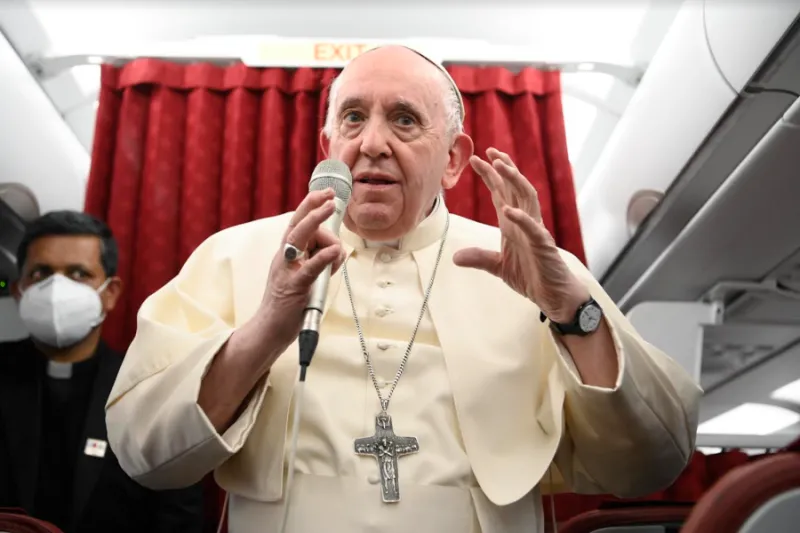



Yes, “development in the same direction” (Pope Francis)…
The wisdom of the cited 5th-century St. Vincent Lerins is the core, of course, to 19th-century St. John Henry Cardinal Newman (the “father of the Second Vatican Council”), who spells out the message in his “Development of Christian Doctrine.” And which, or course, was not unknown to St. Pope Paul VI when he already (!) clarified moral theology in response to theologians of the day who are still hanging around. (A clarification beautifully fleshed out in Pope St. John Paul II in his “Theology of the Body”.) In “The Development of Christian Doctrine,” Newman appeals, in part, to a biological analogy whereby growth (“development”) is one thing, while corruption is another. Unlike the novelty of any “New Paradigm” misappropriated from the research method of the natural sciences:
“I venture to set down seven notes of varying cogency, independence, and applicability to discriminate healthy developments of an idea from its state of corruption and decay, as follows: “There is no corruption if it retains:
(1) One and the same TYPE [doctrine/natural law v. disconnected pastoral accompaniment?],
(2) The same PRINCIPLES [sound philosophy v. neo-Hegelianism, e.g., any distortion of the four cryptic principles advanced in Evengalium Gaudi],
(3) The same ORGANIZATION [the Barque of Peter v. all religions framed equivalently (?) as ‘the will of God’?];
(4) If its beginnings ANTICIPATE its subsequent phases [Scripture/Catechism/Veritatis Splendor v. Germanic normalization of homosexual activity, etc.?],
(5) Its later phenomena PROTECT and subserve its earlier [Veritatis Splendor/Familiarus Consortio v. the published discussions by the Vatican’s Pontifical Academy of Life, in ‘Theological Ethics of Life: Scripture, Tradition, and Practical Challenges,’ 2021];
(6) If it has a power of assimilation and REVIVAL [New Evangelization v. mutations nested within Amazonia and Germania?], and
(7) A vigorous ACTION from first to last…” [vigorous as in ‘steadfastness’–because (!) fully engaging new challenges and double-speak?].”
Is there any wonder what St. Vincent of Lerins himself would say, specifically, about the “direction” of the unfolding “seamless garment”: the Sexual Revolution, then our contraceptive culture, then abortion and euthanasia, then the LBBTQ uprising and anti-binary gender theory, and then the block-party fantasies of the German “synodal way”?
A plea for enlightenment and godliness. Let the leadership be consumed with desire for virtue and true christianity.
Psalm 119:73 Your hands have made and fashioned me; give me understanding that I may learn your commandments.
2 Timothy 3:16-17 All Scripture is breathed out by God and profitable for teaching, for reproof, for correction, and for training in righteousness, that the man of God may be competent, equipped for every good work.
Hebrews 13:8 Jesus Christ is the same yesterday and today and forever.
Matthew 5:1-48 Seeing the crowds, he went up on the mountain, and when he sat down, his disciples came to him. And he opened his mouth and taught them, saying: “Blessed are the poor in spirit, for theirs is the kingdom of heaven. “Blessed are those who mourn, for they shall be comforted. “Blessed are the meek, for they shall inherit the earth. …
Proverbs 17:15 He who justifies the wicked and he who condemns the righteous are both alike an abomination to the Lord.
Thank you for your zeal the considering the truth.
A celibate clerical caste system who for centuries hailed sexual relations in marriage as unworthy or outright sinful is to be disregarded , as THOMAS AQUINAS stated ‘ priests should be celibate lest they touch the sacred vessels defiled’ HE WAS REFERENCING MARRIED MEN WHO HAD RELATIONS WITH THEIR WIVES BEING PRIESTS, THIS ATTITUDE PREVAILED FOR CENTURIES
Theological discussion if hypothetical [a Catholic tradition] may have value. Or it may not, Pope Francis acknowledging simply hypothetical proposals, then adding that the participants were seeking a Church advancement rather than a Lerinian response. That from a pontiff is a consideration of the hypothesis.
If there’s a known percentage of Catholics who abide by Humane Vitae on contraception it is a minority likely somewhere below 10% [some surveys 2%]. Few priests address contraception from the pulpit, as if Humane Vitae, the Catechism 2370 don’t exist. Unfortunately, Paul VI spoke correctly, that “contraception will lead to infidelity, the lowering of morality, a loss of respect for women, and the belief that humans have unlimited dominion over the body”. Divorce among Catholics is now on par with non Catholics.
Discussion on finding general legitimacy for contraception doesn’t make sense. Unless, legitimization would remove the penalty for so many on what 2370 teaches is intrinsically evil. What is reasonable considering the dramatic coincidence of contraceptive use and the breakdown of morality is an increased effort to address the issue. Furthermore, if there’s a marker for the wide loss of faith in the Eucharistic real presence, the sacrament of life, it’s the deprecation of the value of life from its transmission to birth.
A change on what the Church has declared an intrinsic evil will precipitate reconsideration of all intrinsically evil acts. Is that the hidden stratagem, a Synod on Synodality agenda?.
It is clear that our Pope, who has promised he would not change doctrine, (he is a child of the Church), will continue to treat anything that is intrinsically evil as evil. In this interview, which covered many subjects besides contraceptives, he said: But know that dogma, morality, is always in a path of development, but development in the same direction.” In the same direction is a critical part of the sentence which must not be trivialized or ignored.
Every serious Catholic knows what is going on here without the minute parsing of the bafflegab persiflage because we have already seen it so many times already in the past 9 years.
Saint Vincent of Lerins – Pray for us.
Short answer to the title’s question – not if you want to get rid of abortion.
Did I say “yes”?
Should have been “no if you want to get rid of abortion”.