


Rome Newsroom, Jul 30, 2022 / 04:38 am (CNA).
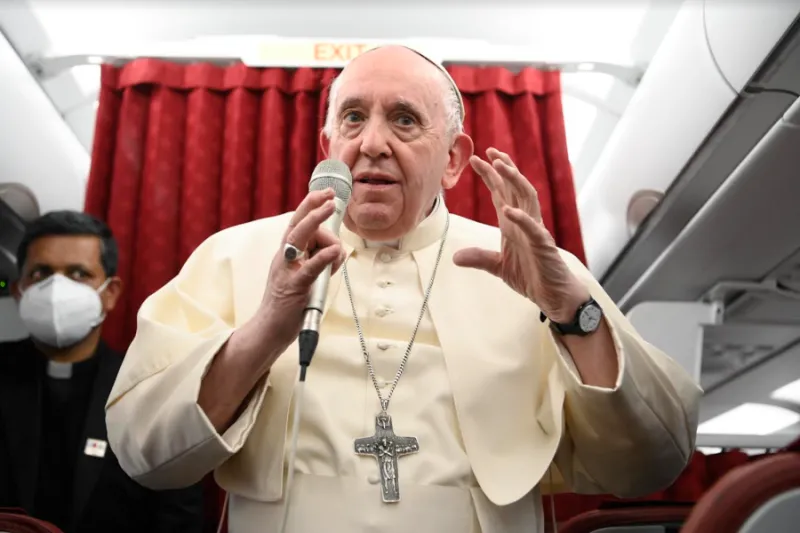
Can the Church’s teaching on birth control change? During Pope Francis’ return flight from Canada, a journalist asked him about the possibility of a development in the Church’s teaching on contraception.
“This is very timely. But know that dogma, morality, is always in a path of development, but development in the same direction,” Pope Francis responded on July 30.
The pope went on to say that he thinks that the development of Catholic moral doctrine, in general, is fine but recommended in particular that it follows the rules outlined by the 5th-century theologian St. Vincent of Lérins.
Pope Francis explained that St. Vincent of Lérins taught “that true doctrine in order to go forward, to develop, must not be quiet, it develops ut annis consolidetur, dilatetur tempore, sublimetur aetate.”
“That is, it consolidates with time, it expands and consolidates, and becomes more steady, but is always ‘progressing.’ That is why the duty of theologians is research, theological reflection. You cannot do theology with a ‘no’ in front of it … the magisterium will be the one to say no,” the pope added.
Francis also addressed the recent controversy over a book published by the Vatican’s publishing house, which discussed “the possible legitimacy of contraception in certain cases.”
The book “Theological Ethics of Life: Scripture, Tradition, and Practical Challenges” was a 528-page synthesis of a theological seminar sponsored by the Pontifical Academy for Life in 2021.
Pope Francis said: “On the issue of contraception, I know there is a publication out on this issue and other marriage issues.”
“These are the proceedings of a congress and in a congress there are hypotheses, then they discuss among themselves and make proposals. We have to be clear: those who made this congress did their duty because they tried to move forward in doctrine, but in an ecclesial sense, not out, as I said with that rule of St. Vincent of Lerins.”
On the subject of birth control, the Catechism of the Catholic Church states that “legitimate intentions on the part of the spouses do not justify recourse to morally unacceptable means (for example, direct sterilization or contraception).”
St. Paul VI issued Humanae Vitae, the landmark encyclical reaffirming Church teaching against contraception, on July 25, 1968.
In the encyclical, Paul VI warned of serious social consequences if the widespread use of contraceptives became accepted. He predicted that it would lead to infidelity, the lowering of morality, a loss of respect for women, and the belief that humans have “unlimited dominion” over the body.
Pope Francis’ press conference on the papal plane touched on many topics, including his potential retirement and his response to the German “Synodal Way.” Pope Francis also described the forced removal of Indigenous children from their families and their treatment in Canada’s residential school system as a form of “cultural genocide.”
During his week-long journey to Canada, the pope traveled to Edmonton, Québec, and Iqaluit on what he called a “penitential pilgrimage” to apologize to the country’s indigenous communities.
Upon his arrival in Rome on Saturday morning, the pope went to Rome’s Basilica of St. Mary Major to spend a moment in prayer before an icon of the Blessed Virgin Mary.
If you value the news and views Catholic World Report provides, please consider donating to support our efforts. Your contribution will help us continue to make CWR available to all readers worldwide for free, without a subscription. Thank you for your generosity!
Click here for more information on donating to CWR. Click here to sign up for our newsletter.



Yes, “development in the same direction” (Pope Francis)…
The wisdom of the cited 5th-century St. Vincent Lerins is the core, of course, to 19th-century St. John Henry Cardinal Newman (the “father of the Second Vatican Council”), who spells out the message in his “Development of Christian Doctrine.” And which, or course, was not unknown to St. Pope Paul VI when he already (!) clarified moral theology in response to theologians of the day who are still hanging around. (A clarification beautifully fleshed out in Pope St. John Paul II in his “Theology of the Body”.) In “The Development of Christian Doctrine,” Newman appeals, in part, to a biological analogy whereby growth (“development”) is one thing, while corruption is another. Unlike the novelty of any “New Paradigm” misappropriated from the research method of the natural sciences:
“I venture to set down seven notes of varying cogency, independence, and applicability to discriminate healthy developments of an idea from its state of corruption and decay, as follows: “There is no corruption if it retains:
(1) One and the same TYPE [doctrine/natural law v. disconnected pastoral accompaniment?],
(2) The same PRINCIPLES [sound philosophy v. neo-Hegelianism, e.g., any distortion of the four cryptic principles advanced in Evengalium Gaudi],
(3) The same ORGANIZATION [the Barque of Peter v. all religions framed equivalently (?) as ‘the will of God’?];
(4) If its beginnings ANTICIPATE its subsequent phases [Scripture/Catechism/Veritatis Splendor v. Germanic normalization of homosexual activity, etc.?],
(5) Its later phenomena PROTECT and subserve its earlier [Veritatis Splendor/Familiarus Consortio v. the published discussions by the Vatican’s Pontifical Academy of Life, in ‘Theological Ethics of Life: Scripture, Tradition, and Practical Challenges,’ 2021];
(6) If it has a power of assimilation and REVIVAL [New Evangelization v. mutations nested within Amazonia and Germania?], and
(7) A vigorous ACTION from first to last…” [vigorous as in ‘steadfastness’–because (!) fully engaging new challenges and double-speak?].”
Is there any wonder what St. Vincent of Lerins himself would say, specifically, about the “direction” of the unfolding “seamless garment”: the Sexual Revolution, then our contraceptive culture, then abortion and euthanasia, then the LBBTQ uprising and anti-binary gender theory, and then the block-party fantasies of the German “synodal way”?
A plea for enlightenment and godliness. Let the leadership be consumed with desire for virtue and true christianity.
Psalm 119:73 Your hands have made and fashioned me; give me understanding that I may learn your commandments.
2 Timothy 3:16-17 All Scripture is breathed out by God and profitable for teaching, for reproof, for correction, and for training in righteousness, that the man of God may be competent, equipped for every good work.
Hebrews 13:8 Jesus Christ is the same yesterday and today and forever.
Matthew 5:1-48 Seeing the crowds, he went up on the mountain, and when he sat down, his disciples came to him. And he opened his mouth and taught them, saying: “Blessed are the poor in spirit, for theirs is the kingdom of heaven. “Blessed are those who mourn, for they shall be comforted. “Blessed are the meek, for they shall inherit the earth. …
Proverbs 17:15 He who justifies the wicked and he who condemns the righteous are both alike an abomination to the Lord.
Thank you for your zeal the considering the truth.
A celibate clerical caste system who for centuries hailed sexual relations in marriage as unworthy or outright sinful is to be disregarded , as THOMAS AQUINAS stated ‘ priests should be celibate lest they touch the sacred vessels defiled’ HE WAS REFERENCING MARRIED MEN WHO HAD RELATIONS WITH THEIR WIVES BEING PRIESTS, THIS ATTITUDE PREVAILED FOR CENTURIES
Theological discussion if hypothetical [a Catholic tradition] may have value. Or it may not, Pope Francis acknowledging simply hypothetical proposals, then adding that the participants were seeking a Church advancement rather than a Lerinian response. That from a pontiff is a consideration of the hypothesis.
If there’s a known percentage of Catholics who abide by Humane Vitae on contraception it is a minority likely somewhere below 10% [some surveys 2%]. Few priests address contraception from the pulpit, as if Humane Vitae, the Catechism 2370 don’t exist. Unfortunately, Paul VI spoke correctly, that “contraception will lead to infidelity, the lowering of morality, a loss of respect for women, and the belief that humans have unlimited dominion over the body”. Divorce among Catholics is now on par with non Catholics.
Discussion on finding general legitimacy for contraception doesn’t make sense. Unless, legitimization would remove the penalty for so many on what 2370 teaches is intrinsically evil. What is reasonable considering the dramatic coincidence of contraceptive use and the breakdown of morality is an increased effort to address the issue. Furthermore, if there’s a marker for the wide loss of faith in the Eucharistic real presence, the sacrament of life, it’s the deprecation of the value of life from its transmission to birth.
A change on what the Church has declared an intrinsic evil will precipitate reconsideration of all intrinsically evil acts. Is that the hidden stratagem, a Synod on Synodality agenda?.
It is clear that our Pope, who has promised he would not change doctrine, (he is a child of the Church), will continue to treat anything that is intrinsically evil as evil. In this interview, which covered many subjects besides contraceptives, he said: But know that dogma, morality, is always in a path of development, but development in the same direction.” In the same direction is a critical part of the sentence which must not be trivialized or ignored.
Every serious Catholic knows what is going on here without the minute parsing of the bafflegab persiflage because we have already seen it so many times already in the past 9 years.
Saint Vincent of Lerins – Pray for us.
Short answer to the title’s question – not if you want to get rid of abortion.
Did I say “yes”?
Should have been “no if you want to get rid of abortion”.