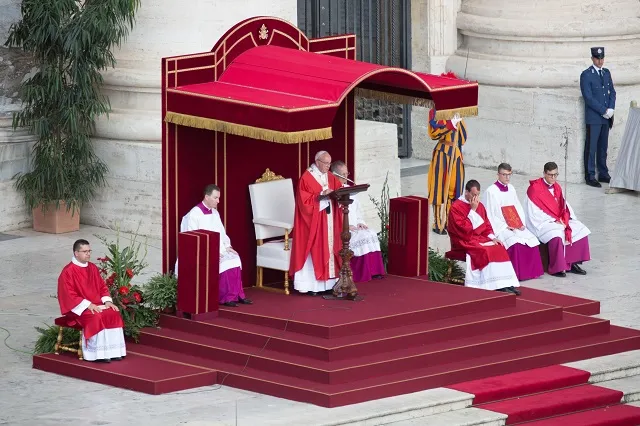
Vatican City, Jun 29, 2017 / 03:01 am (CNA/EWTN News).- On Thursday, the Solemnity of Saints Peter and Paul, Pope Francis said that we can’t just know about our faith, but we must live our faith, with Jesus as the center of our hearts and lives.
“The question of life demands a response of life. For it counts little to know the articles of faith if we do not confess Jesus as the Lord of our lives,” the Pope said June 29.
“Today he looks straight at us and asks, ‘Who am I for you?’ As if to say: ‘Am I still the Lord of your life, the longing of your heart, the reason for your hope, the source of your unfailing trust?’
Jesus is asking us today the same questions he asked to his disciples: “Who do people say that I am?” and “Who do you say that I am?” Francis continued. In the end, only Peter answers that he is “the Christ, the Son of the living God.”
“Along with Saint Peter, we too renew today our life choice to be Jesus’ disciples and apostles. May we too pass from Jesus’ first question to his second, so as to be ‘his own’ not merely in words, but in our actions and our very lives,” he said.
This is the “crucial question,” he continued, especially for pastors. “It is the decisive question. It does not allow for a non-committal answer, because it brings into play our entire life.”
Pope Francis spoke to pilgrims gathered in St. Peter’s Square for his Mass celebrating the Solemnity of Saints Peter and Paul, patrons of the city of Rome. During the ceremony, he blessed the pallia to be bestowed on the 32 new metropolitan archbishops who were present, all appointed throughout the previous year.
The pallium is a white wool vestment, adorned with six black silk crosses. Dating back to at least the fifth century, the wearing of the pallium by the Pope and metropolitan archbishops symbolizes authority as well as unity with the Holy See.
The title of “metropolitan bishop” refers to the diocesan bishop or archbishop of a metropolis, namely, the primary city of an ecclesiastical province or regional capital.
Traditionally the Pope bestows the stole to the new archbishops June 29 each year. The rite is a sign of communion with the See of Peter. It also serves as a symbol of the metropolitan archbishop’s jurisdiction in his own diocese as well as the other particular dioceses within his ecclesiastical province.
However, as a sign of “synodality” with local Churches, Pope Francis decided in 2015 that new metropolitan archbishops will officially be imposed with the pallium in their home diocese, rather than the Vatican.
So while the new archbishops still journey to Rome to receive the pallium during the liturgy with the Pope, the official imposition ceremony is in their home diocese, allowing more faithful and bishops in dioceses under the archbishop’s jurisdiction to attend the event.
In his homily, Pope Francis reflected on three words from the liturgy that he said are “essential for the life of an apostle: confession, persecution and prayer.”
For confession, the Pope spoke of the confession of faith, which means “to acknowledge in Jesus the long-awaited Messiah, the living God, the Lord of our lives.”
We should ask ourselves, he said, if we are “parlor Christians,” who only love to sit and chat about how things are going in the Church and the world, or “apostles on the go,” people “who confess Jesus with their lives because they hold him in their hearts.”
We can’t be half-hearted, he urged, but must be on fire with love for Christ, not looking for the easy way out, but daily risking ourselves to put out “into the deep.”
“Those who confess their faith in Jesus do as Peter and Paul did: they follow him to the end – not just part of the way, but to the very end.”
But doing so isn’t easy, and that’s when we come to the second word, he explained, because following the way of Christ, also means facing the cross and persecution.
Peter and Paul shed their blood for Christ, as well as the early Christian community as a whole. Even today, he continued, a great number of Christians are persecuted.
The Pope emphasized the words of the Apostle Paul, who said “to live was Christ, Christ crucified, who gave his life for him.”
“Apart from the cross, there is no Christ, but apart from the cross, there can be no Christian either,” Francis stated.
The Christian is called to “tolerate evil,” but tolerating evil doesn’t mean simply having patience and resignation, he explained, it means imitating Christ, accepting the cross with confidence, carrying the burden for Christ’s sake and for the sake of others – all the while knowing that we are not alone.
“Tolerating evil,” he continued, “means overcoming it with Jesus, and in Jesus’ own way, which is not the way of the world.”
This is why St. Paul writes: “I have fought the good fight, I have finished the race, I have kept the faith.” The essence of this “good fight,” the Pope emphasized, was living “for Jesus and for others,” giving your all. There is only one thing that Paul kept in his life, and that is his faith.
“Out of love, he experienced trials, humiliations and suffering, which are never to be sought but always accepted. In the mystery of suffering offered up in love, in this mystery, embodied in our own day by so many of our brothers and sisters who are persecuted, impoverished and infirm, the saving power of Jesus’ cross shines forth.”
Lastly, Pope Francis said that the life of an apostle must be a life of constant prayer.
“Prayer is the water needed to nurture hope and increase fidelity. Prayer makes us feel loved and it enables us to love in turn. It makes us press forward in moments of darkness because it brings God’s light. In the Church, it is prayer that sustains us and helps us to overcome difficulties.”
When St. Peter was in prison, it tell us in the Acts of the Apostles that “earnest prayer for him was made to God by the Church.”
“A Church that prays is watched over and cared for by the Lord. When we pray, we entrust our lives to him and to his loving care,” he said.
Francis concluded by praying that the blessed Apostles Peter and Paul, may “obtain for us a heart like theirs.”
Hearts that are wearied because they are constantly asking, knocking, interceding, weighed down by the many needs of people and situations that need to be handed over to God, but also at peace, because the Holy Spirit brings consolation and strength through prayer, he said.
“How urgent it is for the Church to have teachers of prayer, but even more so for us to be men and women of prayer, whose entire life is prayer!”
“The Lord answers our prayers. He is faithful to the love we have professed for him, and he stands beside us at times of trial.”
Just as the Lord accompanied the journey of the Apostles, “he will do the same for you, dear brother Cardinals,” he said.
“He will remain close to you too, dear brother Archbishops who, in receiving the pallium, will be strengthened to spend your lives for the flock, imitating the Good Shepherd who bears you on his shoulders.”
 […]
[…]







The Diocese of Winona-Rochester serves 130,000 Catholics. The Santa Barbara Pastoral Region serves over 1,000,000. Where else might Bishop Barron have been assigned?
Well, given the long-time scandal of careerism, but now the importance given to the peripheries, perhaps we can look forward to Cinderella-Cardinal Cupich someday being re-assigned to, say, the Diocese of Fairbanks, Alaska, where there are about 12,000 Catholics, and no Latin Masses.
Good idea!
As loyal as Bishop Barron is to the pontiff his assignment might be due to attachment to deceased traditions. Actually, the area is beautiful, Minnesota U has a campus in Winona [where my brother lectured], the original Mayo Clinic is in Rochester.
With all due respect, Fr. Morello I am so disappointed that Bishop Baron forgot his fellow priests. There are wonderful hard working priests that should have been referred to become Monsignors. I think he is too self serving. It’s very easy to get puffed up!
What are the real reasons behind this appointment? Why Bishop Barron? Is this a promotion, a gesture of confidence in the faithful and evangelically articulate Bishop? Or is this a type of demotion, a sign that the present Vatican administration is not satisfied with his theological message?
My guess, and that’s all it is, is that it’s getting a midwesterner like Barron back to the midwest.
Los Angeles seemed to be the place for a cleric like Bishop Barron, the city being the heart of cinematic and modern communication technological talent, where the Bishop could draw on the latest advances of know-how in this field for his worthy Word on Fire project. But the good Bishop has been maligned by both right and left. Since the present Vatican administration seems to be controlled by those more sympathetic to woke leftism, my suspicion is that these Vatican bureaucrats do not favor Bishop Barron’s center/right theology. Hence he was sidelined to a smaller diocese with less ecclesial influence…
I can’t help but see parallels to Venerable Fulton Sheen. A popular televangelist and auxiliary bishop of a major see is suddenly shipped off to a previously obscure diocese named Rochester to be the ordinary. I’ll be curious to see how this turns out in three years.
Bishop Sheen’s appointment to my home diocese (hardly obscure) was notable for his advocacy in race relations and his opposition to the war in Vietnam. Bishop Barron is about a decade younger than his predecessor was.
Look at it this way: Bishop Barron is a gifted writer and filmmaker. He’s been a professor most of his career. He only moved into leadership in 2012 as a seminary rector. He’s been #2/3 in a large diocese, but that’s not the same as being captain of his own ship. Maybe his gifts are better suited to his diocese in Minnesota, which is hardly a backwater.
Does everything have to have a political undercurrent?
No comparison!
Bishop Barron seems to be pleased with the appointment. So, it is best to leave it at that.
In reading Bishop Barron’s daily Gospel reflection, I note how often he states, “Your life is not about you.” Yet, The Word on Fire ministry sure seems to be all about Bishop Barron. All the videos of important people in Church history feature Bishop Barron prominently. Perhaps, if he had invited other prelates to be part of this series, I might be more inclined to believe him when he says, “Your life is not about you.”
Have you ever actually watched any of Bishop Barron’s conversations with prominent thinkers/rationalists/evolutionary professors…etc? His videos are the opposite of self-centered. God bless you and I hope you find it in your heart to see all life as a gift. Bishop Barron’s gifts are helping a great many people in a time when the world is very self-centered and prideful.
Thank you I agree and say AMEN
There are indeed striking parallels with Bishop Sheen. I recall his publicly welcoming his appointment (as Bishop Barron has) to Rochester N.Y. in the 1960s. The care of souls, he said, was his great concern. Rochester N.Y. was a far cry from New York City. It clearly did not require a man of Sheen’s great gifts. Likewise, Winona-Rochester is a world away from Los Angeles, and does not require an immensely gifted bishop. Now, as in Bishop Sheen’s day, high church appointments are politically charged. Let us hope and pray Bishop Barron’s tenure will not end as Bishop Sheen’s did.
Godly men appointed to high office are well received by the faithful. Yet, others have responsibility but lack fidelity to scripture and church tradition. Each must decide whom he will serve.
James 1:6-8 But let him ask in faith, with no doubting, for the one who doubts is like a wave of the sea that is driven and tossed by the wind. For that person must not suppose that he will receive anything from the Lord; he is a double-minded man, unstable in all his ways.
James 1:22-25 But be doers of the word, and not hearers only, deceiving yourselves. For if anyone is a hearer of the word and not a doer, he is like a man who looks intently at his natural face in a mirror. For he looks at himself and goes away and at once forgets what he was like. But the one who looks into the perfect law, the law of liberty, and perseveres, being no hearer who forgets but a doer who acts, he will be blessed in his doing.
Blessings to Bishop Barron and appreciation to he who appointed him.
I suspect the appointment, like many others, is a ‘test’ or stepping stone that others who have eventually became archbishops or cardinals went through: first as an auxiliary, then as the bishop of a smaller diocese to see if they can handle being in charge of a small place. Hopefully Bishop Barron can do good work both as bishop and overseeing Word On Fire – maybe a smaller diocese gives him leeway to continue to work on his media projects. But that’s just speculation.
I’ve always enjoyed my time with Barron when in Chicago and wish him the best in Minnesota.
AMEN i AGREE i AM A MEMBER OF WORD ON FIRE AND FOLLOW HIM FAITHFULLY AND I LIKE HIS WAY FO REACHING OUT ( NOT OLD FASHIONED)….MODERN……