

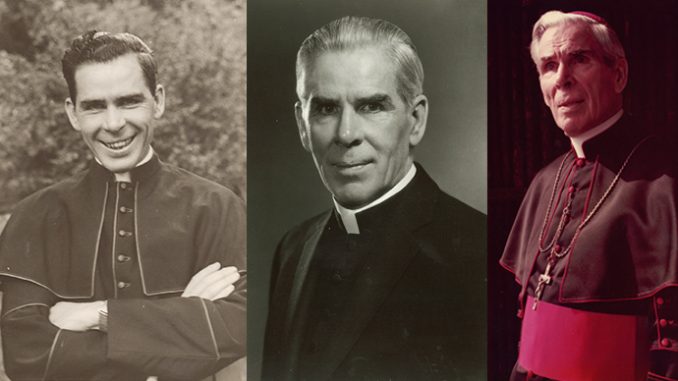
Archbishop Fulton Sheen (1895-1979) will be beatified and receive the title of “Blessed” at a beatification Mass on Thursday, September 24, at The Dome at America’s Center in St. Louis, Missouri.
Sheen was among the most popular and best-known Catholic evangelists and clerics of his time, and was known for his programs on radio and television. He was ordained a priest for the Diocese of Peoria in 1919, although he lived much of his life in New York.
His remains are now interred in Peoria’s Cathedral of St. Mary. A series of beatification events will be held in both Peoria and St. Louis, on September 15-26, in which members of the public are encouraged to participate.
St. Louis was selected as the location for the beatification mass because its Dome facility can accommodate 70,000 or more attendees.
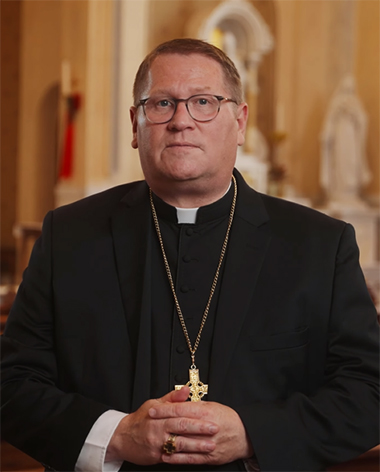
Bishop Louis Tylka, 55, has served as Bishop of Peoria since 2022 (and coadjutor bishop 2020-22). He was born in Harvey, Illinois, and grew up in the south Chicago suburb of Hazel Crest. He was ordained a priest for the Archdiocese of Chicago in 1996 and served 24 years as an archdiocesan parish priest before coming to Peoria.
Peoria is a mostly rural region of Illinois. The diocese serves 130,000 Catholics with 130 active priests. As Bishop of Peoria, Bishop Tylka’s role was to request Sheen’s canonization from Rome; at the canonization, he will read the papal bull in English declaring Sheen blessed.
CWR: What is the significance of Bishop Sheen’s beatification to the Diocese of Peoria?
Bishop Louis Tylka: This is a great moment for the Diocese of Peoria and the Church. We are proud of our native son, Archbishop Sheen. He was born in El Paso and grew up in Peoria. One of our own is reaching a significant moment in the life of the Church.
There’s something appropriate about having him beatified in St. Louis, however, as Archbishop Sheen is not just for Peoria but for the world. He combined his God-given talents and the technology of his day to share his faith in Jesus Christ with the world.
Although he died 47 years ago, he still wields a significant influence. There are many still alive that remember hearing him when he was on the radio and television or share with me that they remember meeting him.
And, I think that over the past 20 years, we’ve seen more interest in his work from younger people. I know that many of our young priests have been impacted by his writing and teaching and his call for a daily holy hour.
CWR: What are some of the stories you’ve heard personally about Archbishop Sheen?
Bishop Louis Tylka: He has an extensive extended family here; the joke is that you can’t throw a stone in Peoria without hitting a Sheen. I’ve had conversation with his niece, Delores Sheen, who’d talk about him coming over for dinner. Or another niece, Joan Sheen Cunningham, would speak affectionately to me about her uncle. They would share about his humanity, his playful nature, and that he’d like to tell jokes.
I’ve had many conversations with people who were inspired by him. In 2023, our vocations office organized a pilgrimage to France. We were at the burial site of St. Margaret Mary Alacoque, known for her visions of Jesus and promotion of the devotion to the Sacred Heart, when I met an 83-year-old priest who greeted me as “Fulton Sheen’s bishop.” He told me that as a boy, he heard Archbishop Sheen and was inspired to become a priest. No matter where I go, I say that I’m Bishop of Peoria, and it leads to Fulton Sheen coming into the conversation.
Another time, I was on a pastoral visit to the Diocese of Bukoba in Tanzania, Africa. As a gift for a priest there, I brought a copy of Fulton Sheen’s 1963 book, The Priest is Not His Own. When I presented it, the priest said, “Oh yes, I’ve read that.” Sheen had inspired him to consider the priesthood as well.
We went to Dodoma, the capital city of Tanzania, to fly home, and there was a Pauline Sisters bookstore at which I stopped. A whole shelf of books there was by Archbishop Sheen.
CWR: Bishop Norman McFarland (1922-2010) once told me the story of how, when he had dinner with Archbishop Sheen, strangers would approach and ask to shake Sheen’s hand. He welcomed such interaction.
Bishop Louis Tylka: Sheen saw a value in everyone he met. You could see it in his encounters with people. People felt like they knew him. Watching him on television in the 1950s was like having him come into your living room and talk to you personally. He had an engaging personality, which came across on the small screen.
CWR: Joan Sheen Cunningham shared with me about Sheen’s love for the poor. When a vagrant would approach him asking for money, he’d give him $20, back when $20 was a lot of money. She’d say, “Don’t you worry that they could be faking, and not really in such dire circumstances?” He’d respond, “I can’t take the chance.”
Bishop Louis Tylka: I think it reflects the values that were instilled in him growing up as a boy in rural Illinois more than a century ago. His parents taught him the importance of faith and family, hospitality, and generosity. These are values he carried with him throughout his life and into ministry.
As national director of the Pontifical Mission Societies, he would travel throughout the world. He would not just drop a check off to be distributed, but wanted to encounter the people. There are photographs of his visits to all corners of the world. As Pope Francis would have said, he had the smell of the sheep.
CWR: Both Delores Sheen and Joan Sheen Cunningham described him as a “wonderful man.”
Bishop Louis Tylka: He had a tremendous intellect. He was a brilliant theologian and philosopher. But he also had the knack for conveying lofty theological principles to the ordinary person in a way that person could understand, using his humor and ability to tell stories. He’d start by trying to relate to you as a person. After he’d establish a connection, he’d instruct you. I think he was a wonderful man.
CWR: Talk about the beatification events at which the public is invited to participate.
Bishop Louis Tylka: First off, we moved the beatification Mass away from Peoria to The Dome in St. Louis so we could maximize people’s participation. We wanted 70,000 of our closest friends to be able to pray and celebrate with us!
That said, we encourage people to come to Peoria both before and after the Mass to a series of events. We have events beforehand to prepare us spiritually, and after in thanksgiving. Our events include a novena of holy hours, which were so important to Archbishop Sheen in his life, done in our Peoria Cathedral, where his remains are interred. These holy hours will be livestreamed and include talks on such topics as the Eucharist, devotion to the Blessed Mother, the priesthood, prayer, and the missions and evangelization.
We’ll also have talks at three of our parishes, and a gala dinner where we’ll inaugurate the Sheen awards to recognize those who are carrying on his work. After the beatification, we’ll have masses of thanksgiving.
People can visit his tomb at the cathedral and enjoy a small museum we have with artifacts from his life. We’re in the process of converting Sheen’s old high school to a new museum we call “The Experience,” which will progress as funds are raised. Visit The Archbishop Fulton J. Sheen Foundation website at www.celebratesheen.com for the most up-to-date information.
CWR: What will happen at the beatification Mass?
Bishop Louis Tylka: At the beginning of the Mass, there will be a simple ritual. Cardinal Luis Tagle, as a papal representative, will read a papal bull in Latin declaring Sheen as blessed. I will then read it in English. We will then present the relic and unveil the official image of Sheen beatified. As he will then be beatified, we will use a prayer text to mark his feast day.
CWR: Who are some of the special guests who will be attending?
Bishop Louis Tylka: We’ll have many family members as well as members of the board of our foundation. We’re expecting a thousand priests and a hundred bishops. Archbishop Ronald Hicks of New York will attend, as will his predecessor, Cardinal Timothy Dolan. We’re expecting Bishop John Bonnici of Rochester, where Sheen was bishop 1966-69, and Bishop Salvatore Matano, Rochester’s bishop emeritus. Cardinal Blasé Cupich of Chicago has also rearranged his schedule so he can participate.
CWR: Once Archbishop Sheen has been beatified, what is needed for his canonization?
Bishop Louis Tylka: We’re looking for one additional miracle to be confirmed. We have five presently that we can investigate, and we hope one will be accepted by Rome. Then the canonization can take place.
CWR: Why was there a delay in Archbishop Sheen’s beatification?
Bishop Louis Tylka: It had been scheduled for 2019, but two issues came up. First, attorneys for the State of New York had opened up a period of investigation to review past allegations of child abuse by clergy. Bishop Sheen was never accused of anything inappropriate, but there was a review to determine if he’d handled cases properly. And the Diocese of Rochester filed for Chapter 11 bankruptcy in 2019, which also delayed things.
CWR: Bishop Sheen was noted for his dedication to prayer. How might the average layman in the pew learn from his example?
Bishop Louis Tylka: We all need to make a commitment to pray daily and make a holy hour when we are able. We also need to cultivate a devotion to Mary and pray the rosary.
CWR: What other thoughts do you wish to share?
Bishop Louis Tylka: This is a great moment in the Church and especially for the Diocese of Peoria. We want to spread the news that this is happening and encourage people to learn more about Archbishop Sheen. Sheen is the vessel, and the mission is to bring an encounter with Jesus Christ.
If you value the news and views Catholic World Report provides, please consider donating to support our efforts. Your contribution will help us continue to make CWR available to all readers worldwide for free, without a subscription. Thank you for your generosity!
Click here for more information on donating to CWR. Click here to sign up for our newsletter.



It would be great if his old TV shows were required viewing with a test for all Bishops, including the one that knelt before Pachamama.
Saints don’t need our honor or veneration. We need their witness.
Let’s all celebrate sanctity but let’s not make celebrities out of saints.
He had a gift but I don’t see where it ever “went to his head.”
A few weeks back (on Sunday morning relevant radio) he was preaching about the differences between an alcoholic and a drunk. One was rich and got sent to a Psychiatrist and the other was poor and was sent to jail. (To that effect) I can see why people would have sent him their coins as he was genuine.
We also need the saints to pray for us.