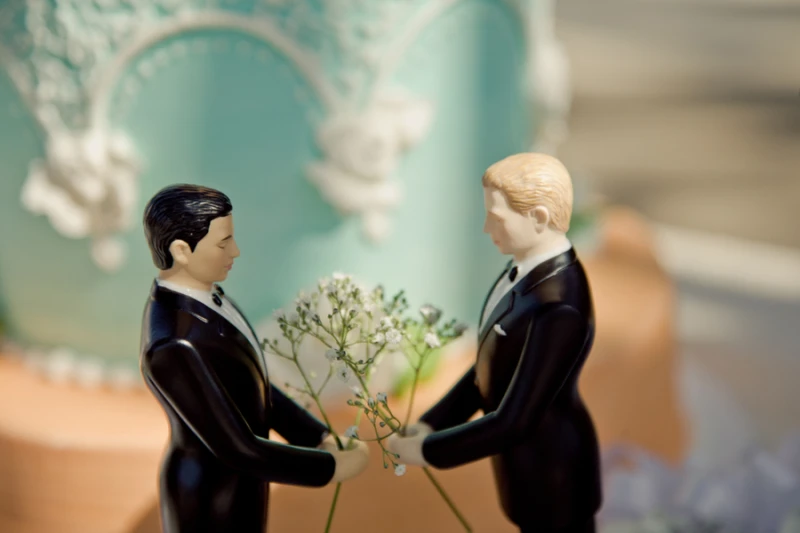
Same-sex wedding cake. / Sara Valenti/Shutterstock
Bern, Switzerland, Sep 27, 2021 / 05:00 am (CNA).
Switzerland voted Sunday to legalize same-sex marriage.
Around 64% of voters backed the measure in a referendum on Sept. 26, making Switzerland the world’s 30th country to approve gay marriage.
The country bordering Italy, France, Germany, Austria, and Liechtenstein has recognized civil unions for same-sex couples since 2007, following a 2005 referendum.
In December 2020, the Swiss parliament approved a bill, called “Marriage for All,” legalizing same-sex marriage and introduced it into the Swiss Civil Code.
In April this year, Campaigners gathered enough signatures to secure a referendum. More than 61,000 valid signatures were submitted in favor of giving the country’s 8.5 million population a final say on the law.
CNA Deutsch, CNA’s German-language news partner, reported that the referendum result was tight in some areas of Switzerland, a federal republic officially known as the Swiss Confederation.
In the canton of Appenzell Innerrhoden, which is traditionally Catholic, 50.8% of voters backed the proposal, which will come into effect from July 2022.
CNA Deutsch said that Simone Curau-Aepli, president of the Swiss Catholic Women’s Federation (SKF), welcomed the referendum result.
“I am really happy that everyone has said yes to marriage for all. For us this is a highly emotional moment,” she commented.
“We at the Swiss Catholic Women’s Association have been fighting for this for 20 years and stand for equal dignity and equal rights.”
Switzerland’s Catholic bishops said in December that legalizing same-sex marriage was “fraught with numerous administrative, legal and ethical difficulties.”
“[T]he Catholic Church is primarily entrusted with the sacrament of marriage. She celebrates before God the union of man and woman as a common, stable, and reproductive life laid out in love,” the Swiss bishops’ conference said in a Dec. 4 statement.
“This is why [we are] convinced, also with regard to civil marriage, that the use of the term ‘marriage’ should not be extended to any connection between two people regardless of their gender. Such a use of the term would bring about an equality that, in [our] opinion, cannot exist.”
If you value the news and views Catholic World Report provides, please consider donating to support our efforts. Your contribution will help us continue to make CWR available to all readers worldwide for free, without a subscription. Thank you for your generosity!
Click here for more information on donating to CWR. Click here to sign up for our newsletter.
Quesada, Costa Rica, Jun 17, 2021 / 16:38 pm (CNA).
The Bishop of Ciudad Quesada on Tuesday called on the faithful not to hide their faith in private, but to live it publicly and to share it with others, following the teachi… […]
Members of the Sts’ailes First Nation at Holy Rosary Cathedral last year for the first Mass to integrate a First Nation language. A Cardus report presents the voices of Indigenous Canadians speaking about their faith and distinguishing it from the traditional spirituality they’re often associated with. / Photo courtesy Nicholas Elbers, 2022
Vancouver, Canada, May 17, 2023 / 14:15 pm (CNA).
A groundbreaking report published by the Ottawa-based Cardus Institute has given voice to Indigenous Canadians who are frustrated by secular society’s unawareness of — or unwillingness to accept — the fact that almost half of them are Christian.
“I find that insulting to Indigenous people’s intelligence and freedom,” Catholic priest Father Cristino Bouvette said of the prejudice he regularly encounters.
Bouvette, who has mixed Cree-Métis and Italian heritage and now serves as vicar for vocations and Young Adults in the Diocese of Calgary, was one of 12 individuals interviewed by Cardus for the report “Indigenous Voices of Faith.”
Father Deacon Andrew Bennett, left, leads a post-production discussion by Indigenous Voices of Faith participants. Photo courtesy of Cardus
Prejudice against Indigenous Christians has become so strong, even inside some Indigenous communities, “that Indigenous Christians in this country right now are living in the time of new martyrdom,” Bouvette said.
Although that martyrdom may not cost them their lives, “they are ostracized and humiliated sometimes within their own communities if they openly express their Christian or Catholic faith.”
Statistics Canada reported last year that the 2021 census found that 850,000, or 47%, of Canada’s 1.8-million Indigenous people identify as Christian and that more than a quarter of the total report they are Catholic. Only 73,000, or 4%, of Indigenous people said they adhere to traditional Indigenous spiritual beliefs.
In a new report, Cardus wants to “amplify the voices of Indigenous Canadians speaking for themselves about their religious commitments, which sometimes clash with the typical public presentation of Indigenous spirituality.” Photo courtesy of Cardus
Ukrainian Catholic Deacon Andrew Bennett, program director for Cardus Faith Communities, conducted the interviews for the think tank last fall. He published his report in March at a time when Canadian mainstream media and many political leaders continued to stir division and prejudice through misleading commentary about abandoned cemeteries at Indian Residential Schools.
The purpose of the report, he writes, “is to affirm and to shed light on the religious freedom of Indigenous peoples to hold the beliefs and engage in the practices that they choose and to contextualize their faith within their own cultures.”
Too often, however, “the public narrative implies, or boldly declares, that there’s a fundamental incompatibility between Indigenous Canadians and Christianity or other faiths,” Bennett said. “[M]any Indigenous Canadians strongly disagree with those narratives.”
Father Bouvette is clearly one of those.
“We did not have Christian faith imposed upon us because of [my Indigenous grandmother’s] time in the residential school or her father’s time in the trade school that he was sent to,” Bouvette said. “No, it was because our family freely chose to receive the saving message of Jesus Christ and lived it and had continued to pass it down.”
Bouvette said his “grandmother was not tricked into becoming something that she didn’t want to be, and then tricked into staying that way for 99 years and 11 months of her life. She was a Christian from the day of her birth, and she remained a Christian until the day of her death. And so that was not by the consequence of some imposition.”
Nevertheless, Canadians continue to labor under a prejudice holding the opposite view. “I do believe that probably the majority of Canadians at this time, out of some mistaken notion of guilt for whatever their cultural or ethnic background is, think they are somehow responsible for Indigenous people having had something thrust upon them that they didn’t want,” Bouvette said.
“We did not have Christian faith imposed upon us,” Father Cristino Bouvette says in a Cardus report on Indigenous faith. Photo courtesy of Cardus
“But I would say, give us a little more credit than that and assume that if there is an Indigenous person who continues to persevere in the Christian faith it is because they want to, because they understand why they have chosen to in the first place, and they remain committed to it. We should be respectful of that.”
The executive director of the Catholic Civil Rights League, Christian Elia, agrees and says society should grant Indigenous Catholics the respect and personal agency that is due all Canadians.
“Firstly, I am not an Indigenous person, so I cannot speak for our Indigenous brothers and sisters, but neither can non-Indigenous secularists who choose to ignore that Indigenous people in Canada continue to self-identify as Christian, the majority of these Catholic,” Elia said in an interview with The B.C. Catholic.
He said his organization has heard from many Indigenous Catholics who are “growing weary of the ongoing assumption that somehow they have been coerced into the faith, that it is inconceivable that they wish to be Catholic. This condescending attitude must stop.”
Deacon Rennie Nahanee, who serves at St. Paul’s Indian Church in North Vancouver, was another of the 12 whom Bennett interviewed. A cradle Catholic and member of the Squamish First Nation, Deacon Nahanee said there is nothing incompatible with being both an authentic Indigenous person and a Catholic.
“I’m pretty sure we had a belief in the Creator even before the missionaries came to British Columbia,” he said. “And our feelings, our thoughts about creation, the way that we lived and carried out our everyday lives, and the way that we helped to preserve the land and the animals that we used for food, our spirituality and our culture, were similar to the spirituality of the Catholic Church.”
“I believe that’s why our people accepted it. I don’t think anybody can separate themselves from God, even though they say so.”
Interviewed later by The B.C. Catholic, Nahanee said he is not bothered by the sort of prejudice outlined by Bouvette. “People are going to say or do what they want,” he said.
Voices of Indigenous Christianity
Bennett, program director of Cardus Faith Communities, interviewed 12 Indigenous Canadians, most of them Christian, about their religious commitments, “which often clash with the typical public presentation of Indigenous spirituality.” Here is a selection of some of their comments:
Tal James of the Penelakut First Nation in Nanaimo spoke about the relationship between Indigenous culture and his Christian faith:
Tal James and wife Christina. Photo courtesy of Project 620 – James Ministry
“I think … that our [Indigenous] cultures were complete, and in Jesus they’re more complete. I think that’s a big thing and a big step for a lot of us. You’re going to have a lot of non-Indigenous people look at you and question your actions based on your Aboriginal heritage. Don’t take that to heart. They’re the ignorant ones who don’t want you to flourish. Those of you who are Christians, First Nations Christians, you come to the table with the same gifting that non-Aboriginal people have. For them to say, ‘We want to make room for you at the table,’ correct them. You are already at the table, and encourage them to step back and allow your gifts to flourish. Because it’s one in the same spirit.”
Rose-Alma McDonald, a Mohawk from Akwesasne, which borders New York, Ontario, and Quebec, talked about re-embracing her Catholic faith:
Rose-Alma McDonald. Photo courtesy of Cardus
“I surprised everybody, including myself, in terms of embracing Catholicism after 20 years away. So I’ve had a few epiphanies in the sense that this is why my mother made me do so much in the church growing up. When I’m working, volunteering, and doing stuff in the church, I remember that. I keep remembering I’m Catholic and I’m still Catholic. I will stay Catholic because of the way I was raised.”
Jeff Decontie, a Mohawk from the Algonquin First Nations who lives in Ottawa, talked about being a person of faith in a secular world:
Jeff Decontie. Photo courtesy of Cardus
“Secular worldviews can sort of eat up everything around them and accept a whole wide range of beliefs at the same time. For example, you have the prevailing scientific thinking alongside New Age believers, and people in society just accept this, saying, ‘Oh, whatever it is you believe in, all religions lead to the same thing.’ No one questions it. How can these contradictions coexist? … Then we ask an [Indigenous] elder to lead prayer? Any other religion would be a no-no, but you can ask for an elder who’s going to pray a generic prayer to some generic Creator, and it’s not going to ruffle any feathers. I think that’s the danger of secular thought creeping into Canada: It goes unnoticed, it’s perceived as neutral, but at the same time it’s welcoming a whole wide range of beliefs. And it doesn’t just influence Indigenous thought. It’s influencing Christianity.”
Rosella Kinoshameg, a member of the Wikwemikong Reserve on Manitoulin Island in Ontario, spoke about being Indigenous and Catholic:
Rosella Kinoshameg. Photo courtesy of the Catholic Register
“Well, I can’t change being Indigenous. That’s something that is me. I can’t change that. But to believe in the things that I was taught, the traditional things, the way of life and the meanings of these things, and then in a church, well, those things help one another and they make me feel stronger.”
This article was originally published May 10, 2023, in The B.C. Catholic, a weekly publication serving the Catholic community in British Columbia, Canada, and is reprinted here on CNA with permission.
Forty-five priests and four bishops in Venezuela have died from COVID-19 as of December 2021, the Venezuela bishops’ conference has reported. / Unsplash
Caracas, Venezuela, Dec 15, 2021 / 13:45 pm (CNA).
The Venezuelan bishops’ conference published new statistics showing that since the beginning of the pandemic 45 priests and four bishops have died from COVID-19.
The conference noted that “in the midst of the global crisis caused by the pandemic, priests are not exempt from the risks of contracting COVID-19,” as they carry out their ministry.
“At a time when people more earnestly seek the comfort of the spirit and closeness to the faith … priests offer their service to the Church,” the conference said.
The conference published current figures on the priests who were infected and died from the deadly virus. In the report, they noted that between March 2020 and Dec. 13, 2021, 439 priests were infected with COVID-19, a figure that represents 20.77% of the total clergy in the country.
During this period, 45 priests have died, or 10.25% of all priests infected with the virus, and 2.13% of all Venezuelan clergy.
Of those infected, 26 were bishops and of these 22 prelates recovered; the other four died in 2021.
The four bishops who died were Archbishop Cástor Oswaldo Azuaje, who served as the bishop of the Diocese of Trujillo until his death on January 8; Bishop César Ortega, who died on April 9; Archbishop Tulio Chirivella, Archbishop Emeritus of Barquisimeto, who died on April 11; and Cardinal Jorge Urosa Savino, Archbishop Emeritus of Caracas, who died on Sept. 23.
The bishops’ conference said that the Church in Venezuela currently has 2,068 priests. Siixty are bishops and of these 41 are titular bishops, three are auxiliary bishops, and 16 are bishops emeritus.
The dioceses with the greatest number of priests are San Cristóbal (208), Trujillo (154), Barquisimeto (148), Mérida (127), Caracas (121), the conference reported.
The bishops’ conference said that since the beginning of the COVID-19 pandemic “it has urged the entire population to comply with the guidelines and recommendations in the field of biosafety” to prevent contracting the virus.
The conference also stressed that taking proper care of oneself, the family and the community “is the best way to prevent the spread of COVID-19.”
Finally, the bishops’ conference exhorted the faithful to “increase their trust in God in times of a health emergency” and encouraged them to continue praying from the Word of God, “especially in the family, the Domestic Church,” since prayer “is an expression of the faith and hope that we need to strengthen.”
It is ever more apparent that two people of the same sex can fall in love in a deeply spiritual way that honors humanity. I truly thank God that more nations now respect this truth. I thank God even more for the wisdom that is the Separation of Church and State. I am no longer Catholic, so my view does not contradict my religion.
If you are no longer Catholic then what are you doing commenting on a Catholic forum? If you feel happy about your faith decision then obviously you would see no need to turn back and pontificate about it.
I am just a person. I may no longer be Catholic, but I will always be Catholic, I think. Just sharing my views, because I was silent and hiding for so long. I don’t mean to insult anyone. When I discovered the comment section, here, I felt strongly about sharing my opinion. A recent opinion on here (by Reilly about LGBT politics) really angered me.
You appear to be one of those people who tailor their religious views to coincide with the sins they want to commit, rather than struggling against temptations to do evil.
“It is ever more apparent that two people of the same sex can fall in love in a deeply spiritual way that honors humanity.”
Balderdash. Vile perversion doesn’t honor humanity.
What, exactly, is “spiritual” about the added homosexual version of tunnel vision, or that contradicts not only Catholic morality, but also nature?
Then there’s the question your raise about the nature of your new religion…Not exclusively Catholic (which you are “no longer”) are such biblical references as these: Noah and Ham (Genesis 9:20–27), Sodom and Gomorrah (Genesis 19:1–11), Levitical laws condemning same-sex relationships (Lev 18:22, 20:13), two Second Testament vice lists (1 Corinthians 6:9–10; 1 Timothy 1:10), and Paul’s letter to the Romans (Rom 1:26–27).
About the separation of Church and state, is the coercive power of the state your new religion? Just askin’…
This vote was decided 2016 at the opening of the Gotthard Tunnel ceremony. “A topless woman decked as a bird hovered above actors representing the nine construction workers who died during the building of the tunnel” is cursory theatre of a radical distancing from moral good. Celebrated was the sensual, the perverse, and the theatrical though spiritually real abandonment of Christ. Some showy displays purposely satanic. As suggested in my comment on tiny San Marino gone abortion ‘crazy’, the only word that comes to mind there are consequences in rejecting Christ. We lose his divinely ordained suzerainty for the macabre devilish. Where there’s a moral vacuum, a house all tidied up the filthy denizens from Hades take residence. And how! The moral rotation is epochal, since the only gift for our salvation Christ has been rejected worldwide. Nothing historical comes close to comparison. A price to be paid is impending absent of a miraculous conversion of hearts.
Maybe they know something that we don’t. Maybe there was a mistake in the recording of God’s plan, when it come to gay relationships. Maybe we are all wrong.
But, even if God means us to avoid homosexuality completely, his followers can continue to strive to see gay people as human beings who struggle like everyone else.
It is ever more apparent that two people of the same sex can fall in love in a deeply spiritual way that honors humanity. I truly thank God that more nations now respect this truth. I thank God even more for the wisdom that is the Separation of Church and State. I am no longer Catholic, so my view does not contradict my religion.
If you are no longer Catholic then what are you doing commenting on a Catholic forum? If you feel happy about your faith decision then obviously you would see no need to turn back and pontificate about it.
I am just a person. I may no longer be Catholic, but I will always be Catholic, I think. Just sharing my views, because I was silent and hiding for so long. I don’t mean to insult anyone. When I discovered the comment section, here, I felt strongly about sharing my opinion. A recent opinion on here (by Reilly about LGBT politics) really angered me.
You appear to be one of those people who tailor their religious views to coincide with the sins they want to commit, rather than struggling against temptations to do evil.
“It is ever more apparent that two people of the same sex can fall in love in a deeply spiritual way that honors humanity.”
Balderdash. Vile perversion doesn’t honor humanity.
Thank you, Leslie.
What, exactly, is “spiritual” about the added homosexual version of tunnel vision, or that contradicts not only Catholic morality, but also nature?
Then there’s the question your raise about the nature of your new religion…Not exclusively Catholic (which you are “no longer”) are such biblical references as these: Noah and Ham (Genesis 9:20–27), Sodom and Gomorrah (Genesis 19:1–11), Levitical laws condemning same-sex relationships (Lev 18:22, 20:13), two Second Testament vice lists (1 Corinthians 6:9–10; 1 Timothy 1:10), and Paul’s letter to the Romans (Rom 1:26–27).
About the separation of Church and state, is the coercive power of the state your new religion? Just askin’…
Yes, Peter, I practice a devout adherence to the coercive power of the State.
Peter, my beliefs are different than yours.
This vote was decided 2016 at the opening of the Gotthard Tunnel ceremony. “A topless woman decked as a bird hovered above actors representing the nine construction workers who died during the building of the tunnel” is cursory theatre of a radical distancing from moral good. Celebrated was the sensual, the perverse, and the theatrical though spiritually real abandonment of Christ. Some showy displays purposely satanic. As suggested in my comment on tiny San Marino gone abortion ‘crazy’, the only word that comes to mind there are consequences in rejecting Christ. We lose his divinely ordained suzerainty for the macabre devilish. Where there’s a moral vacuum, a house all tidied up the filthy denizens from Hades take residence. And how! The moral rotation is epochal, since the only gift for our salvation Christ has been rejected worldwide. Nothing historical comes close to comparison. A price to be paid is impending absent of a miraculous conversion of hearts.
The Swiss Catholic Women’s Federation welcomes the result? And they’ve been fighting for it for twenty years, no less?
Huh?
Maybe they know something that we don’t. Maybe there was a mistake in the recording of God’s plan, when it come to gay relationships. Maybe we are all wrong.
But, even if God means us to avoid homosexuality completely, his followers can continue to strive to see gay people as human beings who struggle like everyone else.
