



Arguably not since Pope St. Pius V, who created the Holy League states that defeated the Ottoman Turks during the Battle of Lepanto in 1571, has any pope influenced world politics as profoundly as St. John Paul II. In addition to his well-known contribution to the peaceful fall of communist rule in East-Central Europe, the pontiff was an outspoken critic of war, poverty, abortion, and other injustices and defender of human dignity. Even if world leaders did not always agree with him, they always listened to him.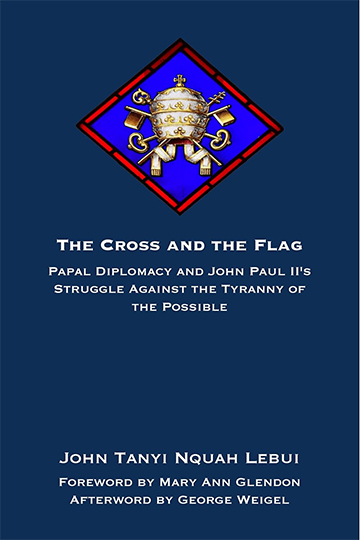
In his new book, Father John Tanyi Nquah Lebui examines John Paul’s legacy as a diplomat. While a valuable work of international relations, it suffers from some rather odd flaws.
Papal diplomacy
Father John Tanyi Nquah Lebui is a Cameroonian priest and scholar of international relations presently serving the Archdiocese of Boston, Massachusetts. His work, titled The Cross and the Flag: Papal Diplomacy and John Paul II’s Struggle Against the Tyranny of the Possible, was published by St. Augustine’s Press.
For those without faith in the Catholic Church as the true Church, it seemed in the nineteenth century that the Catholic Church would implode like the League of Nations, Lehman Brothers, the Soviet Union, British Empire, or any other man-made construct. When Napoleon invaded Rome, he imprisoned Pope Pius VII and later exiled him to France. During the unification of Italy, meanwhile, the Papal States dissolved, only for the Vatican to reemerge as the world’s smallest state, one-eighth the size of Central Park, in 1929.
Such dramatic historical developments, writes Tanyi, were, however, a felix culpa, or “blessed fault.” Having lost all her worldly power, the Holy See could reemerge as a moral superpower. Tanyi thus references classic political scientists, including Fukuyama, Kissinger, and Nye, and uses well-known political science categories to analyze the Vatican and St. John Paul II as political actors. He argues the Vatican employed many kinds of diplomacy during John Paul’s pontificate, including humanitarian work, the use of media communications (the late Vatican spokesman Joaquín Navarro-Valls in particular), and traditional diplomacy.
The Holy See and Palestine are the only two permanent observers at the United Nations. However, Tanyi demonstrates, thanks to John Paul II’s moral authority, the Vatican was a force to be reckoned with at the UN. During the 1994 International Conference on Population and Development in Cairo, the Clinton administration aggressively tried to push the legalization and promotion of abortion as a solution to overpopulation.
Yet Clinton failed, and it was because of the Holy See, which found strange bedfellows in various Muslim-majority states, including Pakistan and its then-Prime Minister Benazir Bhutto, murdered by a suicide bomber in 2007 (and whom Pope Leo XIV praises as a “courageous and generous” woman in his encyclical Magnifica humanitas), to block the championing of killing unborn children.
Tanyi convincingly rejects the Marxist view of history as driven solely by economics, the realist one depicting international affairs as influenced by a power struggle, and the liberal one focusing on economic incentives, demonstrating that individual leaders can affect history. Thus, for example, John Paul II, a Pole who had directly experienced the suffocating repressiveness of communism, unsurprisingly rejected the restrained politeness towards communist regimes of some of his Italian predecessors.
Meanwhile, his growing up in Wadowice, where a fifth of the population was Jewish before the Holocaust, imbued in him a love for the Jewish people that led to the Vatican’s establishment of diplomatic ties with the State of Israel in 1993.
An “African” pope
“The Irish are the blacks of Europe,” says a character in Alan Parker’s 1991 film The Commitments, about a group of Dublin lads who start a soul band. Like the Irish, the Poles have suffered foreign oppression (including chattel slavery, among many injustices committed against them during World War II), so arguably they are also the “blacks of Europe.”
In this context, John Paul II’s national origin is not incidental. According to Tanyi, since the Poles, like the Africans, had experienced the worst of colonialism, this made the pontiff particularly sensitive to the continent’s many woes. Whereas Italy, the country of origin of most popes, had committed horrible crimes against humanity in Libya and Ethiopia, Poland was itself under the foreign yoke during the Scramble for Africa.
St. John Paul II’s African legacy is often overlooked; sadly, this is because the West is willfully ignorant about the continent. Yet, as Tanyi points out, John Paul II made eleven pilgrimages to the continent (by comparison, he visited his native Poland nine times, France eight times, and the United States seven times), visiting thirty-nine of its fifty-four nations. Tanyi quotes papal biographer George Weigel as claiming that no world leader in the late twentieth century was so concerned about the “forgotten continent.”
The Polish pope’s love for Africa and its people was reciprocated. We learn from Tanyi that many Kenyans, for instance, name their children and even pets, farm animals, and hotels after him. Tanyi enumerates John Paul’s specific contributions to Africa, from vociferously appealing to Western nations and international financial institutions to cancel Africa’s debts to making the freeing of political prisoners by African strongmen a necessary condition for papal visits and establishing the humanitarian John Paul II Foundation for the Sahel.
When the Catholic bishops of the impoverished Ivory Coast decided to build the world’s largest basilica in the capital of Yamoussoukro, John Paul agreed to its construction only if a hospital that would serve the poorest of the poor was built on its premises (it has been built since, and its patron is the great altruistic physician St. Joseph Moscati).
“Idiosyncratic” flaws
John Tanyi’s favorite adjective seems to be “idiosyncratic,” and it often appears many times on a single page. He explains that while the word may have negative connotations, he instead uses it positively to refer to John Paul II’s unique personality and background and how it influenced his diplomacy.
Message received. However, The Cross and the Flag suffers from some very, shall I say, idiosyncratic flaws. Many of the same points are made repeatedly, while there is a glaring abundance of spelling and punctuation errors. This can sometimes make for a frustrating read.
More problematic is some of Tanyi’s bibliography. He repeatedly quotes certain authors, some of whom are notorious “dissident Catholics,” who were very critical of John Paul II and the Church, including Peter Hebblethwaite, David Willey, and even David Yallop, who wrote a trashy anti-Catholic bestseller promoting the long-debunked fantasy that the Vatican killed Pope Blessed John Paul I.
Also, some works cited in The Flag and the Cross (Tanyi uses the APA citation style) are puzzlingly absent from the bibliography. There are also quite a few sloppy errors: for instance, Tanyi is off by six years when mentioning John Paul II’s beatification, while the pope’s 1983 Mass in Managua was in front of an image of the Sandinistas, not of Che Guevara (apparently, Tanyi has conflated that turbulent papal Mass with that in Havana fifteen years later).
Some of Tanyi’s opinions are strange. For example, when discussing post-independence African leaders, he lists Ahmed Sékou Touré of Guinea as among those “hailed as heroes and saviors by their peoples” and “thinkers”, not among the dictators mentioned on the next page, such as Idi Amin of Uganda, Muammar Gaddafi of Libya, and Hosni Mubarak of Egypt. Sékou Touré was one of Africa’s worst tyrants; Cardinal Robert Sarah was probably his best-known critic and was subsequently put on the dictator’s death list.
Some of Tanyi’s statements about John Paul II’s native country are problematic. He writes, for instance, that “[s]ome even argue that democracy and diversity are not naturally part of the traditional Polish culture and mentality” without questioning such claims. Saying that about any culture would be offensive, and pre-Partition Poland had one of the world’s oldest parliaments and was the most religiously tolerant country in Europe.
Meanwhile, his repeated calling German-occupied Poland—a country under an extremely harsh occupation without a quisling government—“Nazi Poland”, is unfortunate. And while antisemitism did mushroom in interbellum Poland and Europe, Tanyi’s quoting of Israeli Prime Minister Menachem Begin as claiming that Poles suck antisemitism with their mothers’ milk is unfair (not to mention that he misattributes the above quote, which comes not from Begin but from another Israeli prime minister, Yitzhak Shamir).
However, even so, The Cross and the Flag is a promising scholarly debut book. The chapter on John Paul II and Africa is a very important addition to the body of literature on Wojtyła’s pontificate. I hope he will continue writing about Church diplomacy, Africa, and the political influence of the papacy.
The Cross and the Flag: Papal Diplomacy and John Paul II’s Struggle Against the Tyranny of the Possible
By John Tanyi Nquah Lebui
Foreword by Mary Ann Glendon
Afterword by George Weigel
St. Augustine’s Press, 2024
Paperback, 330 pages
If you value the news and views Catholic World Report provides, please consider donating to support our efforts. Your contribution will help us continue to make CWR available to all readers worldwide for free, without a subscription. Thank you for your generosity!
Click here for more information on donating to CWR. Click here to sign up for our newsletter.

My image of Christ’s witness vis a vis world secular powers is that of Christ standing before Pilate having been brought forth with false charges of blasphemy by Jewish authorities before the Roman governor whom they wanted to be His executioner. Christ stood before Pilate bruised, whipped, tortured, beaten and bloodied and responded to Pilate’s questions with only a few, albeit powerful, words. Our Christian faith, if genuine, does not compete with secular powers; our Christian faith seeks to convert their hearts so they might be saved.
For the average reader, the flaws you list are too great to ignore. When a Catholic publisher puts out a work, we should expect that any errors, including spelling and punctuation, have been corrected. The average Catholic reader is not going to be fact-checking and will probably be expecting that the references made are correct. The work sounds interesting, and your review is very helpful, but I’m disappointed that you seem to be recommending it anyway. The church already has too many members living with their heads full of erroneous information about the history of the church. This one needs to be fixed.
Your review is greatly appreciated.
Very interesting that many conservative Catholics applaud the Political influence of St. John Paul II, while at the same time disparaging attempts of the late Pope Francis and the current Pope Leo XIV as being political meddling. They forget that the Popes wear two hats (secular and religious) and as such have the responsibility of addressing both audiences.
James Connor writes: “Popes wear two hats (secular and religious)…”
Really?
Head of Church, Head of Vatican State
Let’s be real. Vatican City State is much smaller than Central Park in NYC. Sorry, but Christ is not the incarnate God who came to found a country/state/government. It’s Popes who through the centuries managed to stray from Christ’s ecclesial intent and who formed a temporal power base. Never was a good idea.
Because it’s not the same thing. John Paul never said “It it has been said many times and my response has always been that, if anything, it is the communists who think like Christians.” or glibly accepted a sacrilegious crucifix where the cross was a hammer and sickle, while giving lip service to socialism is “wrong”. One wonders what the Popes who declared socialism to be a curse and at odds with Christianity thought from eternity when Bergoglio grabbed the reins and began making a mess. (his stated injunction to others, clearly he walked the walk).
Just one:
“Religious socialism, Christian socialism, are contradictory terms; no one can be at the same time a good Catholic and a true socialist.”
Pope Pius XI
Quadragesimo Anno 120
Perhaps because JPII actually experienced the “Worker’s Paradise” rather than just hung out with a bunch hippie “liberation theologians” who produced neither liberation nor theology but concealed their envy and contempt in a verisimilitude of righteous anger, he was a little more circumspect.
Then again, if Francis was less impulsive and arrogant, he would exercised some restraint, recognizing that having being “allergic to economic things” putatively because his father worked long hours as an accountant was an unresolved psychological issue, not a mandate to comment on matters outside his charism or competence.
Leo is more polished, but more worldly. John Paul met with Hayek before penning Centesimus Annus. Leo seemed more interested in Bad Bunny, Cosplay Sarah, before issuing MH. Now he met with Patty Smith, apparently doesn’t know Patty SmYth is far better.
Because, inter alia, John Paul II never said anything like this:
“it is the communists who think like Christians”
But I repeat myself.
I made it half way through the article and decided the book is so strewn with errors that it in no way can be considered “important”.
We could make a point that the very first Christians tried a form
of socialism (not state socialism) and it didn’t work; and it was possibly abandoned by the Church for many years until during the dark ages it was once again adopted more successfully by a number of religions orders, and is still practiced today. My point being that socialism as a concept is neither inherently evil nor necessarily incompatible with Christianity as many conservatives would claim. It maybe too idealistic to work on a large (State) scale, but has proven feasible on smaller, voluntary ventures such as the many Anabaptist communities.
Religious orders are not socialist. They can be considered “syndicates” (which has a meaning other than a synonym for organized crime) or “(participatory) trusts”. My wife and I are not “socialists” because we own everything in common, sharing gains and losses without allocation.
Everybody that enters an order, does so willingly and that order is either eleemosynary or operates as property owning, for profit enterprises in greater society.
Examples include Mystic Monk Coffee or the jelly I purchased from an order of nuns in Pennsylvania. No order has yet entered capital intense markets such as automobiles.
I live near Anabaptists (Amish and Mennonites), and on occasion transact with them trust me they are capable business owners, unafraid of arduous work-there’s an old saw that they came to do good and did well. But their social organization makes them reliant on the “English” for medical help and their traditional crafts are under assault from foreign machine made counterfeits.
Mother Angelica is lauded for establishing and growing EWTN, but many people don’t know before she became Mother Angelica, she read an ad in a magazine for fishing lure parts. She decided that nuns would go into the fishing-lure business-selling St. Peter’s Fishing Lures. In 1961, Sports Illustrated honored her with a plaque for her “special contribution to a sport.”
She had no business experience but attracted national attention for her entrepreneurship. That business served as her training ground for a global enterprise, which organized as a tax-exempt charity could not operate in a socialist society, because it could not own the real and electronic property or financial capital required to operate. It’s also why she didn’t want to hand it over to the Bishops that coveted what she built-the number of Diocesan bankruptcies attest to the wisdom of her caution.
Multiple Popes have have stated that socialism is wholly incompatible with Christianity, so it’s not as “conservatives claim”, it’s as Popes have proclaimed, but apart from the moral indictments, the abolition, distortion and suppression of prices always results in privation and corruption. God gave us brains, we should understand pigs don’t fly and we don’t need continual porcine defenestration.
There’s nothing “idealistic” about socialism. The promoters always fall in two camps. The cunning, who want to be the kings of hell. They prey on the credulous, envious and ignorant who think every little girl should have a pony, but don’t care who pays for the oats or the stable. There is no allocation without production.