

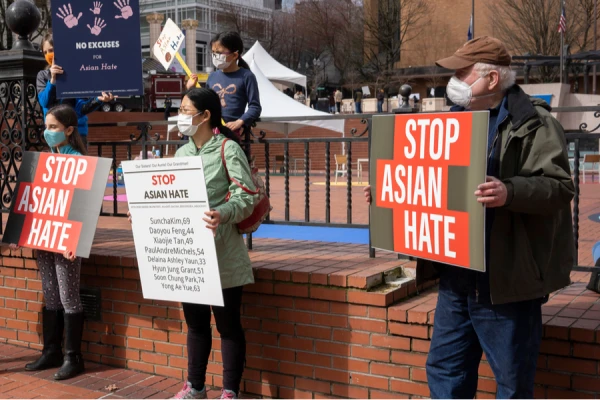
Washington D.C., Mar 22, 2021 / 04:30 pm (CNA).- The U.S. bishops’ conference denounced racism and violence following last week’s shootings in Atlanta that killed six Asian women.
“I am deeply saddened to hear of another mass shooting that has tragically taken the lives of eight people and has renewed concerns about a rise in hostility against individuals of Asian descent,” stated Bishop Oscar Solis of Salt Lake City on Monday.
Solis chairs the U.S. bishops’ conference (USCCB) Subcommittee on Asian and Pacific Island Affairs, and is the first Filipino-born bishop in the United States.
“As bishops, we decry any kind of hatred and violence, particularly based on race, ethnicity, or sex,” Solis stated. “We pray for the families and friends of those who were lost, and for their communities, who may feel unsafe and vulnerable at this time.”
On March 16, a gunman killed eight people – including six Asian women – and injured one person during a series of shootings at three massage parlors in the Atlanta area. The shooter, Robert Aaron Long, 21, had frequented the parlors and had previously been in a rehabilitation program for sex addiction.
The FBI director last week said he did not believe race was a motivating factor in the shootings, and Long has yet to be charged with a hate crime. However, with women of Asian descent making up three-quarters of the shooting victims, the killings sparked conversations about anti-Asian discrimination in the United States – particularly during the COVID-19 pandemic.
Bishop Solis noted that the shooting “prompted national dialogue on addressing anti-Asian bias that has taken the form of numerous other acts of physical violence, verbal attacks and destruction of property against those of Asian descent over the last year that have left communities across the country traumatized.”
“I echo Archbishop Gregory Hartmayer’s words that ‘[w]e must support all victims of violence and stand in solidarity with those who are vulnerable in our communities,’” said Solis, referencing a March 17 statement by the Atlanta Archbishop following the shootings.
For Catholics, Lent must be a season of “conversion” to charity, he added.
“More broadly, we must always stress that every human being is a brother or sister in Christ, created in the image and likeness of a loving God,” said Solis, adding that “particularly during this season of Lent, let us remember God’s love and mercy for each one of us and renew the call for conversion of heart, that we may be more united to God’s love and share it with all of our neighbors.”
At the bishops’ annual fall meeting in November – held remotely in 2020 due to the pandemic – Archbishop Alexander Sample of Portland warned that Asian-Americans in his archdiocese were being scapegoated for the coronavirus pandemic.
Long has been charged with eight counts of murder and one count of aggravated assault. Prosecutors have said that “nothing is off the table” and that additional charges, including hate crimes, may be filed.
Georgia allows for the death penalty, but it is presently unknown if the state will seek that punishment for Long.
If you value the news and views Catholic World Report provides, please consider donating to support our efforts. Your contribution will help us continue to make CWR available to all readers worldwide for free, without a subscription. Thank you for your generosity!
Click here for more information on donating to CWR. Click here to sign up for our newsletter.

Once again hasty statements set down on paper before a full investigation is rolled out. How juvenile – or is politically motivated?
That which has been reported by investigators gives people in high positions an opportunity to speak seriously about the motivation admitted by Mr. Long for committing murder of eight persons.
Atlanta Shooting Suspect Told Police He Targeted Massage Parlors Because of Sex Addiction – WSJ
By Valerie Bauerlein and Cameron McWhirter
Updated March 17, 2021 7:58 pm ET
TEXT
“ATLANTA—Robert Aaron Long, the suspect in the killing of eight people at three massage parlors in the Atlanta area, told investigators that he targeted the businesses because he blamed them “for providing an outlet for his addiction to sex,” law-enforcement officials said.”
“Mr. Long, who is in custody, took responsibility for the shootings and said he acted alone, according to the Cherokee County Sheriff’s Office.”
“It’s a temptation for him that he wanted to eliminate,” Capt. Jay Baker said. “He said it was not racially motivated.”
Here is an opportunity for those in high places to speak to the damaging effects of pornography addiction which apparently according to Mr. Long’s statement was his motivation for the terrible slaughter he perpetrated. Mr. Long was a customer at massage parlors, he was deranged in his addiction and he killed eight people in cold blood “because he blamed them ‘for providing an outlet for his addiction to sex,'”
Why are our leaders(?) not addressing this serious issue of pornography plaquing our society. Guess it is easier or more politically appealing to blame it on race. Where’s the right thinking? – gone out the window. In other words, right thinking has become very unpopular – so go with the flow, people. After all, swimming up stream requires the vision of a goal to be reached, motivation and strong muscle. Softies in high places are flabby, unable to address the issues when it comes to the “seamy side of the garment” These spineless softies are unfit for strong leadership, and grasp at straws rather than “take the bull by the horns.” Where are the John the Baptist, Thomas Moore and St. Paul types when we need them? Gone, I guess. Instead we have elites sitting in their plush offices setting down politically palatable baloney.
That the victims were all Asian probably had nothing to do with it, I presume.
“I must eliminate temptation by killing asians in their massage parlors”
Is a pseudo-religious reason so much more palatable, or non-exclusive to racism? I wonder why it’s almost always white people who are the first to say “it wasn’t racist!” when minorities are killed. Look, you aren’t being impugned here Rosemarie; it’s ok.
Why are you assuming Rosemarie is white? What does her ethnicity have to do with her basic argument? Nothing at all, actually. Why are you also assuming that the motives had to be racial when there is no evidence to support that at present? Check your own biased and privileged assumptions first please.
Not all the victims were Asian. Get your facts straight. Do you have any familiarity at all with crime statistics? Do you know who commits disproportionate shares of violent crime in the US? Hint: It is not white males. A casual review of interracial crime statistics is even more revealing.
J.K.
From what I read, these particular targeted parlors were not illegal.
1) Mr. Long was deranged in his addiction and he killed eight people in cold blood–that is as insane as if an alcoholic tried to eliminate liquor stores because they were a temptation for him to buy liquor.
2) Some congressional and clerical leaders jumped to conclusions as to what Mr. Long’s criminal motivation was before a full investigation has been carried out. That kind of hasty exercise does not exhibit right thinking.
What happens so often with congressional and clerical leaders is that the immediate crux of the problem is laid at the doorstep of firearms or race.
Anyone interested in viewing a sliver of the ugly underbelly of human or drug trafficking can look at the billion dollar industries in a few of the links below:
Chinese moms in America’s illicit massage parlors – SupChina
New solutions for the old problem of illegal massage parlors (apnews.com)
(U) Drug Trafficking Organizations – National Drug Threat Assessment 2010 (UNCLASSIFIED) (justice.gov)
Mexico: Organized Crime and Drug Trafficking Organizations (fas.org)
https://news.trust.org/item/20210301101717-gtrmv/
Canned tuna making ‘glacial progress’ in tackling modern slavery (trust.org)
“The global fishing sector is rife with allegations of abuse – human trafficking, debt bondage … and even murder,” BHRRC’s Pacific representative Amy Sinclair told the Thomson Reuters Foundation.
“But despite continued high demand for canned tuna, our research found there had been glacial progress on action by leading brands when it comes to workers trapped in modern slavery in the Pacific,” she added.
See – it’s all about money and power. Human lives are expendable at the trafficking scene. What a tragedy! That is the problem which needs to be addressed.
I eagerly await the bishops’ statement denouncing the murder of white Christians by a Muslim immigrant terrorist in Colorado yesterday. Of course, no such thing is in the works. The response to this one will be a call for gun control and more funding for mental health services. There also will be warnings against any backlash or scapegoating. Under no circumstances, will it be acceptable to argue against letting more of the adherents of the “religion of peace” into the country.