No Picture
News Briefs

Opposition activists hold hunger strikes in Nicaraguan churches
November 20, 2019 CNA Daily News 0

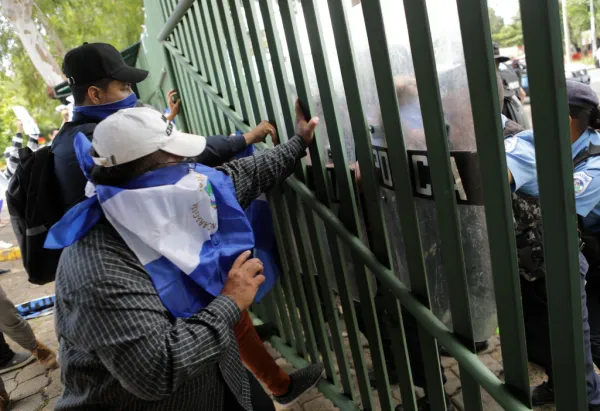
Managua, Nicaragua, Nov 20, 2019 / 05:01 pm (CNA).- Pro-government forces in Nicaragua have ended a siege of the Managua cathedral as mothers holding a hunger strike there were evacuated, though a similar hunger strike at a parish church in Masaya is continuing.

The hunger strikers in both churches – Immaculate Conception Cathedral in Managua and San Miguel in Masaya – have been calling for the release of their relatives, whom they believe to be political prisoners.

Anti-government protests in Nicaragua began in April 2018. They have resulted in more than 320 deaths.

Seven mothers entered Managua’s Immaculate Conception Cathedral Nov. 18, and they were soon followed by the mob of government supporters. The mothers removed themselves to another part of the cathedral.

Msgr. Carlos Avilés, vicar general of the Archdiocese of Managua, stated that “there are a number of unjustly detained political prisoners in the country. Their mothers desperately tried to enter the cathedral to pray … then the government with the police helping them, let in a mob of government supporters backed by the police to violate the cathedral.”

The archdiocese said that “violent groups related to the government entered and took control of the Managua Metropolitan Cathedral. When reprimanded by Fr. Rodolfo López and Sister Arelys Guzmán, these people responded with violence, beating the priest and sister who are okay but who had to leave the church to protect themselves.”

The archdiocese also said that the pro-government forces “broke the padlocks of the bell tower and other padlocks, thus desecrating our Metropolitan Cathedral” during the night.

The mothers took shelter in the cathedral overnight, and were then evacuated Nov. 19 in a Red Cross ambulance, as part of a deal negotiated by Archbishop Waldemar Sommertag, apostolic nuncio to Nicaragua.

The pro-government forces lifted their blockade of the cathedral shortly thereafter.

The archdiocese condemned “the acts of desecration, siege, and intimidation, which do not contribute to the peace and stability of the country.”

The Managua archdiocese also asked president Daniel Ortega to “take immediate action that all our Catholic churches are respected and likewise that the National Police pull back their troops that are besieging and intimidating the cathedral and our parishes.”

Other churches in the country have been encircled by police in an effort to keep the demonstrations from spreading.

In Masaya,  fewer than 20 miles southeast of Managua, a group of women began a hunger strike in  San Miguel parish Nov. 13 or 14.

Authorities cut off electricity and water to the church and the National Police have surrounded the building, threatening to enter by force to end the demonstration.

Thirteen people who tried to bring water to the demonstrators Nov. 14 were arrested. They were charged Nov. 18 with weapons transport. Police say the 13 people were carrying guns and bombs, and that they meant to “continue carrying out terrorist acts … against police buildings, city halls and monuments.”

A group of priests tried to enter San Miguel church Nov. 15, but police held them back.

Cardinal Leopoldo José Brenes Solorzano of Managua has condemned the National Police’s “siege and intimidation” of the hunger strikers in Masaya and their pastor, Fr. Edwin Román.

He called on the national police “to respect the free movement to demonstrate … and the exercise of religious freedom.”

The Nicaraguan bishops’ conference expressed “profound concern” Nov. 19 over the “indifference of the state for the rights of Nicaraguans who are expressing their sorrow and their needs.”

The bishops called on “those responsible for these sieges to change their stance. Nicaraguans have suffered too much pain. The besieged families suffer doubly: the lack of freedom for their incarcerated family members and, now, the state of siege that threatens their lives. We call on the government to hear their petitions which are at the same time their rights.”

Rosario Murillo, Nicaragua’s vice president and Ortega’s wife, criticized “those who claim to speak in the name of the faith,” calling them “repugnant wolves who spread hatred.”

Nicaragua’s crisis began last year after Ortega announced social security and pension reforms. The changes were soon abandoned in the face of widespread, vocal opposition, but protests only intensified after more than 40 protestors were killed by security forces.

The pension reforms which triggered the unrest were modest, but protests quickly turned to Ortega’s authoritarian bent.

Ortega has been president of Nicaragua since 2007, and oversaw the abolition of presidential term limits in 2014.

The Church had suggested that elections, which are not scheduled until 2021, be held this year, but Ortega has ruled this out.

Ortega was a leader in the Sandinista National Liberation Front, which had ousted the Somoza dictatorship in 1979 and fought US-backed right-wing counterrevolutionaries during the 1980s. Ortega was also leader of Nicaragua from 1979 to 1990.
[…]

No Picture
News Briefs

Prosecutor calls for arrest of Vatican bishop charged with abusing Argentine seminarians

November 20, 2019 CNA Daily News 0

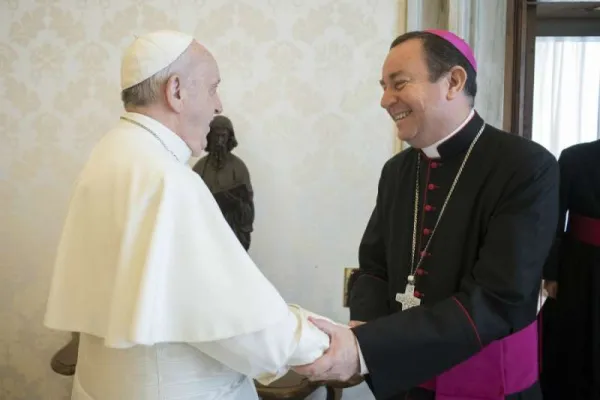
Vatican City, Nov 20, 2019 / 02:05 pm (CNA).- A criminal prosecutor in Argentina has requested the arrest of Bishop Gustavo Zanchetta, who is accused of sexually abusing two seminarians. Zanchetta is suspended from a position at the Vatican’s central bank, where he was appointed an “assessor” by Pope Francis in 2017.

Zanchetta is accused of sexually abusing two seminarians, and was criminally charged in June. He could face three to 10 years in prison if he is convicted.

The bishop lives in the Vatican City State, at the Domus Santa Marta, the same hotel at which Pope Francis resides.

A prosecutor of sexual crimes in Orán, María Soledad Filtrín Cuezzo, has requested international assistance in Zanchetta’s arrest, because, according to El Tribuno newspaper, the bishop has not responded to repeated telephone calls or emails to the contact information provided by his defense counsel.

Cuezzo had opposed allowing Zanchetta to leave the country, according to El Tribuno, but the bishop was permitted to leave after he presented a document showing that he is employed within Vatican City. She has also said that she had frequently found it necessary to request assistance from the apostolic nuncio in Argentina in order to ensure that Zanchetta appeared in court during proceedings in his case.

Zanchetta is alleged to have sent sexually explicit selfies from his cell phone, harassed seminarians, and mismanaged the finances of the Diocese of Oran, which he led from 2014 to 2017. 

Earlier this month, police raided chancery offices in Oran.

The bishop resigned from his diocese in 2017, citing health reasons. Four month later, Pope Francis appointed him to a newly-created position in the Administration of the Patrimony of the Apostolic See, which oversees the Vatican’s assets and real estate holdings.

Reporting from Argentine sources suggests that the bishop was first accused of sexually inappropriate behavior in 2015.

According to a February report from El Tribuno, one of the Zanchetta’s secretaries alerted authorities after accidentally finding sexually explicit images sent and received on Zanchetta’s cell phone in 2015. The complaint says that some of the images depict “young people” having sex in addition to lewd images of Zanchetta himself.

The bishop claimed his phone and computer had been hacked, and that the accusations were motivated anti-Francis voices.

Pope Francis summoned Zanchetta to Rome for five days in October 2015. The pope appeared to have accepted Zanchetta’s excuse that his cell phone had been hacked, and dismissed the allegations.

The Vatican has stated twice that officials did not know about Zanchetta’s misdeeds until 2018, a claim that is disputed by Fr. Juan José Manzano, the former vicar general of the Diocese of Orán. Manzano claims that he reported Zanchetta in 2015, after the pornographic images were found on his phone. Manzano says he also reported him again in 2017.

The report also says three of Zanchetta’s vicars general and two monsignors made a formal internal complaint before the Argentinian nunciature in 2016, alleging inappropriate behavior with seminarians.

That behavior included entering their rooms at night, requesting massages from them, waking up seminarians in the morning, sitting on their beds, drinking alcohol with them, and favoring more the more attractive young men.

The 2017 internal accusation, which The Tribune says alleged more explicit abuse by Zanchetta of seminarians, resulted in Zanchetta’s exit from the diocese, though Zanchetta said he was resigning for health reasons. The Vatican did not open an investigation at that time.

Pope Francis said in January that the Congregation for the Doctrine of the Faith is now investigating Zanchetta.

It is not yet clear whether the bishop will be apprehended in the Vatican City State and extradited to Argentina.


ACI Prensa, CNA’s Spanish-language news partner, contributed to this report.


[…]

No Picture
News Briefs

Politician of Spain’s Vox party offers ultrasounds outside Madrid abortion clinics

November 20, 2019 CNA Daily News 0

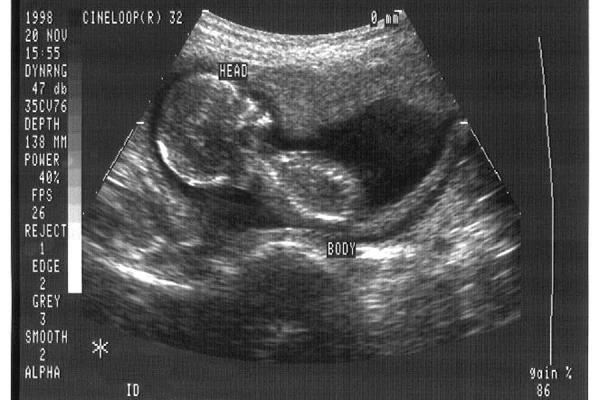
Madrid, Spain, Nov 20, 2019 / 10:56 am (CNA).- Gádor Joya, a pediatrician and a legislator of the Assembly of Madrid from the Vox party, operates the “Life Ambulance Project” outside abortion clinics in the city, offering ultrasounds to pregnant women.

“I and other doctors have been giving these women ultrasounds… Precisely because I have been doing this, I know what has been hidden from these women. Most of them, when they receive the information and hear the heartbeat, decide to go forward with their pregnancies,” Joya said at a meeting of the regional health committee Nov. 5, according to Madrid daily El País.

The ultrasounds are performed in a van near the clinics. The van has been authorized by the health department.

Joya has long been a pro-life advocate. She spoke at the 2014 French march for life, saying that “we know that at the end the Truth will triumph, and abortion will disappear from our society.

The Life Ambulance Project is opposed by Mónica García of Más Madrid, a progressive regional party.

García said that “what we could not have imagined is that there would be people performing ultrasounds on the street. It’s extremely serious.”

Vox is often described as a far-right party. In this month’s Spanish general election, the party took 52 seats. The party opposes both abortion and same-sex marriage.

The November general election was inconclusive. The Spanish Socialist Workers’ Party took 120 seats, and will try to form a coalition government, which it failed to do following the last general election, held in April.

Vox more than doubled its seats thismonth, having won 24 in April.

Santiago Abascal, leader of Vox, said after the Nov. 10 election that “today a patriotic alternative and a social alternative has been consolidated in Spain that demands national unity and the restoration of constitutional order in Catalonia.”

[…]