No Picture
News Briefs

Pope Francis: Tradition is ‘the guarantee of the future’

September 13, 2019 CNA Daily News 1

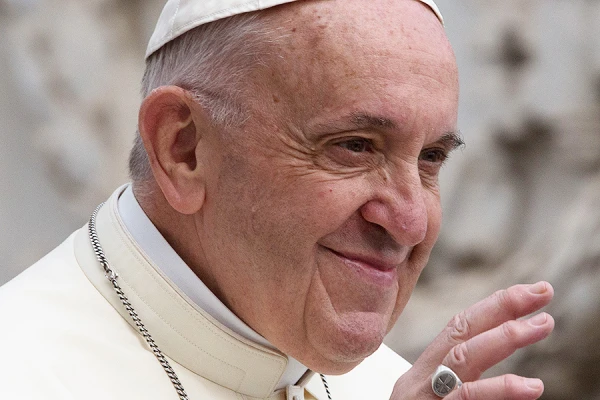
Vatican City, Sep 13, 2019 / 01:11 pm (CNA).- Fidelity to tradition ensures a fruitful future, Pope Francis said in a meeting Thursday with a contemplative-missionary community rooted in the spirituality of St. Augustine.

“To be modern, some believe that it is necessary to break away from the roots. And this is their ruin, because the roots, the tradition, are the guarantee of the future,” Pope Francis said Sept. 12.

In an audience with nearly 200 members of the General Chapter of the Discalced Augustinians, the pope explained that “true tradition” is like the roots that bring a tree sap that allows it to grow, flourish, and bear fruit.

“Never break away from your roots to be modern, that’s suicide,” Francis told the Augustinians.

The Order of the Discalced Augustinians (OAD) was founded 1610 as a reform movement of the Order of St. Augustine (OSA), which dates back to 1244.

“In this long religious tradition begun by St. Augustine, you Discalced Augustinians have your roots,” the pope said. “I encourage you to love and deepen your roots again and again.”

“St. Augustine is one of those figures who make us feel fascinated with God, who attracts us to Jesus Christ and attracts us to the Word of God,” he said.

In addition to the normal vows of poverty, chastity, and obedience, the contemplative-missionary order based on the Rule of St. Augustine takes a fourth vow of humility, which the order has chosen to emphasize and reflect upon this year with their motto: “Happy to serve the Most High in a spirit of humility.”

Pope Francis said that he is enthusiastic about their decision to focus on humility this year.

“Humility is a ‘key’, a key that opens the heart of God and the hearts of men,” he said.

“And, first of all, it opens your own hearts to be faithful to your original charism, to always feel yourselves disciple-missionaries, available to God’s call,” he added.

Pope Francis said we are living in an age in which the mission ad gentes is being renewed, necessitating docility to the Holy Spirit.

“We must always be attentive and docile to the voice of the Spirit: He is the protagonist, it is He who makes the Church grow! Not us, Him. The Holy Spirit is the wind that blows and keeps the Church going with that great strength of evangelization,” he said.

[…]

No Picture
News Briefs

Search for God should be ‘first apostolate’, Pope Francis tells Augustinians

September 13, 2019 CNA Daily News 0

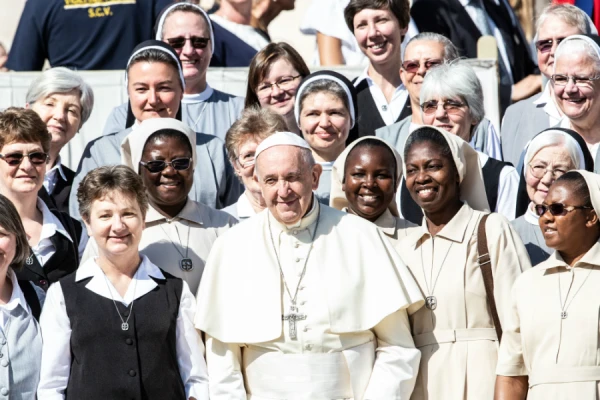
Vatican City, Sep 13, 2019 / 11:47 am (CNA).- Pope Francis told members of a men’s religious order Friday that the first goal personally and in their apostolates should be an orientation of their hearts toward God, who is Love.

“Your hearts always reaching out to God. Always! Each member of the community should be oriented, as the first ‘holy purpose’ of every day, to the search for God,” the pope told about 150 members of the Order of Saint Augustine Sept. 13.

“This ‘direction’ should be declared, confessed, witnessed among you without false modesty,” he continued.

“The search for God cannot be obscured by other purposes, although generous and apostolic. Because that is your first apostolate. We are here – you should be able to say among yourselves every day – because we walk towards God. And because God is Love, we walk towards Him in love.”

Members of the Order of Saint Augustine, also referred to as Augustinians, live as mendicants directed by the Rule of St. Augustine. The order was gathered in Rome this week for its general chapter.

In the order’s audience with Pope Francis, he noted a writing of Fr. Agostino Trapè, now deceased, who was prior general of the Augustinians from 1965 to 1971.

Fr. Trapè wrote that according to the Rule of St. Augustine, “charity is not only the end and means of religious life, but it is also its center: from charity it must proceed and charity must be oriented, with a perennial movement of circular causality, every thought, every affection, every attitude, every action.”

Pope Francis advised thinking on a meditation St. Augustine once gave on the Church as “‘mater charitas,’ a mother who cries for the division of children and calls and calls for unity of charity.”

St. Augustine wrote to St. Jerome about the experience of charity in community, the pope noted. St. Augustine said he finds it “very natural to abandon myself entirely to the affection of such people, especially when I am oppressed by the scandals of the world: in their hearts I find rest free of concern, being convinced that there is God in it.”

“Dear brothers, this is also the challenge and responsibility for you today,” the pope urged, “to live in your communities in such a way as to make the experience of God together and be able to show it alive to the world!”

He explained that this is a big responsibility and asked them to focus on living their community life well, so that they can show God to the outside world “in a clear, courageous way, without compromise or hesitation.”

“You Augustinians have been called to bear witness to that warm, living, visible, contagious charity of the Church, through a life of community that clearly shows the presence of the Risen One and his Spirit,” he said.

He quoted his 2018 apostolic exhortation on the call to holiness in today’s world, Gaudete et exsultate, saying, “Community life … is made up of many small daily details … The community that preserves the small details of love, where the members take care of each other and constitute an open and evangelizing space, is the place of the presence of the Risen One who is sanctifying it according to the plan of the Father.”

[…]

No Picture
News Briefs

Pope Francis urges new bishops to draw close to God and His people

September 12, 2019 CNA Daily News 0

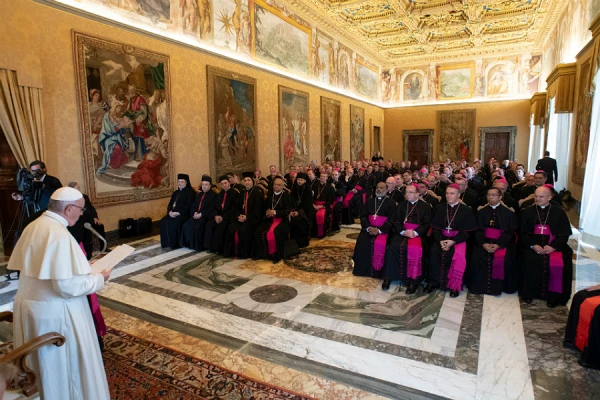
Vatican City, Sep 12, 2019 / 02:01 pm (CNA).- As Pope Francis met Thursday with bishops ordained in the past year, he urged them to make time for an intimate relationship with God and for pastoral visits to people they serve.

“We need bishops capable of feeling the heartbeat of their communities and their priests, even from a distance: feel the pulse,” Pope Francis advised Sept. 12.

The pope urged “real availability” in the life of a bishop, pointing to the example of the Good Samaritan, who saw a need and did not look the other way.

“Stay in contact with people. Dedicate time to them more than at the desk. Don’t fear contact with reality,” he said.

“In particular, I would like to encourage regular pastoral visits: to visit frequently, to meet people and pastors,” he said. “Visit, following the example of Mary, who wasted no time and got up to go quickly to her cousin. The Mother of God shows us that to visit is to bring near Him who makes one jump with joy, is to bring the comfort of the Lord who does great things among the humble.”

The new bishops are in Rome to participate in a formation course organized by the Congregation for Bishops and the Congregation for the Eastern Churches.

“Every day, sparing no time, we must stand before Jesus and bring Him people, situations, like channels always open between Him and our people,” Pope Francis said.

“‘This is my Body offered for you’, we say at the highest moment of the Eucharistic offering for our people. Our life springs from here and leads us to become broken loaves for the life of the world,” he said.

Pope Francis said that without a close connection to Christ, it is easy to slip into the pessimistic mentality of those who say “everything is bad.”’

“Without this personal trust, without this intimacy cultivated every day in prayer, even and especially in the hours of desolation and aridity, the core of our episcopal mission crumbles,” he said.

“Only by being with Jesus we are preserved from the Pelagian presumption that good derives from our skill,” he added. “Only by staying with Jesus does the profound peace that our brothers and sisters seek from us reach our hearts.”

Pope Francis advised that living a simple life as a bishop serves as a witness that Christ is enough.

“The thermometer of closeness is attention to the least, to the poor, which is already an announcement of the Kingdom,” Francis said, noting “not the poor in the abstract with data and social categories, but concrete persons, whose dignity it is entrusted to us as their fathers.”

He said that bishops should be “apostles of listening,” listening even to what is not pleasant to hear. Francis advised the new bishops not to surround themselves with “yes men” or “climbing priests.”

“Please do not let fear of the risks of the ministry prevail, by turning away and keeping your distance,” he advised.

“God surprises us and often loves to upset our agenda: be prepared for this without fear,” Pope Francis added.

[…]

No Picture
News Briefs

Cardinal Dolan ‘consulting extensively’ about allegations against Buffalo Bishop Malone

September 11, 2019 CNA Daily News 7

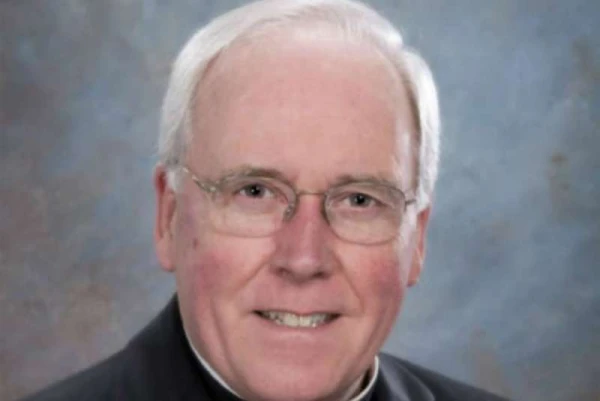
New York City, N.Y., Sep 11, 2019 / 10:59 am (CNA).- Amid calls for his resignation, Bishop Richard J. Malone of Buffalo remains firm in his conviction not to step down from office, even as Cardinal Timothy Dolan of New York assesses whether to open an investigation into Malone’s alleged mishandling of abuse cases.

“Cardinal Dolan has been following the situation in Buffalo very carefully. He is aware of his responsibilities under Vos estis lux mundi, he has been consulting extensively both with individuals in Buffalo, including Bishop Malone, clergy and laity,” Joseph Zwilling, communication director for the New York archdiocese, told CNA in a Sept. 10 interview.

“He has been in touch with the nuncio, and with the Holy See. So he has been remaining on top of it, and I expect that we will hear something, some development sometime in the near future,” Zwilling continued.

Malone took the reigns in Buffalo in 2012. Though no allegations of abuse have been made against Malone, he has recently faced accusations of mishandling or covering up accusations of clerical sexual abuse by priests in the diocese.

Vos estis lux mundi, Pope Francis’ new norms which came into force in June, puts “metropolitan” archbishops in charge of investigations into suffragan bishops, with authorization from the Holy See required.

The motu proprio also calls for an investigation into “actions or omissions intended to interfere with or avoid civil investigations or canonical investigations, whether administrative or penal, against a cleric or a religious.”

In this case, Cardinal Timothy Dolan of the Archdiocese of New York is Malone’s metropolitan archbishop.

“I can’t tell you exactly when, or what the development will be, but I would expect there to be some kind of development in the near future.”

A Buffalo lay group called the Movement to Restore Trust (MRT), which Malone considered an ally after it formed in 2018, on Sept. 5 joined the call for Malone’s resignation.

MRT is calling for the Vatican to appoint a temporary diocesan administrator with no ties to the Diocese of Buffalo while considering the appointment of a permanent bishop.

“Bishop Malone was looking forward to continuing to cooperate with the MRT and regrets that the work will now have to be done without their assistance,” the diocese said in a subsequent statement.

Malone has admitted that he has made mistakes in the past, but denies any criminal wrongdoing and says he will not resign.

Of what is Malone accused?

At least two whistleblowers with high-level access in the diocese— Malone’s former executive assistant and former priest secretary— have gone public with accusations that Malone mishandled several cases of sexual abuse by priests in the diocese, some of which involved minors.

One such case is that of Father Fabian Maryanski, whom a now 50-year-old woman accused of sexually abusing her beginning when she was 15. She reported the abuse in 1995, but a letter from the victim’s attorney seemed to suggest that the woman was in her twenties when the abuse occurred.

The diocesan victim compensation panel found her story believable and offered her compensation, but Bishop Malone said last year that there was still confusion about whether the victim was a minor at the time of the abuse.

As of Jan. 2019, Maryanski’s name was not included on the diocesan page of credibly accused clergy, but it has since been added. Maryanski was removed from ministry last year.

In another case, Father Robert Yetter garnered three sexual harassment complaints. Malone and Grosz reprimanded Yetter, and placed him on “voluntary leave,” WKBW reported late last year. Because the case did not involve minors, the diocese does not publicly list Yetter’s name.

Malone has also faced questions about his handling of the case of Fr. Art Smith, whom Malone’s predecessor Bishop Edward Urban Kmiec placed on leave in 2011, after the mother of a boy at St. Mary of the Lake school complained that the priest was sending inappropriate Facebook messages to her son.

Malone reinstated Smith to ministry in 2012, after the accused priest spent time in a Philadelphia treatment center, according to an investigation by local news station WKBW.

“Maybe I could have looked at it in a different way,” Malone said last November.

“We had decided with Art Smith— because, again, the Facebook incident did not rise technically to be sexual abuse— to keep him in some limited ministry,” Malone told WBEN.

Malone pointed out that he did not again assign Smith to a parish setting. Despite this, the WKBW investigation revealed that while working in nursing home, Smith heard confessions at a diocesan Catholic youth conference attended by hundreds of teenagers in 2013. There were also reports of inappropriate conduct with adults in the nursing home.

“That backfired, too, because even sending him to work in a nursing home…nothing happened with children, but there were some inappropriate actions with adults. So we were dealing with him, but not in a way that I would do now. I admit my failure there,” the bishop said.

He also signed off to allow Smith to become a chaplain on a cruise ship in 2015, and the bishop said now he is “kicking [himself] for that.”

Smith is currently listed on the diocesan page for clergy with substantiated claims of sexual abuse of a minor.

Malone has since suspended a number of clerics, including in Nov. 2018 a young priest from south of Buffalo for alleged sexual misconduct with an adult woman. Most recently, on Sept. 7, the diocese announced that allegations of abuse of a minor against Father Louis S. Dolinic had been substantiated and the priest would remain on administrative leave while the Vatican made a final determination.

In August 2018, WKBW published an investigative report revealing that Malone’s former executive assistant, Siobhan O’Connor, leaked internal diocesan documents to the press which suggested that Malone worked with diocesan lawyers to avoid releasing publicly the names of some diocesan priests accused of misconduct.

Several of the allegations involved boundary violations or sexual misconduct against adults, meaning that the diocese was not required to take action against them in the same way that it would allegations of sexual abuse of minors, under the 2002 Charter for Protection of Children and Young People.

Malone said that while he sought to follow the Charter’s requirements, he “may have lost sight of the Charter’s spirit, which applies to people of all ages.”

O’Connor has been continually calling for Malone’s resignation.

“Be truthful with us, Bishop Malone. Put an end to this toxic secrecy and painful silence,” she wrote in a Nov. 4, 2018 op-ed in The Buffalo News.

“And, if you love us, begin the process of allowing new episcopal leadership to come to our diocese.”

In Sept. 2019, WKBW released recordings of private conversations between Bishop Malone and Fr. Ryszard Biernat, Malone’s former priest secretary, which appear to show that Malone believed sexual harassment accusations made against a diocesan priest months before the diocese removed the priest from ministry.

Biernat recorded the conversations as the bishop discussed how to deal with accusations against Fr. Jeffrey Nowak by then-seminarian Matthew Bojanowski, who accused Nowak of grooming him, sexually harassing him, and violating the Seal of the Confessional.

In an Aug. 2 conversation, Malone can reportedly be heard saying, “We are in a true crisis situation. True crisis. And everyone in the office is convinced this could be the end for me as bishop.”

In one conversation from March, Bishop Malone seems to acknowledge the legitimacy of Bojanowski’s accusation against Nowak months before the diocese removed Nowak from active ministry.

Despite this assessment, Nowak was not removed from ministry until Aug. 7, one day after the seminarian’s mother accused Malone of allowing Fr. Nowak to remain in ministry despite the allegations against him.

Biernat says he made the secret recording after Nowak became jealous of Biernat and Bojanowski’s close friendship. According to a conversation taped Aug. 2, the bishop was concerned that media coverage would focus on a possible “love triangle” between Nowak, Bojanowski, and Biernat.

Biernat also says he was a victim of sexual abuse by Father Art Smith. He alleges that Auxiliary Bishop Grosz threatened to halt his ordination as a priest and have him deported to Poland after Biernat complained in 2004 to Buffalo Diocese administrators that he was sexually assaulted by a priest, according to The Buffalo News.

Grosz has since “categorically” denied the claim.

Reaction in Buffalo

Malone is remaining firm that he will not step down. He reiterated his conviction that he will remain as bishop in a Sept. 6 interview with WBEN Radio.

A lay-led petition calling for his resignation has garnered nearly 10,000 signatures as of press time. A number of clergy have written open letters to local publications calling for Malone’s resignation.

Father Robert Zilliox, of St. Mary’s Catholic Church, drafted a letter in early September calling for Malone and Auxiliary Bishop Grosz to resign.

“We, the People of God that constitute our diocese, are angry, hurt, and in need of authentic, humble, sincere and holy spiritual leadership. We believe that despite your good work in the past you are no longer able to provide that leadership,” the letter reads, as quoted by WKBW.

In mid-August 2019, twenty-two plaintiffs filed a lawsuit against the Diocese of Buffalo, a province of the Society of Jesus, multiple priests, eight parishes, three high schools, a seminary, among others, alleging “a pattern of racketeering activity” that enabled and covered up clerical sexual abuse.

The lawsuit was filed on the first day of a legal “window” allowing for sexual abuse lawsuits to be filed in New York even after their civil statute of limitations had expired.

Among the plaintiffs, who have not been publicly named, are several alleged victims of clerical sexual abuse. The lawsuit alleges specific instances of sexual abuse by priests, and claims that the diocese failed in its duty of care towards children by allowing abusive priests to have contact with minors through parishes and schools.

Calling the diocese and affiliated organizations an “association in fact” for the purposes of federal racketeering laws, the suit alleges “common purpose” in “harassing, threatening, extorting, and misleading victims of sexual abuse committed by priests” and of “misleading priests’ victims and the media” to prevent reporting or disclosure of sexual misconduct.


[…]

No Picture
News Briefs

Pope Francis says he hopes ‘seeds of peace’ will bear fruit in Africa

September 11, 2019 CNA Daily News 1

Vatican City, Sep 11, 2019 / 05:30 am (CNA).- Upon his return to the Vatican after a six-day trip to Africa, Pope Francis said Wednesday that he hopes the “seeds of peace” sown during his apostolic journey will bear fruit in Mozambique, Madagascar, and Mauritius.

“I thank God who allowed me to make this journey as a pilgrim of peace and hope,” Pope Francis said in St. Peter’s Square Sept. 11.

“The hope of the world is Christ, and his Gospel is the most powerful leaven of fraternity, freedom, justice and peace for all people. With my visit, in the footsteps of holy missionaries, I tried to bring this leaven, the leaven of Jesus, to the Mozambican, Malagasy and Mauritian populations,” he said.

Pope Francis said that the Church will continue to support the peace process in Mozambique, which advanced in August, and he thanked the Catholic community of Saint’Egidio for their continued contributions to this dialogue.

“In Mozambique I went to spread seeds of hope, peace and reconciliation in a land that has suffered so much in the recent past due to a long armed conflict, and that last spring was hit by two cyclones that caused very serious damage,” the pope said.

Mozambique fought a civil war from 1977 to 1992 between Frelimo, a socialist party that has ruled the country since it gained independence in 1975, and Renamo, an anti-communist organization. Renamo began a new insurgency in 2013, a conflict that only came to an end in August with the signing of a peace agreement in Serra da Gorongosa.

“The Church continues to accompany the peace process, which has taken a step forward on August 1st with a new agreement between the parties,” the pope said.

“Let us give thanks to God, and ask him that the seeds sown during this apostolic journey will bear abundant fruit for the people of Mozambique, Madagascar and Mauritius,” he said.

The pope reflected that there was much joy amid the rain during the Mass he celebrated in Maputo, Mozambique.

“My visit to Mozambique culminated in Mass, celebrated in the stadium in the rain, but we were all happy. The songs, the religious dances … so much happiness. The rain didn’t matter,” Francis said.

“And there resounded the appeal of the Lord Jesus: ‘Love your enemies’, the seed of true revolution, that of love, which extinguishes violence and generates fraternity,” he added.

After three days in Mozambique, Pope Francis traveled to Madagascar, where he visited the country’s “City of Friendship,” a town built through the leadership of an Argentine priest who sought solidarity with the poorest of the poor.

Pope Francis reflected that Madagascar is a country rich in natural resources and natural beauty, but marked by much poverty.

“I hope that, inspired by its traditional spirit of solidarity, the Malagasy people can overcome adversity and build a future of development by combining respect for the environment and social justice,” he said.

In his meeting with bishops in Madagascar, Pope Francis said that they renewed together a commitment to care for the poor and to be “sowers of peace and hope.”

Pope Francis ended his six-day trip to Africa on the island nation of Mauritius. “I chose it because it is a place of integration between different ethnic groups and cultures,” Pope Francis said, noting the different immigrants from India and other countries who have come to call the tourist destination home over the past two centuries.

Mauritius obtained its independence on March 12, 1968, after more than 200 years of colonization by the French and the British following years of Dutch and Portuguese settlements.

The country is made up of many different ethnic groups, primarily Indo-Mauritian, Creole, Sino-Mauritian, and Franco-Mauritian. The primary religion on the island is Hinduism, followed by Catholicism and Islam.

“There is strong inter-religious dialogue, and also friendship between the heads of different religious denominations. Something that would seem strange to us, but they thus experience the friendship that is natural,” Francis reflected.

The pope said that in Mauritius he found a beautiful bouquet of flowers upon entering the chancery. It was sent as a gift from the grand imam as a sign of brotherhood.

Francis said that he was also impressed to see Muslims and Catholics working together in an HIV treatment clinic in Mozambique run by the Community of Sant’Egidio, a lay movement centered on peace and helping the poor.

On his return flight to Rome, Pope Francis said during an in-flight press conference that he was touched by how the African people in the crowds lifted up their children for him to see.

“Africa is full of life,” Pope Francis said. “It is the treasure of the poor, the child.”

[…]