

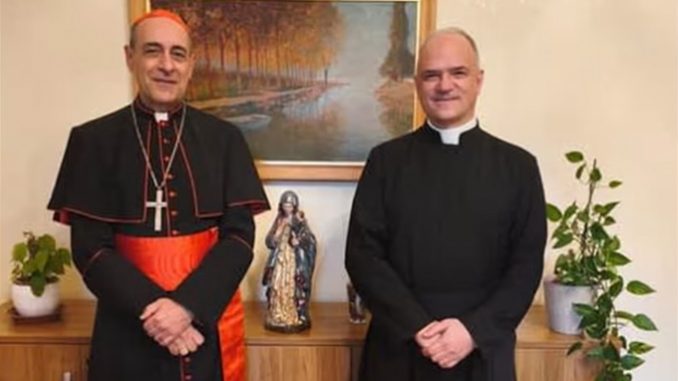
The Holy See has declared that, if the Society of St. Pius X (SSPX) proceeds with the ordination of bishops in July without a papal mandate, those involved in these illicit ordinations are automatically (latae sententiae) excommunicated — that is, excommunicated by their own acts. One may, indeed one should, hope that it does not come to that. But even if the SSPX hits the brakes at the last moment and doesn’t commit formally schismatic acts, the grave problem posed by the SSPX will continue.
That was made rather clear by the May 14 “Declaration of Catholic Faith Addressed to Pope Leo XIV”, in which the SSPX leadership declares, wittingly or not, that it does not share the faith of the Catholic Church.
Take the Declaration’s very first sentence, in which the SSPX declares that “Our Lord Jesus Christ … rendered the Old Covenant definitively null and void.” That would have shocked St. Paul who, wrestling with the tangled question of the relationship between Israel’s election and the New Covenant incorporating the Gentiles into God’s plan of salvation, wrote, under divine inspiration, “They are Israelites, and to them belong the sonship, the glory, the covenants, the giving of the law, the worship, and the promises” (Romans 9:4). Not “belonged,” but “belong.” Two chapters later, Paul insists that “as regards election they [the Jewish people] are beloved for the sake of their forefathers. For the gifts and the call of God are irrevocable” (Romans 11:28-29). God does not repent of his promises, and the Old and New Testaments form a unity, as the Church has consistently affirmed for two millennia. The SSPX Declaration denies this.
The Declaration goes on to claim that “every man must be a member of the Catholic Church in order to save his soul, and there is but one baptism as a means of being incorporated into her. This necessity concerns the whole of humanity without exception and embraces without distinction Christians, Jews, Muslims, pagans, and atheists.” SSPX hell is thus quite well populated, and includes your Lutheran, Anglican, Jewish, Muslim, and non-believing friends and relatives.
This, however, is precisely the extreme distortion of the old maxim extra ecclesiam nulla salus (no salvation outside the Church) for which Father Leonard Feeney was excommunicated in 1953, the theological ground for that sanction being laid by a 1949 statement of the Holy Office approved by Pope Pius XII.
Ironically, the SSPX Declaration affirms that “the denial of even a single truth of the Faith destroys faith itself and renders radically impossible all communion with the Catholic Church.” Yet that is precisely what the SSPX does in declaring God’s promises to the Jewish people “definitively null and void” and by giving the most extreme possible interpretation to extra ecclesiam nulla salus. The SSPX thus contradicts the teaching of such giants as St. Augustine and St. Thomas Aquinas, the papal condemnations of Jansenism, and the teaching of Blessed Pius IX in Quanto Conficiamur Moerore on the availability of grace beyond the sacraments.
It has long been obvious that the root of the movement begun by Archbishop Marcel Lefebvre, which continues today in the SSPX, was not simply the archbishop’s rejection of the post-conciliar liturgy, but a rejection of the Second Vatican Council’s teaching on the Church, salvation, religious freedom, Church-state relations, and the Church’s relationship to other religions. In this connection, it should be remembered that Archbishop Lefebvre was a supporter of Marshal Henri Petain and the collaborationist Vichy regime in France during World War II: a regime that rejected modernity root and branch. Elements of Vichy eventually careened into a lethal antisemitism that grew in part from the rejection of Romans 9-11 that the SSPX Declaration also rejects. To raise even the faintest echo of that tawdry history amidst today’s antisemitic outrages is, to put it gently, frighteningly obtuse.
In May, a distinguished Italian historian noted, with reference to the episcopal ordinations the SSPX intends to carry out and the excommunications that will automatically follow, that “what is set to happen in July will not be the building of a bridge but the creation of a new chasm between [the SSPX world] and the Holy See.” True enough.
That will only happen, however, if the 700+ priests, 200+ seminarians, and hundreds of thousands of laity involved in the SSPX continue to acquiesce, cult-like, in the heterodoxy of the SSPX leadership, whose claim to be the only true Catholics is what will detonate ecclesial bridges and create whatever sorry chasms follow. The people who find spiritual nourishment in SSPX Mass centers deserve better than that.
If you value the news and views Catholic World Report provides, please consider donating to support our efforts. Your contribution will help us continue to make CWR available to all readers worldwide for free, without a subscription. Thank you for your generosity!
Click here for more information on donating to CWR. Click here to sign up for our newsletter.

The SSPX momentum to ordain bishops without papal approval reminds me of Gabriel Garcia Marquez’s “Chronicle of a Death Foretold.” It’s been many years since I read it, but as I recall, everone in the book sees a disaster (the murder of a young man) coming, everyone involved makes half-hearted attempts to avert the tragedy (even the killers have no desire to kill the victim), yet no one does anything definitive, and the killing goes as planned. A far fetched comparison? I’m not so sure.
SSPX should ask the Chicoms to make some bishops for them.
Excellent idea–and would have some cross-cultural/diversity warmth to it as well.
Hear, hear.
Nostra Aetate: yet another instance where the Documents of Vatican II must be read in their entirety. The overall meaning of Nostra Aetate is largely about the nature of God—such that while He works through the sacraments of the Eucharistic Church, His gratuitous work is not limited to the sacraments.
In the thicket of human words (not quite the Word), easily read out of context and misconstrued and exploitable, we are informed on the one hand that “the Catholic faithful [are] to recognize the signs of the times [?]…” (n. 3), BUT THEN come the possibly needed and surely clarifying words:
“Nothing is so foreign to the spirit of ecumenism as a false conciliatory approach which harms the purity of Catholic doctrine [!] and obscures its assured genuine meaning [!]. At the same time, Catholic belief needs to be explained more profoundly and precisely [!], in ways and terminology which our separated brethren [!] too can really understand [!]” (n. 11).
In the secular world, many argued at the time that it was the absence of similarly clarifying words–on the meaning of “unconditional surrender”–that likely led directly to Hiroshima and Nagasaki. Today, and within the Church, the nuclear option of schism.
Christ wept at Gethsemani…
“Nostra Aetate: yet another instance where the Documents of Vatican II must be read in their entirety. The overall meaning of Nostra Aetate is largely about the nature of God—such that while He works through the sacraments of the Eucharistic Church, His gratuitous work is not limited to the sacraments.”
******
Yes, thank you Mr. Peter.
The overall meaning of Nostra Aetate is the claim that those who worship a monotheistic Creator, are worshiping the same True God , The Most Holy And Undivided Blessed Trinity, In The Unity Of The Holy Ghost, which is not true. While Nostra Aetate has some elements of truth in it, no doubt, the claim that all who worship a monotheistic Creator are worshipping The Most Holy Blessed Trinity is false and misleading.
We all worship the same God though our understanding of Him may differ. Whether we are sons of Abraham by blood, by adoption, or by another mother, He’s still our Father.
When you create God in your own image, you are not worshipping God at all. Worshiping your ego is not the same god as God.
A heterodox bishop, giving a retreat at my parish, professed that Catholics were in communion with Jews and Muslims, worshiping the same God. I think he should have qualified his teaching.
I wouldn’t say “in communion ” . The trouble is when people take something too far one way or the other.
If the entire trouble with the SSPX were that they have misunderstood the documents or failed to read them in context, one would think the Vatican could clear that up readily enough, by issuing a correct interpretation or a clear rejection of that interpretation. The trouble might have something to do with there being too many bishops and cardinals who agree with the SSPX’s interpretation of NA, and who will not be happy if it is clearly and authoritatively condemned – even if the SSPX is.
Last I heard, they are not Feeneyites and would agree that God’s work is not limited to the fulfillment of His promises.
Even when read in context, to reject the existence of Christ, is to reject the existence of The Holy Ghost, The Spirit Of Perfect Divine Eternal Infinite Love Between The Father And His Only Begotten Son, Jesus The Christ, Who Proceeds From Both The Father And His Only Begotten Son, Jesus The Christ, and thus reject The Divinity Of The Most Holy Blessed Trinity.
God Is Love. Love Exists In Relationship. God is not self love, God Exists In The Communion Of Perfect Divine Eternal Infinite Trinitarian Love.
“Let US Create man in OUR Image.”
Pope John said he was not calling a Doctrinal Council.
Pope Paul VI at the Council conclusion said it was not a Doctrinal Council.
The SSPX say they accept all doctrines prior to V II.
The Vatican says they must accept the doctrines of Vatican II.
Can the Vatican list the new doctrines of Vatican II that the SSPX must accept?
Can the SSPX list what new items of Vatican II they do not accept?
Can we then just sort out what is doctrine and what is policy and practice?
Policy and practice that contradicts Doctrine, such as The Catholic Church’s Teaching on The Ten Commandments including Christ’s Teaching on The Sixth Commandment “to protect the integrity of Marriage while affirming that all sexual desires must be ordered toward the faithful, lifelong union of a man and woman in marriage and open to the creation of new life”, would certainly constitute a rupture from Catholic Dogma on The Sanctity and Dignity of the marital act within The Sacrament of Holy Matrimony , and The Teaching of The Catholic Church on Chastity.
Mr. Weigel has gone to the heart of the matter. Ultimately the authenticity of the Catholic faith is based on the unified testimony of Scripture and Tradition, not on formulas spelled out in theological manuals. Unfortunately, the French hard-liners in the SSPX imitate their Rationalist and Gallicanist ancestors, thinking that whatever they think is best and ignoring Rome whenever convenient. The SSPX worldwide IS better than that and deserves better than such “elite capture.”
I really do not think that Mr. Weigel did go to the heart of the matter. If anything, he missed it. His critiques of the statements within their creed are, to be blunt, completely unfounded — and, dare I say, he is the one who may need to do a double check on whether his beliefs align with the Catholic tradition.
Here are quotes from Mystici Corporis (Pius XII):
“but on the gibbet of His death Jesus made void the Law with its decrees [32] fastened the handwriting of the Old Testament to the Cross, [33] establishing the New Testament in His blood shed for the whole human race.[34]”
“He made the Old Law void “that He might make the two in Himself into one new man,” that is, the Church, and might reconcile both to God in one Body by the Cross.””
“And first of all, by the death of our Redeemer, the New Testament took the place of the Old Law which had been abolished; then the Law of Christ together with its mysteries, enactments, institutions, and sacred rites was ratified for the whole world in the blood of Jesus Christ.”
So . . . according to Weigel, the OT has not been abolished? Are we still sacrificing lambs on Passover and circumcising our male children on the eighth day?
Furthermore, I do not quite understand what Weigel is even criticizing about their view of ‘extra ecclesiam nulla salus’? To me, there seemed nothing wrong with the SSPX statement. It clearly is not Feeneyism (which denies baptism of desire and baptism of blood, which SSPX never even stated in their declaration). All it is saying is that you cannot be saved apart from the Catholic Church. That is the only good interpretation of it. That’s literally what the name of the doctrine states. What the SSPX statement is not saying is that, unless you are visibly in the Catholic Church, and baptized, you are going straight to hell. In the Baltimore Catechism version which the SSPX publishes in their homeschool program (I think this is where they published it), it states how someone outside of the visible Catholic Church could potentially be saved.
The Athanasian Creed states, “Whosoever will be saved, before all things it is necessary that he hold the catholic faith.” Weigel better go after this one, too!
If anything, Weigel’s statement, “SSPX hell is thus quite well populated, and includes your Lutheran, Anglican, Jewish, Muslim, and non-believing friends and relatives” needs revision. And… what if it does? This basically seems to be saying, “Well, we don’t like that interpretation, and it is definitely not nice, so it cannot be right.” There is not intellectual argument here. What if it does include those people? What if even most Catholics go to hell? There is nothing in the Catholic Scriptures or Tradition which denies that position of “the fewness of the saved.” I’m not advocating for that view; all I am saying is that Weigel’s argument is based on emotion and no intellectual substance — the idea that, if it isn’t nice and might mean people you love could go to hell, it can’t be true.
I’m not even saying that I agree with everything the SSPX does. I don’t. All I’m saying is that Weigel’s critiques are part of the issue which is preventing their full communion. We need to go beyond these infantile, strawman criticisms of the SSPX. I do understand that you can see how Weigel did a good job. If I did not do my long hours of research on the matter, I may agree with parts of Weigel, too. But time and research proves him wrong.
I bought homeschooling curriculum years ago from an SSPX associated school and the illustrated Baltimore Catechism they provided clearly taught how those who are not formally Catholic can be saved. I wish the SSPX would be as clear today in their statement.
Jews don’t sacrifice animals because of the destruction of the Temple. Why would we? But I would recommend waiting till the 8th day for circumcision. There’s an important medical/ safety reason to wait. God knew what He was doing when He gave those instructions. And so did St. Joseph and the Blessed Mother.
🙂
Ah, thank you for validating where it is from!
“I wish the SSPX would be as clear today in their statement.” Fair enough! In the Declaration they proposed, though, it’s not meant to be a dense theological argument, just as in the Creed we do not give a detailed analysis on the Filioque, haha.
“Jews don’t sacrifice animals because of the destruction of the Temple. Why would we?” Right. I was speaking tongue-in-cheek to show that the Old Covenant is indeed abrogated. You are definitely correct to point out, though, that there was both a theological AND physical reason for circumcising then! Otherwise, the children would have bled out, since they did not produce Vitamin K yet, which is needed for blood clotting. Amazing how provident God is!
Dialogue is great, but it must be constructive. The Church is in the position to set the guidelines and conditions. The Church has been very patient with the Society for well over a half century and will probably continue to do so, but eventually the problem must be solved once and for all. Even if there is a split, as “separated brethren “ they would be much closer to us than most of the others are. While they would not likely accept us as brethren, we would accept them as part of the greater Church.
As always Mr Weigel, good job on an excellent article. Thank you sir.
My name is John Cassidy and I live in London. I ws brought up in the Catholic Church before Vatican Two but drifted away from the practise of the true religion for 30 years. I therefore missed out on most of the Polish Pope’s Pontificate. Upon returning to the Catholic Church in 2014 – thanks to the Spiritual Exercises of St. Ignatius – I read a book called ‘THE HIDDEN POPE’ by Darcy O’ Brien. I feel sure that this book must be one of Mr Weigel’s favourites. Kind regards Mr John Leo Cassidy, Notting Hill.
Man is man and there will always be schism. Or as the Amish say “Only good wood splits!”
I wish this problem was limited to the SSPX but it’s not. I’ve been encountering it in other Catholic circles recently & it seems to be growing.
Back when we first began homeschooling there was only one Catholic curriculum provider I could find & it was associated with the SSPX. Their materials were good & solid. The illustrated Baltimore Catechism included with our textbooks clearly taught how those not formally within the Church can be saved.There was an illustration that helped in understanding how that works.
Fr. Feeney was not a well man & he took a wrong turn, perhaps in part because of that. I’d like to think so.
It was a real tragedy because he initially did so much good & at Harvard of all places. He had students crowded outside the building when he spoke because there was no room left inside.He was that popular a speaker. Imagine that happening at an Ivy League university today?
Fr. Feeney was excommunicated because of his refusal to go to Rome when summoned. But his going off the rails is what prompted that.
Sometimes I think Satan goes after the best & the brightest-those who could pose the greatest threat. The indifferent & lukewarm are less of a concern.
Satan does go after the best and brightest. But so do human beings, generally out of envy or fear. We hammer on good people because we fear their invisible faults, or because we don’t want to know there is someone better than us, or because their goods seem to highlight our evils.
Envy comes into it for us, too.
Thank God that there are so many who intercede with The Father to touch hearts that have become ‘rigid’ – including the good and holy Popes – Pope Leo X111 to the present name sake as we too can join in same intention to help do away with such attitudes in ourselves and many more .
https://en.luisapiccarretaofficial.org/news/the-divine-will-at-the-heart-of-holiness/2003
https://bookofheaven.com/2015-conference/pope-leo-xiv/ – May 8 – election of
Pope Leo X1V as anniv. of apparition of St.Michael here .
Pope Pius X , Luisa , St.Hannibale Di.Francia -latter to whom Pope Benedict XV1 also much devoted .
https://bookofheaven.com/who-is-luisa/pope-st-pius-x/
The remarks about The Church becoming ‘small’ -also likely having the prophetic meaning of the child like innocence & holiness that was in Adam being restored in many more in The Church and not to claim smallness in #s alone as a criterion of special holiness .
https://luisapiccarreta.co/?page_id=23475
Mercy !
Pope Francis – one day soon enough, many hopefully to recognize the depth of his mystical & prophetic gifts , its fruit as his great compassion for the weak, the poor and suffering , in his patience for the the misunderstandings & persecution about the Pachamama incident . That statue can also be seen as an icon of the sorrow and gratitude of Eve after The Fall – the nakedness of our First Parents after The Fall when they lost the Divine Will with its light and glory that reigned in them ,the gratitude and trust in The Father for His promise of the Redeemer !
Our oneness in Adam of old and our New Adam – to bring the hope and joy that one day soon enough, as narrated by persons such as Rev.Fr.Jim Blount, that the whole world is going to be Catholic. FIAT !
in his patience for the the misunderstandings & persecution about the Pachamama incident . That statue can also be seen as an icon of the sorrow and gratitude of Eve after The Fall.
Pope Francis himself said they were pachamama. There is only one definition of what pacahamam is and represents and its not Eve. It’s a sad day when the Catholic church chooses a pagan idol to evangelise the Americas rather than Our Lady of Guadalupe.
Two wrongs do not make a right, but Rome cannot credibly insist on disciplining the SSPX while tolerating (and even promoting) priests and bishops in “full communion” who publicly contradict or campaign against Catholic doctrine. Such inconsistency creates a perception of injustice, undermines the Church’s authority, and lends credibility to the SSPX’s argument that fidelity to tradition is treated more harshly than open dissent. “Fidelity for thee, but not for me” is no way to run the Church or foster genuine ecclesial communion.
“one cannot credibly insist on disciplining the SSPX while tolerating (and even promoting) priests and bishops in “full communion” who publicly contradict or campaign against Catholic doctrine.”
The more bureaucratic an organization becomes, the more insistent it is on submission to personal rank and the less insistent it is on maintaining on fidelity to charter, mission and purpose.
Francis’ papacy illustrated how advanced this disease really is in the Church. He was aggressively imperial. McElroy just exhibited the same tendency with Father Rosetti.
Master bureaucrats act swiftly and severely (and capricious disorder and disproportion ), instead of through deception and subterfuge to remind their subordinates of their position in the food chain, once convinced either through weakness or shared objectives their own superiors will allow them to operate with impunity.
If there was a healthy Church governance, Father Rosetti would have access to a canonical judicial process to examine the validity of the charge made against him as well as the validity and propriety of the action taken against him and McElroy’s reputation (as it is) would be subject to scrutiny. It’s amazing how many have found the charge wanting and the sanction severe.
For decades, Popes had advanced Bishops and Cardinals whose doctrinal fidelity was lax and then they reached a critical mass in the St. Gallen Mafia.
“Every man but one a subordinate clerk in a bureau. What an alluring utopia! What a noble cause to fight!”
-Ludwig Von Mises “Bureaucracy” (1944)
Errata:
Master bureaucrats act swiftly and severely (and WITH capricious disorder and disproportionate response), instead of through deception and subterfuge to remind their subordinates of their position in the food chain, once convinced either through THE weakness or shared objectives OF their own superiors will allow them to operate with impunity.
There seem to be an archbishop and priests involved in Study Group 9’s report promoting gay marriage. Somehow or other there hasn’t been public discipline or public Curial correction of their public offense.
Disobedience offends God, the Church, and the *hierarchy*. False teaching only offends God and the Church – no big deal.
As the Second Vatican Councils says, everyone gets into heaven, except the SSPX.
VII closed in 1965. The SSPX was founded in 1970. Remarkable work by the Councils (sic).
And if you are old enough to remember 1970, even as a small child, you remember a charge that could be described with adjectives such as authoritative, confident and consequential, significant and vibrant. Today none of that applies.
Don’t get me wrong, the rot (McCarrick & Weakland, et al) were already present, but they had merely just begun munching on timbers and beams.
If one went out back then and a woman was wearing a veil, you could be confident that she was a nun. Today you can be confident she’s neither a nun or a Catholic. I’m not even sure you can be confident that the wearing is female.
A Church, not a charge.
Is it a sin to loathe autocorrect and the people that concocted it?
I hate auto correct, too Mr Pitchfork. It has on one occasion substituted a word in a text that made the message obscene. I’m trying to be more cautious but auto correct is sneaky.
not automatically a sin, prob venial if it qualifies
But on questions of orthodoxy, I’ve learned not to take GW too seriously, or even the historical accounts of this historian. The founder of the SSPX, Archbishop Lefebvre, was adamant in his belief of baptism by desire, even extending it to atheists, who might live with a desire to serve God with or without self-awareness of the object of their love.
That’s good news Mr. Baker. I wish it had been emphasized more in the SSPX’s declaration.
Laughing out loud inside.
(and let’s not forget the Hitler exception…so everyone but SSPX and Hitler.)
I don’t really dispute the argument made by Mr. Weigel so much as his decision to make it. He is on record over many years for disparaging the traditional form of the Mass and cheerleading Paul VI’s missal. Interested readers will know his opinions before they read them.
Agree.
Christ Is The Messiah Who Fulfills The Old Covenant, thus to deny Jesus The Christ Is The Word Of Perfect Divine Eternal Infinite Salvational Love Incarnate, is to deny that The Sacrifice Of The Cross, The Sacrifice Most Holy, The Sacrament Divine, Is The Sacrifice Of The Most Holy Blessed Trinity, “For God So Loved Us, He Sent His Only Son…”.
Salvation is for all people to either accept or reject.
God Promised to send The Israelites The Messiah, and God Sent His Only Begotten Son, Jesus The Christ.
The Catholic Church teaches that this is our Sacred Heritage, The Sacred Heritage of all human persons, from the moment of conception; Salvation Is Of The Jews, From The Father, Through , With, And In His Only Begotten Son, Jesus The Christ, In The Unity Of The Holy Ghost, The Spirit Of Perfect Divine Eternal Infinite Love Between The Father And His Only Begotten Son, Jesus The Christ., Who Proceeds From Both The Father And His
“The ambiguity of the moment is whether enabling an informal church-within-the-Church, while also affirming formal doctrine, constitutes an actual “public defection” from the Catholic faith.”
It does, because such ambiguity denies The Unity Of The Holy Ghost.(Filioque), and can no longer be claimed to be “ambiguous” because the SSPX is under threat of being excommunicated for holding fast to Sacred Tradition, Sacred Scripture , and The Teaching Of The Magisterium, grounded in Sacred Tradition and Sacred Scripture, while those who desire to accommodate the denial of The Sanctity and Dignity of the marital act within The Sacrament Of Holy Matrimony and thus God’s Will that we respect The Sanctity and Dignity of Human Life from the moment of conception are being affirmed and promoted within the hierarchy of the counterfeit magisterium that is anti Christ because it denies Christ’s teaching regarding lust and the sin of adultery, making it appear as if lustful sexual acts that deny the inherent Sanctity and Dignity of our beloved sons and daughters are acts of Love.
Father Leonard Feeney was excommunicated for”heresy and persistent disobedience, for denying The Catholic Church’s Teaching on The Baptism of Desire, and refusing to appear before the Pope”.
Are you suggesting that by recognizing that outside The Catholic Church, there is no Salvation, The SSPX is denying The Church’s Teaching on The Baptism of Desire that, at the hour of his death, in recognizing Christ In All Christ’s Glory, St.Dismas, The Penitent Thief, experienced?
CCC 846 “All Salvation comes from Christ The Head through The Church which is His Body.”
Sorry George, but you’re wrong. It’s the Conciliar Church that has left the Faith, not the SSPX. As during the Arian Crisis the Modernists are occupying the Vatican, the chanceries, and the rectories.
Thank you for a clear eyed assessment of the sad state of the SSPX and the society’s errors.
Mr Weigel, there is something a little disingenuous about your latching on to the Jewish issue, but it is also pretty important that you did.. As you know, the SSPX upholds the faith ad33-1962.
Before 1962, Catholic theology taught that the OT Covenant of Moses had been fulfilled and superseded by the NT.
For example, the Council of Florence in Cantate Domino (1442):
“The Holy Roman Church firmly believes, professes and teaches that the legal prescriptions of the Old Testament… after the coming of our Lord had been signified by them, ceased, and the sacraments of the New Testament began.”
ppPius XII was clear as day in Mystici Corporis Christi (1943):
“By the death of our Redeemer, the New Testament took the place of the Old Law which had been abolished.”
Taking issue with traditional Catholic teaching is one thing. Accusing the SSPX of antisemitism for simply upholding the 2000 year teaching of the Roman Catholic Church is quite another.
For the record, I personally respect the Ratzinger solution of two valid Covenants.
This single issue highlighted by Mr Weigel is one Solid Reason why the Vatican has no interest in blowing the bridge – for the Church needs the family silver of tradition – and the family silver needs the post-conciliar polishing of ppBXVI.
Please Holy Father, allow the ordinations and engage ecumenically with SSPX…
The SSPX is not silver. It is dross.
Thank you so much Gerard for taking the pain to leave us all with the depth of your intellectual musings.
You are most welcome
I’m OK with the idea of 2 valid covenants. The covenant with Noah certainly seems to still stand.
But the Old Covenant doesn’t save, and never did. It very validly convicts its adherents of sin and provides no sufficient solution, and the prophets of the Old Covenant affirm this, as does St. Paul. Those who accept the New Covenant are freed from the prescriptions of the Old, and receive salvation provided they keep the Covenant. Those who stick with the Old are obligated to obey the whole of it, have only an unsure hope of salvation (as everyone outside the New Covenant does), and miss out on the ordinary (and extremely powerful) means of salvation and Sacramental grace.
From Mr. Cracked Nut: “For the record, I personally respect the Ratzinger solution of two valid Covenants.”
Valid, yes, but also not quite parallel and equivalent…
Theologian Thomas G. Guarino suggests: “Therefore, God’s relationship with Israel is not to be regarded of having once existed but as now surpassed. A ‘living covenant’ with God must be attributed to the Jewish people, even if Christ is that covenant’s fulfillment. For Nostra aetate, Judaism is not analogically related to—in fact, is the irreplaceable foundation of—the fullness of revelation found in the Christian faith” (“The Disputed Teachings of Vatican II,” Eerdmans, 2018)…
“Analogical” meaning to now stress “similarities” among religions, rather than “differences” (as done in the past) which are obviously present. While the Council placed its accent on commonalities among religions (of which Judaism is a special case)—and distancing specifically from past antisemitism—Benedict also discerned in the Council a “combination of continuity and discontinuity at different levels” (speech in 2005). This nuance rather than reading actual “rupture” into the Council’s work. On Nostra Aetate, in 2012 he even added: “In the process of active reception, a weakness of this otherwise extraordinary text has gradually emerged: it speaks of religion solely in a positive way and it disregards the sick and distorted forms of religion [later Pachamama!] which, from the historical and theological viewpoints, are far-reaching importance.”
Thought Experiment: About SSPX, what are the similarities and differences with heretical Marcionism? About Judaism and instead of rejecting the Nostra aetate and the Vatican Council, Marcion of Pontus rejected the Old Testament outright and all the gospels except Luke (who was a converted gentile rather than a Jew).
Good reading you Peter, but there is surely a significant difference between taking issue with some of the V2 council’s texts and rejecting sacred scripture – bar Luke!
It is a great quote you provide from ppBXVI 2012 – requiring an ajustment of the NA text via a magisterial document?
Not directly related, but still waiting on the Pope or Vatican to explain the pope’s 1995 picture at a pachamama worship service. Is it now okay to break the First Commandment (if you are well-intentioned)?
Perhaps telling God sorry for his having been sent there under obligation?
or for obeying men rather than God?
Maybe just not understanding obedience, well? Especially pertinent now that the Holy Father is in the constant mix with people and groups and diverse motives.
That’s a good point, thank you Elias.
Some of the things we were expected to attend as Catholics decades ago were pretty awful. But we weren’t under obedience to be there.
The odd thing is I thought we were done with that sort of nonsense when Francis passed on.
Stupid me.
Have you never been to a service of another’s faith? Have you never been silent at a funeral out of respect for another’s beliefs? Never been to a Protestant wedding and politely declined the “communion “? Never been to a dinner and quietly kept your head bowed though the prayers didn’t agree with you? Never been to a Seder or the celebration of Eid? Ever been to a cemetery on All Souls while those around you mourned with music and dancing? I wish you a wider circle of friends.
Are you a freemason, Gerard?
No dear. Again your moniker fits.
I had to go to a protestant celebration of life once for a friend. I obviously disagreed with their presumptuous perspective, but you have to pay your respects to your family and your friends, even if it means going to a different church for (gasp! An hour or two) To do otherwise is to be an aloof, self righteous snob.
Gerard does have a point. Usually at Nascar and lower level stock car races, a general prayer of invocation to the Heavenly Father is said before the race. It’s not a Catholic one, and it probably doesn’t come out of your polished leatherbound 1962 hand missal, but it doesn’t mean that we have to stick our fingers in our ears until it’s over.
Maybe what Gerard meant was there’s more places to see in life and many people to engage with than just being around places and people who share your same faith.
I’d like to visit the deep south someday. Yes, many of them have a different faith than mine, but at least they’re not a bunch of stuffed shirts.
Come visit us Didn’t Think So.
🙂
Depending what part of the Deep South you go to you can find pockets of Catholics. Some descend from the original colonists because a large part of the Southern US first belonged to Spain and France.
I don’t see the kind of discord that I can find in Catholic comment boxes. People generally get along with each other and recognize fellow Christians. Separated brethren yes, but fellow believers in Christ. We aren’t each other’s enemies.
Your lecture on tolerance is not relevant to the discussion.
Truth matters. I hope in your “circle of friends” no one prays for abortion rights while you remain silent.
I bear witness to the hope within. That is what God asked.
After all, who in the ordinary way is likely to injure you for being enthusiastic for good? And if it should happen that you suffer “for righteousness’ sake”, that is a privilege. You need neither fear their threats nor worry about them; simply concentrate on being completely devoted to Christ in your hearts. Be ready at any time to give a quiet and reverent answer to any man who wants a reason for the hope that you have within you. Make sure that your conscience is perfectly clear, so that if men should speak slanderously of you as rogues they may come to feel ashamed of themselves for libelling your good Christian behaviour.
Gerard,
It is disingenuous to quote scripture without indicating that you’ve done that.
On the basis of past experience with you, we have barely recognized Christ in your heart without urging forth a fair degree of benevolence.
IOW, Scripture like you’ve quoted does not square with speech which typically comes out of you.
So thanks for your efforts here. Next time, tell us book, chapter, and verse. Know that my English teacher red-pen is ready to draw lines to assist you.
Mr Baker, we aren’t the only Christians who oppose legalized feticide.
We can find any number of Catholics who are either unengaged or indifferent about prolife issues and who vote for candidates who promote greater access to feticide. Sometimes those candidates are Catholics also.
As a former athesist who opposed feticide, I submit you completely missed my point. My rebuke was towards the cheap condescending sentiment expressed by Gerard where he aserts that presumed good intentions are all that matters.
No, a Catholic, being totally converted to Christ, In The Unity Of The Holy Ghost, can never break one of God’s Commandments and be “well intentional”.
The Roman Theological Forum discusses schism and salvation at https://www.rtforum.org/lt/lt149.html
Orthodox theologian Fr. Harrison asks what necessary and sufficient conditions put one outside the church (and thus not saved). His last and most relevant points are Nos. 7 and 8.
1. Being unbaptized?
2. Being in the state of original or mortal sin (i.e., lacking supernatural charity)?
3. Lacking supernatural faith? This is not necessary, because formal schismatics and excommunicated persons can be outside the Church while retaining the theological virtue of faith. However, since the Church is first and foremost the community of the Christian faithful – the Christifideles – anyone who lacks the virtue of faith (whether culpably or inculpably) is certainly outside that community. This is sufficient, but not necessary, for being ‘extra Ecclesiam’.
4. Being visibly unconnected (sacramentally or sociologically) to the Church’s organized structures? Not sufficient, because Catholic teaching has explicitly recognized ever since the third century that infants validly baptized in, and being raised in, heretical/schismatic communities are at least for a few years members of the true Church – although not visibly so.
5. Being unentitled to receive the (post-baptismal) sacraments? No, this is an effect, not a cause, of being outside the Church.
6. Lacking an explicit will to be subject to the Roman Pontiff? Not necessary, because a person EXCOMMUNICATED FOR CERTAIN OFFENCES COULD STILL HAVE SUCH A WILL. Neither is such a lack sufficient in itself to put you outside the Church. After all, baptized Catholic babies and inadequately catechized Catholics – children or adults – can lack this explicit will; yet not only are they not outside the Church; they are fully inside her, as true members.
7. Having an explicit will not to be subject to the Roman Pontiff? This is not necessary as a condition for being outside the Church, for the same reason disposition #6 above is not necessary.
8. Having an explicit and CULPABLE WILL not to be subject to the Roman Pontiff?
“…all who are outside the Church lack charity, while all who lack theological faith, along with all schismatics who retain faith while CULPABLY refusing subjection to the Roman Pontiff, are outside the Church.
“…being truly separated from the Church of Christ – being outside her in the sense that excludes from salvation – IS ESSENTIALLY AN INNER SPIRITUAL CONDITION (though of course it can be outwardly manifested with words and deeds).”
Fr. Harrison’s commentary is worthy of note.
With all due respect, Mr. Weigel’s reasoning is okay so far as it goes, but bias is never a good sheen. None of us has any way of knowing to what extent LeFebvre (or the SPPX order today) was as antisemitic as Weigel seems to suggest. Many French people supported Petain.
Not everyone who lived during the time of WWII was a fighter in the Resistance. Not everyone acted as did St. Benedicta or St. Kolbe. Not everyone could speak or plot against Naziism as did Bonhoeffer. Even Pope Pius XII exercised prudential caution in an effort to avoid agitating the Nazi regime.
Mr Cracked Nut, I personally knew “Bishop” Williamson years ago and he was quite antisemitic in his sermons and his general demeanor. He was also Lefebvre’s close associate so he must have been aware, and yet still handpicked him to be consecrated back in “88. Williamson was also in charge of their seminary and spread a lot of this nonsense to many young men in priestly formation. It was well known that he was a proponent of the “Protocols of the Elders of Zion.” Yes, he was eventually kicked out of the SSPX but he did a lot of damage for years, as did his cohorts at the school in St. Mary’s Kansas. He warped whatever the teaching of the Church was prior to Vat II.
Dear PG,
The sad Williamson affair – which cost both ppBXVI and the SSPX dearly – should be motivation enough for the Vatican to weigh in on the Ordinations and do the vetting of the candidates etc.
It is not possible to know if saintly Marcel Lefebvre could foresee Williamson’s future excesses. A Vatican vetting procedure was needed then, as now. Although we can imagine the SSPX has learned from the Williamson case.
We must pray for the situation.
Marcel Lefebvre wasn’t “saintly”. He died as an excummunicated bishop who rejected papal authority. He’s no hero, and even if he were, most heroes remain unknown.
The doctrines of the Church prior to VII is the same as it is today, despite how hundreds of thousands of Catholic teachers have lied about it without personal consequences, warping and damaging the lives of millions.
The possible idiocy of Williamson does not excuse the infidelity of recent popes.
I’m sorry to hear that. I had thought Bishop Williamson was a one-off.
I remember hearing about some of the goings on in Kansas back then. It reminded me of a season 3 Father Ted episode when a deceased priest bequeathed Fr.Ted his entire Nazi memorabilia collection. I hope that was a one-off at St. Mary’s too.
It’s a super funny Fr. Ted episode if you can find it on YouTube.
Grand operas of anti-Catholic bigoty and never “one-offs.” They don’t even end at the Vatican.
That should be never are “one-offs).
Our first homeschooling curriculum came from the SSPX. It was the only Catholic homeschooling source I could find back then.I had an SSPX homeschooling friend and we kept in touch for years.
I followed news about St.Mary’s and Bishop Williamson in publications like ” The Wanderer “. I believed those weren’t representative of the SSPX as a whole.
I read up on Williamson. Seems he was a real piece of work. Besides being an antisemitic Holocaust denier, he was twice excommunicated, and even conferred a conditional, invalid consecration to excommunicated Viganò, (who so-called “Dr” Taylor Marshall constantly sucked up to, along with that sedevacantist John-Henry Westen). Those two, despite their conservative and pro-life views, are basically schismatics themselves.
Consider some proportion. Tens of thousands of priests, theologians, bishops, cardinals, and two popes in a row who have been aggressively heterodox without consequence to their standing in the Church.
It is an odd world. I couldn’t get that picture out of my head as I was reading the article. To see Tucho Fernández standing next to Pagliarani. It is Pagliarani and the fellows in the SSPX who Fernández and Weigel see as the untouchables, the spiritual lepers. And yet It is Tucho who writes books in admiration of sexual lust. It is Tucho who blew up Africa with Fiducia Supplicans; who blew up 2000 years of thinking on divorce and remarriage, and who helped scuttle the work of Benedict on the rapprochement with the traditionalists. And Weigel stoops to associate Lefebvre and the SSPX, (and all traditionalists too?) with French Nazi collaborators. Wow. How low will Weigel go?
He’s not referred to by many, including me, as Pollyana George for nothing.
Question: Does “the Church Establishment” expect us to all please understand that such issues served up in this essay are ALL UTTERLY MEANINGLESS?
A. Exhibit A. Baptized members of the Church who obstinately profess heresy are “formal heretics” and regarding their status, are automatically excommunicated by their own acts (latae sententiae), per Canon Law 1364.
B. Exhibit B. Walter Kasper, a Cardinal and papal elector, in 1974, and again in 2011, published his own heresy denying the resurrection of [the body] of Jesus, declaring instead that Jesus only “obtruded in the spirit.”
C. Exhibit C. One can be a priest, and Bishop, and papal elector Cardinal, and be a formal heretic who is simultaneously excommunicated latae sententiae, and yet remsin “in good standing in The Church,” retain teaching authority as Bishop, and wield papal election power as a Cardinal.
And yet, we are asked by the author (and the appalling, psycho-sexually disoriented Eminence Tucho Fernandez pictured at left in the photo) to rend our garments over the SPXX drama.
Kasper was also an early promoter of process theology, which implies a dumb God is still in the process of figuring thing out, yet he obtained the status as “the pope’s theologian” early in the pontificate of Francis.
Yes, I know.
I conclude that Cardinal Kasper is not a Christian. He is a believer in “The Church,” but he does not believe that Jesus is the Son of the Living God.
Thank you for calling to my attention to all these things Chris, which I did not know. I am in tears. I went and researched and found more horrors. See below the site of the SSPX online and the Novus Ordo site, none of which I knew about.
https://www.sspxasia.com/Documents/SiSiNoNo/2001_November/Cardinals_With_No_Faith.htm#:~:text=If%20Jesus%20is%20not%20God%20but%20was%20made,ambiguous%20phenomenon%2C%20open%20to%20different%20possibilities%20of%20interpretation.%22
Deniers of the Resurrection: Walter Kasper, Gerhard Muller, Joseph Ratzinger
https://novusordowatch.org/2016/03/deniers-of-the-resurrection/
Oscar:
I have found that on the topic of the Resurrection, Kasper and Ratzinger strongly diverge. Kasper outright denies the resurrection of Jesus (he only “obtruded in the spirit”). Ratzinger rejects the denial ideology (he deals with this very topic in one of my books if his essays – I have misplaced but will later find it and quote for you).
In any case, Kasper is in the post-Christian camp that denies the resurrection, and calls it “a grotesque idea.” Kasper alludes to the dismissive description of the Resurrection as “a resuscitated corpse” and rejects it outright.
Ratzinger instead says wait a minute, the Gospel accounts, and St. Paul, repeatedly attest to the physical presence of Jesus, and this is revelation, not speculation. Thus, we need to ground our understanding in that evidence, which has the same authority as the evidence of “the empty tomb” and goes beyond it.
It is worth noting here that this type of divergence of Kasper and Ratzinger accounts for Ratzinger et al after several years leaving the “Consilium” group (who espoused the ideology of Kasper et al) and founding the “Communio” group, who were seeking enriched understanding of the articles of faith denied by Kasper et al.
Ratzinger simply explains that the resurrection is far beyond the trivialized notion of a mere resuscitated corpse (which is the false notion Kasper is repulsed by, and is the pretext for Kasper’s denial of the resurrection). Ratzinger explains that when Jesus raised Lazarus (and others) from the dead, these really was in a sense merely resuscitating a corpse, as Lazarus’ would later die a natural death. The distinction Ratzinger makes is that Jesus’s resurrection is something far beyond this, because his body (which could be touched, and could eat and drink), was mysteriously glorified, and could live while yet retaining open wounds in his hands and side, and could suddenly appear and disappear and enter locked rooms unrestrained by the barred doors. Ratzinger simply speculates that Jesus’s glorified body was not the once scourged and brutalized body of Good Friday, but somehow that same body transformed. And Ratzinger recalls St. Paul, who himself testified that he beheld the risen Christ, “as one untimely born,” and the same St. Paul is recalled by Ratzinger, who says “do not be mistaken, the perishable cannot become imperishable, but at the resurrection of the dead, our bodies will be changed, in an instant.”
Kasper has denied the resurrection. Ratzinger instead seeks a deeper understanding of it.
I could go further, but this is sufficient, and a faithful account.
The discipline the SSPX is threatened is without credence since the lash is spared on those promoting a host of moral and liturgical abuses.
I write as one who has not attended a Vetus Ordo Mass since the late sixties. I write as one who has observed over a lifetime the abuse of authority by the episcopate in countless situations — moral, theological and simply practical.
The only facet of Catholic doctrine, dogma and praxis exempt from alteration is the mighty stick of a bishop…ironically even the synodal operation which threatens their legitimate authority is a conivance to evicerate the very nature of the the Catholic Church.
Pope Leo serves us and his legacay, historical and eternal, very poorly if he does not sit down with the SSPX and fix this scandalous situation in accord with some uncomfortable truths. Declining to do so simple gives the upper hand to the SSPX.
The SSPX have no hand.
“Pastor Aeternus” of Vatican I which defined the nature of papal infallibility provided a linchpin toward the end: “The Holy Spirit was not given to the Roman Pontiffs so that they might disclose new doctrine, but so that they might guard and set forth the Deposit of Faith handed down from the Apostles.” It would do well to recall a statement of sixteenth century Bishop Melchior Cano, O.P., theologian at the Council of Trent: “Peter has no need of our lies or flattery. Those who blindly and indiscriminately defend every decision of the Supreme Pontiff are the very ones who do most to undermine the authority of the Holy See – they destroy instead of strengthening its foundations.” Presently we observe those who weaponize the impulse to papolatry against which Cano warns in order to eviscerate the papacy and make Roman Catholicism prone to total deconstruction from within while maintaining the façade.
Ignorance bequeaths a false confidence.
The sheer terror of the situation is beautifully expressed, James.
I appreciate this quote.
The infallibility protection of the Church from the Pope’s errors doesn’t apply most of the time. The guidance of the Holy Spirit surely does, and the grace in accordance with his office is not withdrawn, but the Pope is free to reject these.
I have worked with people who are under my authority (in a very limited sense). I have always appreciated that they do not note my mistakes, keep their mouths shut, and hang me out to dry. Giving the Pope the benefit of the doubt that he cares about doing his job right should actually entail a willingness to tell him (kindly and respectfully, but clearly and persistently) when he’s doing it wrong.
Ok The SSPX’s fate is in their hands. No one is to blame but them.
https://www.youtube.com/watch?v=BxDv0k1p0MA
We are all responsible to and for the perennial Magisterium — indeed it is that responsibility for which the living Magisterium exists.Tis the temporal shepherd who will answer. Obstreporousness defense of the zeitgeist serves as no purpose but to undermine the Gospel.
There is reasoning to your comments but here you seem to decide the issue YOURSELF by reference to pop music. Are you the Pope then? Or did he send you to announce in an unidentifiable manner. In another place in CWR you said Catholicisn is not a performative business. All due consideration and regard.
Gerard
June 10, 2026 at 2:33 pm
As a regular Ordinary Form Catholic, it’s part of the ethos that we don’t “perform” our Catholicism for others’ observation or example.
https://www.catholicworldreport.com/2026/06/07/is-a-schism-in-the-air/
If you separate yourself from the barque of Peter you separate from Christ, no advanced degree required to understand,
You haven’t said if the Pope sent you to say the thing or be mediator.
SSPX have some serious concerns, the latest article at CWR by Melina shows other faithful people have serious concerns, Pelagianism only being noticed as a specific even though it was there a very long time before and after the Council. So Holy See needs to treat them with care.
The Pelagianism issue to this day has not been joined properly or at all. That would span the whole time from about 1900 later pinned by Humanae Vitae.
In another place you said keep it simple but it strikes me that you are reductive in some parts and simplictical/overly simplistic which is not ordinary faith. The reference to “advanced degree” is just like the pop song. The Lord said let them grow ’till harvest when the angels do sorting.
What is the rush to judgement.
Francis suggested a few times that he was the “same as Christ,” but he lied. To himself and to serious minds throughout world, and to all the fools throughout the world.
Also this from St. John Henry Cardinal Newman, who said that the effect of the definition is “not to enfeeble the freedom or vigour of human thought in religious speculation, but to resist and control its extravagance” (“Apologia Pro Vita Sua,” Garden City, New York: Image, 1962), p. 329).
“Extravagance”? Fiducia Supplicans is only one more example that does not meet the criteria for infallible. Papolatry and now cardinalolatry!
Talk about ironies, errors, and heterodoxy: neo-cons like the blessed weigel continue to parrot the same old narratives over VII. These narratives undermine themselves, for one, e.g., we are told VII taught no new doctrines, had no rupture with what went before it, was only pastoral. Weigel then says the SSPX is denying VII’s “teaching” on various issues. So, it wasn’t just pastoral but offered new teachings?; which also must be different than what was taught before, if someone’s profession of faith now must include VII “teachings.” Which is it? Meanwhile, cowardly Weigel says nothing to call out the errors of Leo, and until he does so, his words are meaningless. He wants to remain in good stead with the establishment and jump in on bashing their current whipping boy. Yet how many cardinal prefects in Rome, as well as Leo, don’t accept some fundamental aspects of the Faith? And just this week we have: the italian bishops celebrated a homosexual “pride mass;” a swiss bishop appointed by Leo started a campaign, with one promotion being, “Together, paving the way to the election of the first female pope;” the Archbishop of Detroit praised the opening of a huge mosque, saying it is a sacred place where the divine presence dwells and that he has never felt more respect, fraternity, and kindness but there. These instances are not anomalies, either, but are precisely the result of the trajectory of VII, such as N. Aetate, which the likes of Weigel deify.
You seem to have a difficult time submitting your will to God’s vicar. I will pray for you.
The Vicar of Christ has no more authority to defy submitting to Catholic truth as anyone else.
Oh but he does, Christ Himself said so.
It’s been amazing to watch the radical left transfer their mandatory fealty to the state to the Pope since the Gallen Mafia got their man. They’ve also become caricatures of the Papolaters imagined by Protestants.
Christ said popes have the authority to use His Church as the personal plaything of popes?
You’re really a Protestant troll, aren’t you?
I keep wondering, if the SSPX is making all these errors in interpreting Vatican 2, the Vatican does not correct their errors, publicly and clearly, to prevent their leading souls astray. That would entail an explanation of what the errors are, and what allowable theological opinions are. The SSPX is hardly the only group misinterpreting these passages, and teaching is the business of the successors of the Apostles.
GW, if they are heretics, let the Church judge them so they will know the Church judges their error. If they are schismatics, let the Church judge them so they will know the Church judges their division. But the Church hasn’t judged them on these matters. You have. And I assume you have not judged them to their face. Rather, it’s a public rebuke behind their backs. For what gain? Is this building a bridge or destroying their reputations as you describe them nearly wholesale as a cult in one line and then seemingly insincerely saying they deserve better at the conclusion. No. The Church deserved better. We have cardinals calling for the ordination of women, photos showing the pope worshipping idols, and spin doctors pushing conservative cocktails as though you’re feeding the hungry with traditional doctrine. The milk you offer is sour. The honey is no longer sweet. So much potential to build up the body and spread the kingdom. Wasted.
Righteous!, and righteously so have you spoken.
The doctrines of the Church prior to VII are the same as it is today, despite how hundreds of thousands of Catholic teachers have lied about it without personal consequences, warping and damaging the lives of millions.
The possible idiocy of Williamson does not excuse the infidelity of recent popes.
Archbishop Lefebvre’s father was imprisoned, and died in a concentration camp in Germany during WWII.
Thank you for pointing that out to Mr. Weigel, as facts are somewhat more concrete than narratives.
I must say, however, that the SSPX abandoned any credible claim of seeking dialogue with Rome the moment they began marketing hotel and vacation packages for the July consecrations. They even released a line of commemorative wines to mark the occasion. This is not the behavior of a group reluctantly taking extraordinary measures out of necessity; it is the behavior of an organization turning a contentious ecclesiastical act into a branded event.
Had these consecrations simply been carried out quietly in one of their chapels, their appeals to necessity might at least have appeared sincere. Instead, they have transformed them into a commercial spectacle complete with merchandising and religious tourism. Their mask is slipping. Those who value the Church’s traditional liturgical and spiritual heritage would be far better served by traditional communities that preserve those traditions while remaining in full communion with Rome (i.e. Oratorians, FSSP, ICKSP etc).
Link to official SSPX consecration merch: https://econe2026.ch/souvenirs
The recent actions of the SSPX seem less about deliberately provoking the Holy See and more a reflection of a deeper, systemic impasse. They knocked on the door and Rome refused to answer. The SSPX has historically shown a willingness to engage in dialogue and seek a canonical path forward with Rome; however, from their perspective and from the neutral observer, Rome has often appeared hesitant or slow to reciprocate.
While the upcoming episcopal ordinations are understandably a monumental event within the SSPX community, I agree that the high degree of commercialization surrounding the celebrations does cause some spiritual discomfort. However, I have no relationship with the SSPX and don’t sense any need to celebrate.
Ultimately, this ongoing fracture is deeply saddening. While the canonical and theological disputes between Rome and the SSPX are complex, my primary focus remains on Jesus Christ, who binds all His followers together. No theological position or disciplinary dispute can overshadow His saving grace. The loving embrace of our Lord and Savior transcends the limitations of human judgment, institutional boundaries, and our rigid definitions of orthodoxy and heterodoxy.
Whatever his reasons, the optics of meeting with Orthodox Patriarchs, Anglican fake bishops, Protestant leaders, and Muslim imams… but not with the SSPX, are not particularly good for convincing me that the Curia wants reconciliation.
Your link shows the seminary offering a 1- or a 4-count wine bottle package for sale. Nothing else. Is this the “high degree of commercialization” that causes [Michael]
“spiritual discomfort.”
I would count it a gracious act of hospitality if the order, anticipating visitors, obtained and/or advertised group rates from local hotels so guests would have a place to stay. I would appreciate notice of nearby restaurants if I were to visit. Would you have visitors camp out in tents, sleeping in bags on seminary lawns? Would you have guests bathe in the Rhone? Should they raid farms to gather fruits, nuts, or berries from nearby alpine slopes to feed their hungry children?
Sure. This is nothing more than “commercial spectacle.” Surely you jest.
It is unseemly that there be guests to an act of excommunication.
Being present at an event is not assenting to an act of another at that event. It’s an act of courtesy, solidarity, or affection for the PERSONS in the event. Guests can include parents, siblings, other close relatives. Guests can be personal friends, pastors, fellow students. Some guests may not even be Catholic.
What’s your beef? Did you complain at who showed for Obama’s Library Opening because they were not biracial past presidents pushing the same policies as Obama?
Look at susanne’s (OOPS, I meant Gerard’s, i.e., your) post of June 17, 2026 at 8:43 pm in this OP:
“Have you never been to a service of another’s faith? Have you never been silent at a funeral out of respect for another’s beliefs? Never been to a Protestant wedding and politely declined the “communion “? Never been to a dinner and quietly kept your head bowed though the prayers didn’t agree with you? Never been to a Seder or the celebration of Eid? Ever been to a cemetery on All Souls while those around you mourned with music and dancing? I wish you a wider circle of friends.”
What is unseemly are contradictions against your own better self. A core of integrity and authenticity has gone missing.
As a Catholic I don’t attend services whose entire purpose is to undermine my religion. This is entirely different from social support of people who are not sticking their middle finger in your eye. This isn’t hard. Stop making it complicated.
If you trace my line of reflection on Lefebvre, over some many years, Holy See HAS AN INTEREST IN SEEING IF HE DESERVES BEING REHABILITATED. And if that is so, the investigation has to be defended against being unduly prejudiced by ANYONE.
That would mean that Holy See has to take care not to lose sight of essentials especially if things get into a mess not intended by Holy See or not properly appreciated by the present SSPX group/members. Justice.
One thing Holy See can do at this time is request a postponement for a year while the Lefebvre matter is given a chance to be studied responsibly.
Holy See also and especially should direct affairs on such ordinary path particularly because of all the uncertainty thrown up upon Benedict’s resignation. Now this is the cardinal virtue of prudence; yet more, if it is inspired in the speaker here, it is direction from the Lord.
*****
Gerard
June 17, 2026 at 8:43 pm
Have you never been to a service of another’s faith? Have you never been silent at a funeral out of respect for another’s beliefs? Never been to a Protestant wedding and politely declined the “communion “? Never been to a dinner and quietly kept your head bowed though the prayers didn’t agree with you? Never been to a Seder or the celebration of Eid? Ever been to a cemetery on All Souls while those around you mourned with music and dancing? I wish you a wider circle of friends.
Thank you for quoting me! You seem not to understand and are misapplying my point.
I understand very well that the SSPX deserves as much care as anyone else and more given the amount of time and concern the Magisterium has invested in them. I have not “misapplied” anything; you just want your point here, reserved for how you had cast it.
The situation with the SSPX disposes to and allows for more than 4 or 5 valid positions for the time being but as I have said there is an unfortunate rush happening. So that even if my own position on it is a weak one or for that matter invalid, there still are others that must be weighed with due consideration and concern. I do not think my position against the consecrations is invalid or weak; rather, what I say buttresses Holy See and calls SSPX to attention.
How it went, SSPX are the ones presently putting Holy See in a bind by the preemptive move and I have suggested for SSPX to announce a pause.
Whether or not my point is weak or invalid or strong, your approach is one of adding confusion. Completely unnecessary.
SSPX is allowed to offer Mass and attending their “services” is not “undermining” the Catholic faith or “your religion”; nor is it true that their “entire purpose” is to “undermine” -that’s just flagrant.
In another place you refer to respect for women but you’re telling meiron about being a hit dog hollering sticking a middle finger in your eye. Tough stuff.
Pope Leo himself said yesterday that the issue is about those “points” in Vatican II. Therefore, talking about Ecclesia Dei groups resolves nothing because they have all, by definition, incorporated whole all those “points” in Vatican II, without authoritative clarification in the light of the infallible ordinary papal magisterium of all time. This is what the SSPX asks for. Why is that so hard for Pope Leo?
As regards the SSPX not “accepting” Vatican II, I quote Dom Alcuin Reid’s commentary today at “The Catholic Herald”:
Respect is due to the policies and non-defined teachings of an ecumenical council, certainly, but one may freely question the wisdom of the prudential judgements of any general council of the Church without denying anything “that the holy Catholic Church believes, teaches and proclaims to be revealed by God”, be those judgements the policy on religious liberty, the desire for reform of the liturgy, a naïve, starry-eyed openness to the modern world, a desire for ecumenism, or whatever. In all of these areas, as in others, there are significant differences, if not substantial deviations, from the nuanced positions adopted at the Council and their later interpretation and implementation.
With 60 years of hindsight and experience, a loyal Catholic could even suggest that it is high time to revise, retire or “ressourcer” some of these policies for the urgent good of the Church and the salvation of souls. But no. For many ecclesiastics, particularly bishops, this is simply unthinkable. It would betray everything for which they stand and have worked lifelong. “Credo in concilium Vaticanum secundum…” is indeed their creed.
This put me in mind of Mr. Cracked.
Fr. the Council being part of the faith, it can’t be as in a parallel Church.
But I did say/argue/declare elsewhere in CWR it is not all-encompassing “all-defining”.
I am like many, I don’t know what’s going on in SSPX or between them and the DDF inside the negotiation. Maybe the negotiation is badly handled somewhere -I can’t say.
Like this sort of.
The founder, I recollect, held to VATICAN II. The SSPX would deny the Council which would contradict their founder. Unless the founder was fibbing. If he was fibbing has SSPX admitted it? If he did NOT hold to the Council and it’s a secret, SSPX is hiding it. If he did hold to the Council, SSPX are defying their founder. But then they want to consecrate in the name of the Society he founded? So that the “newly consecrated” are consecrate to defy the Council. And to begin with, their talks with DDF express any effort for first redeeming the founder not presuming results via rush consecration? They don’t want to open up about the founder one way or another because it’s a “bad DDF”? Does having the founder in his rightful place even matter to them -do they just want, for themselves, that they should be SSPX?
And such and so. If things are so, does it bespeak well.
Mr Nut, if you please.
The founder had grave reservations on numerous V2 documents.
The SSPX publishes his misgivings on audio CDs, and is in perfect alignement with his commentaries.
To suggest otherwise is not to have listened to the CDs.
Mr. Nut, Cracked, some pseudonyms present as temptations to maliciousness!
LEAD US NOT!
Humour is the making of saints, they say 😉
A good bit of the problem is the meaning of “hold to the Council”. Does this mean “agreed with everything in the documents”? or “affirms the post-Vatican-2 official acts of the Pope, Curia, and bishops that are connected in some way with V2? or “holds all doctrines infallibly defined by the Council”? or “believes the teachings relating to religion in the Council as required by the level of authority they actually have, which might be nothing”? That last one seems most sensible, but then you immediately run into the question of “which teachings have what level of authority?”. No one has actually said – certainly not out loud, where the rest of the Church might be able to take note of what we are supposed to be believing.
+Lefebvre could very easily have accepted Vatican 2, including the disputed sections, under the assumption that they would be interpreted in accordance with Scripture and Tradition – and then determined after Vatican 2 that, by the actions and statements of Pope, Curia, and bishops, they were not being interpreted as he expected. It’s pretty well known at this point that an awful lot of people used the “Spirit of Vatican 2” to justify, and bully people into accepting, total nonsense. It’s also known that St. Paul VI declined to employ the charitable anathema that might have restrained bishops who played a role in that.
If the SSPX vanished from the face of the earth, the Church would still have a Vatican 2 problem.
Fr. Thomas: Wasn’t Dom Alcuin Reid allegedly suspended following an illicit ordination? And at one point, didn’t Cardinal Pell allegedly suspend him as a deacon and encourage him to seek laicization in the 1990s?
This is precisely the problem. Too many Catholics are willing to overlook dissent, disobedience, or other serious issues when they come from figures on “their side.” When liberals dissent and do schismatic things it is wrong. When trads or conservatives do the same thing it is also wrong.
Bad behaviour does not cease to be bad because it is committed by someone who shares our liturgical, theological, or ecclesial preferences. If we are going to criticize misconduct, we should do so consistently, regardless of whether it comes from the left or the right.
The solution is not partisan Catholicism but fidelity to the Catechism, obedience to legitimate authority, and remaining firmly in the heart of the Church.
Source:
https://www.catholicculture.org/news/headlines/index.cfm?storyid=54962
The link from Catholic Culture to a headline story in The Tablet, about Pell and Reid, has been scrubbed. Anything else you’d like to add??
A prudent man would do well to offer some part of his Communion intentions for people who judge others harshly, without knowledge, without evidence. Shallow media lynch mobs do exist.
“It is dangerous to judge others because, being unaware of the need or the motive out of which they do things offensive to us but either correct or excusable in God’s sight, we put ourselves in the position of having judged them rashly; in this we commit no small sin by thinking of our brothers other than we ought.” ~ St. John Cassian
Meiron: You proved my point. Since you like Reid’s positions, you suddenly became very incurious about the allegations against him. Would you be as sanguine if he was liberal? I doubt it. You can do your own research. Let’s stand for truth, not our respective camps in the Church.
Allegations are statements made without proof. There was no evidence to prove any allegation against the Dom. That is the truth. Now go to the little corner of your little room. I’m off to the beach.
Well said. Some can be particularly unchristian when challenged as well. They need to defend their ideologies even to the point of idolatry.
Like you?
Father, well said. I remember fondly your presentation on the ROTR & the 2010 liturgical updates at St. Gertrude in 2011 and your continued work since.
GW claims that “SSPX hell” is widely populated. So how would George know? SSPX does not state anything new or old or anything other than what Lumen Gentium (George’s beloved VCII) teaches. Lumen Gentium Ch. II, para. 14 teaches that which the SSPX Declaration states:
14. This Sacred Council…teaches that the Church,… is necessary for salvation. Christ, present to us in His Body, which is the Church, is the one Mediator and the unique way of salvation. In explicit terms He Himself affirmed the necessity of faith and baptism(124)… for through baptism as through a door men enter the Church.”
There is also Lateran 4: “There is indeed one universal church of the faithful, outside of which nobody at all is saved, in which Jesus Christ is both priest and sacrifice.”
GW claims: “Archbishop Lefebvre was a supporter of Marshal Henri Petain and the collaborationist Vichy regime in France during World War II: a regime that rejected modernity….”
Perhaps there are two Archbishop Lefebvres? According to my biography of Lefebvre, he wasn’t even present in France during WWII but worked as a missionary priest in Gabon.
What hole will GW not dig to further his preferred spin-slant?
A minor point but Marshall Philip* Petain was the leader of Vichy France not “Henri” Petain.
Thanks, Mortain.
Digging for truth, I found Lefebvre’s 1986 book, “An Open Letter to Confused Catholics.”
If GW can read, turn pages, and recognize numbers, on p. 80, he will find LeFebvre’s understanding of Baptism as necessary for salvation:
“Our Lord did not found a number of churches: He founded only One. There is only one Cross by which we can be saved, and that Cross has been given to the Catholic Church. It has not been given to others. To His Church, His mystical bride, Christ has given all graces. No grace in the world, no grace in the history of humanity is distributed except through her.
“Does that mean that no Protestant, no Muslim, no Buddhist or animist will be saved? No, it would be a second error to think that. Those who cry for intolerance in interpreting St. Cyprian’s formula, “Outside the Church there is no salvation,” also reject the Creed, “I confess one baptism for the remission of sins”, and are insufficiently instructed as to what baptism is. There are three ways of receiving it: the baptism of water; the baptism of blood (that of the martyrs who confessed their faith while still catechumens) and baptism of desire.”
GW would do well to revisit the ‘SSPX hell’ he pretends to know and portends to tell what groups SSPX would have there.
Thanks meiron. I read his book years ago, but you saved me the trouble of a citation. Baptism by desire always interested me because I did make efforts to be a decent man even during my years of atheism, which included being an active pro-lifer. After I gained faith, I often wondered how I would have stood at my final accounting had I died young. I did find solace for that thought with an excerpt from Henry Hyde’s famous speech about our final accounting:
“I really think that those in the pro-life movement will not be alone. I think there will be a chorus of voices that have never been heard in this world but are heard beautifully and clearly in the next world, and they will plead for everyone who has been in this movement. They will say to God, “Spare him because he loved us,” and God will look at you and say not “Did you succeed?” but “Did you try?”
I appreciate the Hyde quote. I appreciate your years of hard labor in the Life Fight.
I worked similar trenches for 7-10 years. At one point, I ‘worked against’ my pastor who forbid my little group from handing out pro-life literature on church grounds; the theme was prudential voting according to Catholic principles.
We were not allowed a place in the parish web site nor announcements in the bulletin. We wrote the archbishop; he did not reply. We did receive rebuke from the pastor in his homily the following Sunday, as if in retaliation. Many of us worked with the ‘pastor’ as well as we could, then left that parish, not in retreat, but for a well deserved rest.
The pro-life battle never ends. Abortion is so blatantly and outrageously horrid, evil and tragic, HOW does it seem possible that the whole world appears not to see and to cry out to the Lord for vengeance?
We are surrounded by angels.
Once I stood with a few friends, in vigil at Planned Parenthood. A young gal accompanied by apparent boyfriend turned to face us before he opened the door of the facility for her. The very next day at the ‘kiss’ of peace at Sunday Mass I held out my hand to her and her boyfriend as they stood in front of me. Her hand was cold, thin, hard, and chapped. She seemed to exude both antiseptic and blood. I hope she forever remembers my face. I will never forget hers.
We are surrounded by angels. God bless you, Edward J Baker.
Thank you and God bless you too Meiron, and you as well mrscracker.
And thank you for your story. We never know what encounters providence has for us to begin the process of turning another heart around.
And I recommend finding Henry Hyde’s entire speech, found with a search using a few of the words I quoted above.
Thank you for sharing that Mr Baker. That was a lovely reflection from Henry Hyde .
Neither Fr. Feeney, nor any of the SSPX members were excommunicated for holding theological positions. They were all excommunicated for disobedience: Feeney, for refusing to leave Boston and report to Rome for an inquisition; and the SSPX bishops for giving and receiving episcopal consecrations without papal mandate. What’s more, all of these cleric had their excommunications revoked by later popes, including Feeney, while he still lived, and without requiring any recantation of their theological statements. Mr. Weigel makes both affairs out to be straight forward cases of heresy vs. orthodoxy, when in fact, much of the conflict has to do with complex Church politics based on competing interpretations of Church doctrine.
Is THAT what SSPX zoned in on in “negotiations” with Holy See?
In other words SSPX deliberations with Holy See might not even be cogent, might be irrational in places too. We just do not know. I can find nowhere if they are in fact trying to redeem their situation from Lefebvre come all the way to today; Lefebvre being still excommunicate. Fellay would have no right appropriating Lefebvre’s inspiration on any count; meanwhile SSPX freely throwing around with “their weight”.
I had been defending them -trying to defend them- here at CWR -:
https://www.catholicworldreport.com/2022/01/10/why-i-left-the-society-of-st-pius-x-an-open-letter-to-fr-golaski/
Father Feeney was summoned to Rome because of what he was teaching publicly. Not because he privately held those errors.
Name the heresy Mr. Bates.
If SSPX were filled with homosexual priests and bishops and their homo-supporters, I’d guess they’d be summarily dismissed from the clerical state.
If the ChiComs (who are avowed atheists) can name their own bishops, why couldn’t SSPX?
The SSPX havent been spared the same sort of troubles because they are broken human beings , too.
It’s a fallen human nature problem.
The Chinese are not appointing bishops without permission of the Holy See.
Gerard, the atheist Chinese gaggle give Roam the names of those good comrades that wish to advance in the Communist Chinese Catholic Church . . . and $2B annually to appoint whomever they want. Roam simply stashes the money and looks the other way. Fact.
2025
https://bitterwinter.org/chinas-shadow-over-the-conclave-two-bishops-appointed-without-vaticans-approval/
2023
https://www.aljazeera.com/news/2023/4/4/vatican-says-china-has-unilaterally-appointed-bishop-to-shanghai
2027 China will further appoint 2 more bishops without notice?
Every 2nd year, on cycle?
It does seem fair to throw a red flag at Mr. Weigel here, as several commenters have done, when Mr. W smears Archbishop Lefebrve as a collaborator with Vichy (i.e., Jew-hating) France, when some research indicates that Lefebrve’s father was arrested and died in a concentration camp, all the while during which Lefebrve was a missionary priest in Africa.
You see, just because when you throw dirt at someone sometimes the dirt sticks, that doesn’t always certify you as a reliable mudslinger.
Kiss-kiss to His Eminence Tucho the Exquisite of Argentina.
His father’s death doesn’t change the record.
To what RECORD do you refer??
Does the baby need his diaper changed?
Let us take note of the fact and enter it into our RECORD book.
A hit dog hollers.
Mr. Weigel is upset because his precious OT, in his own estimation, was rendered irrelevant by the SG of the SSPX. We can’t forget that George comes from a long lineage of “chosen people” that played violins on tin roofs and sang “Tradition!”. That said, I’m surprised he can allow due deference to the OT – as a matter of principle – and not seem to give two shillings to the 2,000 year tradition of the Catholic Church as embraced, preserved, advanced by the SSPX’s 700+ priests and millions of laity, world-wide. We’re it consolidated into a single diocese and compared to the other dioceses here in the United States, at this point, the SSPX would have the second largest priestly population. No matter what George thinks, or says, the reality is that the SSPX are growing; even while the mainstream church continues to decompose. Next stop for the lilting Barque is the safe harbor of synoldality where all things uniquely Catholic will either be negated or jettisoned into the harbor. It seems Roam is willing to give honor to every OTHER creed than the Catholic and shows itself to be a willing accomplice in ushering in the “Novus Ordo Seclorum”.
It’s one thing to tar the entire SSPX because of the troubles of a few . The SSPX are not the only clergy who have had issues in the past. From what I’ve read, Archbishop LeFebvre did much good in Africa. God bless him for that.
But fiddle players on rooftops? Seriously? If Mr. Weigle’s article is factually incorrect, please just point out those errors and provide references so we can have the correct information. Thank you.
You have managed to combine the heresies of antisemitism and replacement theology in one verbose post.
Mark Tabish left an excellent post, and I wholly agree with his intelligent conclusions.
Again, your moniker fits.
It’s odd or at least inconsistent to be proud of ancient heritage (his reference to how SG Davide Pagliarani “dissed” the OT) and be indifferent to a heritage of 2,000 years in the institution he purports to have embraced. How is it that most people today are not aware when they are condemning the faults of others only to be gleefully perfecting those faults in their own lives in some fashion? The self-referential inconsistency makes the eyes bleed.
Purports to have embraced? Is there any doubt about that?
Normally I like George Weigle’s articles, but this one has me scratching my head. I think the Vatican better tread lightly here with the SSPX. While it is only a small percentage of Catholics who attend its chapels, the rest of us in the pews of the Church are closely watching how this plays out. So, on the one hand you have the Batican saying that the SSPX does not hold fundamental truths about the Church as delineated by Vatican II and that therefore the Pope will not approve their new bishops, and therefore if they go through with the consecrations, they’ll be excommunicated. At the same time we have:
– the German bishops who are in open heterodoxy and even heresy in their denials of the doctrines of Catholic moral teaching (marriage is between one man and one woman, homosexual acts are ALWAYS gravely wrong, those living in adulterous situations may not receive Holy Communion until they repent and etc)
– the deal made in Hell with China which allows CCP to dictate who becomes a bishop there without any necessity of the Pope approving them
– numerous bishops, including cardinals, especially in Europe and the US espousing positions clearly at odds with Scripture and tradition, i. e. heretical positions, including entertaining the ideas of women’s ordination, gay marriage, and etc.
– liturgical abuses amounting to sacrilege in the Novus Ordo too numerous to list here
And yet, where are the excommunications for these prelates and priests?
You can’t compare a person’s sin to another’s. Each is judged individually by God based on His perfect Mercy. Bringing in all the wrongs you perceive in your brothers does not make you more holy.
So, if I understand your comment correctly, you can overlook the sins against the faith sequestering them off to the realm of the Divine Subjective, i.e. it’s Gods prerogative to “deal with them”; however, when the SSPX are willing to fall on the sword of schism in order to preserve the faith it becomes an egregious offense against the church. I think your take is inside-out and upside-down, which is typical for modernists and indicative of the mess we’ve had to suffer for the last 60+ years. I look forward to this declaration of (supposed) schism which will only work to set the SSPX aside so that it cannot be compromised by the wiles of a demonically diabolical Roamin’ prelature.
“where are the excommunications for these prelates and priests?”
These “prelates and priests” advance the aggiornamento – aligning New Church with the contemporary world. They are participating actively in the destruction of the Catholic Church – which is the post-conciliar enterprise.
Question: Before V2 freemasons were publicly excommunicated. After V2, real-deal Catholics are ostracised and excommunicated. So who is now in charge of the Vatican apparatus?
It’s funny to call those willfully disobeying the Magisterium “real deal Catholics “. Protestants is a more fitting term.
Gerard/Gerad, I would like to introduce you to the trilogy of Michael Davies: “Cranmer’s Godly Order”, “Pope John’s Council” and “Pope Paul’s New Mass”. They are a must-read if you wish to better understand those who you would like to condemn as non-Catholics. You have yet to be “red-pilled”. I hope you’re not adverse to learning new things about the church.
Gerard: The magisterium is the Deposit of Faith. It is not the personal beliefs of prelates. Protestantism involves a rejection of the Deposit of Faith, even when performed by popes. It is not for nothing that “real Catholics” did get upset when Francis ridiculed the Deposit of Faith as “museum pieces for the mentally ill.”
Before VII all kinds of people were publicly excommunicated. Including segregationists .
After Vatican II, only the most faithful of Catholics. That’s the point.
One prayerful fantasy for July 1 is an integrative package deal of real leadership, whereby:
(a) Synodal Study Group #9, first, is officially repudiated and then der Synodal Weg discovers enough internal disunion (non-toady bishops) so as to withdraw from its self-inflicted precipice into hell (the liturgical blessing of “couples”), partly because the weighty Cardinal Marx withdraws his suffocating premise that “the subjective is the objective truth”;
(b) while at the other end of the spectrum, SSPX explicitly tones down their past rhetoric, so as engage in a dialogue-within-unity over apparent ambiguities between some vocabulary-and-other corrective counterpoints, in the package-deal Vatican II Documents;
(c) while the carryover Cardinal Fernandez generously seeks reassignment—with regard to both bipolar instances—from possible new and stabilizing initiatives within the, yes, tattered unity of the Church; and externally, the Provisional Agreement with China is not to be routinely renewed in its present form.
About such an “ecology” of internal Church governance, we even have it from the former pope that “everything is interconnected” (Laudato Si).