


 By
By 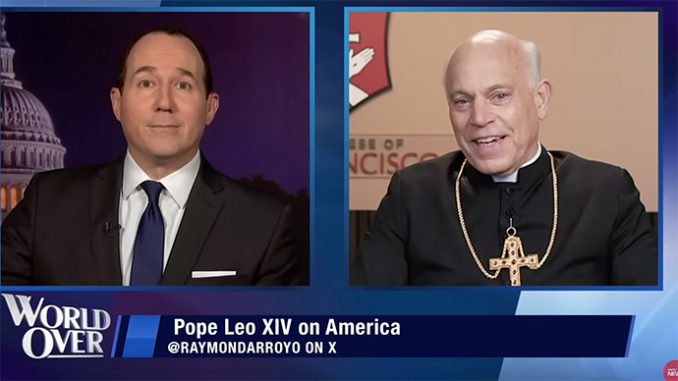
Archbishop Salvatore Cordileone of San Francisco called for “easier access” to the Traditional Latin Mass (TLM) as the future of the restrictions on the traditional rite remains uncertain.
“I think with some precautions, we can allow a greater access to the Mass and maintain unity within the Church,” Cordileone said in a July 30 interview on “The World Over with Raymond Arroyo.”
Cordileone, who is one of seven new members of the Apostolic Signatura appointed by Pope Leo XIV, spoke about the Latin Mass restrictions following the excommunication of the Society of St. Pius X (SSPX) members involved in consecrating four bishops without the pope’s permission.
The SSPX consecrations manifest “a growing lack of trust that has been simmering for a very long time,” Cordileone wrote in a post to X.
“Let us pray that an ardent effort toward sincere and honest dialogue will soon start up, and that easier access to the traditional form of the Mass will be available to our people, so they will not feel as if they are constrained to seek spiritual nourishment outside of the family in union with Rome,” he said in the July 10 statement.
While Cordileone and other leaders have called for less restrictions on the TLM, Cardinal Arthur Roche, head of the Vatican’s Dicastery for Divine Worship and the Discipline of the Sacraments, said in an interview with The Tablet that Pope Leo has no intention of changing Pope Francis’ restrictions on the traditional liturgy.
Cordileone told Raymond Arroyo in response to Roche’s comments: “I donʼt know how well he knows the mind of the Holy Father. But I think one thing thatʼs clear to everyone is the Holy Father wants to bring everyone together. Heʼs all about unity.”
Cordileone said he is concerned that if the restrictions remain in place, people who want a traditional form of worship will feel they “have no choice” other than “to go outside of officially approved institutions and communities.”
“They will do that. So I think thereʼs concern for unity on both sides. One, if the restrictions are in place, people will then go to these other groups that are not in full communion with the See of Rome,” he said.
“But if theyʼre allowed generously, we have to make sure that the people who access the Mass are in full communion in terms of their belief and their acceptance of the teachings of the Second Vatican Council,” he said.
In the U.S. and other nations, Cordileone said that has, for “the most part,” been the case.
“So I think with some precautions, we can allow a greater access to the Mass and maintain unity within the Church,” he said.
Reconciliation of TLM restrictions not ‘realistic’
While Cordileone said he believes more access to the TLM is possible, he said he does not think itʼs “realistic” to reconcile the TLM restrictions following Pope Leoʼs message to the French bishops to be more inclusive of those who want to celebrate the traditional rite.
In March, Pope Leo XIV called for “concrete solutions” to heal divisions over the Mass in a message to the French bishops.
The Holy Father called for renewed unity in the Church’s liturgical life, urging French bishops to seek “concrete solutions” to include Catholics attached to the Traditional Latin Mass while preserving communion.
“We look at the younger generation — they all love the tradition,” Cordileone said. “They love the more classical way that the Church worships, the traditional Mass, what we call the traditional Mass, the form of the Mass before it was changed after the Second Vatican Council.”
“But even the order of the Mass as we have now done in a more traditional way with the priest ad orientem, and the sacred music, and great solemnity, and reverence. Theyʼre desiring this deep tradition. It takes them to a very deep place,” he said.
“This is unstoppable. Itʼs whatʼs drawing young people in and will continue to do so,” he said.
If you value the news and views Catholic World Report provides, please consider donating to support our efforts. Your contribution will help us continue to make CWR available to all readers worldwide for free, without a subscription. Thank you for your generosity!
Click here for more information on donating to CWR. Click here to sign up for our newsletter.

Bishop Cordileone, who I greatly respect, says “Let us pray that an ardent effort toward sincere and honest dialogue will soon start up, and that easier access to the traditional form of the Mass will be available to our people, so they will not feel as if they are constrained to seek spiritual nourishment outside of the family in union with Rome,”.
Spiritual nourishment cannot be found outside of the family in union with Rome. It’s not found in Protestant churches or Lefebvrian chapels.
It’s only found in the One, Holy, Catholic and Apostolic Church, gathered on the Barque of Peter.
How is there to be “unity” among Catholic practices that commonly demontrate disrespect towards the Real Presence in the Eucharist and catogorically reject the immutable Deposit of Faith, including moral precepts, even when promoted by prelates in high places? How is there to be unity when those who respect the Real Presence and moral precepts are expunged?
What proof do you have for your accusations?
As Pope Francis reminded the world, “You cannot bless sin.”
>James Martin, SJ has entered the chat.
Google search terms: what is the statistical difference regarding Catholic belief in the Real Presence in the Eucharist among those who favor the Latin mass versus those who favor the Novus Ordo
Repeating the search minutes later gives the same conclusion, but not exactly the same output.
AI Overview begins (links to sources and bold style omitted):
Statistical data shows that Catholics favoring the Traditional Latin Mass (TLM) exhibit a near-universal belief in the Real Presence (approx. 98%–99%), whereas among those attending the ordinary form (Novus Ordo), weekly attendees show about a 63%–81% belief rate, and general self-identified attendees drop significantly. [1, 2, 3, 4, 5]
Survey Comparisons and Findings
• Traditional Latin Mass Attendees: Studies like the national TLM demographic surveys indicate that roughly 98% to 99% of Latin Mass attendees explicitly affirm belief in the Real Presence, with only about 2% viewing it as a symbol. [1, 2]
•
• Novus Ordo / General Attenders: Broad Pew Research data found that only 31% of all self-identified U.S. Catholics believe in the Real Presence, rising to 63% among those who attend Novus Ordo or ordinary parishes on a weekly basis. More recent targeted studies (such as Vinea Research) suggest weekly Novus Ordo/general Mass-goers run higher at roughly 81%, but still lag behind the near-total consensus found in TLM communities. [1, 2, 3, 4]
•
• Liturgical Predictors: Academic research published in the Catholic Social Science Review notes that traditional liturgical markers—such as hearing consecration bells, receiving communion on the tongue, and exposure to the Latin Mass—strongly correlate with higher certainty in Eucharistic doctrine. [1, 2]
•
Correlation is not causation.
“constrained to seek spiritual nourishment outside the family in union with Rome”
There is something evil creeping into the Church, division and condemnation of the true Church, Vat II and the “new” mass which brought great victory and fruit around the globe. To my poor knowledge the traditional Latin Mass was never forbidden; they created an almost militant opposition and yes, even hatred and insults like blasphemy to the true Church. Division and condemnation in the parishes calling themself the only holy remnants of God. If you enjoy the Latin Mass but do not acknowledge the ever more division and lies against the Church and N.O. than you are dishonest. Christ is the Church and He will restore it. Pope Leo XIV has to first strengthen the global Church and it is happening right now.
Edith, you claim the Novus Ordo brought “great victory and fruit around the globe.” However, in reality, church attendance declined significantly, vocations to Holy Orders diminished, and the number of priests willing to serve sharply decreased. From my perspective, Vatican II was an unmitigated disaster for the Church if success is measured solely by the number of congregants and clergy. While there is a valid argument that the harm was not caused directly by Vatican II itself, but rather by its implementation, the fact remains that the Church has yet to recover from the losses sustained since that time.
The church really should be run by conservatives, and not liberals. Kicking people out of mass because they didn’t have a vaccine card? Where did the mRNA cells originate from,for starters?
There were no cells in the covid vaccine given in the U.S. The term “mRNA” stands for “messenger ribonucleic acid”. It is definitely not a cell but is a construct designed to carry the information on how to make a protein to the ribosomes in our cells. These cells will use the information to build the protein using amino acids. In the case of the vaccine, the mRNA is viral in origin. Our cells then make this viral protein, which our immune cells recognize as foreign so they make antibodies to it to destroy it. Then our white blood cells locate it, eat and digest it. They’re now primed to destroy any whole viruses carrying these proteins that may come along.
No one got “kicked out of Mass” for not having a vaccine card. Hyperbole doesn’t help your case.
Catholic Church 500.000 in 1960 and now 1.4 billion. The church universal globally is still increasing especially in Asia and in Africa.
World population in 1960 was 3.015 Billion. World population in 2026 is 8,3 billion. Percent Catholic (nominal?) in 1960 was 16.5%; percent Catholic in 2026 is 16.8% (even more nominal?).
Edith: Your comments seem rather Orwellian. Are you really unaware of the indisputable findings of hundreds of surveys, in addition to common sense experience, conducted for more than half a century that demonstrate attitudes ranging from indifference to outright hostility, often venomous, by large percentages of self-identified Catholics towards fidelity to the faith? Even secular politicians are quick to note that most Catholics reject the teaching of their religion on contraception and abortion, discarding pillars of Catholic witness in defense of the most defenseless that now two popes in a row have now gone out of their way to downplay, going so far as to routinely honor many of the world’s most notorious abortionists at the Vatican.
In spite of undisputable widespread suppressions of the Latin Mass, in defiance of anathemas established by Pius V for anyone who would try, worship in the TLM is approached with the reverence that we worship God, not ourselves in whatever delusions of “community” we entertain. It’s not about “grand old tradition” for tradition’s sake. It’s about truth. It’s about never forgetting that God and only God is the source of truth, not some, not a lot, all truth. His creatures create no truth at all, and truth never changes.
Traditional Latin prayers that have been stricken, to create a watered-down Mass, emphasize humility, repentance, and reverence for the communion of saints that preceded us and remind us we are never superior to those of the past. We recognize the Holy Sacrifice of the Mass and the Real Presence. It’s sad that a majority of NO mass goers do not believe in the Real Presence.
The very synchronistic and Masonic mind that oversaw the decreased sense of devotion of the N.O. Mass, intentionally eliminated any prayers that could cause non-Catholics to feel uncomfortable. The results have created grand operas of liturgical abuse, much of it blasphemous, the Mass as secular entertainment.
Two popes in a row have now been denying immutable truth in addition to denying moral absolutes, In the case of Francis, he reaffirmed the process theologies, popular in the seventies, that holds that an imperfect and incomplete God is in the process of still trying to figure things out. Francis also held pro-abortion prelates in high regard because of their devotion to “reforming” the Church in ways to be acceptable to the modern world.
There is an evil hatred directed to the one true Church. Unfortunately, much of this has come from powerful prelates and those uncritically submissive. It does not honor God to live in denial.
How can you be so at ease with your accusations for thousands of parishes who love the Lord and service and help others 7 days a week. Or is your judgment because receiving in the hand. “I desired to rest in your hands, not only in your heart” (160, diary of Saint Faustina )
How can you be so comfortable falsely accusing me of accusing? I said nothing at all about what exists in the hearts and minds of any individual nor any collective within a parish. Only God can make these judgments. Judging behavior and noting what professed Catholics profess and how they conduct themselves is not judging souls.
Pursuits of unity are foolhardy. “Unifying” good with evil or desiring to achieve such unification is evil.
God’s creatures cannot create what God cannot create. Humanity cannot “evolve” towards a batter world achieved by lowest common denominator “unity.” Not even God can create utopia. Original sin means the human condition is permanently imperfectible, just as Our Lord made clear. Catholic voices aligning themselves with utopian ideologies, overtly or by degree, are immersed in denial processes.
Whatever you assume about Catholic populations and their unknowable intentionality of identification, actual Catholic practice and the beliefs of those who profess being Catholic matters. Shriveled confession lines and the common practice of brief periods allowed in communion with Jesus at Mass after the distribution of the Eucharist, quickly interrupted by announcements of parish events, gives clear indications of a lack of reverence. So do giggling footraces towards the door immediately upon receiving the Eucharist and treating the host as chewing gum. Presumptions about those you label as sanctimonious for their devotion to immutable truth requires mutual honest self-reflection.
“Spiritual nourishment cannot be found outside of the family in union with Rome. It’s not found in Protestant churches or Lefebvrian chapels.”
Hmmm… What does the Church say about that? (From the Catechism of the Catholic Church.)
“Furthermore, many elements of sanctification and of truth”273 are found outside the visible confines of the Catholic Church: “the written Word of God; the life of grace; faith, hope, and charity, with the other interior gifts of the Holy Spirit, as well as visible elements.”274 Christ’s Spirit uses these Churches and ecclesial communities as means of salvation, whose power derives from the fullness of grace and truth that Christ has entrusted to the Catholic Church. All these blessings come from Christ and lead to him,275 and are in themselves calls to “Catholic unity.”276
EDIT: Paragraph 819
A lot of the people who are anti-SSPX are inclined to oppose the SSPX in ways that are contrary to Vatican 2 and the CCC, and meet them with harshness, insults, and condemnation.
It’s the sort of thing that can make unity and reconciliation unnecessarily difficult, along with demanding that people switch from a beautiful Mass, chant and ad Orientem and traditional Propers, easily available Baptism, Confession and Last Rites, to whatever level of liturgical abuse is at the local NOs, with Confession by appointment only, and Last Rites only if you can get past the parish secretary.
What makes unity impossible is your pharisaical attitude toward the ordinary form of the Mass. If the 96% of Catholics agreed that your preferred Mass was preferable, they would be celebrating it. They don’t.
More of your intelligence challenged logic. Aside from your flat out lie that there is anything that justifies a characterization of “pharisaical” in the practice of noting liturgical abuse, sometimes blasphemous, common sense, elusive to you, would indicate that it is excessively burdensome for very many to travel a hundred miles or several hours to the nearest TLM.
Catholic anti-Catholic bigotry is pervasive, and it includes all the venom towards Catholics who simply want to be Catholic and recognize we are not superior to the past.
I should have been more clear, everyone. What I meant was that practicing Catholics who jump ship for the Lefebvrian or Protestant churches, regardless of the reason, won’t find much spiritual nourishment because those places lack unity and hierarchical structure, not to mention valid Sacraments. In short, those people know better than to leave the True Church for something else.
For people who were raised as Protestants or Orthodox, it’s different. If they absolutely and truly believe that they are in the right place spiritually, I believe God will take that into account.
I only urge everyone to remain in union with Rome. Stay the course.
There is no such thing as a Lefebvrian church, and it is viciously insulting to infer that there is.
Well if not Lefebvran, what would you call them? They’re not Catholic; they disagree with Catholic teaching by rejecting papal authority and have been excommunicated. I find it “viciously insulting” to be seen as inferior because I attend a novus ordo Mass. I haven’t rejected the faith. Fully accepting Vatican II hasn’t made me doubt the Real Presence. The fearmongering coming out of their group is insane.
Kelly, no reply button below your comment, so I’ll post here:
Name one Catholic teaching those you refer to as “a group” reject. And when you can’t, apologize.
And popes who refuse to recognize their canonical limitations are themselves rejecting proper papal authority, including the precipitous excommunications in direct opposition to canon law.
And who inferred that you are inferior for attending a Novus Ordo mass or that you’ve rejected the faith? False projections about another’s comments, however, are a violation of the Eighth Commandment. Observing the indisputable fact that liturgical abuse is and has been widespread in Novus Ordo masses does not imply a thing about any individual in attendance, including me. Nonetheless, a denial that faith among Catholics has been on the decline, especially towards the Real Presence, for sixty years can be more accurately characterized as “insane.”
Well, the certainly is a Lefebvrian church. They call themselves the SSPX. The facts don’t care about your feelings on the matter.
Susanne, true, facts don’t care about “feelings.” And your feelings of contempt do not create a fact. No more so than your past comments implying that only a medical certificate qualifies anyone to have an opinion about abortion.
Undoubtedly the saintly Archbishop Lefebvre prays for your soul from his perch in eternity.
Spiritual nourishment can be found outside the Church.
Sure it can. With Confucians, Muslims, Anglicans, and we can surely find it from Cosplay Sarah, even with rubber-stamped CCP episcopal nominees.
But those SSPX folks? Heretics!
Absolutely, Br. Jacques. But the full teachings of Christ are found in the Church He founded.
Abp Cordileone has set the church back to pre-Vatican II in the SF archdiocese and it’s painful to see. What a waste of time that could be spent helping people. Progressive parishes are fewer and farther between and cash is pouring out in pedophile settlements. Forget the ridiculous idea of bringing back the Latin Mass. The church needs women as deacons,priests and bishops, married priests and direct line to civil authorities for any and all reports of abuse.
“Progressive parishes are fewer and farther between and cash is pouring out in pedophile settlements.”
More than a little irony in this one statement.
Define “progressive”.
Are you related to Cardinal Farrell?
If ” progressive parishes ” translates to “The Spirit of VII ” parishes there’s probably an explanation relating to the ageing out of folks in that generation. Ditto for older clergy.
Younger people and younger priests lean more towards tradition.
And here we see the “fruits” (in more than one sense) of the new Mass and the Council.
Farrell, the Church has no authority to ordain women, even if the Pope wanted to. He can’t do something that the actual Church forbids. Read the history of the Catholic Church and why women are not allowed to be ordained before posting a heretical comment.
Some of the best teachers I had were Dominican nuns.
Truth is not on a timeline. Truth never changes, except in the mind of an atheist.
The following is from “Catholic Culture” today:
Cardinal Roche: ‘Pope Leo is not going to change Traditionis Custodes‘
We don’t KNOW what Pope Leo is going to do and it is presumptuous to think we do, but we can and should pray that he makes wise and holy decisions; and be ready and willing to accept and support them once they are made. One thing that we can assume is that not all will be happy with whatever conclusions he makes, and this contributes to the ongoing divisions in the Church.
The Pope can begin to change things by ‘promoting” certain bishops to bureaucratic jobs in the Vatican.
Personnel is policy.
Cardinal Arthur Roche has conflated his will with that of the Pope. To be fair, the Holy Father has left the Cardinal in his office. His Eminence has also overreached by ostensibly excommunicating his critics when he asked rhetorically, “Can you honestly say you are Catholic when you write such hateful things about people, and about the Church? No!” Why is it antithetical to Catholicism to point out that the Cardinal began his public life as a figure skater ⛸️?
As for the TLM, if the pretext for punishing these folks for disobedience to the Petrine Office, how can that charge be substantiated since by definition TLM Mass goers have resisted the temptation to leave the Catholic Church for the SSPX?
What a Silly Billy I am to fall for the joke that the Cardinal was ever athletic.
Every time I see Traditionis Custodes, I think of “trash” and “custodian”.
It’s time to enshrine Francis in the Papal Hall of Shame.
Exactly. That is the real news but it has gone largely unreported, including by etwn, who does this piece with cordileone instead. The popesplaining by americans continues. And people are even trying to find ways around Roche’s statement too, all unrealistic. Roche publicly says such things because Leo is of like mind. As certain confirmation of this, there has been zero pushback by anyone else at the holy see about his remarks nor will there be. It’s also not the first time Roche has said this, another being right under leo’s nose at the january consistory, in a statement given to all the world’s cardinals. No challenge from that one either. (Roche also shows signs of favor from leo as he has been assigned to multiple other positions.) Yet some people still want us to believe that Leo doesn’t necessarily agree but allows these statements to be made and for it to also be the actual practice! As to the latter, there’s the fact that replies from the holy see to individual bishops in regard to diocesan tlm’s are saying that the aim is to phase it out and push everyone to celebration of the NO.
The fact remains, Leo could makes changes tomorrow and it’s been well over a year and he has done zero to alter anything but only cracked down further. It’s thus almost bizarre that people keep saying, ‘oh, we have to wait and see, he’s going to change it soon.’ They’ve been saying that for more than a year now. It reminds one of the denial during the initial years of Francis. It also seems people learned nothing under Francis and the tactic of having subordinates disseminate something in order for the boss to try and keep their clean of something. Wake up folks, leo is francis 2.0.
David: Leo has, in my opinion, a duplicitous smile. He’s yet another hierarch who’s more a politician than a Vicar of Christ. I’d like to see less of Popes in front of cameras and microphones. Sound bytes from Popes have gotten tiresome. Catholics are being played. Gone on the days when men got to be bishops by their exemplary holiness rather than their knowing how to work the political machinations of Mother Church. Let’s remember Christ’s very words: “Let your ‘yes’ mean yes and your ‘no’ mean no.”
Cardinal Roche is obsolete. The more balanced challenge under Vatican II is not ideological. Instead: “…like the owner of a house who brings out of his storeroom new treasures as well as [!] old” (Mt 13:52).
Keep in mind that while Cardinal Roche has not yet been replaced, he remains a holdover from the previous pontificate and could be replaced at any time if Pope Leo decides that he wants his own man in there, or perhaps someone who better understands what Pope Leo has in mind. It wouldn’t be the first time that someone in the Curia spoke out of turn, so take what Cardinal Roche said with a grain of salt until we actually hear it from the Pope’s mouth– and Archbishop Cordileone was just promoted, so he’s a rising star while Cardinal Roche may well be on his way down the ecclesiastical ladder. I confess bias here, but this isn’t an unrealistic analysis.
“‘I don’t know how well he [Roche] knows the mind of the Holy Father.'”
Speak the truth in (undeserved) charity.
Cordileone in a nutshell, IMO.
Perhaps more attention should be given to ICKSP and other traditional groups who have stayed faithful to the Pope and the Council.
Saint John of the Cross. One of the founders of the Discalced Carmelites, sought a more traditional form of worship. The resistance to his stricter and more formal praise, came from the Carmelite Orders. It resulted in him, in a six by ten foot cell, abused, cold and starved, writing poetry, standing in the dark on his bench writing in a slender beam of light from a high window. Why would they imprison and disgrace him? Because he had followers, there were men and women who sought the kind of spirituality he preached. So many that his superiors in the Carmelite Order began to worry that he would take over and change the direction they thought was best. He was eventually freed by his followers. today there are two Carmelite Orders,the Carmelites of the Ancient Observance and the Discalced Carmelites. We, not the Pope, not the theologists, or the political Vatican are the people of the church. Born in suppression, forged by imprisonment, the Discalced Carmelites still exist after almost a thousand years.
Like the diocesan priests who want to say the TLM?
Literally, for the love of God and for unity among all Christians and persons of good will through Christ, our Lord. the Holy Mass is now celebrated throughout the world in every language known to man that has a living community still utilizing each language, all for the praise and glory of God, the Most Holy Trinity.
Why is anyone so upset that some persons seek to hear the Mass and celebrate the same in Latin? Do they also object to it being celebrated in Greek, Spanish, French, German, Polish, Italian, Russian or any other language?
If the TLM touches the hearts and, thereby, the souls of some, can’t others, out of Christian love and kindness, allow them to do so?
What then is the real “issue”? It is, unfortunately, a lack of true Christian charity towards all of our brothers and sisters and a desire to “be in control”, to seen and followed as the ones who are seen as being in the right while condemning those who do not agree with them.
Perhaps we would all benefit by reflecting on the writings of the Fathers of the Church from the 1st, 2nd and 3rd Centuries, when the seeds of faith were being watered by the blood of the martyrs and the “Church” was not bound by “legalism” but, rather, by the love of God through Christ in unity with the Holy Spirit.
I grew up in the Church before the Second Vatican Council. I delight in the TLM and I also delight in the celebration using the common vernacular. I don’t want to ever tell others not to pray especially when they are praying in a manner that is leading them to a greater union with God, in God and through God.
My brothers and sisters, there is room enough in the Sacred Heart of Jesus for us all.
Instead of dividing ourselves, let us pray for the unification of all the faithful, Latin rite and Byzantine, Catholic and Protestant so as to allow God to speak to the heart of each person as only He knows best how to do.
Yours in Christ.
Thank you Mr Harrell. The Mass or language isn’t the problem. The problem is when a particular liturgical rite is used to fight against Rome. It seems to be the Latin Mass that is being abused and used as a tool to set up a church to counter Rome, so maybe that’s why it’s being suppressed.
Utter preposterous nonsense, especially at a time when “Rome” is fighting against the Catholic religion.
You make me think of that old joke “Is the Pope Catholic”. It would be funny if not so terribly illogical.
You don’t think, you emote.
When a pope repeatedlyridiculed received truth and the Deposit of Faith, it is quite illogical to claim that it is illogical to take note and feel sadness for God.
Exactly how is a Mass used as an instrument of war?
Crusader above (5:44 p.m.)
Your quote, a headline pointing to an article, is from The Catholic Thing, not Catholic Culture.
Give it up, Crusader, or, better yet, try reading both of those two excellent columns.
How does Leo propose “unity” among the 20+ churches of the Eastern Byzantine Rites?
Let us all see the current organization chart of the Roman Catholic Church.
There are only 14 Byzantine sui iuris Churches. The other 9 Eastern Churches belong to different Rites.
There is unity among the Eastern Churches since there are 5 or 6 distinct Rites under the Eastern Code of canon law and the fact that their liturgies complement each other. They don’t use their liturgies to fight against Rome. I don’t believe those sui iuris autonomous Churches don’t celebrate Ordinary and Extraordinary forms of their liturgies. Byzantines have 3 liturgies: The Divine Liturgy of Sts John Chrysostom and Basil the Great. The only difference between the two is some of the prayers and the Anaphora.
The Liturgy of the Presanctified Gifts is only said during Great Lent.
They seem grateful to be in union with Rome, and there doesn’t seem to be competitive liturgical wars among their 23 Churches and Rites.
The 1 Roman Rite, whether it’s in Latin or the vernacular, when done correctly, isn’t the problem. The division only occurs when people believe that a particular Rite, whether it’s Roman, Byzantine, or Maronite is superior to another and uses it to wage war against the Vicar of Christ. The TLM or the Byzantine Rite isn’t superior to the vernacular Mass or vice versa.
Meh. There are people who use different practices or translations of the Novus Ordo to fight against other practices and translations of the Novus Ordo. There are certainly those who have employed the Novus Ordo Mass to oppose the Pope (false ordinations of women, LGBT-celebrating Masses, etc.). If you insist on banning everything that gets used for evil by someone, you will not have a Church left.
The overwhelming majority of people who want the TLM just want a Mass that is beautiful, traditional, and fitting – and many would go to an Eastern Rite if no TLM was available.
The Byzantines in the US, for the record, converted to Orthodoxy in large numbers when they were barred from having married priests in Latin territories, something that would have shut down many parishes. Rome eventually recognized the error of that particular rule, far too late. A similar thing occurred after desegregation: bishops shut down black parishes, and lost black parishioners in large numbers. A generalized version might be that you had better have an extremely good reason for forcing people out of a holy, traditional Rite, approved by the Church, or closing thriving parishes, because you *will* lose many souls, and bishops will have to render an account for those souls at their judgement. They are called to strengthen the weak and care for the sick and injured, not to drive the sheep hard to see which are the “best” or most loyal.
We read: “The overwhelming majority of people who want the TLM just want a Mass that is beautiful, traditional, and fitting – and many would go to an Eastern Rite if no TLM was available.”
Four points:
FIRST, the sticking point is not with the “overwhelming majority” (but up to 2/3rds of the total 800,000 are no longer practicing), but with their leadership who unfortunately have coupled (!) TLM with rejection of the Second Vatican Council regarding “freedom from coercion” for the personal conscience (NOT libertarian subjectivism), ecumenical dialogue (NOT blending with Protestant sects), and interreligious dialogue (NOT the accused convergence of supposedly equivalent religions).
SECOND, meanwhile, der Synodal Weg apparently has not yet formally and liturgically blessed irregular couples as “couples,” which was also scheduled to take place on July 1 (same date as the SSPX illicit consecration of four bishops) and which also would have resulted in self-excommunication….
THIRD, about which, we recall Cardinal Fernandez’s precarious Fiducia Supplicans (2023) which falsely enabled “non-liturgical, non-formal and non-scandalous” blessings. Public dissent (meaning affirmation of moral clarity) came from all of continental Africa, Poland, Hungary, Peru, the Netherlands, Kazakhstan, Ukraine and parts of Argentina, Spain and France. Cardinal Mueller explained that Fiducial Supplicans was not yet heretical but that it would lead to heresy. Apparently not yet; no news is good news. https://www.firstthings.com/web-exclusives/2024/02/does-fiducia-supplicans-affirm-heresy
FOURTH, with needed attention to significant details, I disagree with the other comment somewhere above that two recent popes have denied immutable truth.
Yes, to insinuations, enabling hints, Jimmy Martin photo-ops, implications, open-ended footnotes (Amoris Laetitia, 2015), discounting or ignoring Veritatis Splendor (1993), spin-cycle synodality, and a hanging Study Group #9—but not actually denying. And about Pope Leo XIV, he’s navigating the minefield left in his path by his predecessor and others. Part of the choreography is to avoid being viciously and publicly painted by the saboteurs, for the next twenty years, as a vindictive and rigid reactionary…
I’m waiting to see the long game after this first year and am not losing sleep.
To be more clear, this comment refers to the SSPX and not to the non-schismatic Priestly Fraternity of Saint Peter (PFSP).