Firefighters inspect collapsed wooden houses in Wajima, Ishikawa Prefecture, on Jan. 2, 2024, a day after a major 7.6-magnitude earthquake struck the Noto region in Ishikawa Prefecture. / Credit: KAZUHIRO NOGI/AFP via Getty Images
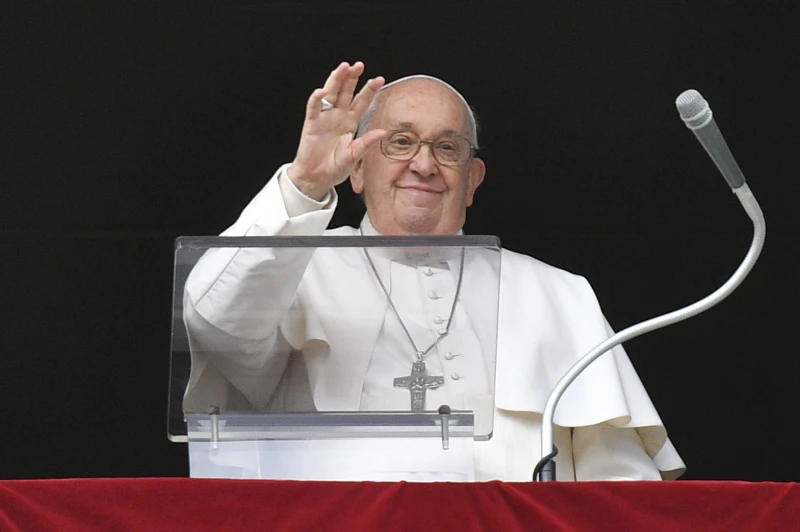
Pope Francis smiles at pilgrims gathered in St. Peter’s Square on Jan. 1, 2023, for his first Angelus of the new year. / Credit: Vatican Media
Rome Newsroom, Jan 1, 2024 / 09:47 am (CNA).
Pope Francis delivered his first Angelus of the new year on Jan. 1, the Solemnity of Mary, Mother of God, by reflecting that the importance of Mary’s motherhood is defined by love and underscored by a quiet silence that allowed her to place Christ at the center.
“She is Mother not only because she carried Jesus in her womb and gave birth to him, but because she brings him into the light, without occupying his place,” said the pope to the nearly 35,000 faithful gathered in St. Peter’s Square.
Pope Francis also used the occasion to appeal for prayers for the Church in Nicaragua, which has been at the center of an escalating persecution launched by the country’s president, Daniel Ortega.
“I am following with deep concern what is happening in Nicaragua, where Bishops and priests have been deprived of their freedom. I express to them, their families, and the entire Church in the country my closeness in prayer,” the Holy Father said.
“I also invite all of you present here and all the People of God to insistent prayer, while I hope that we will always seek the path of dialogue to overcome difficulties. Let’s pray for Nicaragua today.”
The priests are: Monsignor Carlos Avilés, vicar general of the Archdiocese of Managua; Father Héctor Treminio, pastor of Holy Christ Parish in Esquipulas in the same archdiocese; and Father Fernando Calero, pastor of Our Lady of Fatima Parish in Rancho Grande in the Diocese of Matagalpa.
In his Angelus reflection, Pope Francis noted that Mary’s silence is a “beautiful feature” but should not be thought of as a “simple absence of words” but rather as a feature that is “filled with wonder and adoration for the wonders that God is working.”
“In this way, she makes room within herself for the One who was born; in silence and adoration, she places Jesus at the center and bears witness to Him as Saviour,” the pope observed.
The Holy Father went on to express that this expression of maternity seen in Mary is an ideal that is also seen in our mothers who “with their hidden care, with their thoughtfulness, are often magnificent cathedrals of silence. They bring us into the world and then continue to attend to us, often unnoticed, so that we can grow. Let us remember this: love never stifles; love makes room for the other and lets them grow.”
Pope Francis added that by reflecting on mothers, we can “learn that love that is cultivated above all in silence, that knows how to make room for the other, respecting their dignity, leaving the freedom to express themselves, rejecting every form of possession, oppression, and violence.”
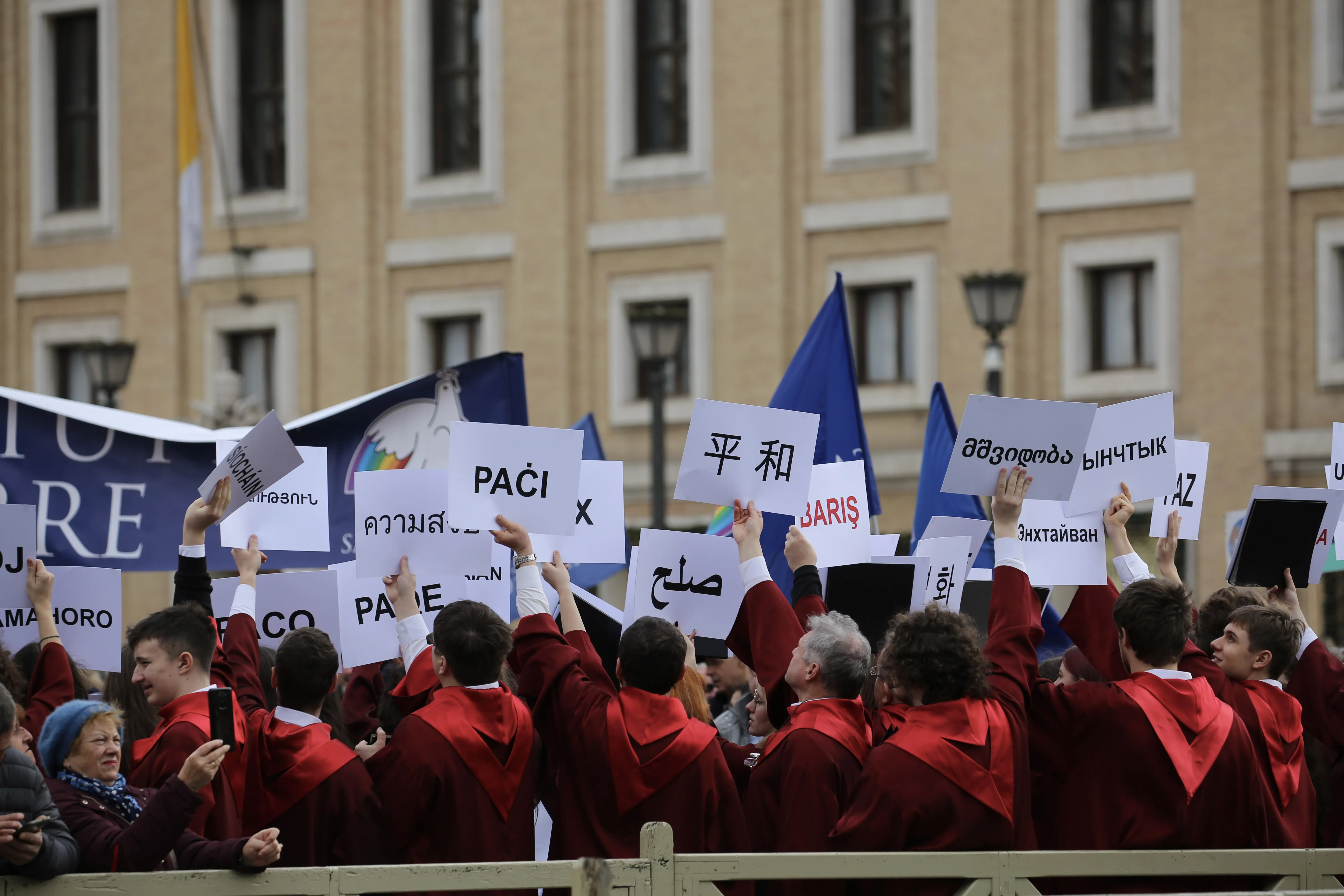
Pilgrims gathered in St. Peter’s Square for Pope Francis’ Angelus reflection on Jan. 1, 2024, wave peace signs. On Jan. 1 the Catholic Church observes the Solemnity of Mary, Mother of God, as well as the World Day of Peace. Credit: Elizabeth Alva/CNA
In addition to the day’s Marian feast, on Jan. 1 the Church celebrates the World Day of Peace, a tradition which was started by Pope Paul VI in 1968. In light of this celebration, Pope Francis took a moment during the Angelus to note that “‘freedom and peaceful coexistence are threatened whenever human beings yield to the temptation to selfishness, self-interest, the desire for profit, and the thirst for power.’”
The pope underscored that the antidote to overcoming these destructive tendencies that are ubiquitous today is “love” which “consists of respect and kindness: In this way, it breaks down barriers and helps us to live fraternal relationships, to build up more just and humane, more peaceful societies.”
Pope Francis invoke the Virgin Mary as the Queen of Peace and Mother of Mercy at a prayer vigil for peace in St. Peter’s Basilica, Friday, Oct. 27. / Credit: Courtney Mares
Rome Newsroom, Jan 1, 2024 / 09:00 am (CNA).
In a video marking the World Day of Peace on Jan. 1, Pope Francis asks the Blessed Mother to “teach us to cherish and care for life — each and every human life” and “to repudiate the folly of war, which sows death and eliminates the future.”
“This is a dark hour, Mother,” the pope prays in the video, which was released Monday. “Turn your eyes of mercy toward our human family, which preferred Cain to Abel.”
The Vatican described the video, which used selections from Pope Francis’s Oct. 27 prayer for peace, as an exploration of “the visual and existential contrasts between war and peace.”
It shows a child walking across a desolate field, as another runs joyfully through the tall grass. Smoke billows from a just-bombed building, while fireworks of celebration light up the night sky. Other scenes juxtapose marching soldiers with civilians crossing the street, flying kites with fighter jets, and an elderly woman crying in anguish with another praying serenely.
“You suffer with us and for us, as you see your children suffering from conflicts and wars that are tearing our world apart,” Pope Francis prays to Mary, as an image of a burned-out church is set against a chapel glowing with lit votive candles. You can watch the full video below.
Praying for peace has been a major emphasis of Pope Francis’s in recent months, as armed conflicts rage across the world. In his Urbi et Orbi address on Christmas Day, the pope prayed for an end to violence in Israel and Palestine, Ukraine, Armenia, Azerbaijan, and several other conflict areas in Africa and the Middle East. Francis has repeated many of these intentions in his most recent addresses.
“Please, let’s not forget Ukraine, Palestine, Israel, which are at war,” the pope said in his Angelus message for Jan. 1. “Let’s pray for peace to come, altogether.”
The Catholic Church has observed the World Day of Peace on Jan. 1, the Solemnity of Mary, Mother of God, since 1968. For this year’s observance, Pope Francis also released a message calling for the global regulation of artificial intelligence for “peace and common good.”
In the newly released video, a young girl sits in rubble while another reads quietly on her classroom floor, as Pope Francis tells the Blessed Mother that “we cannot succeed alone.” The pope continues, asking Mary to grant that a “glimmer of light may illumine the dark night of conflict.
“Mother Mary, Queen of Peace, pour forth into our hearts God’s gift of harmony.”
Pope Francis waves at the crowd of 1.5 million people who attended the closing Mass of World Youth Day 2023 in Lisbon, Portugal on Aug. 6, 2023. / Vatican Media.
Washington, D.C. Newsroom, Dec 30, 2023 / 07:00 am (CNA).
Pope Francis maintained … […]
Pope Francis meets with Ukraine President Volodymyr Zelenskyy at the Vatican on May 13, 2023, their first meeting since the start of the full-scale war with Russia. / Credit: Vatican Media
More than 4,000 faithful attended the celebration of the Christmas Mass at the St. George Parish in the suburb of Edappally, India. / Credit: Anto Akkara
Kochi, India, Dec 28, 2023 / 14:35 pm (CNA).
While most of the approximately 350 parishes … […]
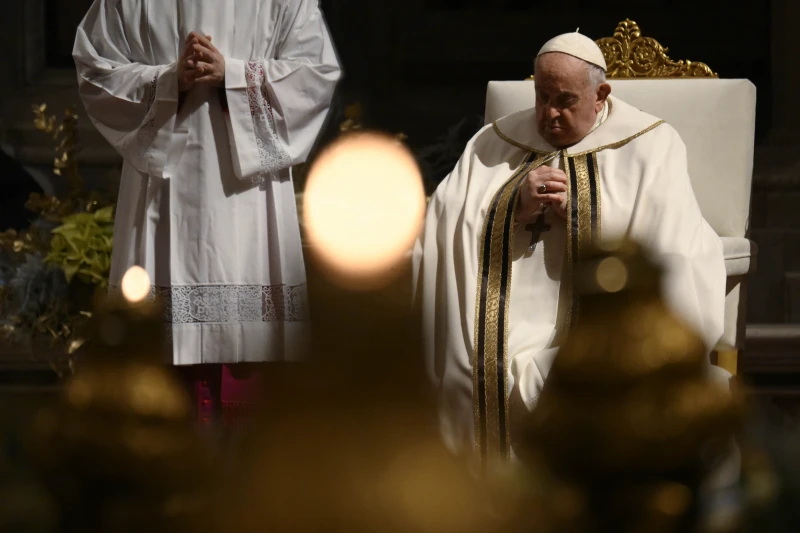
Pope Francis prays during Christmas Mass in St. Peter’s Basilica on Dec. 24, 2023. / Vatican Media
Vatican City, Dec 24, 2023 / 18:00 pm (CNA).
Below is the full text of Pope Francis’ homily for the Solemnity of the Nativity of the Lord, delivered on Dec. 24, 2023, in St. Peter’s Basilica.
“A census of the whole earth” (cf. Lk 2:1). This was the context in which Jesus was born, and the Gospel makes a point of it. The census might have been mentioned in passing, but instead is carefully noted. And in this way, a great contrast emerges. While the emperor numbers the world’s inhabitants, God enters it almost surreptitiously. While those who exercise power seek to take their place with the great ones of history, the King of history chooses the way of littleness. None of the powerful take notice of him: only a few shepherds, relegated to the margins of social life.
The census speaks of something else. In the Scriptures, the taking of a census has negative associations. King David, tempted by large numbers and an unhealthy sense of self-sufficiency, sinned gravely by ordering a census of the people. He wanted to know how powerful he was. After some nine months, he knew how many men could wield a sword (cf. 2 Sam 24:1-9). The Lord was angered and the people suffered. On this night, however, Jesus, the “Son of David”, after nine months in Mary’s womb, is born in Bethlehem, the city of David. He does not impose punishment for the census, but humbly allows himself to be registered as one among many. Here we see, not a god of wrath and chastisement, but the God of mercy, who takes flesh and enters the world in weakness, heralded by the announcement: “on earth peace among those whom he favors” (Lk 2:14). Tonight, our hearts are in Bethlehem, where the Prince of Peace is once more rejected by the futile logic of war, by the clash of arms that even today prevents him from finding room in the world (cf. Lk 2:7).
The census of the whole earth, in a word, manifests the all-too-human thread that runs through history: the quest for worldly power and might, fame and glory, which measures everything in terms of success, results, numbers and figures, a world obsessed with achievement. Yet the census also manifests the way of Jesus, who comes to seek us through enfleshment. He is not the god of accomplishment, but the God of Incarnation. He does not eliminate injustice from above by a show of power, but from below, by a show of love. He does not burst on the scene with limitless power, but descends to the narrow confines of our lives. He does not shun our frailties, but makes them his own.
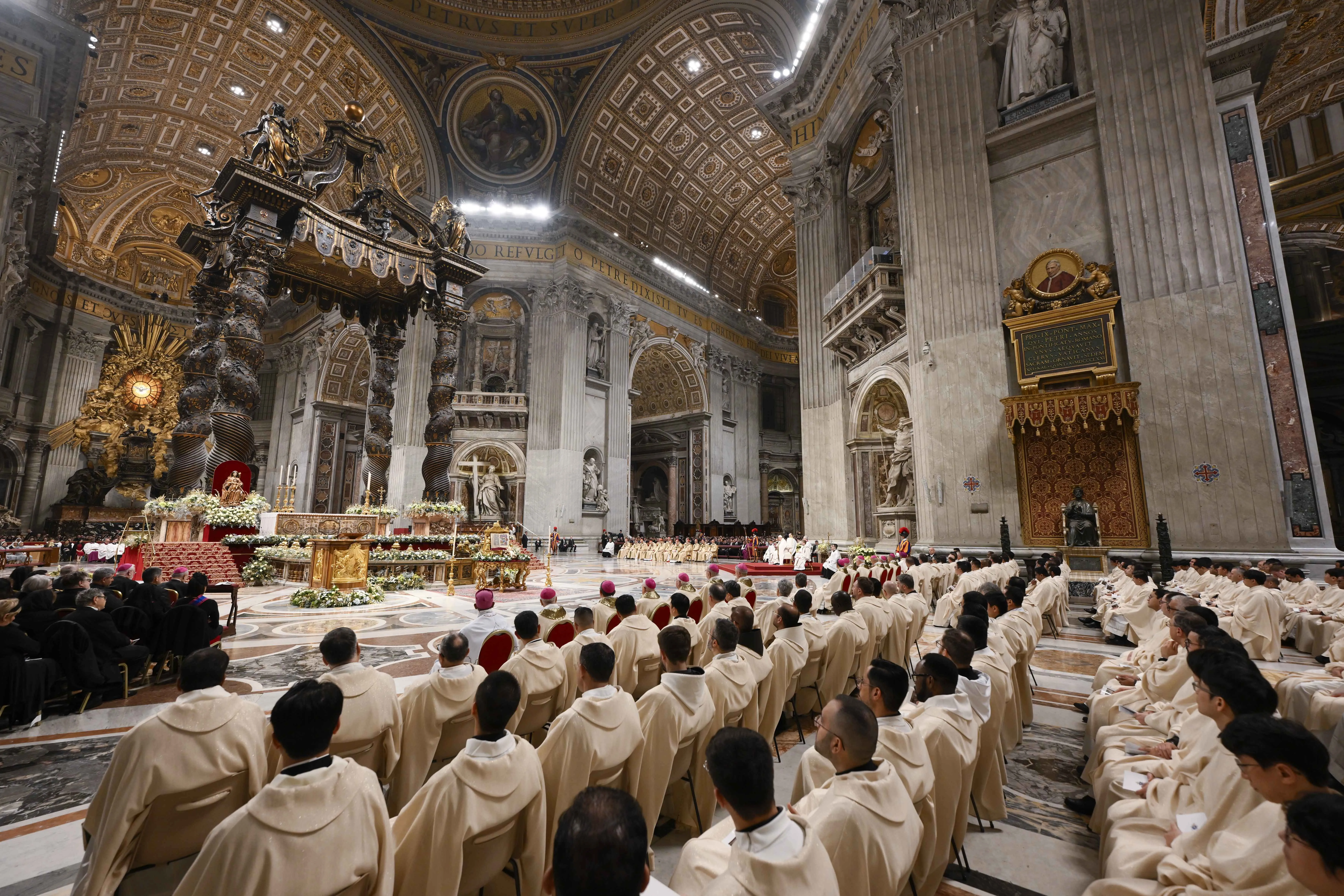
Christmas Mass in St. Peter’s Basilica on the night of Dec. 24, 2023. Vatican Media
Brothers and sisters, tonight we might ask ourselves: Which God do we believe in? In the God of incarnation or the god of achievement? Because there is always a risk that we can celebrate Christmas while thinking of God in pagan terms, as a powerful potentate in the sky; a god linked to power, worldly success, and the idolatry of consumerism. With the false image of a distant and petulant deity who treats the good well and the bad poorly; a deity made in our own image and likeness, handy for resolving our problems and removing our ills. God, on the other hand, waves no magic wand; he is no god of commerce who promises “everything all at once”. He does not save us by pushing a button, but draws near us, in order to change our world from within. Yet how deeply ingrained is the worldly notion of a distant, domineering, unbending, and powerful deity who helps his own to prevail against others! So many times this image is ingrained in us. But that is not the case: our God was born for all, during a census of the whole earth.
Let us look, then, to the “living and true God” (1 Thess 1:9). The God who is beyond all human reckoning and yet allows himself to be numbered by our accounting. The God, who revolutionizes history by becoming a part of history. The God who so respects us as to allow us to reject him; who takes away sin by taking it upon himself; who does not eliminate pain but transforms it; who does not remove problems from our lives but grants us a hope that is greater than all our problems. God so greatly desires to embrace our lives that, infinite though he is, he becomes finite for our sake. In his greatness, he chooses to become small; in his righteousness, he submits to our injustice. Brothers and sisters, this is the wonder of Christmas: not a mixture of sappy emotions and worldly contentment, but the unprecedented tenderness of a God who saves the world by becoming incarnate. Let us contemplate the Child, let us contemplate the manger, his crib, which the angels call “a sign” for us (cf. Lk 2:12). For it truly is the sign that reveals God’s face, a face of compassion and mercy, whose might is shown always and only in love. He makes himself close, tender, and compassionate. This is God’s way: closeness, compassion, tenderness.
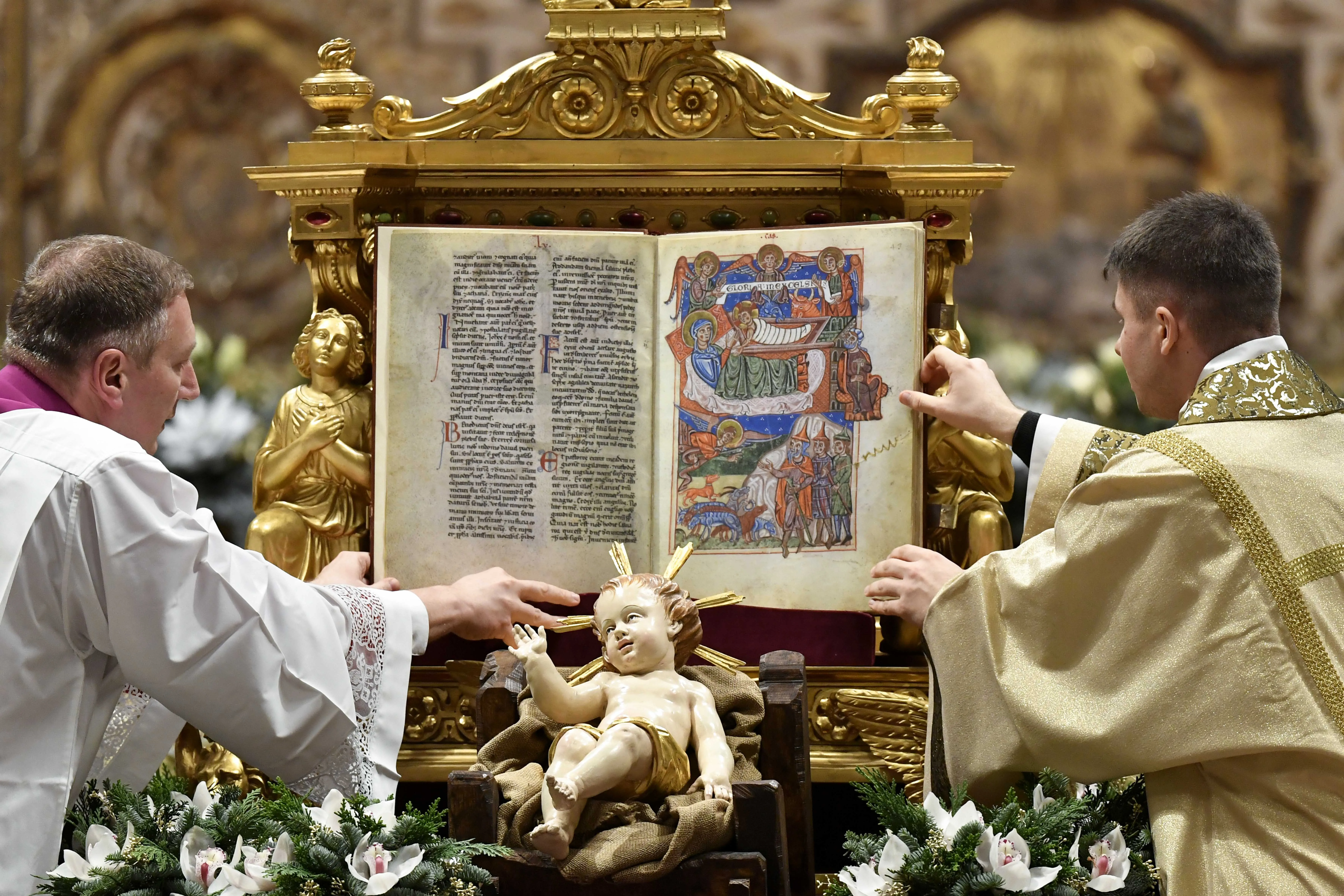
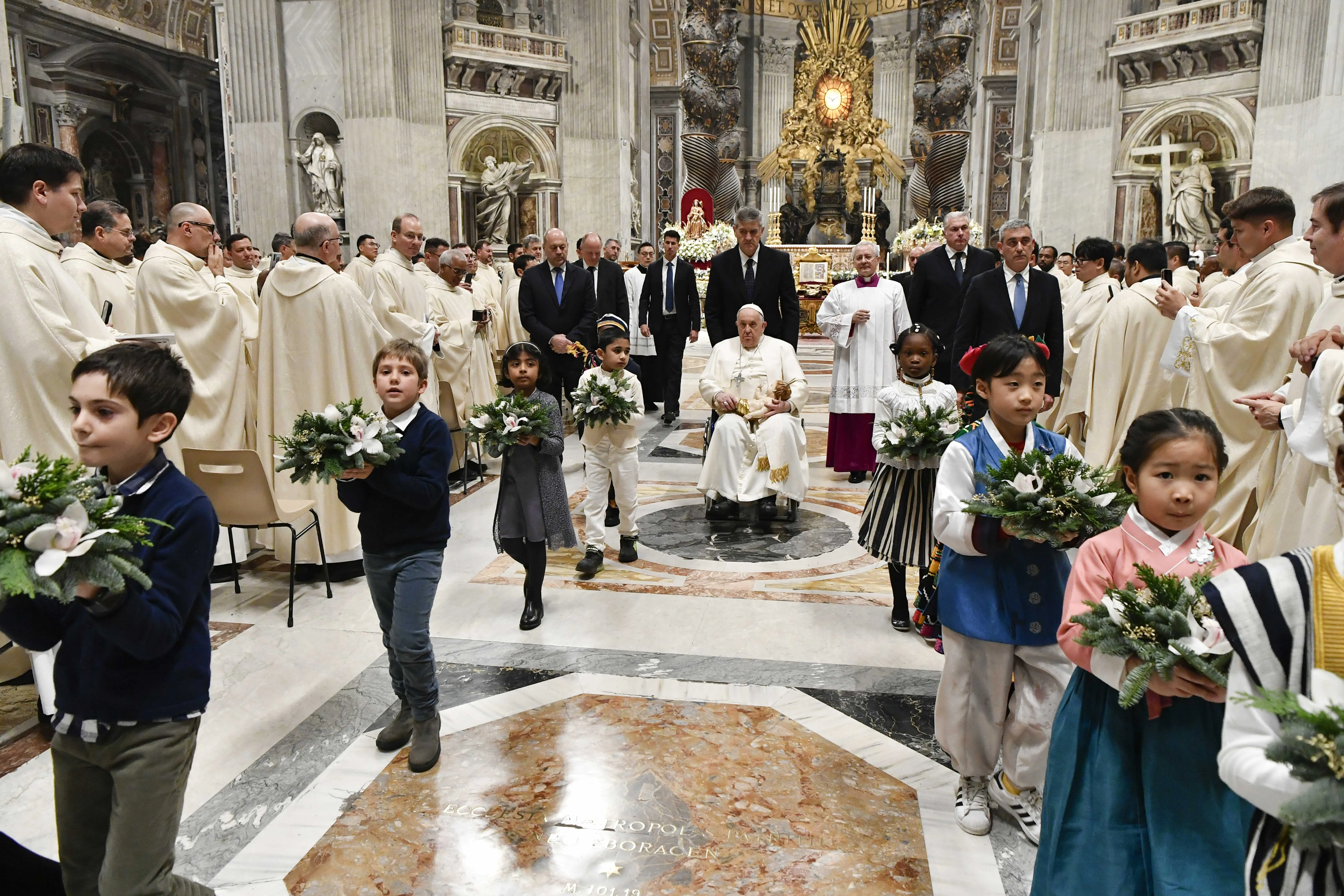
Pope Francis brings a figure of the Christ child over to the nativity scene inside of St. Peter’s Basilica at the end of Mass. Vatican Media
Sisters and brothers, let us marvel at the fact that he “became flesh” (Jn 1:14). Flesh: the very word evokes our human frailty. The Gospel uses this word to show us that God completely assumed our human condition. Why did he go to such lengths? Because he cares for us, because he loves us to the point that he considers us more precious than all else. Dear brother, dear sister, to God, who changed history in the course of a census, you are not a number, but a face. Your name is written on his heart. But if you look to your own heart, and think of your own inadequacies and this world that is so judgmental and unforgiving, you may feel it difficult to celebrate this Christmas. You may think things are going badly, or feel dissatisfied with your limitations, your failings, your problems, and your sins. Today, though, please, let Jesus take the initiative. He says to you, “For your sake, I became flesh; for your sake, I became just like you”. So why remain caught up in your troubles? Like the shepherds, who left their flocks, leave behind the prison of your sorrows and embrace the tender love of the God who became a child. Put aside your masks and your armor; cast your cares on him and he will care for you (cf. Ps 55:22). He became flesh; he is looking not for your achievements but for your open and trusting heart. In him, you will rediscover who you truly are: a beloved son or daughter of God. Now you can believe it, for tonight the Lord was born to light up your life; his eyes are alight with love for you. We have difficulty believing in this, that God’s eyes shine with love for us.
Christmas Mass in St. Peter’s Basilica on the night of Dec. 24, 2023. Vatican Media
Christ does not look at numbers, but at faces. However, who looks at him amid the many distractions and mad rush of a bustling and indifferent world? Who is watching? In Bethlehem, as crowds of people were caught up in the excitement of the census, coming and going, filling the inns, and engaged in petty conversation, a few were close to Jesus: Mary and Joseph, the shepherds, and then the Magi.
Let us learn from them. They stood gazing upon Jesus, with their hearts set on him. They did not speak, they worshiped. Tonight, brothers and sisters, is a time of adoration, of worship.
Worship is the way to embrace the Incarnation. For it is in silence that Jesus, the Word of the Father, becomes flesh in our lives. Let us do as they did, in Bethlehem, a town whose name means “House of Bread”. Let us stand before him who is the Bread of Life. Let us rediscover worship, for to worship is not to waste time, but to make our time a dwelling place for God. It is to let the seed of the Incarnation bloom within us; it is to cooperate in the work of the Lord, who, like leaven, changes the world. To worship is to intercede, to make reparation, to allow God to realign history. As a great teller of epic tales once wrote to his son, “I put before you the one great thing to love on earth: the Blessed Sacrament… There you will find romance, glory, honor, fidelity, and the true way of all your loves on earth” (J.R.R. TOLKIEN, Letter 43, March 1941).
Brothers and sisters, tonight love changes history. Make us believe, Lord, in the power of your love, so different from the power of the world. Lord, make us, like Mary, Joseph, the shepherds, and the Magi, gather around you and worship you. As you conform us ever more to yourself, we shall bear witness before the world to the beauty of your countenance.
People mourn outside the Charles University building following a mass shooting yesterday, on Dec. 22, 2023, in Prague, Czech Republic. Fourteen people were killed and 25 injured. Police say the gunman was a 24-year-old student at the university…. […]