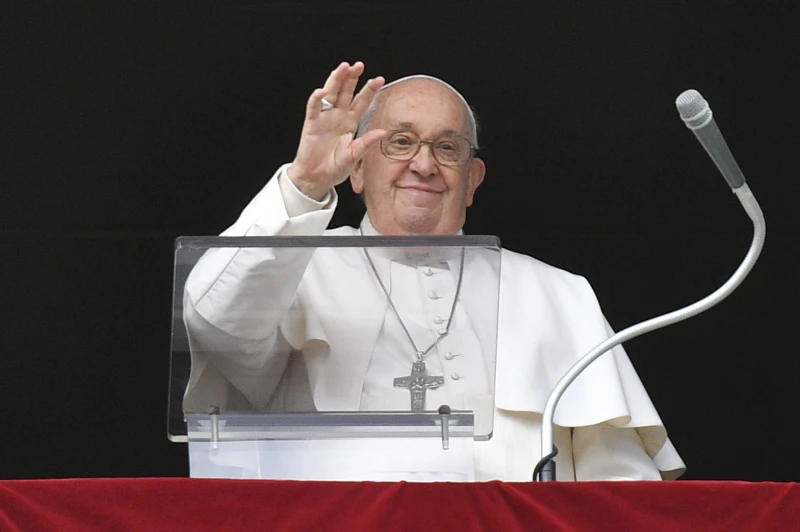
Pope Francis smiles at pilgrims gathered in St. Peter’s Square on Jan. 1, 2023, for his first Angelus of the new year. / Credit: Vatican Media
Rome Newsroom, Jan 1, 2024 / 09:47 am (CNA).
Pope Francis delivered his first Angelus of the new year on Jan. 1, the Solemnity of Mary, Mother of God, by reflecting that the importance of Mary’s motherhood is defined by love and underscored by a quiet silence that allowed her to place Christ at the center.
“She is Mother not only because she carried Jesus in her womb and gave birth to him, but because she brings him into the light, without occupying his place,” said the pope to the nearly 35,000 faithful gathered in St. Peter’s Square.
Pope Francis also used the occasion to appeal for prayers for the Church in Nicaragua, which has been at the center of an escalating persecution launched by the country’s president, Daniel Ortega.
“I am following with deep concern what is happening in Nicaragua, where Bishops and priests have been deprived of their freedom. I express to them, their families, and the entire Church in the country my closeness in prayer,” the Holy Father said.
“I also invite all of you present here and all the People of God to insistent prayer, while I hope that we will always seek the path of dialogue to overcome difficulties. Let’s pray for Nicaragua today.”
The priests are: Monsignor Carlos Avilés, vicar general of the Archdiocese of Managua; Father Héctor Treminio, pastor of Holy Christ Parish in Esquipulas in the same archdiocese; and Father Fernando Calero, pastor of Our Lady of Fatima Parish in Rancho Grande in the Diocese of Matagalpa.
In his Angelus reflection, Pope Francis noted that Mary’s silence is a “beautiful feature” but should not be thought of as a “simple absence of words” but rather as a feature that is “filled with wonder and adoration for the wonders that God is working.”
“In this way, she makes room within herself for the One who was born; in silence and adoration, she places Jesus at the center and bears witness to Him as Saviour,” the pope observed.
The Holy Father went on to express that this expression of maternity seen in Mary is an ideal that is also seen in our mothers who “with their hidden care, with their thoughtfulness, are often magnificent cathedrals of silence. They bring us into the world and then continue to attend to us, often unnoticed, so that we can grow. Let us remember this: love never stifles; love makes room for the other and lets them grow.”
Pope Francis added that by reflecting on mothers, we can “learn that love that is cultivated above all in silence, that knows how to make room for the other, respecting their dignity, leaving the freedom to express themselves, rejecting every form of possession, oppression, and violence.”
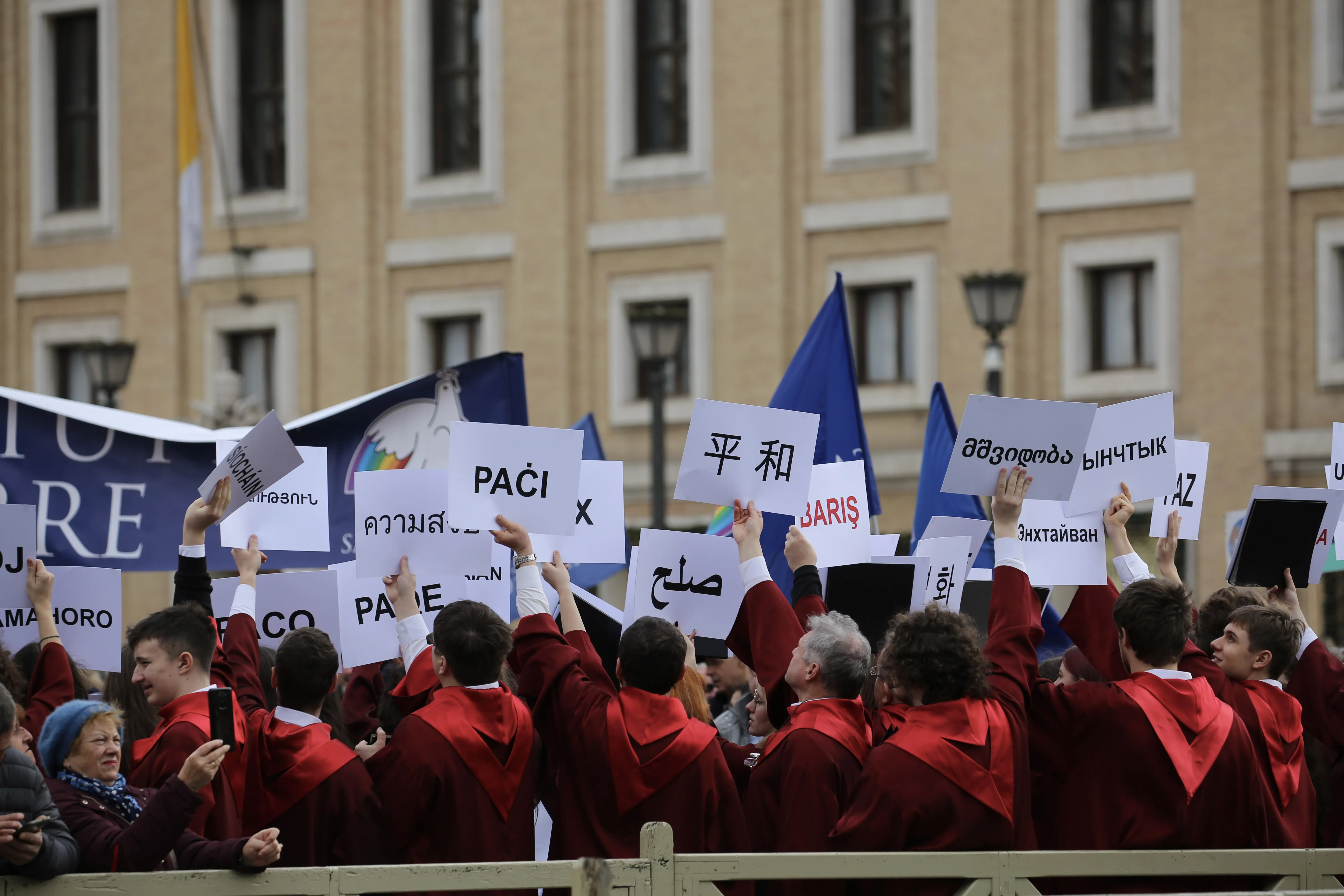
Pilgrims gathered in St. Peter’s Square for Pope Francis’ Angelus reflection on Jan. 1, 2024, wave peace signs. On Jan. 1 the Catholic Church observes the Solemnity of Mary, Mother of God, as well as the World Day of Peace. Credit: Elizabeth Alva/CNA
In addition to the day’s Marian feast, on Jan. 1 the Church celebrates the World Day of Peace, a tradition which was started by Pope Paul VI in 1968. In light of this celebration, Pope Francis took a moment during the Angelus to note that “‘freedom and peaceful coexistence are threatened whenever human beings yield to the temptation to selfishness, self-interest, the desire for profit, and the thirst for power.’”
The pope underscored that the antidote to overcoming these destructive tendencies that are ubiquitous today is “love” which “consists of respect and kindness: In this way, it breaks down barriers and helps us to live fraternal relationships, to build up more just and humane, more peaceful societies.”
If you value the news and views Catholic World Report provides, please consider donating to support our efforts. Your contribution will help us continue to make CWR available to all readers worldwide for free, without a subscription. Thank you for your generosity!
Click here for more information on donating to CWR. Click here to sign up for our newsletter.
Cardinal José Luis Lacunza. / Credit: Daniel Ibáñez/ACI Prensa
ACI Prensa Staff, Feb 1, 2024 / 18:10 pm (CNA).
The Panamanian Episcopal Conference (CEP) announced that Cardinal José Luis Lacunza was found safe and sound today after being missin… […]
The Sisters of St. Joseph of the Apparition cover the altar, just dedicated by the cardinal. The covering of the altar signifies that it is both the place of the Eucharistic sacrifice and the Lord’s table. / Credit: Photo courtesy of the Latin Patriarchate of Jerusalem
Jerusalem, Sep 12, 2024 / 07:00 am (CNA).
On Aug. 31, exactly 100 years after its dedication, the Church of Our Lady of the Ark of the Covenant was reopened for worship on the hill of Kiryat Yearim, nine miles from Jerusalem.
The church, which was closed for four years for restoration work, stands atop the hill overlooking the (Muslim) village of Abu Gosh. From the top, visitors can see Jerusalem.
A view from the hill of Kiryat Yearim, where the Church of Our Lady of the Ark of the Covenant stands. At the foot of the hill lies the Muslim village of Abu Gosh, with Jerusalem visible in the background, a little more than nine miles away. The place, mentioned in the Bible as “Kiriath-Jearim,” held an important role in the history of the Jewish people, as it was here that the Ark of the Covenant rested for about 20 years until King David brought it to Jerusalem. Credit: Marinella Bandini
The place, mentioned in the Bible as “Kiriath-Jearim,” has held an important role in the history of the Jewish people as it was here that the Ark of the Covenant rested after being recovered from the Philistines (see 1 Samuel 6).
The ark contained the two stone tablets on which the Ten Commandments — God’s covenant with the Jewish people — were inscribed and was the sign of God’s presence among his people.
According to the Bible, it was hosted in the house of Abinadab, where it remained for about 20 years (see 1 Samuel 7:1-2) until King David brought it to Jerusalem.
For this reason, even today, the site is visited by many groups of Jews.
A Byzantine basilica was built on the top hill around the fifth century. The current church, the foundation stone of which was laid in 1920, stands on the remains of that building. It was consecrated in 1924 by the then-Latin patriarch of Jerusalem, Luigi Barlassina, and dedicated to Our Lady of the Ark of the Covenant.
The Church of Our Lady of the Ark of the Covenant in Kiryat Yearim (exterior). The church is dedicated to the Virgin Mary, whom Christians also honor with the title of “Ark of the Covenant.” “The covenant of God with his people finds its fulfillment in Jesus Christ, who is no longer just the sign of God’s presence but God himself among us. Mary is the new Ark of the Covenant because she carried Christ himself in her womb,” said Cardinal Pierbattista Pizzaballa, the Latin patriarch of Jerusalem, in his homily. Credit: Marinella Bandini
Cardinal Pierbattista Pizzaballa, the current Latin patriarch of Jerusalem, recently came to the basilica to dedicate its new altar on the occasion of the reopening of the church.
“This reopening is a moment of trust in the future, a desire to start anew, and this is what we need most at this time, when everything around us speaks of death and endings,” he told CNA after the celebration on Aug. 31.
The opening of the doors of the Church of Our Lady of the Ark of the Covenant in Kiryat Yearim on Aug. 31, 2024, for the solemn celebration with the rite of dedication of the altar, presided over by Cardinal Pierbattista Pizzaballa, the Latin patriarch of Jerusalem. Credit: Photo courtesy of the Latin Patriarchate of Jerusalem
“Climbing this mountain, blessed by the presence of the Lord,” he added, “invites us to have a broad and farsighted perspective on events and not to close ourselves off in the dramatic present moment.”
Hosting the event were the Sisters of St. Joseph of the Apparition, a French congregation founded in 1832 by Mother Emilie De Vialar, which owns and operates the church and surrounding property.
The complete details of how the land came to be acquired by the sisters are lost to history, but it centers on one of the order’s sisters who died in 1927. Sister Josephine Rumèbe, who is buried in the church, was reportedly endowed with special mystical gifts and managed to acquire the land on behalf of the sisters. The story goes that she had 5,000 francs at her disposal and sought the help of a clergyman for the purchase. To prevent a competing buyer from acquiring it, the cleric secured the entire hill for 20,372 francs. Miraculously, when Sister Josephine counted the gold coins hidden in her room, the amount matched exactly what she needed.
Cardinal Pierbattista Pizzaballa, the Latin patriarch of Jerusalem, pours the chrism oil on the new altar of the Church of Our Lady of the Ark of the Covenant in Kiryat Yearim. On Aug. 31, 2024, he presided over the solemn Mass with the rite of dedication of the altar, marking the reopening of the church after four years of restoration and maintenance work. Credit: Marinella Bandini
The dedication of the new altar in the basilica took place after the recitation of the creed and chanting of the litanies. The cardinal placed relics in the altar, including that of Mother Emilie De Vialar, who was canonized a saint in 1951. This was followed by the anointing of the altar with chrism oil, the incensing of the altar, the covering of the altar, and the lighting of the altar.
The relics placed inside the new altar of the Church of Our Lady of the Ark of the Covenant in Kiryat Yearim, which was dedicated by Cardinal Pierbattista Pizzaballa, the Latin patriarch of Jerusalem, on Aug. 31, 2024. Among the relics are those of Mother Emilie De Vialar, founder of the Sisters of St. Joseph of the Apparition, the order who owns the church and surrounding property. Credit: Marinella Bandini
“The covenant of God with his people finds its fulfillment in Jesus Christ, who is no longer just the sign of God’s presence but God himself among us. Mary is the new Ark of the Covenant because she carried Christ himself in her womb,” said the cardinal in his homily, inviting the faithful, following the example of the Virgin Mary, to renew their trust in God as the Lord of history and active within history.
Upon entering the church — whose iconographic elements were created by artists from the Ave Center of the Focolare Movement — the eye is drawn to the golden flame emanating from the center of the apse.
Cardinal Pierbattista Pizzaballa, the Latin patriarch of Jerusalem, celebrates the Eucharistic liturgy on the altar he dedicated in the Church of Our Lady of the Ark of the Covenant in Kiryat Yearim on Aug. 31, 2024. Credit: Marinella Bandini
A special decoration that, on one hand, evokes the biblical significance of fire, symbolizing the presence of God, and on the other, is connected to the history of this place and particularly to Sister Josephine’s vision of a “mountain of fire,” holds significance here.
When she was still a young postulant in France, during Eucharistic adoration, Sister Josephine had a vision of flames forming a mountain with Jesus above them instead of the host. The vision then vanished, and only 50 years later, at the time of laying the foundation stone of the church, it was revealed to her that the “mountain of fire” was indeed Kiryat Yearim, which she used to call “the Holy Mountain.”
Sister Valentina Sala, the current provincial of the congregation for the Holy Land, immediately felt a strong connection to this place. She recounted to CNA: “The first time I came here for a few weeks, a sister took me to Kiryat Yearim. I knelt at Sister Josephine’s tomb and prayed to return if that was God’s will.”
Sister Valentina Sala, the current provincial of the congregation of the Sisters of St. Joseph of the Apparition for the Holy Land, prays at the tomb of Sister Josephine Rumèbe, founder of the convent and the church in Kiryat Yearim. “The first time I came here for a few weeks, a sister took me to Kiryat Yearim. I knelt at Sister Josephine’s tomb and prayed to return if that was God’s will,” she recounted to CNA. Credit: Marinella Bandini
On the centenary of the church’s dedication, Sister Valentina also emphasized the significance of this place for her congregation, whose charism is to serve the needs of people through works of charity.
“What is charity work? What people need today is not just health care or education; there is a hunger and thirst for God. We must be able to recognize this need, helping those who come here to listen to his voice. We need places where people can pause and rest with God,” she said.
When the construction of the church was nearly complete, Sister Josephine had a vision of the Virgin Mary, at the top of the church, facing Jerusalem with outstretched arms in a gesture of dispensing grace. A statue now stands above the church to recall that vision, facing away from those entering and directed toward Jerusalem.
“This place, which evokes the covenant, invites us to realign ourselves with God and to be under this blessing,” Sister Valentina concluded.
This is also the meaning of the words she addressed to those present — the vast majority of local faithful from Jerusalem as well as from Galilee — at the end of the Mass.
Hundreds of local faithful from Jerusalem and Galilee attend the solemn Mass with the rite of dedication of the altar, marking the reopening of the Church of Our Lady of the Ark of the Covenant in Kiryat Yearim, on Aug. 31, 2024. A hundred years ago, Sister Josephine Rumèbe of the Sisters of St. Joseph of the Apparition wrote about having seen a vision of “a crowd rushing toward the basilica. I saw priests, sisters of our order, and then men and women of the world who were even more pleasing to God than all the others, holy souls shining like stars.” Credit: Marinella Bandini
“Sister Josephine had already seen you in various visions: ‘I saw a crowd rushing toward the basilica. I saw priests, sisters of our order, and then men and women of the world who were even more pleasing to God than all the others, holy souls shining like stars.’”
She continued: “And what if we are that vision? What if we are that future? Of course, we are! From now on, you will be the ones to bring life to this hill, to this covenant between God and his people. Come, rush, stay, feel at home. There is not only a newly renovated church to see but a Presence to discover: Take the time to dwell with the Lord. What could be more beautiful… Many graces await to be dispensed from here!”
Pope Francis greets pilgrims in St. Peter’s Square after the Wednesday general audience, June 1, 2016. / Daniel Ibáñez/CNA.
Vatican City, Nov 12, 2021 / 13:00 pm (CNA).
Pope Francis has called on governments to take urgent action against the production of child pornography in an interview with the French magazine Paris Match.
“I believe that governments should act against this delinquency as soon as possible. The groups responsible behave like mafias who hide and defend themselves,” the pope said.
“Their victims are children and minors who are used for filming; so many people, so many young people, sometimes even minors, watch these things.”
The publication of the pope’s condemnation of pornography on Nov. 11 came days after a Catholic priest in the Diocese of Cleveland, Ohio, was sentenced to life in prison on convictions of sex trafficking of youths under 18, child pornography, and sexual exploitation of children.
In the interview with the French publication, the pope also responded to a landmark report published last month which estimated that hundreds of thousands of children were abused in the Catholic Church in France over the past 70 years.
Pope Francis underlined his sense of “shame” in response to the report — a word he also used when he spoke the day after its publication at a general audience.
“To the victims, I wish to express my sadness and my pain for the traumas they have endured and my shame, our shame, my shame that for so long the Church has been incapable of putting this at the center of its concerns, assuring them of my prayers,” he said Oct. 6.
The pope said that when speaking of this shame, he recalled “the Prophet’s words, ‘To Thee, O Lord, be the glory, to me be the shame.’”
Pope Francis has repeatedly called this year for the legal protection of human dignity online.
In an audience with the International Catholic Legislators Network, the pope urged the use of public policy to combat child pornography, data breaches, and cyber attacks.
“In our age particularly, one of the greatest challenges confronting us is the administration of technology for the common good,” the pope said on Aug. 27.
“By means of policies and regulations, lawmakers can protect human dignity from whatever may threaten it. I think, for example, of the scourge of child pornography, the misuse of personal data, attacks on critical infrastructures such as hospitals, and the spread of false information on social media and so on,” he said.
The full interview with the pope will be published in a book in French, “Pourquoi eux: Ils ont fait notre époque” (“Why them: They made our epoch”), by Caroline Pigozzi on Nov. 18.
When asked in the interview about his health after the pope’s colon surgery last July, Francis responded: “I am doing well. I lead a normal life and can work at the same pace as before.”
Be with us O Mary along the way – Guide every step we take in 2024.