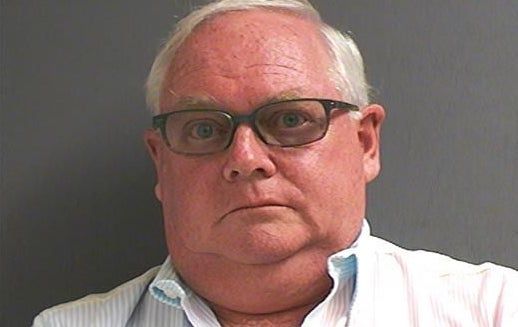
The Diocese of Richmond, Virginia, says it has received allegations of child sexual abuse against Father Walter Lewis, a retired priest. / Powhatan County Sheriff’s Office
The Diocese of Richmond, Virginia, says it has received allegations of child sexual abuse against a retired priest, with law enforcement investigating the claims as the priest remains removed from public ministries.
The Richmond Diocese — the larger of the two in the state in front of the Diocese of Arlington — said in a July 1 press release that it had “received a recent report of alleged child sexual abuse against Father Walter Lewis.”
“The allegation reports that the abuse took place in the 1980s while Father Lewis was serving as pastor of St. Anne Catholic Church, Bristol,” the diocese said. “The allegation has been reported to law enforcement.”
Bristol is located in the extreme southwestern part of the state near the Tennessee border. Lewis served at the parish from 1983–1995.
Bishop Barry Knestout “immediately prohibited Father Lewis from any public ministry in the diocese” for the duration of the investigation, the press release said, adding that diocesan officials would not “reach any conclusions regarding this allegation until the investigation concludes.”
Lewis has denied the allegations, the diocese said. He retired from active ministry in May of this year.
The priest in 2017 pleaded guilty to a drunk driving offense, his second in less than 10 years. Pulled over after driving erratically, Lewis blew .11 on a breathalyzer test, above the legal limit of .08. He received a 12-month sentence, with all but 10 days in prison suspended. He had previously been found guilty of drunk driving in 2011.
The diocese did not immediately return a request for comment on the investigation, which was launched earlier this month.
In 2019 Knestout released a list of any diocesan priests who have “a credible and substantiated claim of sexual abuse against a minor.”
Twenty-three priests are currently on the list; Lewis has not yet been added. Three other lists include priests “alleged to have committed abuse in the present-day territory of the Catholic Diocese of Richmond” who were “later incardinated to the Catholic Diocese of Arlington” as well as priests from outside the diocese alleged to have committed abuse there and clergy who worked in the diocese but who have been accused of abuse outside of it.
Denver, Colo., Jul 24, 2023 / 11:00 am (CNA).
People who identify as LGBT or gender nonconforming should be served by Catholic ministry that shows charity, sensitivity, understanding, and genuine accompaniment… […]
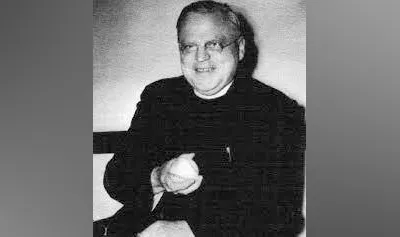
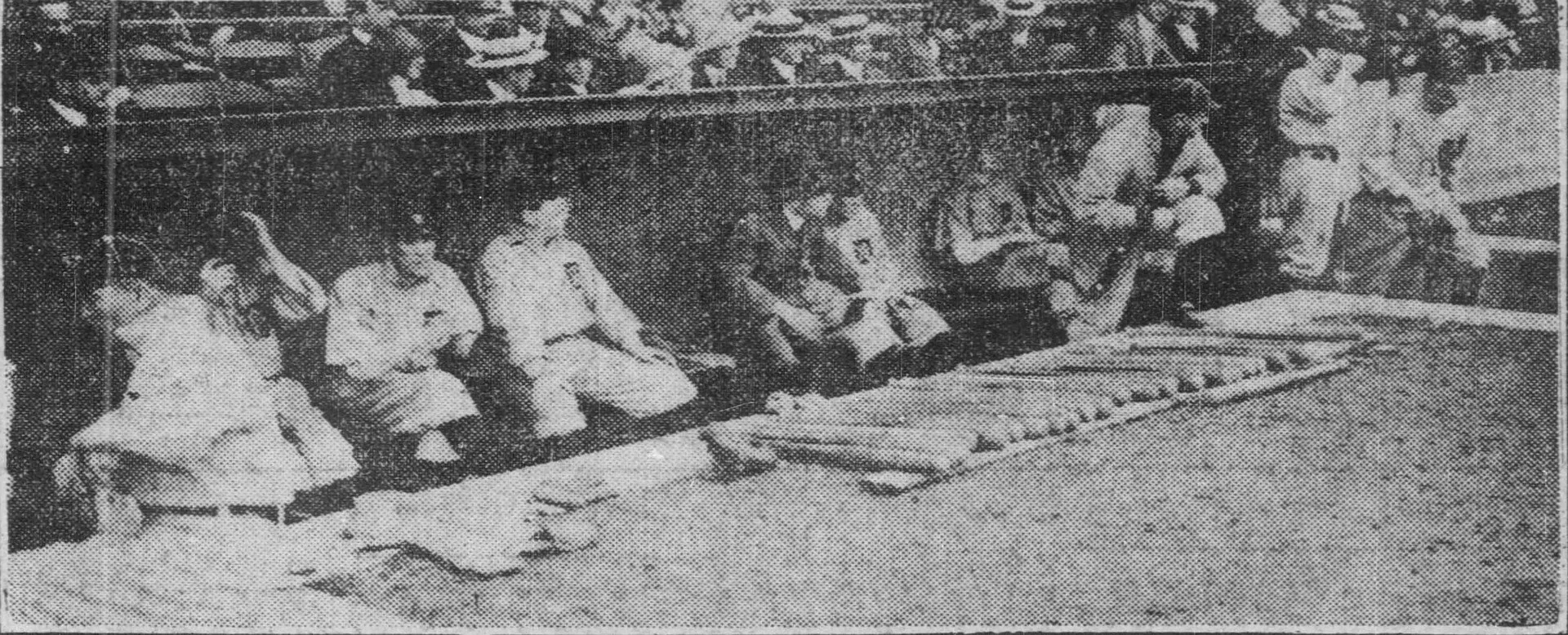
This photo of Father Allan Travers was featured in the local newspaper after his pitching “performance” for the Detroit Tigers against the Philadelphia A’s on May 18, 1912. The photo featured the caption “strikebreaker,” which worried Travers’ mother, since there was a street trolley strike in Philadelphia earlier in the month, and she didn’t want her son caught in the confusion. / Photo credit: Public domain
Detroit, Mich., Jul 23, 2023 / 08:00 am (CNA).
The worst pitcher ever to take the mound for the Detroit Tigers became a Catholic priest.
Granted, Allan Travers was already on the path to the priesthood before suiting up for Detroit on May 18, 1912. But his story — and place in baseball history — is the prime example of being in the right place at the right time (or the wrong place at the wrong time).
Travers played in only one game, but one was enough to show that God had plans for him that didn’t involve the big leagues.
The story begins, as most stories of Tigers lore do, with Ty Cobb.
The Tigers were in New York on May 15 to play the Highlanders (the precursor to the Yankees). Cobb was playing in the outfield when he was verbally abused by a New York fan who was using profanity and racial slurs to describe Cobb’s play.
Cobb — never known for keeping his cool — stormed into the stands and unleashed a volley of punches on the fan. Tigers players rushed to the scene of the chaos, yelling at Cobb to lay off the man, who was missing one hand and three fingers on his other hand after suffering an industrial accident.
Cobb didn’t care and continued the barrage.
Ban Johnson, president of the American League, happened to be at the game, checking on the family-friendly excitement of what was turning into America’s pastime.
Having one of the league’s star players beat up a disabled spectator didn’t jibe well with Johnson’s vision for baseball, so Cobb was suspended indefinitely.
The Tigers felt Cobb’s punishment was unfair, so the players voted to strike until Cobb was reinstated for the club’s next game in three days against the two-time defending World Series champion Philadelphia Athletics.
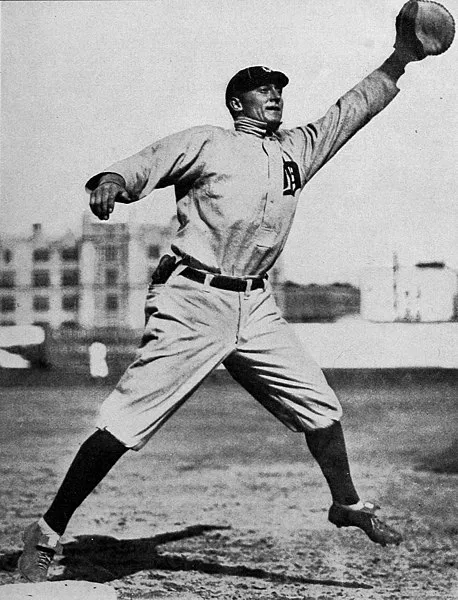
Detroit Tigers legend Ty Cobb is pictured in 1911. Not one to keep his cool, Cobb launched himself into the stands to attack a fan who insulted him in 1912, resulting in a league suspension and sparking his teammates to strike in protest. Credit: Public domain
Johnson called the Tigers’ bluff, informing then Tigers owner Frank Navin the team would face a $5,000 fine for every game Detroit forfeited.
Navin needed to field a team, and quick, so he and Tigers manager Hughie Jennings collaborated with Athletics owner/manager Connie Mack to field a team of players to take the field.
This was well before the age of expansive minor league rosters — or commercial airlines, for that matter — so it wasn’t as though the Tigers could call up the farm team in Toledo and get them to Philadelphia in time to play the A’s. Instead, scouting was done the old-fashioned way, spreading word throughout town, asking who wanted to play baseball.
And this is where Aloysius Joseph “Allan” Travers, the student manager on the St. Joseph’s College baseball team, comes into the story.
Jennings worked with a friend of his, Joe Nolan, a sportswriter for The Philadelphia Bulletin,to field a team. Nolan knew Travers, a junior at St. Joseph’s who lived in Philadelphia, from the time the A’s fielded a second-stringer team to play St. Joseph’s College.
Nolan asked Travers to find 10-12 amateur players in the area who could suit up for the Tigers in case the Tiger players followed through on their strike threats. The idea was that the amateurs would never actually take the field; rather, it was just a tactic to get Jennings’ “real” players on the field.
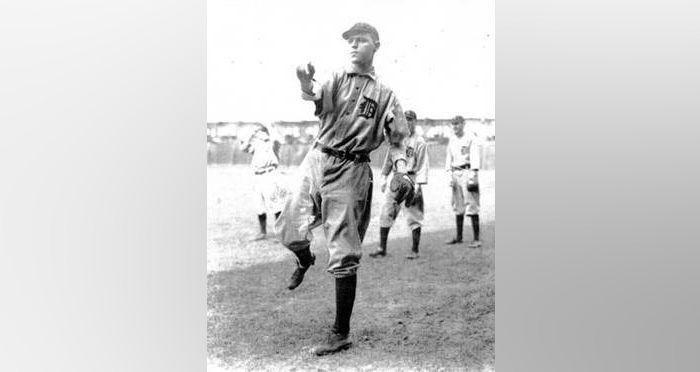
Father Allan Travers, SJ, was a priest who taught at St. Joseph’s College (now St. Joseph’s University) in Philadelphia. But in 1913, while a student at St. Joseph, he was the improbable pitcher for the Detroit Tigers, where he secured a bizarre spot in baseball history. Credit: Public domain
Travers rounded up eight players who were free that day and enticed by the $25 Navin offered to each player.
Jennings had his team of strike-breakers, as requested by Navin.
When the umpire called “play ball,” the Tiger regulars took the field, but when the umpire spotted Cobb and told him to take a seat, the rest of the team walked out and took off their uniforms.
The strike-breakers would have to play after all. They were ushered into the locker room and donned the Tigers’ gray uniforms (this was in the days before names were on the back of uniforms). Two bench coaches joined the group to offer the squad some big league experience.
The question was, who would pitch?
There were no takers at first, so Navin offered an extra $25. Travers volunteered; $50 was good money for a college kid in 1912. There was one small problem — Travers had never played organized ball.
He was the assistant manager on the college baseball team, tasked with keeping stats and writing game summaries.
But there he was, the college student with plans to join the seminary after graduation, pitching before 20,000 fans at Shibe Park against the two-time defending World Series champions. A modern David versus Goliath, a plucky underdog story.
This time Goliath won.
Travers did as well as one would expect the assistant manager of a college baseball team to do against professionals. He pitched a complete game, surrendering 24 runs on 26 hits (both American League records), walking seven and striking out one. He got an MLB strikeout — they can’t take that away from him.
But the 15.75 ERA leaves a mark. He also batted 0-for-3 at the plate.
Travers’ time in the major leagues was abrupt. After the 24-2 shellacking the A’s put on the strikebreaking Tigers, Cobb persuaded his teammates to end the strike before the team’s upcoming series against the Washington Senators.
Travers’ calling was the priesthood, not pitching.
After graduating from St. Joseph’s College in 1913, he joined the Society of Jesus, studying at St. Andrew on the Hudson in New York and Woodstock College in Maryland. He was ordained a priest in 1926, making him the only priest ever to play in a Major League game.
His ministry took him to teaching positions at St. Francis Xavier High School in Manhattan and St. Joseph’s Prep and St. Joseph’s College in Philadelphia.
Father Travers didn’t speak about his baseball exploits, but he did give an interview about his bizarre start for the Tigers.
“About noon when Nolan told me about the strike of Detroit, he told me the club would be fined and might lose its franchise if 12 players didn’t show up,” Travers told sportswriter Red Smith. “He told me to round up as many fellows as I could. We never thought we’d play a game.”
The replacement Detroit Tigers are pictured in the dugout against the Philadelphia A’s on May 18, 1912. Photo credit: Public domain
The priest said Jennings told him to avoid throwing fastballs to “avoid getting killed out there,” but the A’s didn’t hold back, even resorting to bunting when they found out the third baseman had never played baseball before.
“I fed ‘em nothing but slow stuff after Frank Baker almost hit one out of the park on me, which fortunately went foul,” Travers said. “I was doing fine until they started bunting. The guy playing third base had never played baseball before. I just didn’t get any support. I threw a beautiful slow ball and the A’s were just hitting easy flies. Trouble was, no one could catch them.”
Curious enough, the only “fame” Travers got from his start was his picture in the newspaper with the word “Strikebreaker” printed above. There was a trolley strike in Philadelphia that month, and Travers’ mother was worried for her son’s safety because people might suspect he was a scab.
Travers didn’t like talking about his baseball “career” with his students, and his story is not well known, save for a few baseball history blogs.
He did sign a ball from that fateful day that wound up in the collection of Ada, Michigan, resident Steve Nagengast, who claims to have the largest collection of Tigers autographs. Nagengast was featured in the Detroit News, and the anecdote about Travers piqued Detroit Catholic’s interest.
Travers didn’t have the greatest impact on Tigers history. But the $5,000-per-game fine the Tigers faced for each game the club forfeited would have been devastating, especially in an era when professional teams folded and changed towns all the time.
So who knows.
Father Travers’ one-game career might have just saved the Tigers.
"…every baby is a miracle from God who deserves to be loved, protected, and supported,” the EveryLife baby products website states. / Credit: rawpixel.com on Freepik
Denver, Colo., Jul 22, 2023 / 06:00 am (CNA).
A diaper company has rele… […]
David Bloch, who founded the snowboarding team at Woodstock Union High School in 2011, served as the head coach from its onset until he was fired in February. / Courtesy of Alliance Defending Freedom
A mother and her baby who were served by one of Pregnancy Care Alliance’s member centers. / Photo courtesy of Pregnancy Care Alliance of Massachusetts
Boston, Mass., Jul 21, 2023 / 15:02 pm (CNA).
Pro-life pregnancy centers in Massachusetts have allied to enhance collaboration and share resources amid hostility from advocates for abortion.
CNA has tracked more than 60 pro-abortion attacks on pro-life pregnancy centers since May 2022 — four of which occurred in the Bay State — in which vandals have marked pro-life facilities with threatening graffiti and in some cases broken windows and burned down buildings.
Last year, ordinances were enacted in the cities of Cambridge and Somerville, located north of Boston, to issue fines of up to $300 for every instance of “deceptive” advertising by local pregnancy clinics that do not perform abortions or refer clients to those that do perform them.
Other municipalities have attempted to adopt the same ordinance. The state Legislature is currently considering a bill that contains the same language targeting “deceptive advertising” from pro-life pregnancy centers, although there is no definition of the term in it.
That bill in the state Legislature is “clearly aiming to censor protected speech,” Myrna Maloney Flynn, president of Massachusetts Citizens for Life (MCFL), told CNA on July 20.
Myrna Maloney Flynn, president of Massachusetts Citizens for Life. Myrna Maloney Flynn
MCFL came up with the idea for the pregnancy center alliance in 2022 to serve as a “hub” for the member pregnancy centers, Flynn said.
“The network was formed with a dual mission of building public awareness and also serving more women,” Flynn said.
One of the ways the alliance is working to share its message is through video testimonials on YouTube of women whose lives were positively impacted through the services of pro-life pregnancy centers.
A 29-year-old woman named “Crystal,” who was able to save the life of her son through the abortion pill reversal method, gave her testimony in a video dated May 17.
After regretting her visit to a Planned Parenthood, Crystal shared her experience with the women working at Abundant Hope pregnancy resource center in Attleboro, Massachusetts.
“There I met the most amazing group of women that really helped me feel confident in my decision and really supported me through the abortion pill reversal,” she said of her visit.
“I am so happy to say that thanks to them and their support, I was able to deliver my son and we had him last April, and he really is the light of my life,” Crystal said.
Flynn said that both MCFL and the pregnancy center alliance are “eager” to tell the stories of women who benefited from the centers. The collaboration means they can wage an effective social media campaign across different platforms.
“Now we work together to come up with creative campaigns, or hashtags or fundraisers, or a series of open houses that we held earlier this year,” she said.
“We’re hitting multiple audiences way more efficiently than each center could do on [its] own. And so, consequently, we hope that in a shorter amount of time, the public in Massachusetts will be better informed and more widely informed about the truth of pregnancy resource centers,” she added.
Flynn will be testifying in front of a joint committee in the state’s Legislature on July 24 in order to oppose the passage of the “deceptive advertising” bill called “An Act to protect patient privacy and prevent unfair and deceptive advertising of pregnancy-related services.”
The bill says: “No limited services pregnancy center, with the intent to perform a pregnancy-related service, shall make or disseminate before the public, or cause to be made or disseminated before the public, in any newspaper or other publication, through any advertising device, or in any other manner, including, but not limited to, through use of the internet, any statement concerning any pregnancy-related service or the provision of any pregnancy-related service that is deceptive, whether by statement or omission; and a limited services pregnancy center knows or reasonably should know to be deceptive.”
Using data taken from the member pregnancy centers in the alliance, Flynn will testify that no clinic that is part of the Pregnancy Care Alliance has received complaints related to “deceptive advertising.”
“Furthermore, Pregnancy Care Alliance centers maintain consistently high satisfaction ratings by their clients,” she said. “Thousands of women have found pregnancy resource centers via internet searches and are grateful that they did.”
In March of this year, Massachusetts Gov. Maura Healey, a Democrat, signed a $389 million supplemental budget bill that included a $1 million “public awareness campaign focused on the dangers of crisis pregnancy centers and pregnancy resource centers.”
It’s unclear how the state is planning to use the funds, as CNA inquired with the governor’s office but did not receive a response. However, Flynn said that MCFL is planning to launch a counter-campaign soon called “$1 million for women.”
“The funds raised would support Pregnancy Care Alliance’s member centers and, by extension, women,” Flynn said.
“By nature of the fact of being a network, these pregnancy resource centers become stronger, and with MCFL as the hub, we can help to make them stronger and spread the word about what they do and correct misinformation in the public sphere,” Flynn said.
Several other states have initiatives bringing pro-life pregnancy centers together in collaboration, such as Indiana, North Carolina, Wisconsin, and Oklahoma.
The Pregnancy Care Alliance website can be found here.