No Picture
News Briefs

Papal Foundation announces nearly $15 million in global grants, humanitarian aid

April 12, 2024 Catholic News Agency 3
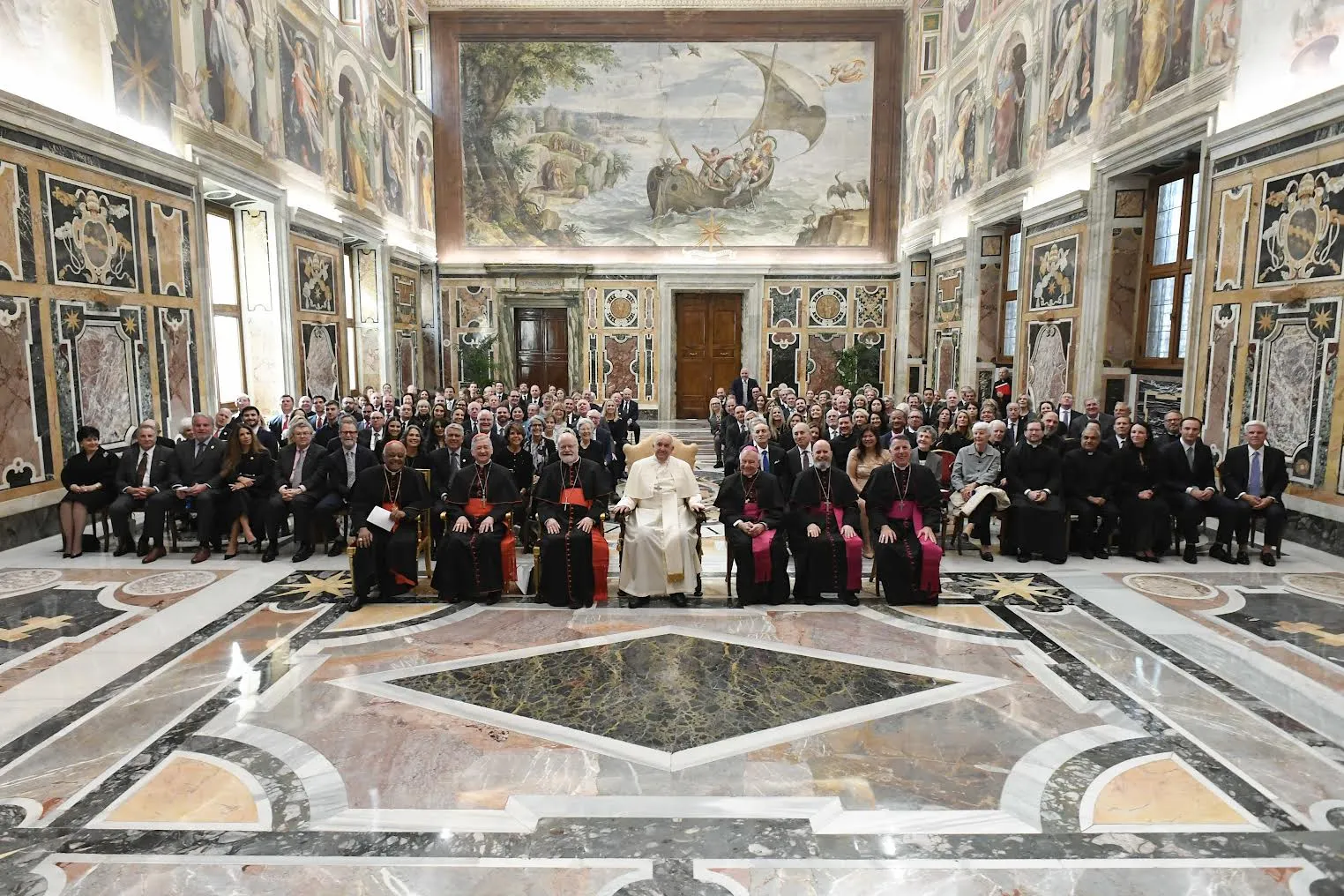
Pope Francis blesses an unborn baby during the Papal Foundation’s annual pilgrimage in Rome on Friday, April 12, 2024. / Credit: Vatican Media

CNA Staff, Apr 12, 2024 / 12:45 pm (CNA).

The Papal Foundation, a U.S.-based organization that provides funding for Catholic projects around the world, announced on Friday the distribution of nearly $15 million in grants, scholarships, and charitable aid “to care for those in need and grow the Catholic faith around the world.”

The group said in a press release that it would be distributing nearly $10 million in 2024 alone to more than 100 projects and recipients in several dozen countries. Among the beneficiaries include efforts at “providing for basic needs such as access to clean water,” “constructing schools and renovating classrooms,” and “translating Church teachings for evangelization.”

The money will also go toward “restoring Churches, convents, and seminaries in desperate need of repairs,” “providing students in remote areas with transportation to further their education,” and “building health care facilities.”

The foundation was founded 35 years ago in response to a wish from Pope John Paul II. Stewards with the organization donate their personal money to support projects specifically identified and requested by the pope, who is made aware of needs through his nuncios, or ambassadors, around the world.

Pope Francis meets with members of the Papal Foundation on Friday, April 12, 2024, at the Vatican. Credit: Vatican Media

The Papal Foundation describes itself as “the only charitable organization in the United States that is exclusively dedicated to fulfilling the requests of the Holy Father for the needs of the Catholic Church.” On Friday the organization said it would also be providing more than $800,000 via its St. John Paul II scholarship program, which “will enable more than 100 priests, women religious, and seminarians to study in Rome.”

The Holy Father met with the Papal Foundation on Friday during the group’s annual pilgrimage to Rome this week. The organization was scheduled to be in Rome from April 9–13. 

During the audience at the Vatican’s Clementine Hall, Pope Francis told the group’s members that their work “enhances the integral development of so many, including the poor, refugees, immigrants, and nowadays the increasingly large numbers of those affected by war and violence.”

“Through these various worthy initiatives,” the pope said, “you continue to help the successors of Peter to build up many local Churches and care for large numbers of the less fortunate, thus fulfilling the mandates entrusted to the apostle by Our Lord.”

David Savage, the group’s executive director, on Friday described it as a “a blessing to support this mission of cooperation and collaboration, bringing together laity, clergy, and Church hierarchy to address priorities identified by the Holy Father and care for his flock around the globe.”

Cardinal Sean O’Malley, the chairman of the Papal Foundation’s board of trustees, on Friday quoted the Gospel of Luke, saying: “To whom much is given, much shall be required.”

“In a society where the divide between rich and poor continues to grow, stewards of St. Peter of the Papal Foundation recognize their responsibility to put the needs of the poor and vulnerable first,” the prelate said.

[…]

No Picture
News Briefs

Pope Francis reinstates papal title ‘Patriarch of the West’ in Pontifical Yearbook

April 12, 2024 Catholic News Agency 1
Pope Francis presides over Easter Sunday Mass in St. Peter’s Square on March 31, 2024. / Credit: Vatican Media

Rome Newsroom, Apr 12, 2024 / 09:50 am (CNA).

In the 2024 edition of the “Annuario Pontificio,” or Pontifical Yearbook, released this week, Pope Francis reinstated the ancient, honorary pontifical title of “Patriarch of the West,” reversing Pope Benedict XVI’s 2006 decision to suspend the title. 

This honorific designation has reappeared among the list of “historical titles” used to designate the theological and temporal reality of the pontifical office. Those include Vicar of Jesus Christ, Successor of the Prince of the Apostles, Supreme Pontiff of the Universal Church, and Metropolitan Archbishop of the Province of Rome, among others.

Following Pope Benedict XVI’s decision to drop the title in 2006, the Dicastery for Promoting Christian Unity (then the Pontifical Council for Promoting Christian Unity) issued a statement noting that it had become “obsolete” and “no longer usable.” 

The dicastery argued that the cultural and geographic understanding of the West had expanded from Western Europe to also cover North America, Australia, and New Zealand. 

“The renunciation of this title is intended to express historical and theological realism and, at the same time, to be the renunciation of a claim, a renunciation that could be of benefit to ecumenical dialogue,” the dicastery said at the time.

The title “Patriarch of the West” was adopted in the year 642 by Pope Theodore and was used for centuries, though it was not until 1863, during the pontificate of Pope Pius IX, that the title first appeared in the Annuario Pontificio. 

Aristomenis “Menios” Papadimitriou, a historian of religion at Fordham University specializing in modern Christianity, told CNA via email that any attempt to read into the decision would run the risk of being “mainly speculative” and “not grounded in a serious understanding of ecclesial administration.” 

But Papadimitriou noted that “at the heart of it lies the question of the historic and contemporary meaning of the episcopal honorific of ‘patriarch’ and [the life] of that term through the vicissitudes of history.”

Neither the dicastery nor the Holy See Press Office has released a statement explaining Pope Francis’ decision to reinstate the title. 

This is not the first time Pope Francis has made changes to the papal titles in the Annuario Pontificio, the more-than-2,400-page long official directory of the Catholic Church’s global leadership and structure.

The honorifics were previously published above the volume’s short papal biography, but as of 2020 they are listed below that biography in smaller font and identified as “Historical Titles.”

According to Matteo Bruni, the director of the Holy See Press Office, the 2020 decision was “intended to indicate the link with the history of the pope” rather than “historicizing” the titles themselves.

That same year, Cardinal Gerhard Mueller, the Vatican’s former doctrinal chief, rebuffed the move, calling it an act of “theological barbarism.” 

He argued that the revised yearbook mixed the term “Vicar of Christ” with designations that “have nothing to do with primacy and have only grown historically but [have] no dogmatic meaning, such as ‘Sovereign of Vatican City State.’”

Nikos Tzoitis, an analyst in the press office of the Ecumenical Patriarchate of Constantinople and former spokesperson for Ecumenical Patriarch Bartholomew I, argued in an April 6 article that the pope’s decision to reintroduce the honorific of Patriarch of the West “is part of the rediscovery of confraternity.” 

“In this way, he wants to emphasize the importance of the lost synodality in the Lord’s Church, which expresses his Body and has synodality as a tool,” Tzoitis wrote.

Pope Francis has cemented ecumenical dialogue as one of the main priorities of his pontificate.  

In 2014 Francis, during an apostolic visit to the Holy Land, met with Ecumenical Patriarch Bartholomew I on the occasion of the 50th anniversary of the historic meeting between Pope Paul VI and Orthodox Ecumenical Patriarch Athenagoras I of Constantinople on the Mount of Olives in Jerusalem in 1964. 

That was the first formal meeting of a pope and ecumenical patriarch since 1438, marking a paradigm shift in the ecumenical relations between the Catholic and Eastern Orthodox Churches. 

“We need to believe that, just as the stone before the tomb was cast aside, so too every obstacle to our full communion will also be removed,” Pope Francis said during his 2014 address with the Ecumenical Patriarch. 

[…]

No Picture
News Briefs

Pope Francis to travel to Indonesia, Singapore, East Timor, and Papua New Guinea

April 12, 2024 Catholic News Agency 2
Pope Francis greets pilgrims at the Wednesday general audience in St. Peter’s Square on March 22, 2023. / Daniel Ibanez/CNA

Vatican City, Apr 12, 2024 / 06:45 am (CNA).

Pope Francis will travel to the Southeast Asian countries of Indonesia, Papua New Guinea, East Timor, and Singapore later this year, the Vatican announced Friday.

The 11-day multi-country voyage from September 2 to 13 will be the longest international trip of Francis’ papacy.

The trip announcement comes after the 87-year-old pope has slowed down his travel schedule in recent months as health issues have forced him to cancel some public appearances. Francis, who often uses a wheelchair, has not traveled internationally since September 2023.

Indonesia

Pope Francis’ first stop will be Indonesia, home to the largest Muslim population in the world. The country’s 229 million Muslims make up more than 12% of the global Muslim population. Nearly all of Indonesia’s Muslims are Sunni.

Cardinal Ignatius Suharyo of Jakarta welcomed the news that the pope will visit Indonesia from Sept. 3 to 6.

“Catholics throughout Indonesia want to shake hands with the pope one by one, but we all know that is impossible,” Suharyo said in a video message announcing the visit.

More than 29 million Christians live in Indonesia, 7 million of which are Catholic. Pope St. Paul VI visited the country in 1970 and Pope St. John Paul II traveled there in 1989.

“Hopefully, with this visit, Indonesian Catholics will become more courageous in voicing the truth and become an example for people of other religions in terms of truly religious life, namely love above all, as the pope always emphasizes,” the Indonesian cardinal told UCA News.

Papua New Guinea

Pope Francis will be the second pope to visit Singapore, East Timor, and Papua New Guinea after John Paul II.

The pope will visit the cities of Port Moresby and Vanimo in Papua New Guinea from September 6 to 9.

Papua New Guinea is a country of nearly nine million people on the eastern half of the island of New Guinea. The other side of the island consists of two Indonesian provinces. Papua New Guinea is a nation of considerable cultural diversity, comprised of hundreds of ethnic groups indigenous to the island with 851 indigenous languages spoken in the country.

Nearly all Papua New Guinea citizens are Christians, and 26% of the population is Catholic.

East Timor

The pope’s next stop on his Southeast Asia tour will be Dili, the capital city of East Timor from September 9 to 11.

East Timor is a small country on the island of Timor. It gained independence from Indonesia in 1999, following decades of bloody conflict as the region vied for national sovereignty.

More than 97% of East Timor’s population of 1 million people are Catholic. It is one of only a few Catholic-majority countries in Southeast Asia.

A Catholic bishop from East Timor, Bishop Carlos Filipe Ximenes Belo, received the Nobel Peace Prize together with the country’s second president, Jose Manuel Ramos-Horta, in 1996 for their efforts to reach a peaceful and just end to fighting in the country.

The Vatican confirmed in 2022 that Belo has been under disciplinary restrictions since September 2020 due to accusations of sexual abuse of minors.

Singapore

Pope Francis will conclude his trip with a visit to the island country of Singapore from September 11 to 13.

Singapore has the highest GDP per capita in Asia and the second-highest population density of any country in the world. The Archdiocese of Singapore has a diverse population of 395,000 Catholics, offering Masses predominantly in English, Chinese, Tamil, as well as other languages from Southeast Asia.

Nearly 75% of Singapore’s population is ethnic Chinese, according to the 2020 census, which also lists 13% of the population as ethnic Malay and 9% ethnic Indian.

The U.S. Report on International Religious Freedom states that among ethnic Indians in Singapore, 57.3% are Hindu, 23.4% Muslim, and 12.6% Christian. The ethnic Chinese population includes Buddhists (40.4%), Christians (21.6%), Taoists (11.6%), and 25.7% with no religion.

Pope Francis has long expressed interest in visiting Indonesia and other neighboring island nations in Southeast Asia. A papal trip to Indonesia, Papua New Guinea, and East Timor was canceled in 2020 due to the COVID-19 pandemic.

Vatican spokesman Matteo Bruni said that the pope’s full schedule for this apostolic journey will be published at a later date.

[…]

No Picture
News Briefs

Pope Francis on Divine Mercy Sunday: The ‘fullness of life’ is ‘realized in Jesus’ 

April 7, 2024 Catholic News Agency 2
The Divine Mercy image is displayed at St. Peter’s Square before Pope Francis Regina Caeli prayer on April 7, 2024. / Credit: ALBERTO PIZZOLI/AFP via Getty Images

Vatican City, Apr 7, 2024 / 09:10 am (CNA).

Pope Francis during the Regina Caeli on Divine Mercy Sunday noted that the “fullness of life” comes not from the pursuit of transitory pleasure but is “realized in Jesus.” 

“To have life,” the pope said, “it is enough to fix one’s eyes on the crucified and risen Jesus, encountering him in the sacraments and in prayer, recognizing that he is present, believing in him, letting oneself be touched by his grace and guided by his example, experiencing the joy of loving like him. Every living encounter with Jesus enables us to have more life.” 

Divine Mercy Sunday, instituted by St. John Paul II during the Jubilee Year of 2000, is celebrated on the Second Sunday of Easter.

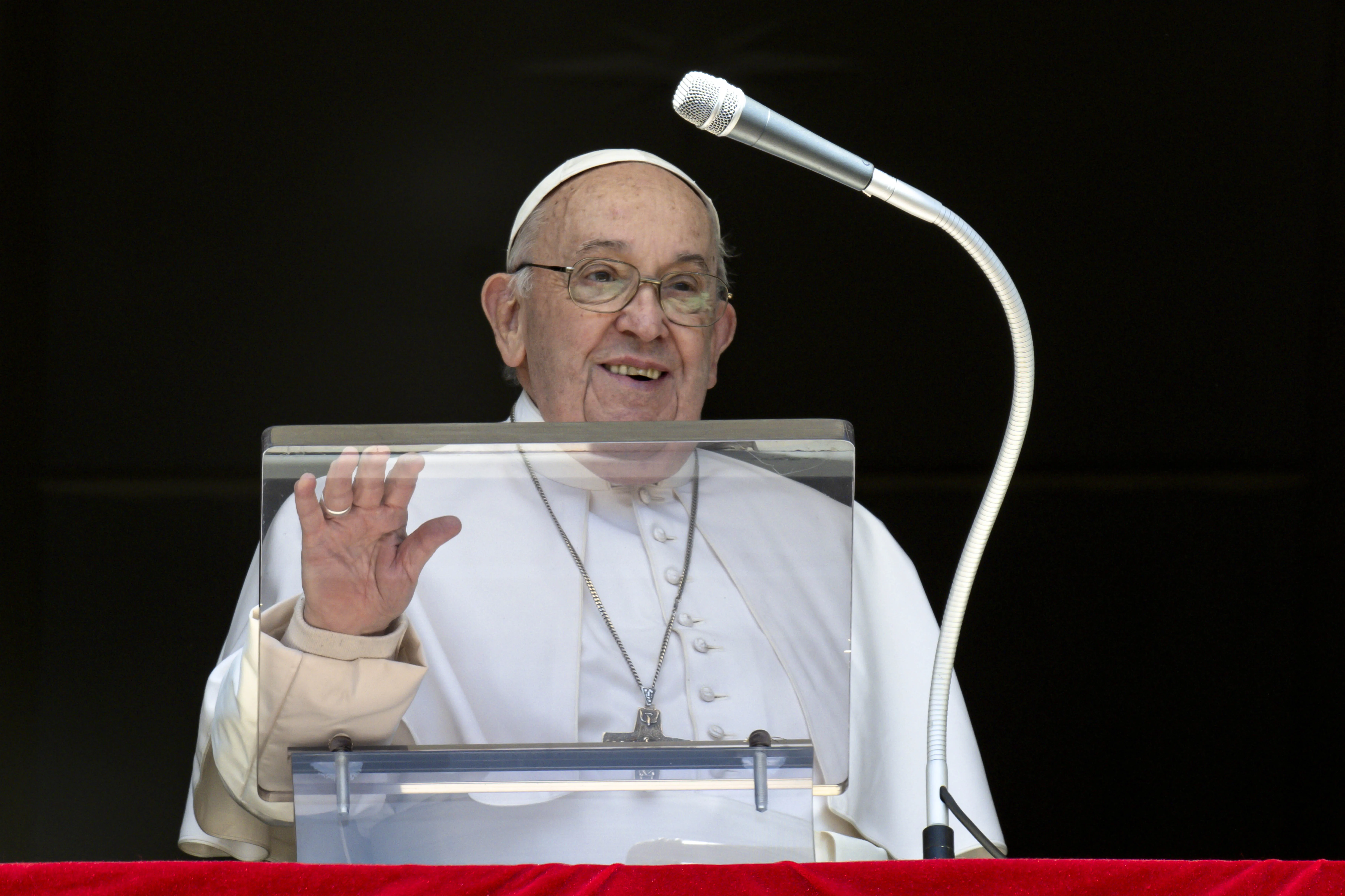
Pope Francis delivers his Regina Caeli reflection on April 7, 2024. Credit: Vatican Media

The pope drew upon the disciples, despondent and secluded in the upper room, who “are going through the most tragic moment in life” to showcase how Christ’s coming to them was a deeply transformative moment, one that not only reveals his mercy but also promises a new life. 

“The Risen One comes to them and shows them his wounds,” the pope said. “They were the signs of suffering and pain, they could stir feelings of guilt, yet with Jesus they become channels of mercy and forgiveness.” 

“The disciples see and touch with their hands the fact that with Jesus, life wins; death and sin are defeated. And they receive the gift of his Spirit, which gives them a new life, as beloved sons, imbued with joy, love, and hope.”

Pope Francis presented this message in contrast with today’s prevalent narratives of what constitutes a good life and the pursuit of happiness, observing that it is “a frenetic race to enjoy and possess many things.” 

Cautioning against this materialistic and myopic view, he stressed that “by following the path of pleasure and power one does not find happiness.”

“Indeed, many aspects of existence remain unanswered, such as love, the inevitable experiences of pain, of limitations, and of death. And then the dream we all have in common remains unfulfilled,” the pope continued. 

To counter this tendency the pope encouraged the faithful to ask the following questions: “Do I believe in the power of the resurrection of Jesus, in his victory over sin, fear, and death? Do I let myself be drawn into a relationship with him? And do I let myself be prompted by him to love my brothers and sisters, and to hope every day?”

At the end of the Regina Caeli, the pope reiterated his long-standing call for a “lasting peace” in “the tormented Ukraine” as well as in Palestine and Israel by imploring leaders to find a way to de-escalate tensions and to negotiate.

The pope’s plea comes six months after the start of the Israel-Hamas war on Oct. 7, 2023, which to date has left over 33,000 civilians dead in the Gaza Strip. 

[…]