No Picture
News Briefs

Pope Francis beatifies two Colombian martyrs

September 8, 2017 CNA Daily News 2

Villavicencio, Colombia, Sep 8, 2017 / 10:39 am (CNA/EWTN News).- During Mass in Colombia on Friday, Pope Francis beatified two martyrs from the country, both of whom were killed in hatred of the faith within the last 60 years.

Bishop Jesús Emilio Jaramillo Monsalve and Fr. Pedro María Ramírez Ramos were declared “blessed” by the Pope, moving them further ahead on the road to canonization.

The two martyrs, Francis said, are a sign of God’s presence in Colombia, as promised at the end of the Gospel of Matthew, where it says: “I will be with you always, to the close of the age.” They are “an expression of a people who wish to rise up out of the swamp of violence and bitterness,” he said.

Bishop Jaramillo, known for his care of the poor, served as bishop of Arauca. He became a target of the National Liberation Army, a Marxist guerrilla group in Colombia, when he spoke out against their kidnappings and involvement in the drug trade. Members of the guerrilla group kidnapped Bishop Jaramillo and killed him on Oct. 2, 1989.

After decades of fighting, the National Liberation Army and the Colombian government arrived at an agreement for a temporary ceasefire earlier this week. It will go into effect Oct. 1.

Born in La Plata in 1899, Fr. Ramirez became priest in 1931. When civil war erupted in Colombia between conservative and liberal groups, he was serving as a pastor in Armero. Local families offered to smuggle him to safety, but the priest refused to abandon his people.

On April 10, 1948, he was dragged out of his church by a group of rebels, who accused him of hiding weapons for conservatives. They lynched him in the town square. He died forgiving his killers.

The Pope spoke about reconciliation to large crowds gathered for an outdoor Mass in the Catama neighborhood of Villavicencio in Colombia.

He pointed to the martyrs as an example of what it means to make reconciliation concrete. The most powerful protagonists in the peace-building process are those people who have been victims of violence themselves, but have overcome the temptation to act with vengeance, he said.

“What is needed is for some to courageously take the first step in that direction, without waiting for others to do so. We need only one good person to have hope! And each of us can be that person!” he emphasized.

This does not mean sugarcoating or ignoring injustice and conflict, he noted. Still, he said, “every effort at peace without a sincere commitment to reconciliation is destined to fail.”

The Holy Family offers an example as well, he said.

“How can we best allow the light in? What are the true paths of reconciliation?” he reflected.

“Like Mary, by saying yes to the whole of history, not just to a part of it. Like Joseph, by putting aside our passions and pride. Like Jesus Christ, by taking hold of that history, assuming it, embracing it.”

“That is who you are, that is who Colombians are, that is where you find your identity. God can do all this if we say yes to truth, to goodness, to reconciliation, if we fill our history of sin, violence and rejection with the light of the Gospel,” he said.

In his homily, the Pope also referenced the day’s Gospel, which tells the long genealogy of Jesus.

This long list helps us to keep a good perspective – it shows us what a small part we play in the vast history of the world and integrates into salvation history “those pages which are the darkest and saddest, moments of desolation and abandonment comparable to exile.”

The people of Colombia have their own genealogies, he continued. “Here too we can write genealogies full of stories, many of love and light; others of disagreement, insults, even of death…How many of you can tell of exile and grief!”

The genealogy of Christ mentions numerous women, he pointed out. In communities still weighed down with “patriarchal and chauvinistic customs, it is good to note that the Gospel begins by highlighting women who were influential and made history.”

Noting that Sept. 8 is the Feast of the Nativity of the Blessed Virgin Mary, Francis particularly highlighted Mary as an example of the light of reconciliation breaking into the world, because she is “the first light who announces night’s end, and above all, the impending day.”

“Her birth helps us to understand the loving, tender, compassionate plan of love in which God reaches down and calls us to a wonderful covenant with him, that nothing and no one will be able to break.”

Mary transmits God’s light, he concluded. And just like Mary, we need to say ‘yes’ to reconciliation, “and sing with her ‘the wonders of the Lord,’ for as he has promised to our fathers, he helps all nations and peoples, he helps Colombia which today wishes to be reconciled; it is a promise made also to its descendants forever.”


[…]

No Picture
News Briefs

Catholics pray, prepare as Hurricane Irma looms

September 7, 2017 CNA Daily News 0

Miami, Fla., Sep 7, 2017 / 05:42 pm (CNA/EWTN News).- As Hurricane Irma moves through the Atlantic – one of the strongest storms ever recorded in that ocean – Catholic groups are offering prayers and helping prepare for the recovery efforts… […]

No Picture
News Briefs

Christ calls Colombia to cast a net of peace, Pope Francis says

September 7, 2017 CNA Daily News 0

Bogotá, Colombia, Sep 7, 2017 / 04:26 pm (CNA/EWTN News).- Just as Christ called Peter to cast his nest where there seemed to be no fish, Christ is calling Colombians to take risks in order to build a culture of peace and life, Pope Francis said in the capital Bogota on Thursday.

“…the word of Jesus has something special that leaves no-one indifferent; his word has the power to convert hearts, to change plans and projects. It is a word demonstrated by action, not academic findings, cold agreements, removed from people’s pain; for his is a word valid both for the safety of the shore and the fragility of the sea,” Pope Francis said Sept. 7 during his homily at a Mass in Simón Bolívar Park.

The Pope is on a 6-day trip to the South American country, which has just recently established a peace accord between the government and the guerilla group FARC. His trip is centering on peace and reconciliation, with the overarching theme “Let us take the first step”.

Pope Francis reflected on the Gospel of Luke and the calling of Simon Peter the fishermen, one of the first disciples called to follow Christ, during the homily on the first full day of his trip.

“Jesus scatters and destroys all this darkness with the command he gives to Peter in the boat: ‘Put out into the deep sea,’” the Holy Father noted. Despite his doubts, Peter follows the command of Christ and is able to bring into his boat a huge haul of fish.

Colombia itself has known its fair share of darkness, he added, including war, political division and corruption, and a disrespect for human life.

But like Peter, Colombia is called to respond to the call of Christ to take the first step out of darkness and toward peace, he said.

“In Bogotá and in Colombia a vast community journeys forwards, called to conversion in a healthy net that gathers everyone into unity, working for the defense and care of human life, especially when it is most fragile and vulnerable: in a mother’s womb, in infancy, in old age, in conditions of incapacity and in situations of social marginalization. Great multitudes of people in Bogotá and in Colombia can also become truly vibrant, just and fraternal communities, if they hear and welcome the Word of God,” the Pope said.

Evangelizing men and women with the Word of God will raise up a generation of people ready to hear the call of the Lord and able to foster peace and a culture of life, he added. He urged Colombians to work together and rely on each other in this common cause.

“He calls everyone, so that no one is left to the mercy of the storms; to go into the boat of every family, that sanctuary of life; to make space for the common good above any selfish or personal interests; to carry the most fragile and promote their rights,” he said.

He urged Colombians to remember to follow the Lord on the path of peace, even when it may seem difficult or they may be afraid.

“…in the same way as Simon, Jesus invites us to put out into the deep, he prompts us to take shared risks, to leave behind our selfishness and to follow him; to give up our fears which do not come from God, which paralyze us and prevent us becoming artisans of peace, promoters of life.”

[…]

No Picture
News Briefs

The significance of Pope Francis’ speech to Latin America’s bishops

September 7, 2017 CNA Daily News 2

Bogotá, Colombia, Sep 7, 2017 / 03:09 pm (CNA/EWTN News).- What is likely one of the most important speeches of Pope Francis’ visit to Colombia, political processes aside, and one which can offer key insights into his thinking, is his Thursday meeting with representatives of Latin America’s bishops.

Francis’ meeting with the continent-wide ecclesial body outlined not only vision for the Church in Latin America specifically, but his reflections also offer his key priorities for the universal Church.

In his Sept. 7 speech, the Pope said that since its foundation, the Episcopal Conferences of Latin America (CELAM) has become “a vital point of reference for the development of a deeper understanding of Latin American Catholicism.”

At the same time, he praised the entity for its efforts at becoming “a home at the service of communion and the mission of the Church in Latin America, as well as a center for fostering a sense of discipleship and missionary spirit.”

Given that he is himself Latin American, Francis obviously has strong ties to the ecclesial body, and in 2007, while Archbishop of Buenos Aires, he was charged with drafting the concluding document of their 5th General Conference in Aparecida, Brazil.

That document was taken by many as a compass of-sorts for Francis’ pontificate after he was elected, and with good reason.  

However, far beyond Latin America and the current Vicar of Christ, himself the first-ever South American Pope, CELAM has left a much bigger mark on the universal Church.

CELAM

The entity, which is composed of the 22 bishops’ conferences of Latin America and the Caribbean, was established by Venerable Pius XII in 1955 as the first continent-wide bishops’ conference.

The seven cardinals and 90 bishops who originally composed CELAM had met for their own conference during the Eucharistic Congress held in Rio de Janiero in 1955. The meeting was prompted by the Holy See itself, and Ven. Pius XII sent his own Cardinal legate, Adeodato Piazza, to attend the discussion.

One of the main reasons for the gathering was to create a new pastoral program for the region which addressed four major topics at the time: the shortage of priests, religious education, social problems, and the plight of Amerindian population.

Conclusions from the meeting were drafted and sent to Rome for approval before being published. Since then, CELAM members have met every few years to continue discussing major issues affecting the region, and theirs was a key voice on social issues during the Second Vatican Council.

However, though it was a novelty at the time, CELAM set the stage for the eventual creation of other continent-wide bishops conferences, all of which were established after Vatican II in a bid to foster greater unity and to encourage collegiality among local Churches.

Though still active, CELAM took a step back during the 1980s and ’90s under St. John Paul II, who preferred a greater emphasis on bishops as shepherds of their local Church.

The last major conference CELAM held before the 2007 gathering in Aparecida was their 4th General Conference in Santo Domingo of the Dominican Republic in 1992.

However, when Benedict XVI was elected, he offered his full support and empowerment to CELAM, and personally inaugurated the 2007 gathering in Aparecida.

When asked on the flight there how Brazil had impacted his  personal formation, Benedict said that while he was no expert, “I am convinced that it is here, at least in part – and a fundamental part – that the future of the Catholic Church is being decided. This has always been evident to me.”

And indeed it was during that gathering for CELAM in Aparecida that Cardinal Bergoglio would take the lead role in drafting a document that has become one of the most quoted and footnoted in his magisterial publications as Pope Francis.

Pope Francis and Aparecida

During his first international appointment as Pope, attending the 2013 World Youth Day in Rio de Janeiro, Francis made headlines for his vibrant style of communicating, his closeness to the people, and for dropping lines like the famous appeal for Argentine youth to get on the streets and “make a mess” with their love for Christ in spreading the Gospel.

But in addition to his official WYD commitments, he also met with CELAM leaders, telling them to embrace a “missionary spirit,” and referred them back to the 2007 concluding document from Aparecida, which he said launched a continent-wide mission aimed at Christ-centered service.

The document itself was a regional preview of what have become Francis’ top priorities for the universal Church. Among other things, it places strong emphasis on popular religiosity and included an introduction on how to approach contemporary reality as “missionary disciples.”

It also focuses on giving thanks, and the “joy of being disciples and missionaries” of God, and places a strong emphasis on the Church’s mission to evangelize.

The document is read through the lens of what it means to be a “missionary disciple” and how this should be the lens through which we read reality and its current challenges, including cultural trends and threats to the family and the environment.

Other topics mentioned that have come up frequently in Francis’ pontificate are: indigenous peoples, technology, the role and dignity of women, the importance of fostering community amid the diversity of the Church’s various charisms and spiritualities, interreligious dialogue, the role of the Holy Spirit, human dignity, and the need to go out of ourselves.

The document also dwells on marriage, the elderly, migrants, the poor, the need for solidarity and issues of social justice, emphasizing the Beatitudes, as Francis often does, as a road-map for how the Church’s social teaching out to be lived out.

In his speech to CELAM leaders in Colombia this week, Pope Francis again referred back to the “pastoral legacy” of the 2007 Aparecida document, telling them it is “a treasure yet to be fully exploited.”

“I am certain that each of you has seen how its richness has taken root in the Churches you hold in your hearts,” he said, and outlined the signs of hope found in the region. Namely, he said hope in Latin America is found primarily in the youth, in women – who “keep patiently kindling the flame of faith” – and in the laity.

These are all issues brought up at some point in the Aparecida document, and which that have become familiar to the eyes of Vatican-watchers throughout the world.

While the Pope certainly doesn’t shy away from these topics when conversing in other forums and with other demographics, he understandably feels more at home among his fellow Latin Americans, especially since he understands their reality so well.

That being said, we can expect to continue hearing the same messages from Pope Francis even from Rome. But if there’s one thing we can take away from his audiences with CELAM, it’s that they have played a significant role in his own life and pontificate, and will undoubtedly continue to do so. If we want to keep tabs on his vision for the universal Church, his meetings with them are a good place to start.

[…]

No Picture
News Briefs

Pope Francis lays out his vision for Church’s mission in Latin America

September 7, 2017 CNA Daily News 1

Bogotá, Colombia, Sep 7, 2017 / 02:55 pm (CNA/EWTN News).- The Catholic Church must avoid a sense of superiority and clericalism and instead teach forgiveness, reconciliation, and justice, Pope Francis said in forceful comments Thursday to a gathering of Latin American bishops.

“The Church is not present in Latin America with her suitcases in hand, ready, like so many others over time, to abandon it after having plundered it,” he said Sept. 7.

“Such people look with a sense of superiority and scorn on its mestizo face; they want to colonize its soul with the same failed and recycled visions of man and life; they repeat the same old recipes that kill the patient while lining the pockets of the doctors. They ignore the deepest concerns present in the heart of its people, the visions and the myths that give strength in spite of frequent disappointments and failures.”

He warned against those who “manipulate politics and betray hopes, leaving behind scorched land and a terrain ready for more of the same, albeit under a new guise.”

“Powerful figures and utopian dreams have promised magic solutions, instant answers, immediate effects,” he said.

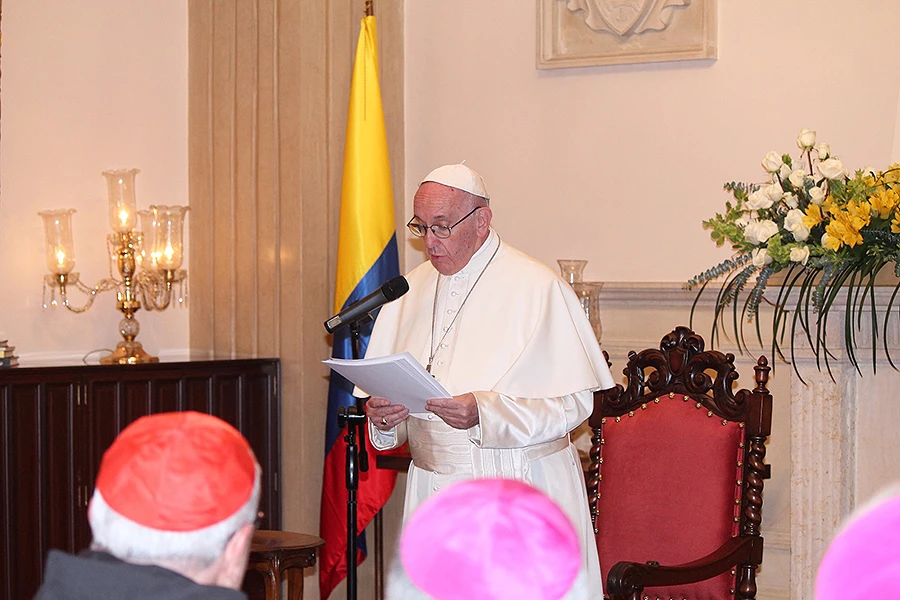
The Pope spoke to the executive committee of the Latin American Episcopal Conference, known also by its Spanish acronym CELAM. He spoke at the apostolic nunciature in Bogota during his visit to Colombia.

“The Church, without human pretensions, respects the varied face of the continent, which she sees not as an impediment but rather a perennial source of wealth. She must continue working quietly to serve the true good of the men and women of Latin America,” Pope Francis said. “She must work tirelessly to build bridges, to tear down walls, to integrate diversity, to promote the culture of encounter and dialogue, to teach forgiveness and reconciliation, the sense of justice, the rejection of violence. No lasting construction in Latin America can do without this invisible, yet essential, foundation.”

“The Church appreciates like few others the deep-rooted shared wisdom that is the basis of every reality in Latin America,” the Pope continued. “She lives daily with that reserve of moral values on which the life of the continent rests.”

He advocated continued dialogue with this reality. The Church cannot lose contact with this moral foundation, this “vital humus which resides in the heart of our people.” In this soil, he said, “we see the subtle yet eloquent elements that make up its mestizo face – not merely indigenous, Hispanic, Portuguese or African, but mestizo: Latin American.”

He warned against the habitual traps this part of the world faces: a lack of focus, the squandering of the continent’s diversity, and “a constant process of disintegration.”

“To speak to this deepest soul, to speak to the most profound reality of Latin America, the Church must continually learn from Jesus. The Gospel tells us that Jesus spoke only in parables. He used images that engaged those who heard his word and made them characters in his divine stories. God’s holy and faithful people in Latin America understand no other way of speaking about him,” he said. “We are called to set out on mission not with cold and abstract concepts, but with images that keep multiplying and unfolding their power in human hearts, making them grain sown on good ground, yeast that makes the bread rise from the dough, and seed with the power to become a fruitful tree.”

The Pope warned of a “deficit of hope” in Latin America, but also pointed to Christians’ supernatural hope.

“Once you think hope is gone, it returns where you least expect it,” he said. “Our people have learned that no disappointment can crush it. It follows Christ in his meekness, even under the scourge. It knows how to rest and wait for the dawn, trusting in victory, because – deep down – it knows that it does not belong completely to this world.”

In Latin America, hope has a youthful face, he said. Some people point to young people’s alleged shortcomings and lack of motivation, and others see them as potential customers or seek to enlist them in violence and trafficking.

“Pay no attention to these caricatures of young people. Look them in the eye and seek in them the courage of hope,” Pope Francis said. “Look them in the eye and seek in them the courage of hope.”

“It is not true that they want to return to the past,” he claimed.

“It is our task us to present the young with lofty ideals and to encourage them to stake their lives on God, in imitation of the openness shown by Our Lady.”

Hope in Latin America also has a woman’s face, the Roman Pontiff reflected.

“From their lips we learned the faith, and with their milk we took on the features of our mestizo soul and our immunity to despair,” he explained. “I think of indigenous or black mothers, I think of mothers in our cities working three jobs, I think of elderly women who serve as catechists, and I think of consecrated woman and those who quietly go about doing so much good. Without women, the Church of this continent would lose its power to be continually reborn. It is women who keep patiently kindling the flame of faith.”

He stressed the grave obligation to understand, respect, appreciate, and promote women’s impact on society and the Church. He invoked the example of the women who accompanied Christ and did not abandon him at the foot of the cross.

“Please, do not let them be reduced to servants of our recalcitrant clericalism,” he said, declaring that women are on “the front lines” of the Church.

He stressed that hope must pass through the hearts, minds, and arms of the laity. He challenged a clericalism that treats the laity as children and impoverishes the identity of clerics.

Hope must also look at the world with “the eyes of the poor.”

“Hope is poor, like the grain of wheat that dies, yet has the power to disseminate God’s plans,” said the Pope.

Wealth frequently blinds us to “both the reality of the desert and the oases hidden therein,” and offers “textbook answers and repeats platitudes,” he said.

“It babbles about its own empty ideas and concerns, without even coming close to reality. I am certain that in this difficult and confused, yet provisional moment that we are experiencing, we will find the solutions to the complex problems we face in that Christian simplicity hidden to the powerful yet revealed to the lowly. The simplicity of straightforward faith in the risen Lord, the warmth of communion with him, fraternity, generosity, and the concrete solidarity that likewise wells up from our friendship with him.

The Pope stressed that God does not speak to us as if we were strangers or as if he were a solicitor delivering a personal summons, nor does he “lay down rules to be followed like certain functionaries of the sacred.”

Rather, “God speaks with the unmistakable voice of the Father to his children; he respects the mystery of man because he formed us with his own hands and gave us a meaningful purpose.”

“Our great challenge as a Church is to speak to men and women about this closeness of God, who considers us his sons and daughters, even when we reject his fatherhood,” the Pope told the bishops. “For him, we are always children to be encountered anew.”

The Gospel cannot be reduced to “a programme at the service of a trendy gnosticism, a project of social improvement, or the Church conceived as a comfortable bureaucracy, any more than she can be reduced to an organization run according to modern business models by a clerical caste.”

“The Church is the community of Jesus’ disciples. The Church is a Mystery and a People. Better yet, the Church the Mystery becomes present through God’s People,” he said.

Missionary discipleship is “a call from God for today’s busy and complicated world.”  In this discipleship, the Christian is constantly setting out with Christ “in order to know how and where the Master lives.”

“Only a Church which is Bride, Mother and Servant, one that has renounced the claim to control what is not her own work but God’s, can remain with Jesus, even when the only place he can lay his head is the cross,” he said.

Closeness and encounter are the means that God uses, with the mystery of the Church being “the perennial place of this encounter.”

He told the bishops that the most essential and urgent activities are to pray and foster their relationship with the living Christ, where unity is always found: “How greatly we need to be alone with the Lord in order to encounter anew the heart of the Church’s mission … How greatly we need to be recollected, within and without! Our crowded schedules, the fragmentation of reality, the rapid pace of our lives: all these things might make us lose our focus and end up in a vacuum. Recovering unity is imperative.”

“If we do not we set out with [Christ] on our mission, we quickly become lost and risk confusing our vain needs with his cause. If our reason for setting out is not Jesus, it becomes easy to grow discouraged by the fatigue of the journey, or the resistance we meet, by constantly changing scenarios or by the weariness brought on by subtle but persistent ploys of the enemy,” he said.

Yielding to discouragement is not part of the Christian mission, and Christ “does not feed our fears.”

“The Gospel is always concrete, and never an exercise in sterile speculations. We know well the recurring temptation temptation to get lost in the byzantinism of the doctors of the law, to wonder how far we can go without losing control over our own demarcated territory or our petty portion of power.”

He stressed the importance of Christ’s encounter with persons, and how he draws near to them, talks to them, touches them, and brings them healing and salvation.

“His aim in constantly setting out is to lead the people he meets to the Father,” the Pope said. “We must never stop reflecting on this. The Church has to re-appropriate the verbs that the Word of God conjugates as he carries out his divine mission. To go forth to meet without keeping a safe distance; to take rest without being idle; to touch others without fear … We cannot let ourselves be paralyzed by our air-conditioned offices, our statistics and our strategies. We have to speak to men and women in their concrete situations.”

He summed up his message by saying the bishops must serve with passion: We need to have the passion of young lovers and of wise elders, a passion that turns ideas into viable utopias, a passion for the work of our hands, a passion that makes us constant pilgrims in our Churches … My brothers, please, I ask you for passion, the passion of evangelization.”

He commended the bishops, their local Churches, and all the people of Latin America and the Caribbean to Our Lady of Guadalupe and to Our Lady of Aparecida, the patron saint of Brazil.

“I do so, in the serene certainty that God who spoke to this continent with the mestizo and black features of his Mother, will surely make his kindly light shine in the lives of all.”

[…]

No Picture
News Briefs

On plane, Pope gets a gift from his ‘spiritual friend’ Saint Therese

September 7, 2017 CNA Daily News 2

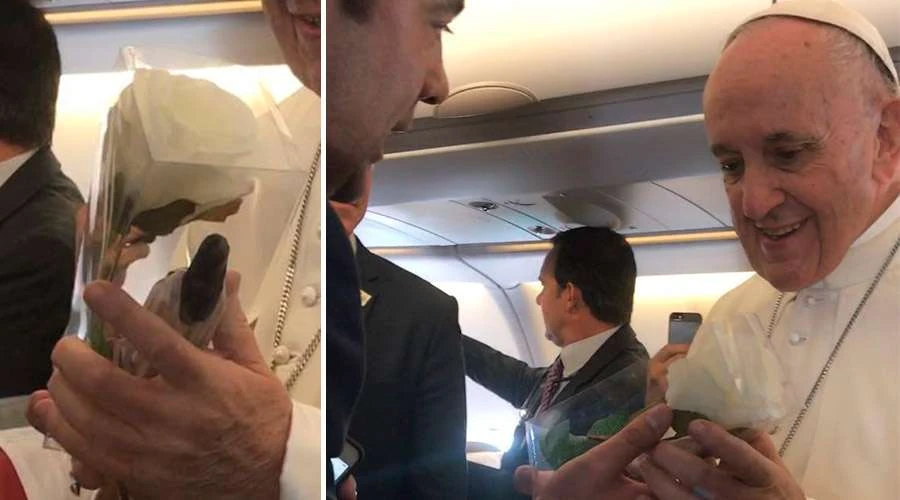
Bogotá, Colombia, Sep 7, 2017 / 01:29 pm (CNA).- During his flight to Colombia Pope Francis received a white rose from a Colombian journalist, recalling his deep devotion to Saint Therese of Lisieux.

On various occasions, Pope Francis has spoken of his custom of asking favors from the saint, and her responses in his view are little “miracles.”

During the papal trip to Colombia Sept. 6, it was the journalist from Caracol Radio, Cesar Moreno, who gave the white rose to the Holy Father.

“When I gave it to him he said ‘Ah, we begin with dear Saint Therese! We’re getting off to a great start.’ So he liked it a lot and looked very happy. I felt very happy and joyful that I had pleased him,” the journalist told CNA.

Moreno said he had consulted “a couple of Argentine friends who knew Francis” about the devotion to Saint Therese of Lisieux, and they told him of “the significance the white rose has for him in moments of difficulty.”

“When they (difficulties) come up, it is said that the Pope thinks and feels that he can face them,” he added.

Moreno told how his mother is also devoted to Saint Therese of Lisieux and so she helped him prepare the gift: “the white rose, the figurine of Saint Therese of  Jesus with her holy card.”

In 2015, when Pope Francis traveled to the Philippines, he revealed that before every trip or a concern of his, he usually asks for “a rose” from Saint Therese of Lisieux, for whom he has a special devotion.

“When I don’t know how things are going to go, I have the custom of asking Saint Therese of the Child Jesus to take the problem into her hands and that she send me a rose,” the Pope told journalists at the time.

Pope Francis’ Sept. 6-11 trip to Colombia follows apostolic visits by two of his predecessors, Bl. Paul VI and St. John Paul II. During his trip, he plans to meet with bishops from the neighboring country of Venezuela, which is facing widespread chaos over government corruption.

[…]

No Picture
News Briefs

Don’t let anything silence the truth, Pope tells Colombian bishops

September 7, 2017 CNA Daily News 1

Bogotá, Colombia, Sep 7, 2017 / 11:22 am (CNA/EWTN News).- In a lengthy speech on Thursday, Pope Francis urged the bishops of Colombia to uphold their pastoral responsibilities, proclaiming and teaching the truth even in the face of challenges.

“From your lips as legitimate shepherds of Christ, Colombia has a right to be challenged by the truth of God, who never ceases to ask: ‘Where is your brother?’ That question may not be silenced…” the Pope said Sept. 7.

“Even if those who hear it can do no more than lower their gaze in embarrassment and stammer in shame that they sold him, perhaps for the price of a fix of narcotics or for some misguided notion of reasons of state, or even for the false belief that the end justifies the means.”

Though many people can help, the mission of the bishops is unique, Pope Francis continued. “You are not mechanics or politicians, but pastors.”

“Christ is the word of reconciliation written on your hearts. You have the power to preach that word not only in pulpits, in ecclesial documents or newspaper articles, but also in the hearts of individual men and women,” he said.

“You have the power to proclaim it in the inner sanctum of their consciences, where they hope to hear the heavenly voice that proclaims: ‘Peace to those whom God loves’ (Lk 2:14). You must speak that word with the frail, lowly yet invincible resource of God’s mercy, which is capable of averting the pride and cynicism of selfish hearts.”

Pope Francis addressed the Colombian bishops in Bogota on the first full day of his Sept. 6-11 apostolic visit to the country.

Keep your gaze fixed not on some vague or generalized “man,” he told the bishops, but on concrete men and women, who are “loved by God and composed of flesh and bones, history, faith, feelings, disappointments, frustrations, sorrows and hurts.”

This approach is what will help to “unmask cold statistics, twisted calculations, blind strategies and falsified data,” he said.

Acknowledging the generous pastoral work already carried out by the bishops, Francis then laid out his concerns for what he sees as challenges to the Church living out its mission.

First among these are challenges to Colombia’s families. The defense of life from the womb to natural death, the “scourge of violence,” alcoholism, the weakening of the marriage bond and the absence of fathers are all attacks on the life of the family today, he said.

Young people are facing the threat of “spiritual emptiness,” which they seek to escape through drug use, frivolous lifestyles and a rebellious spirit. Lay faithful in general, even those who attend Mass and practice their faith, face “the new dogma of selfishness and the death of solidarity,” he noted.

There are also challenges for generous priests, he said, who require support in their daily commitment to Christ and the Church, while others “continue to propose the easy way out, avoiding genuine commitment and remaining isolated and self-centered.”

“I offer you no recipes, much less do I intend to leave you a list of things to do. Still, I would ask you, as you carry out in communion your demanding mission as the bishops of Colombia, to maintain your serenity,” he encouraged.

Though the devil continues to sow weeds, “imitate the patience of the Lord of the harvest and trust in the good quality of his grain. Learn from his patience and generosity. He takes his time, because his loving gaze sees far into the distance.”

When love grows weak we become impatient and anxious, making ourselves busy with many things as we are “hounded by the fear of failure,” he said.

Instead, “believe above all in the smallness of God’s seeds. Trust in the power hidden in his yeast. Let your hearts be drawn to the great beauty that leads us to sell everything we have, in order to possess that divine treasure,” he urged.

Speaking more about priests, who he said are on “the front lines” of the Church, the Pope said that the first gift a bishop can give his priests is to be a father to them – the physical and affective closeness of their bishop is a vital and urgent need.

And although in this digital age it is easy to reach each other instantly, the paternal heart of a bishop should not be content with this impersonal and formal means of communication, but be truly concerned with where and how his priests are living.

“Are they truly living as Jesus’ disciples? Or have they found other forms of security, like financial stability, moral ambiguity, a double life, or the myopic illusion of careerism?”

Pope Francis also appealed to bishops to show concern for the lives of consecrated men and women, who represent “an evangelical rebuke to worldliness.”

“They are called to purify every residue of worldly values in the fire of the Beatitudes lived sine glossa and in total self-abnegation for the service of others.” They should not be looked at as merely “‘useful resources’ for the works of the apostolate,” he said, instead hearing in them the “Bride’s cry of consecrated love: ‘Come, Lord Jesus.’”

The formation of the laity should not be forgotten either, Francis said, noting that they are the ones responsible not only for the strength of their faith communities, “but in great part for the Church’s presence in the area of cultural, political and economic life.”

When it comes to the history of the Church in Colombia, he asked the bishops “not to be afraid to touch the wounded flesh of your own history and that of your people.”

This path isn’t easy, but it’s necessary, he explained. Colombia needs that attention in order “to sustain its courage in taking the first step towards definitive peace and reconciliation, towards abdicating the method of violence and overcoming the inequalities at the root of so much suffering.”

Speaking of the “first step” that must be taken on the path to peace and reconciliation, he said, “God goes before us. We are only branches, not the vine.”

He warned them about silencing the voice of God or falling under the delusion that the success of the mission depends on their own “meagre virtues,” saying that prayer should be fundamental in the life of a bishop.

Instead of relying on themselves or others, he urged praying “fervently when you have so little to give, so that you will be granted something to offer to those who are close to your hearts as pastors.”

In his lengthy speech, the Pope also spoke about the Church in Amazonia, the southernmost region of Colombia, encouraging the bishops not to abandon it and the “profound wisdom of the indigenous peoples.”

He said they should also show particular sensitivity to the Afro-Colombian roots of the country, which have had a great influence on Colombia.

“I am convinced that Colombia has one remarkable feature: it has never been a goal fully attained, a destiny completely achieved, or a treasure totally possessed,” he said.

This treasure includes the nation’s human riches, vast natural resources, culture, heritage of the faith, and irrepressible joy and fidelity to the Gospel of Christ and his Church, he noted.

“And, above all, its indomitable courage in resisting threats of death not merely proclaimed but often experienced at first hand,” he said. “All this recedes, hides itself, from those who come here as foreigners bent on domination, while offering itself freely to those who touch its heart with the meekness of a wayfarer.”

“Such is Colombia.”

[…]

No Picture
News Briefs

Peace can start by grabbing drinks, Pope tells Colombian youth

September 7, 2017 CNA Daily News 0

Bogotá, Colombia, Sep 7, 2017 / 10:57 am (CNA/EWTN News).- Speaking to youth in Colombia Thursday, Pope Francis urged them to move away from the violence of the past and to work toward healing and building a culture of encounter, which he said often begins simply with a drink or a cup of coffee.

“For you, young people, it is so easy to encounter one another. All you need is a good coffee, a good drink or any other excuse to meet,” the Pope said Sept. 7, his first full day in Colombia.

Topics such as art and music can often bring people together, he said.

“Even a final between Atlético Nacional and América de Cali is an opportunity to be together,” he exclaimed, referring to the rival association football teams from Medellin and Cali who compete in Colombia’s premier tournament league.

Youth are able to teach their elders that “the culture of meeting is not in thinking, living or reacting to everyone in the same way; it is rather in knowing that beyond our differences we are all part of something greater that unites and transcends us; we are part of this wonderful country.”

“Help us, your elders, to enter into this culture of encounter that you practice so well,” he implored them.

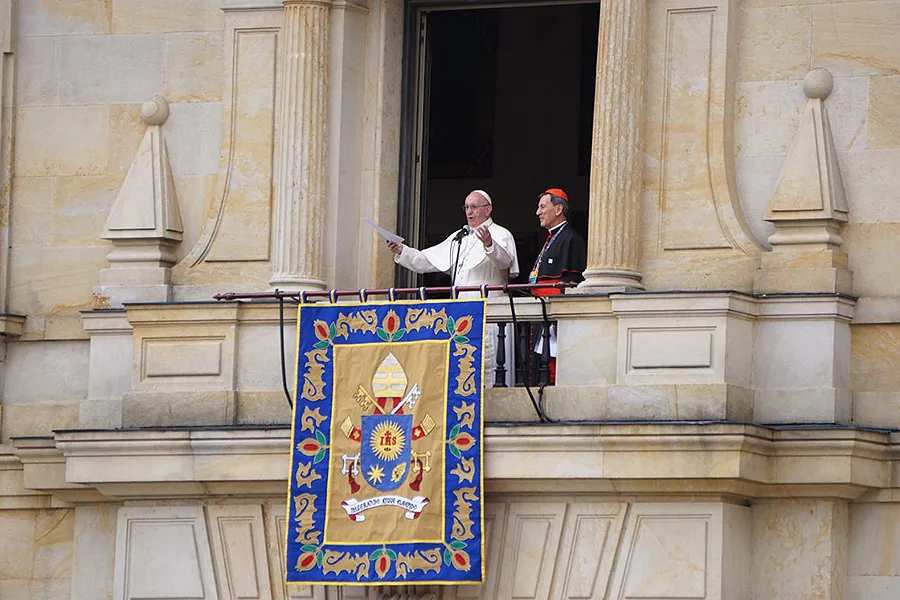
Pope Francis spoke to the youth gathered below the balcony of the Cardinal’s Palace in Bogota. He greeted the crowd and offered his blessing after meeting the country’s authorities earlier that morning, marking the first day of official appointments during his Sept. 6-11 visit to Colombia.

Immediately before his greeting to the faithful, Francis had visited Bogota’s Cathedral Basilica of the Immaculate Conception, leading a Marian litany for peace in the country.

In his address, Pope Francis said he had come to Colombia “as a pilgrim of peace and hope” and “to understand you”, and “to learn from your faith, your strength in the face of adversity. You have endured difficult and dark moments, but the Lord is near you, in the heart of every son and daughter of this country. He is not selective, he does not exclude anyone but embraces all; and we are all important and essential to him.”

“During these days I would like to share with you the most important truth: that God loves you with the love of a Father who encourages you to continue looking for and desiring peace, that peace which is authentic and abiding.”

He reiterated that “God loves us with the love of a father,” and then had the youths repeat his words – something he did several times in his address when he wanted to emphasize a point.

the Pope said he’s always happy when he meets young people, and told them to “keep joy alive,” because it is “a sign of a young heart, of a heart that has encountered the Lord.”

“Do not let anyone rob you of joy,” he said, and asked them to preserve the joy that “unites everyone in the knowledge of being loved by the Lord,” because “the flame of the Lord Jesus’ love makes this joy burst forth, and is sufficient to set the whole world ablaze.”

“How could you not be capable of changing this society and accomplishing all you decide to do!” he said, and told them to “dare to dream big … please, don’t think small. Dream high, and dream big!”

Youth have a special knack for recognizing pain and suffering in others, he said, noting that this is made obvious by the sheer number of youth who serve as volunteers in programs to help the poor and needy.

But this quality can also emerge “in contexts where death, pain and division have impacted you so deeply that they have left you half-dazed, as if numb,” he said, alluding to the effects of the country’s longstanding civil war, which has largely de-escalated, thanks in part to the encouragement of Pope Francis and the Holy See.

With as many as 260,000 killed and millions displaced in the five-decade conflict, Francis told the youth to “allow the suffering of your Colombian brothers and sisters to strike you and mobilize you! Help us, your elders, not to grow accustomed to pain and neglect.”

Those who come from complex backgrounds and different family situations “have grown used to seeing that not everything is black and white; you have seen that daily life is made up of a broad scale of grey tones, and that this can expose you to the risk of falling into a climate of relativism, thus discarding that potentiality which young people have, of perceiving the pain of those who suffered.”

Youth not only have the ability to recognize and point out mistakes, but they are also capable of something more “beautiful (and) constructive.” This, he said, is the ability of “understanding. An understanding that even behind a wrong – for wrong is (always) wrong and cannot be just smoothed over – lies an endless number of causes, of mitigating factors.” He reiterated that “wrong is always wrong: you can’t put lipstick on it.”

“Colombia needs you so much to put yourselves in the shoes of those who, many generations earlier, could not or did not know how to do so, or did not come up with the right way to reach understanding,” he said.

Another unique ability which, while generally difficult, comes a bit easier to youth is the ability to forgive, especially those who have hurt us, Francis said.

“It is remarkable to see how you do not get entangled in old stories, how you watch with surprise when we adults repeat events that divide us simply by being tied to resentments,” he said, telling youth they are able to help their elders “in the desire to leave behind what has hurt us, to look to the future without the burden of hatred.”

“You make us see the wider world which stands before us, the whole of Colombia that wishes to grow and continue its development; that Colombia which needs all of us, and which we older people owe to you,” he said.

Because of this, youth now face the challenging task of “helping us to heal,” he said.

“An atmosphere of anxiety sickens the soul; it sees no way out of problems, and ostracizes those who try,” he said, and voiced hope that the dreams of the youth would “give fresh life to Colombia, and fill the country with wholesome goals.”

“Only in this way will people be motivated to discover the country hidden behind the mountains, the one that goes beyond newspaper headlines and which does not seem to be a daily concern since it is so far away,” he said.

The Pope noted that young people are often “spurred into action” when faced with great challenges, and told them he believes they have what it takes “to build the nation we have always dreamed of.”

Pope Francis closed his address by offering a word to all those present “as someone bringing you hope.”

“Do not let difficulties weigh you down; may violence not break you; may evil not overwhelm you,” he said, noting that as Christians, we believe Christ has already conquered evil, sin, and death, and “all we need to do is go out to meet him.”

“I invite you not to be just dutiful but to be committed to renewing society, so that it will be just, stable and fruitful,” he said, and urged them to place their trust in the Lord, “who is the only one who sustains us and inspires us to contribute to reconciliation and peace.”

Concluding, the Pope led those gathered in praying the Hail Mary, and gave them his blessing.

[…]

No Picture
News Briefs

Pope to Colombian authorities: Eliminate violence by upholding dignity of all

September 7, 2017 CNA Daily News 0

Bogotá, Colombia, Sep 7, 2017 / 08:46 am (CNA/EWTN News).- In the first formal speech of his visit to Colombia, Pope Francis on Thursday told government authorities that the key to eliminating conflict is to recognize the dignity of all people, especially the poor and marginalized.

“I ask you, please, to listen to the poor, to those who suffer. Look them in the eye and let yourselves be continually questioned by their faces racked with pain and by their pleading hands. From them we learn true lessons about life, humanity and dignity,” the Pope said Sept. 7.

He explained that the Church, “faithful to her mission” and “committed to peace, justice and the good of all,” knows that the principles of the Gospel “are a significant dimension of the social fabric of Colombia, and thus can contribute greatly to the growth of the country.”

“Particularly, sacrosanct respect for human life, above all for the weakest and most defenseless, is a cornerstone in the formation of a society free from violence.”

Pope Francis met with political and religious authorities, the diplomatic corps, entrepreneurs, and representatives of civil society and culture at the Plaza de Armas of the “Casa de Nariño” in Bogota on the first full day of his Sept. 6-11 trip to Colombia.

His trip follows apostolic visits by two of his predecessors, Bl. Paul VI and St. John Paul II. “Like them,” he said, “I am moved by the desire to share with my Colombian brothers and sisters the gift of faith, which put down its roots so strongly in these lands, and the hope which beats in the hearts of everyone.”

“Only in this way, by means of faith and hope, can we overcome the numerous difficulties encountered along the way, to build a country that is a motherland and a home to all Colombians.”

He said the work of creating and shaping society must include all people, encouraging authorities to look in particular to those who are excluded and marginalized by society, because “Colombia needs the participation of all so as to face the future with hope.”

Francis noted the significant progress towards peace that had been achieved over the past year with the signing of the peace accord between authorities and the guerilla group FARC. These steps give rise to hope, he said.

“Seeking peace is an open-ended endeavor, a task which does not relent, which demands the commitment of everyone.”

“It is an endeavor challenging us not to weaken our efforts to build the unity of the nation. Despite obstacles, differences and varying perspectives on the way to achieve peaceful coexistence, this task summons us to persevere in the struggle to promote a ‘culture of encounter.’”

A culture of encounter requires us to place the human person at the center of everything – all political, social and economic activity – and in doing so, may we have the determination and strength to resist the temptation to vengeance and partisan interests, he continued.

“The motto of this country is: ‘Freedom and Order.’ These two words contain a complete lesson. Citizens must be valued according to their freedom and be protected by a stable order. It is not the law of the most powerful, but rather the power of the law, approved by all, that regulates a peaceful coexistence.”

Francis urged them to institute just laws in order to promote peace and overcome the country’s decades-long conflict.

Referencing Evangelii Gaudium, he said that we need laws “which are not born from the pragmatic need to order society,” but from the “desire to resolve the structural causes of poverty that lead to exclusion and violence.”

“Only in this way can there be healing of the sickness that brings fragility and lack of dignity to society, leaving it always vulnerable to new crises. Let us not forget that inequality is the root of social ills,” he said.

In the speech, Pope Francis also pointed out Colombia’s great biodiversity, considered second in the world, and which he said requires careful respect.

The nation is blessed in many ways, he said, including in the beauty of its nature: “traveling through this land one can taste and see how good the Lord has been in bestowing such immense variety of flora and fauna…”

He also noted the vibrancy of the country’s culture and people. Just as St. Peter Claver, the Spanish missionary, first saw Colombia with amazement, we too are amazed at its landscape and its inhabitants, the Pope said.

Let us stop to recognize, in particular, all those who have no voice: the weakest, the oppressed and maltreated, as well as the contribution of women, he said. “Ladies and Gentlemen, you have before you a fine and noble mission, which is also a difficult task,” he emphasized.

Concluding, the Pope quoted from the acceptance speech of Colombian author and Nobel Prize winner Gabriel García Márquez, who said in spite of the difficulty of the task, “Before oppression, plundering and abandonment, we respond with life.”

“Neither floods nor plagues, famines nor cataclysms, nor even the unending wars down the centuries, have been able to subdue the tenacious advantage of life over death. An advantage which is both increasing and accelerating.”

“We do not want any type of violence whatsoever to restrict or destroy one more life. I have wanted to come here to tell you that you are not alone, that there are many of us who accompany you in taking this step; this visit intends to offer you an incentive, a contribution that in some way paves the path to reconciliation and peace,” he said.

“You are in my prayers. I pray for you, for Columbia’s present and future.”


[…]