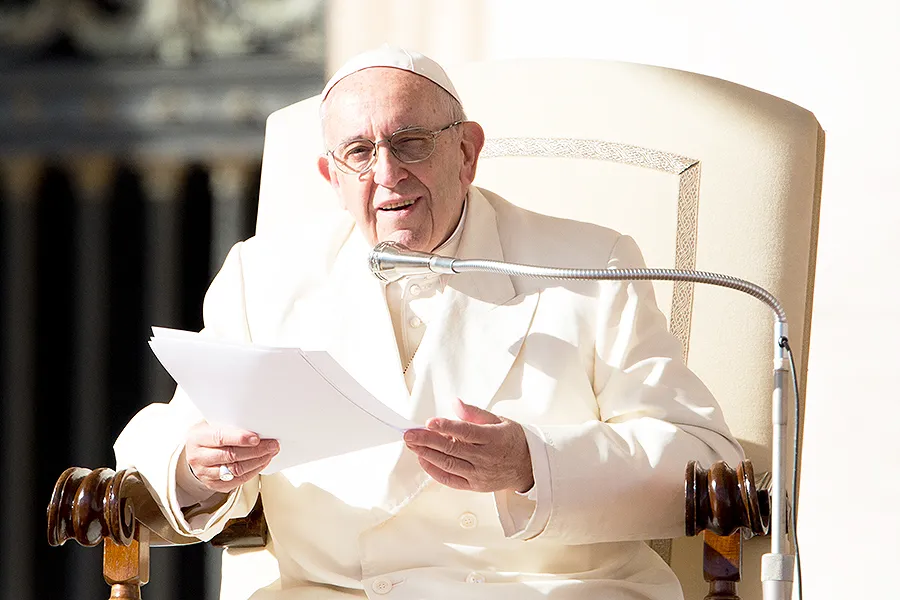
Yangon, Burma, Nov 28, 2017 / 04:13 am (CNA/EWTN News).- In a major speech in Burma, Pope Francis told the nation’s leaders to leave conflict behind and work for peace by promoting justice and respect for the rights of all citizens, regardless of religion or ethnicity.
“The arduous process of peace-building and national reconciliation can only advance through a commitment to justice and respect for human rights,” the Pope told Burmese civil authorities Nov. 28.
Speaking from the capital of Yangon on the first full day of a six-day visit to Burma and Bangladesh, Francis noted how justice is historically understood as “a steadfast will to give each person his due,” and is often viewed as “the basis of all true and lasting peace.”
This understanding is what, after the experience of two world wars, led to the formation of the United Nations and their subsequent declaration on human rights as the foundation for global efforts to promote justice, peace and human development, and to resolve conflict through dialogue, “not the use of force.”
With a past marred by internal conflict and a present filled with ongoing political tensions, Pope Francis said the future of Burma “must be peace.” This peace, he said, must be “based on respect for the dignity and rights of each member of society,” as well as respect “for each ethnic group and its identity.”
It must also be founded on a keen respect “for the rule of law, and respect for a democratic order that enables each individual and every group – none excluded – to offer its legitimate contribution to the common good.”
Pope Francis landed in Yangon Nov. 27 for the first phase of his third tour of Asia, which will take him to both Burma – also called Myanmar – and Bangladesh. He will be in Burma Nov. 27-30, and will visit two cities before moving on to Dhaka, Bangladesh, where he will stay Nov. 30-Dec. 2.
His visit to Burma, in particular, is significant not only because the country has a small Christian minority, but also due to a contentious political situation that has roots in both a recent regime change and an ongoing crisis over their minority Rohingya Muslim population.
Francis’ visit comes amid a spike in state-supported violence against the Rohingya, the largely Muslim ethnic group who reside in Burma’s Rakhine State. The staggering scope of the crisis has prompted the U.N. to declare the situation “a textbook example of ethnic cleansing.”
The Burmese government refuses to recognize the Rohingya, and considers them illegal immigrants from Bangladesh. They have been denied citizenship since Burma gained independence in 1948.
Facing heightened persecution in their home country, many Rohingya have fled to neighboring Bangladesh, with millions camping along the border as refugees. More than 600,000 Rohingya have fled Burma for Bangladesh in the past few months alone.
The Pope’s visit also falls as Burmese officials continue to work out a recent transition to democracy after more than 50 years of military dictatorship, which began to come unhinged as democratic reforms started taking root in 2011.
In November 2015, Aung San Suu Kyi, who belongs to the National League for Democracy, was elected by an overwhelming majority, putting an end to military rule.
However, despite the win, she is still barred from officially becoming president, and holds the title of “State Counsellor” and Foreign Minister, while a close associate is acting as president. The military also still wields considerable political authority, including the appointment of cabinet ministers, and one-quarter of the nation’s legislature, making the ongoing transition rocky.
In his speech to Aung San Suu Kyi, civil authorities and the diplomatic corps in Burma, Pope Francis praised the efforts of all those working to build “a just, reconciled and inclusive social order” in the country.
While Burma is known for its beauty and natural resources, the nation’s greatest treasure are its people, he said, noting that they have suffered and continue to suffer from civil hostilities “that have lasted all too long and created deep divisions.”
“As the nation now works to restore peace, the healing of those wounds must be a paramount political and spiritual priority,” he said.
To this end, Francis said the country’s various religious traditions and its youth will have key roles to play in working toward national reconciliation and building a better, more just future.
Religious differences in Burma, a majority Buddhist country, “need not be a source of division and distrust, but rather a force for unity, forgiveness, tolerance and wise nation-building,” he said, adding that religions can play an important role in healing the emotional, spiritual and psychological wounds of years of unrest.
“They can help to uproot the causes of conflict, build bridges of dialogue, seek justice and be a prophetic voice for all who suffer,” he said, and pointed to current joint efforts among religions to work together in peace efforts through education, assistance to the poor and in promoting human values.
By seeking to build a culture of encounter and solidarity, religions contribute to the common good and lay “the indispensable moral foundations for a future of hope and prosperity for coming generations.”
Youth also have an essential role to play, the Pope said, calling them “a gift to be cherished and encouraged, an investment that will yield a rich return if only they are given real opportunities for employment and quality education.”
This attention to youth is “an urgent requirement of inter-generational justice,” he said, noting that the future of the nation is changing at an increasing pace.
Given these rapid changes, youth will need to be trained not only in the technical field, but also in “the ethical values of honesty, integrity and human solidarity that can ensure the consolidation of democracy and the growth of unity and peace at every level of society,” he said.
Future generations must also be guaranteed that the natural environment and beauty Burma enjoys is “unspoilt by human greed and depredation,” he said, and stressed the importance of not allowing youth to be “robbed of hope and of the chance to employ their idealism and talents in shaping the future of their country and, indeed, our entire human family.”
Pope Francis closed his speech encouraging fellow Catholics in the country to persevere in faith and to continue spreading a message of “reconciliation and brotherhood” through both charitable and humanitarian works.
“It is my hope that, in respectful cooperation with the followers of other religions, and all men and women of good will, they will help to open a new era of concord and progress for the people of this beloved nation,” he said.
Thanking his audience for their attention and service to the common good, he said “long live Myanmar!” and asked God to bless its leaders with “wisdom, strength and peace.”
In a speech to Pope Francis, Aung San Suu Kyi told the Pope that “you bring us strength and hope in your understanding of our need, our longing, for peace, national reconciliation and social harmony.”
She said his words on justice resonate, and serve as a “reminder that in our quest for peace we must be guided by the wisdom and aspirations of our fathers.”
Burma currently faces various challenges, Suu Kyi said, noting how the country is made up of people from various ethnic and religious backgrounds.
“It is the aim of our Government to bring out the beauty of our diversity and to make it our strength, by protecting rights, fostering tolerance, ensuring security for all,” she said, adding that the road to peace is not always smooth, but is the only way to ensure the people of a “just and prosperous land.”
Among the greatest of the challenges the nation faces is the refugee crisis involving Rohingya Muslims from Burma’s Rakhine State, she said, adding that the Pope’s “compassion and encouragement” for the situation “will be treasured” as the country seeks to address the longstanding social, economic and political issues that have “eroded” trust, understanding and cooperation between different communities in the area.
Suu Kyi closed her speech saying the Pope’s blessing will be shared by everyone in Burma as they seek to spread “goodwill and joy” throughout the nation.
The nation’s leaders “will strive to discharge our duties with probity and humility,” she said, adding, “we wish to leave to the future a people united and at peace, secure in their capacity to grow and prosper in a changing world; a compassionate and generous people, always ready to hold out a helping hand to those in need; a people strong in skills and whole in spirit.”
“The road ahead is long,” she said, “but we will walk it with confidence, trusting in the power of peace, love and joy.”
 […]
[…]