New tests have confirmed the age of the Holy Sepulchre

November 30, 2017 CNA Daily News 0

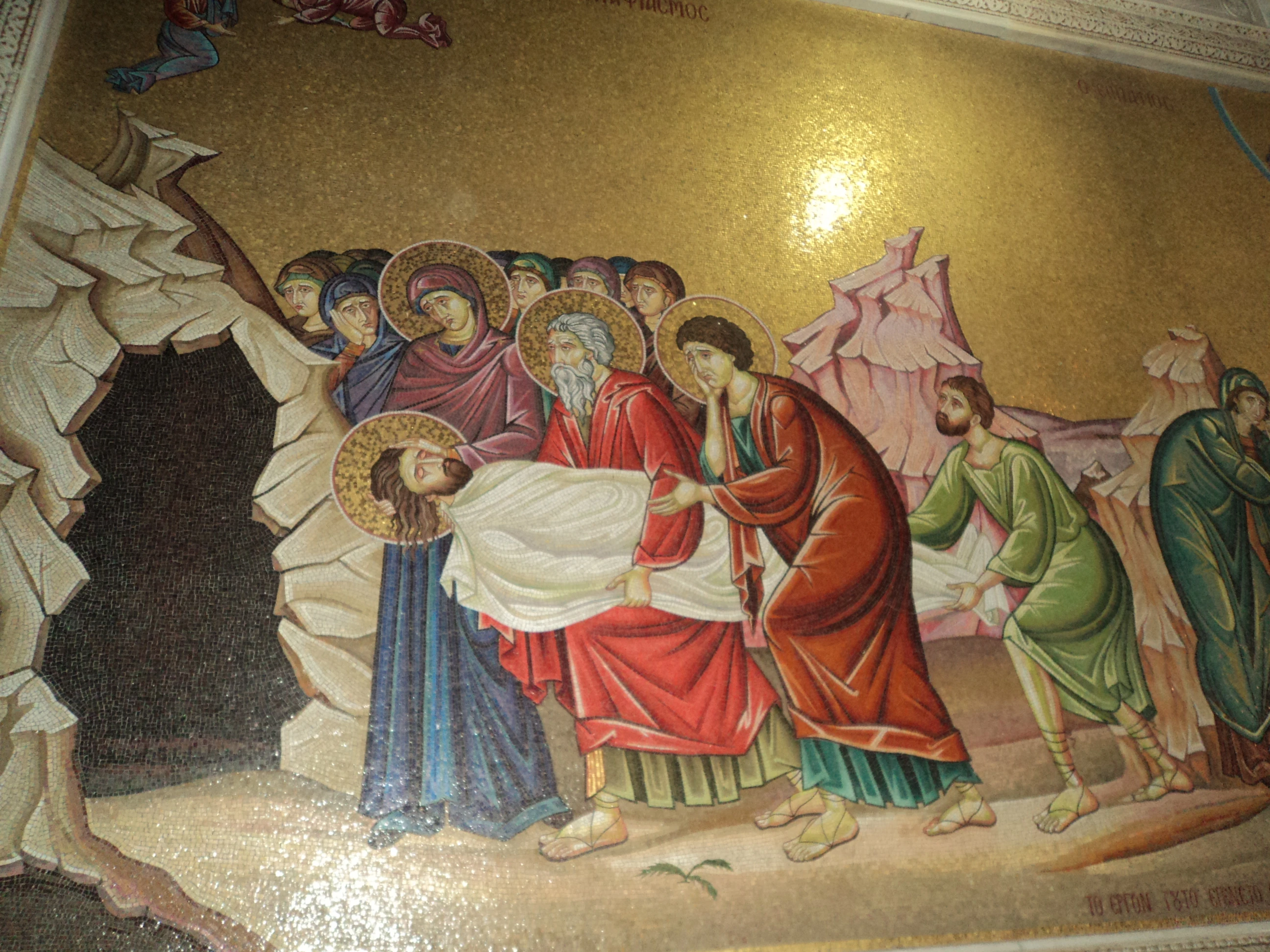
Jerusalem, Nov 30, 2017 / 10:33 am (CNA/EWTN News).- Following the recent restoration of the Holy Sepulchre, archaeologists have confirmed the construction dates of the structure surrounding what is believed to be the tomb of Jesus.

Having undergone renovations in 2016, the tomb was opened for first time in centuries last October. Archeologists were able to test samples of the mortar near the cave’s southern wall and the entrance, according to National Geographic. The sediment in the samples was was measured for its most recent exposure to light using a process called optically stimulated luminescence.

They found that the mortar and marble slab covering the original burial bed dated back to about 345 AD. This coincides with the time period that Constantine was believed to have built the shrine around the tomb, and refutes claims by many researchers that the shrine was built only 1,000 years ago, during the Crusades.  

Veneration of Christ’s burial place dates back to the fourth century, when St. Helena is believed to have discovered and identified the tomb. St. Helena’s son, Emperor Constantine, is believed to have built the Church of the Holy Sepulchre in 326 and enshrined the tomb.

The shelf on which Christ’s body was laid is the central point of veneration, which has been encapsulated by a 3-by-5 foot marble structure – the Edicule – since at least 1555.

Since its construction, the church has been built and rebuilt several times, repairing destruction caused by fires, earthquakes, and religious conflicts.

A year-long restoration of the site was recently completed, and scientists are looking into additional restoration work on the foundation.

Scientists also found that in between the burial bed and the most recent marble covering was a broken slab marked by a cross and words “burial tomb,” belonging to the original shrine.

The tests performed on the tomb samples also provided evidence for the historical restorations of the Crusades and the 16th century Franciscans.
 

[…]

Pope kicks off Bangladesh visit with call to action on Rohingya crisis

November 30, 2017 CNA Daily News 1

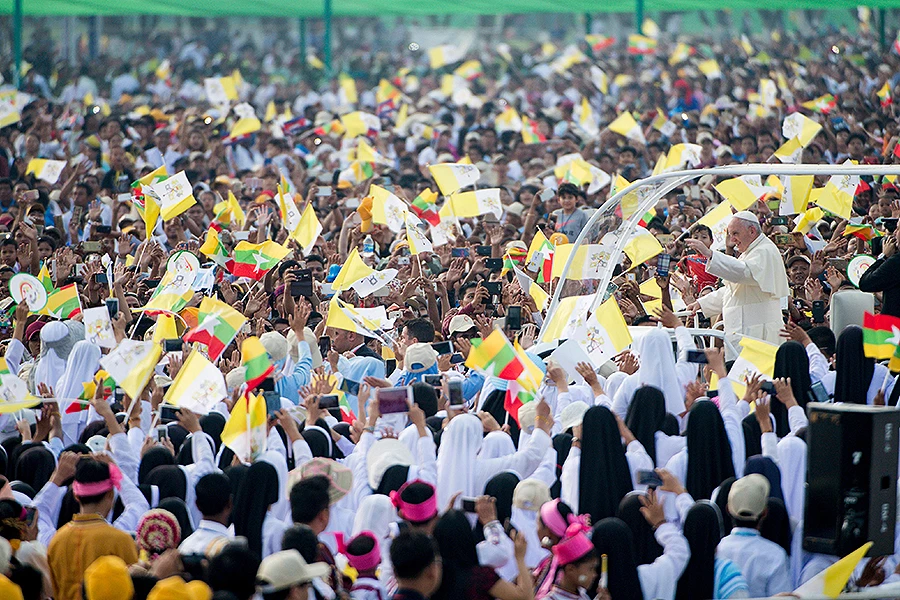
Vatican City, Nov 30, 2017 / 05:44 am (CNA/EWTN News).- Pope Francis arrived in Bangladesh with words of praise for the humanitarian assistance the nation has given to Rohingya Muslim refugees, and urged greater action on their behalf from the international community.

Speaking to Bangladeshi president Abdul Harmid and the nation’s authorities and diplomatic corps, the Pope said that in recent months “the spirit of generosity and solidarity” the country is known for “has been seen most vividly in its humanitarian outreach to a massive influx of refugees from Rakhine State.”

He noted how Bangladesh “at no little sacrifice” has provided shelter and basic necessities for the hundreds of thousands of Rohingya Muslims at their border.

With the eyes of the world watching the crisis unfold, no one “can fail to be aware of the gravity of the situation, the immense toll of human suffering involved, and the precarious living conditions of so many of our brothers and sisters, a majority of whom are women and children, crowded in the refugee camps,” he said.

It is therefore “imperative” that the international community “take decisive measures to address this grave crisis.”

Resolution, he said, means not only working to resolve the political problems that led to the mass displacement of people in recent months, “but also by offering immediate material assistance to Bangladesh in its effort to respond effectively to urgent human needs.”

Pope Francis spoke hours after arriving in Dhaka, Bangladesh, for the second phase of his Nov. 27-Dec. 2 tour of Asia. He was in Burma Nov. 27-30, and will stay in Bangladesh for two days before returning to Rome.

His visit comes amid boiling tensions over the mass exodus of the Rohingya, a largely Muslim ethnic group who reside in Burma’s Rakhine State, from their homeland amid increasing state-sponsored violence that has led the United Nations to declare the crisis “a textbook example of ethnic cleansing.”

With an increase in persecution in their home country of Burma more than 600,000 Rohingya have fled across the border to Bangladesh, where millions are in refugee camps.

Though the Vatican has said the crisis was not the original reason behind the Pope’s visit to the two nations, it has largely overshadowed the trip, with many keeping a watchful eye on how the Pope would respond, specifically when it comes to use of the term “Rohingya.”

Despite widespread use of the word in the international community, it is controversial within Burma. The Burmese government refuses to use the term, and considers the Rohingya to be illegal immigrants from Bangladesh. At the request of local Church leaders in Burma, Pope Francis refrained from using the word, and he has also done so in Bangladesh.

In his speech to authorities, the Pope praised the natural beauty in Bangladesh, which is seen in its vast network of rivers and waterways, saying the vision is symbolic of the nation’s identity as a people made up of various languages and backgrounds.

Pope Francis then pointed to the nation’s first leaders, whom he said “envisioned a modern, pluralistic and inclusive society in which every person and community could live in freedom, peace and security, with respect for the innate dignity and equal rights of all.”

Bangladesh gained independence from West Pakistan in 1971 after a bloody nine-month war that began when Pakistani military attacked their eastern state in a bid to eliminate Bengali nationalists from the region. West Pakistan began their assault in March 1971, and surrendered in December of the same year, resulting in the independence of the People’s Republic of Bangladesh.

The future of democracy in the young nation and the health of its political life, then, are “essentially linked” to fidelity to the original vision of the founding fathers, Pope Francis said.

“Only through sincere dialogue and respect for legitimate diversity can a people reconcile divisions, overcome unilateral perspectives, and recognize the validity of differing viewpoints,” Francis said, adding that true dialogue looks to the future and builds unity in the service of the common good.

This dialogue, he said, is also concerned for the needs of “all citizens, especially the poor, the underprivileged and those who have no voice.”

These words are especially relevant for Bangladesh, which is among the most populated countries in the world, but is also one of the poorest, with nearly 30 percent of the population living under the poverty line.

Francis said that while he came primarily to support the tiny Catholic community in the country, he is looking forward to meeting with interreligious leaders, as he did in Burma.

Interfaith dialogue has been a major theme of the Pope’s visit, as Burma is a majority Buddhist nation and Bangladesh is majority Muslim. In Bangladesh, 86 percent of the population practices Islam. The 375,000 Catholics there represent less than 0.2 of the total population.

In his speech, Pope Francis noted that Bangladesh is known for the sense of harmony that exists between followers of different religions, saying this atmosphere of mutual respect and interreligious dialogue “enables believers to express freely their deepest convictions about the meaning and purpose of life.”

By doing this, religions are able to better promote the spiritual values which form the basis for a just and peaceful society. And in a world “where religion is often – scandalously – misused to foment division, such a witness to its reconciling and unifying power is all the more necessary.”

Francis said this witness was seen in an “eloquent way” after a brutal terrorist attack at a bakery in Dhaka last year left 29 people dead, prompting the country’s leaders to make a firm statement that God’s name “can never be invoked to justify hatred and violence against our fellow human beings.”

Speaking of the role Catholics play in the country, Pope Francis said they have an essential contribution, specifically through the schools, clinics and medical centers run by the Church.

The Church, he said, “appreciates the freedom to practice her faith and to pursue her charitable works, which benefit the entire nation, not least by providing young people, who represent the future of society.”

He noted how many of the students and teachers in Church-run schools are not Catholic, and voiced his confidence that in keeping with the Bangladeshi constitution, the Church “will continue to enjoy the freedom to carry out these good works as an expression of its commitment to the common good.”

The Pope closed his speech assuring his of his prayers “that in your lofty responsibilities, you will always be inspired by the high ideals of justice and service to your fellow citizens.”

In his greeting to Pope Francis, Bangladesh President Abdul Harmid thanked the Pope for his visit and stressed the importance the nation places on religious freedom and development.

“People are only truly free when they can practice their faith freely and without fear,” he said, adding that in Bangladesh they “cherish” religious liberty and therefore stand with the Pope in defending it, “knowing that people everywhere must be able to live with their faith, free from fear and intimidation.”

Harmid also pointed to Francis’ message on mercy, which he said Bangladesh has put into practice with their welcome of the Rohingya Muslims.

“It is our shared responsibility to ensure for them a safe, sustainable and dignified return to their own home and integration with the social, economic and political life of Myanmar,” he said, adding that the Pope’s “passionate” condemnation of the brutality they face brings hope for a resolution.

“Your closeness to them, your call for helping them and to ensure their full rights gives moral responsibility to the international community to act with promptness and sincerity.”

The president also pointed to the problem of radical terrorist violence, saying “no religion is immune from forms of individual delusion or ideological extremism.”

The Bangladesh government, he said, is therefore pursuing a “zero tolerance” policy committed to eradicating the root causes of terrorism and violent extremism.

“We denounce terrorism and violent extremism, in all its forms and manifestations,” Harmid said, yet at the same time, like other Muslim majority countries, Bangladesh is also concerned about “the rise of Islamophobia and hate crimes in many western societies, which is adversely affecting lives of millions of peaceful people of faith.”

“We believe that inter-faith dialogue, at all levels of the society, is important to combat such extremist trends,” he said. He closed his speech with an appeal to protect the natural environment, and said the Pope’s visit “renews our resolve towards building a peaceful, harmonious and prosperous world.”

[…]

Your faith and enthusiasm are a welcome sight, Pope tells Burmese youth

November 29, 2017 CNA Daily News 0

Yangon, Burma, Nov 29, 2017 / 09:46 pm (CNA/EWTN News).- The Catholic young people of Burma are “a welcome sound” of encouragement, Pope Francis told them Thursday at a Mass said at St. Mary’s Cathedral in Yangon.

“Dear young people of Myanmar … you are a beautiful and encouraging sight, for you bring us ‘good news’, the good news of your youth, your faith and your enthusiasm. Indeed, you are good news, because you are concrete signs of the Church’s faith in Jesus Christ, who brings us a joy and a hope that will never die,” Francis said Nov. 30 in the largest city of Burma (also known as Myanmar).

The Pope’s Mass with Burmese youth comes at the conclusion of his visit to the country, where he arrived Nov. 27. He also met with government officials, religious leaders, Buddhist monks, and the country’s bishops. The previous day, he said Mass in Yangon’s Kyaikkasan Ground, attended by much of the country’s Catholic population. From Burma, he will continue on to Bangladesh before returning to Rome.

“As my visit to your beautiful country draws to a close, I join you in thanking God for the many graces we have received in these days,” he stated.

“Some people ask how it is possible to speak of good news when so many people around us are suffering? Where is the good news when so much injustice, poverty and misery cast a shadow over us and our world?”

In the face of this suffering, he said it is important that the Burmese youth “are not afraid to believe in the good news of God’s mercy, because it has a name and a face: Jesus Christ. As messengers of this good news, you are ready to bring a word of hope to the Church, to your own country, and to the wider world.”

“You are ready to bring good news for your suffering brothers and sisters who need your prayers and your solidarity, but also your enthusiasm for human rights, for justice,” and for Christ’s love and peace.

The Pope’s words about solidarity, human rights, and justice come as international attention on Burma is focused on the Rohingya, a predominantly Muslim ethnic minority who have been denied citizenship and who face general persecution in the Buddhist-majority country. In recent months, more than 600,000 Rohingya have fled the country for Bangladesh amid state-sponsored violence against them.

At the same time, Pope Francis challenged his listeners with three conditions of salvation given in St. Paul’s Epistle to the Romans which was proclaimed at the Mass, and which ask us “to think about our place in God’s plan.”

“In effect, Paul asks three questions, and I want to put them to each of you personally,” he said. “First, how are people to believe in the Lord unless they have heard about him? Second, how are people to hear about the Lord unless they have a messenger, someone to bring the good news? And third, how can they have a messenger unless one is sent?”

While wanting all of his listeners “to think deeply about these questions,” the Pope offered guidance to “help you to discern what it is that the Lord is asking of you.”

First, he said, it is important to listen for God’s voice: “Our world is full of many sounds, so many distractions, that can drown out God’s voice. If others are to hear and believe in him, they need to find him in people who are authentic. People who know how to listen … But only the Lord can help you to be genuine, so talk to him in prayer. Learn to hear his voice, quietly speaking in the depths of your heart.”

“But talk also to the saints,” he added, pointing to Saint Andrew, whose feast was celebrated at the Mass. “Andrew was a humble fisherman who became a great martyr … But before he became a martyr, he made his share of mistakes, and he needed to be patient, and to learn gradually how to be a true disciple of Christ. So do not be afraid to learn from your own mistakes!”

Pope Francis urged Burma’s youth to “let the saints lead you to Jesus and teach you to put your lives in his hands. You know that Jesus is full of mercy. So share with him all that you hold in your hearts: your fears and your worries, as well as your dreams and your hopes. Cultivate your interior life, as you would tend a garden or a field. This takes time; it takes patience. But like a farmer who waits for the crops to grow, if you wait the Lord will make you bear much fruit, a fruit you can then share with others.”

The Pope then turned to young people’s need to be “messengers of the good news of Jesus, above all to your contemporaries and friends. Do not be afraid to make a ruckus, to ask questions that make people think!”

“Don’t worry if sometimes you feel that you are few and far between,” he told them, in consideration of the fact that Catholics make up only about one percent of Burma’s population. “The Gospel always grows from small beginnings. So make yourselves heard.”

<blockquote class=”twitter-tweet” data-lang=”en”><p lang=”en” dir=”ltr”><a href=”https://twitter.com/hashtag/Pope?src=hash&amp;ref_src=twsrc%5Etfw”>#Pope</a> to young people in Yangon: “Do not be afraid to make a ruckus, to ask questions that make people think!… Make yourselves heard. I want you to shout! But not with your voices. No! I want you to shout with your lives, with your hearts, &amp; in this way to be signs of hope…” <a href=”https://t.co/XvufBjwyhR”>pic.twitter.com/XvufBjwyhR</a></p>&mdash; Edward Pentin (@EdwardPentin) <a href=”https://twitter.com/EdwardPentin/status/936088670423019520?ref_src=twsrc%5Etfw”>November 30, 2017</a></blockquote>
<script async src=”https://platform.twitter.com/widgets.js” charset=”utf-8″></script>

“I want you to shout … with your lives, with your hearts, and in this way to be signs of hope to those who need encouragement, a helping hand to the sick, a welcome smile to the stranger, a kindly support to the lonely.”

Finally, Pope Francis discussed being sent forth at the conclusion of Mass “to take with us the gifts we have received and to share them with others. This can be a little daunting, since we don’t always know where Jesus may be sending us. But he never sends us out without also walking at our side, and always just a little in front, leading us into new and wonderful parts of his kingdom.”

To be sent by Christ is to follow him, the Pope added. “The Lord will invite some of you to follow him as priests … Others he will call to become religious or consecrated men and women. And yet others he will call to the married life, to be loving fathers and mothers. Whatever your vocation, I urge you: be brave, be generous and, above all, be joyful!”

Francis concluded by given Burma’s young people the example of Mary, who though young, “had the courage to trust in the ‘good news’ she had heard, and to express it in a life of faithful dedication to her vocation, total self-giving, and complete trust in God’s loving care. Like Mary, may all of you be gentle but courageous in bringing Jesus and his love to others.”

“Dear young people, with great affection I commend all of you, and your families, to her maternal intercession. And I ask you, please, to remember to pray for me. God bless Myanmar!”

[…]

The royal engagement: What Catholics should know

November 29, 2017 CNA Daily News 3

London, England, Nov 29, 2017 / 04:52 pm (CNA/EWTN News).- In 1936, when British King Edward VIII declared that he was intended to marry Wallis Simpson, he abdicated the throne.

Opposition to the union was strong – Simpson was doubly-divorced, and many thought she was only after Edward for his money.

Besides general disapproval from the elite, a more definite obstacle stood in the couple’s way – as King, Edward VIII was the head of the Church of England, which at the time did not allow divorced persons to remarry if their first spouse was still alive. In order to marry Simpson in a civil ceremony, he abdicated the throne in December, and was succeeded by his brother, George VI.

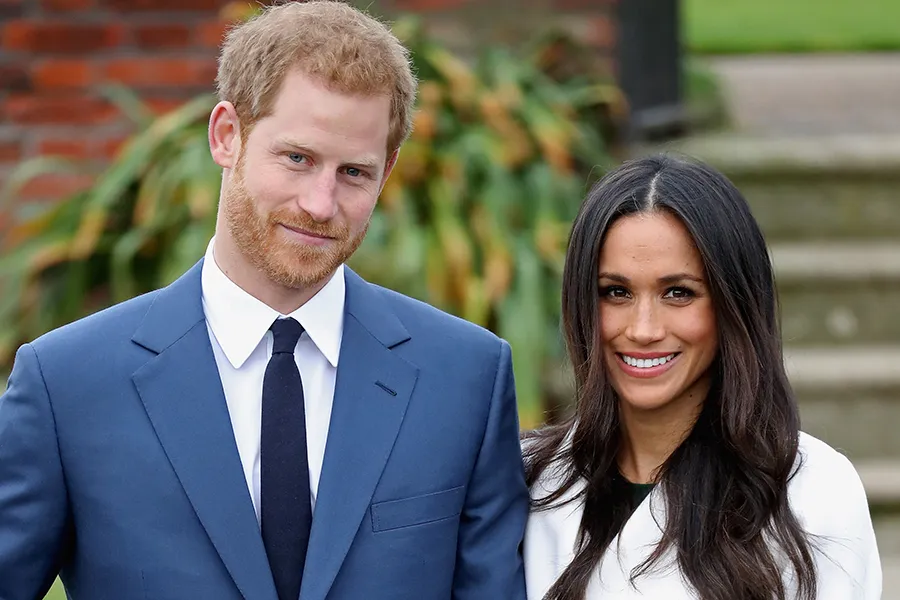
Earlier this week, another royal engagement was announced. On Monday, Kensington Palace announced that Prince Harry, who is fifth in line for the throne, is engaged to Meghan Markle. Like Simpson, Markle is an American and divorced. Furthermore, Markle has Catholic ties in her family, and is possibly a baptized Catholic herself.

Obstacles which just a few years ago might have disqualified the couple from ascending to the crown – divorce, Catholic ties – no longer require the Prince to abdicate his place in the line of succession to the British throne.

What has changed?

Father James Bradley, a Catholic priest in the U.K. and a former Anglican, told CNA that because of the previous rules of the Anglican Church, Edward was essentially obligated to abdicate because “he would have been in a relationship which the Church of which he was Supreme Governor did not approve,” he said.

In 2002, a synod of Anglican bishops officially changed Anglican doctrine regarding divorce, declaring that while “marriage should always be undertaken as a ‘solemn, public and lifelong covenant between a man and a woman’…some marriages regrettably do fail and that the Church’s care for couples in that situation should be of paramount importance…there are exceptional circumstances in which a divorced person may be married in church during the lifetime of a former spouse.”

The Anglican Church does not define exactly what qualifies as exceptional circumstances; this is primarily left up to the presiding minister to determine whether a second church wedding can be allowed.

One instance in which the Anglican Church forbids a second church wedding for divorced persons is if the new relationship contributed to the breakdown of the first marriage, Ed Condon, a Catholic canon lawyer in the U.K., told CNA. This was what prevented a church wedding for Prince Charles and Camilla Parker Bowles in 2005.

“If there’s been no openly scandalous reasons or contributing factors, that would allow the Anglican authorities to say well, you can have a church wedding,” Condon said. Harry and Markle are expected to be married at St. George’s Chapel at Windsor Castle.

But accepting attitudes about divorced monarchs is indicative of a broader breakdown of marriage that can be seen, particularly in the West, Bradley noted.

“The opposition to Edward VIII was, first of all, that society didn’t recognize divorce as something that was good at the time, and now it does, unfortunately,” he said.

Currently, “(the) new head of the [British] Supreme Court is pushing for no-fault divorce. We’ve gone from a situation where divorce was such a social issue that you couldn’t remain monarch and be married to a divorced person, and now we’re in a situation where the Supreme Court is pushing for no-fault divorce,” he said. “So it’s the complete collapse of marriage as we see in America and the rest of the West.”

Royals marrying Catholics

While Markle attended an all-girls Catholic school in L.A., it is unclear whether she was baptized as a Catholic, and she told Vanity Fair earlier this year that she was not raised as one.

Numerous British sources report that Markle has identified as a Protestant for some time before the engagement, and plans to be baptized and confirmed in the Church of England before marrying Harry.

However, if she were a Catholic, this too would have been an obstacle to her marrying into the royal family until very recently. Opposition to Catholics ascending to the throne dates back to King Henry VIII, who broke from the Catholic Church in the 1500s in order to divorce his wife, Catherine of Aragon, and marry another, because he blamed Catherine for failing to produce a son who could succeed to the throne.

The Succession to the Crown Act 2013 allowed heirs to the throne to marry Catholics, among other changes. However, the law still stipulates that the acting British sovereign mustn’t be a Catholic.

Catholics and the indissolubility of marriage

The Catholic Church teaches “that marriage is indissoluble, it is literally black and white,” Bradley noted.

“It’s a bond that cannot be broken, because God respects the promises that the husband and wife make to each other, and he does what’s asked. He binds together these two people who are asking to be bound together, it’s a respecting of the free will of the individuals,” he added.

The Catechism of the Catholic Church, in paragraph 1614, states that: “In his preaching Jesus unequivocally taught the original meaning of the union of man and woman as the Creator willed it from the beginning permission given by Moses to divorce one’s wife was a concession to the hardness of hearts.The matrimonial union of man and woman is indissoluble: God himself has determined it “what therefore God has joined together, let no man put asunder.”

The Catholic Church recognizes as sacramental the marriages between two baptized persons of any Christian community, Bradley noted.

“If there are two baptized Anglicans marrying, the Catholic Church would recognize that as a sacramental marriage,” he said, because the Catholic Church recognizes all Christian baptisms as valid.

“If both parties are baptized it’s a sacramental marriage, and non-Catholics are not bound by canonical form, so they’re quite at liberty to be married in the Church of England, and we recognize that they’re being married according to the rights of their ecclesial communities.”

However, if Markle’s first-marriage were valid, she would not be free to validly marry Harry.  An annulment, or declaration of nullity, of her first marriage, would establish that her previous marriage was invalid, Bradley said.

Condon noted that the Catholic Church also presumes the indissolubility of all marriages, whether those be marriages of Catholics, Christians, believers, or nonbelievers.

“The life-long partnership of one man and one woman is part of the natural law and God’s plan for all humanity. The Church’s presumption of validity pertains to all marriages, including Ms. Markle’s,” he said.

“That having been said, we don’t know any of the details of that union, or if a canonical process is underway regarding it. Catholics should, I would suggest, understand the royal engagement the same way they would the marriage of any two people they don’t know personally: be happy for them.”

Bradley added that the fact that royal engagements are always met with a resounding reaction of “joy and happiness,” which “shows that even when, in some sense, the marriage isn’t everything we would want it to be, society as a whole has a natural inclination towards the good and towards what marriage represents.”

“So people see the goodness of marriage, even people who are opposed to the institution of marriage will cheer when a couple like this get married, or get engaged, because it takes a very hardened heart not to be happy that two people are seeking this good.”

[…]

Burmese bishops say despite pressure, Suu Kyi has their support

November 29, 2017 CNA Daily News 0

Yangon, Burma, Nov 29, 2017 / 10:56 am (CNA).- As international criticism mounts for Burmese leader Aung Sun Suu Kyi over perceived inaction on the nation’s Rohingya refugee crisis, Catholic bishops say they support her, fearing too much pressure could lead to a collapse of their newly-formed democracy, which is still struggling to take root.

“We need to really rebuild our nation,” said Fr Mariano Soe Naing, spokesman for the Catholic Bishops’ Conference of Burma. He noted that even two years ago, it would not have been possible for the bishops to be vocal about their stand given the tumultuous political climate.

“We are only here (because of) the lives that have been shed on the streets, so we have gone through such a struggle in this country and we cannot compromise the lives, the blood, that this country has given,” he said. “We need to go on with our democratic reform of this nation.”

Fr. Soe Naing spoke to journalists at a press briefing on the second full day of Pope Francis’ Nov. 27-30 visit to Burma, also known as Myanmar. The Pope will next travel to Bangladesh Nov. 30-Dec. 2 before returning to Rome.

The visit comes at a precarious time for Burma as it continues to struggle in transitioning to democracy. Burma functioned as a military dictatorship for more than 50 years, until democratic reforms began taking root in 2011. In November 2015, Suu Kyi and her party, the National League for Democracy, were elected by an overwhelming majority, putting an end to a five-decade military dictatorship.

Suu Kyi and her party had also won the election in 1990, but the results were not recognized by the military government, and she was put under house arrest. However, despite her success in 2015, she is still barred from officially becoming president, and holds the title of “State Counselor” and Foreign Minister, while a close associate is acting as president.

Despite emerging signs of democratic reform in Burma, the transition has been rocky. The military still wields considerable political authority, including the appointment of cabinet ministers, and one-quarter of the nation’s legislature.

Compounding the issue, the Pope’s visit also takes place amid a sharp increase in state-supported violence against the Rohingya, a largely Muslim ethnic group who reside in Burma’s Rakhine State, prompting the United Nations to declare the crisis “a textbook example of ethnic cleansing.”

With an increase in persecution in their home country, many of the Rohingya have fled to neighboring Bangladesh, with millions camping along the border as refugees. More than 600,000 Rohingya have fled Burma for Bangladesh in recent months.

However, despite widespread use of the term “Rohingya” in the international community, the term is controversial within Burma. The Burmese government refuses to use the term, and considers them illegal immigrants from Bangladesh. They have been denied citizenship since Burma gained independence in 1948.

In many ways this crisis has overshadowed the Pope Francis’ trip, the first-ever visit from a Pope to the Asian nation. Specific attention has been paid to whether or not Francis will use the term “Rohingya” while on Burmese soil. So far, he has refrained, upon the request of the country’s Catholic leaders.

In the Nov. 29 news briefing, Vatican Spokesman Greg Burke said while the topic of migrants and refugees is a major concern for Pope Francis, the plight of the Rohingya “was not the original intention for making the trip.”

Differing from the Pope’s 2016 daytrip to the Greek island of Lesbos, which Burke described as a “refugee trip,” the visit to Burma was made as an official visit to a country with whom the Holy See has just established diplomatic relations, and the refugee crisis happened to escalate at the same time.

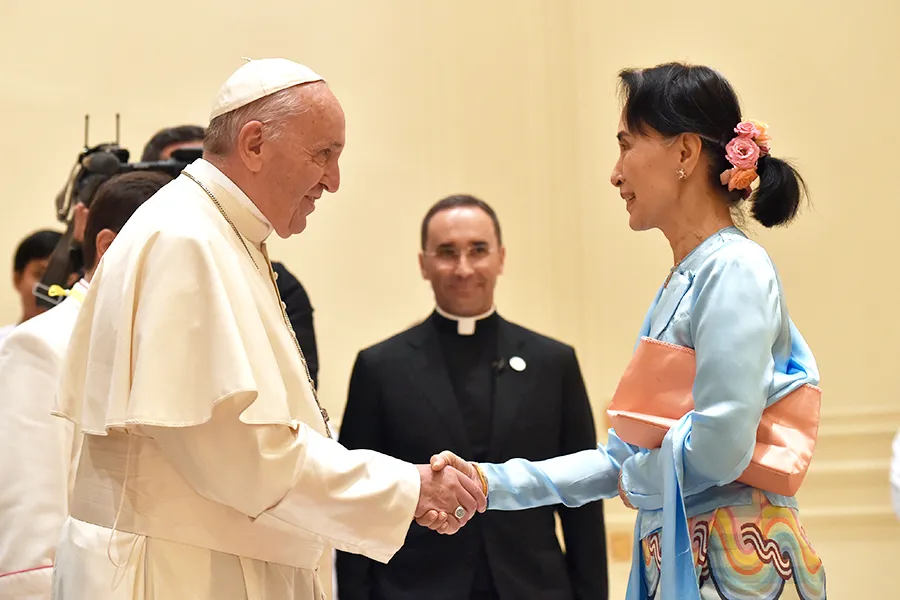
The decision to officially form diplomatic ties was made in March, and relations were further cemented in May when Suu Kyi visited Pope Francis at the Vatican, with both leaders agreeing to send ambassadors to each other’s countries.

With Catholic bishops in Burma backing Suu Kyi and her government, the decision to establish ties and schedule a papal visit so soon after was likely made in a bid to support democracy in the country amid fears it could crumble under too much pressure from both inside and outside of the country.

In his first speech of the trip, given to Burmese authorities and diplomats Nov. 28, the Pope said healing and peace in the nation can only be achieved through the pursuit of justice and the promotion of human rights.

He also advocated for “the consolidation of democracy and the growth of unity and peace at every level of society.” He further advanced the cause of democracy in his speech to bishops earlier today, during which he told them to spread the Gospel through charity and the “support for democratic rule.”

In the lead-up to Francis’ visit, the heat has been turned up on Suu Kyi, with many claiming the leader isn’t doing enough to defend the Rohingya.

On Monday the Oxford City Council voted to strip Suu Kyi of her “Freedom of Oxford” award over what they said was a failure to speak out on abuses committed against the Rohingya. She was initially given the award in 1997 and collected it personally in 2012 after 15 years of house arrest.

However, the bishops have continued to support Suu Kyi. In a September statement, they called for an end to persecution of the Rohingya, while also emphasizing the complicated nature of the political, military, and humanitarian situation in the country, and saying that lasting reform will take time and that placing sole blame on Suu Kyi is counterproductive.

“Thousands of citizens went on the street against the socialist government and gave their lives on the streets of Yangon,” Fr. Soe Naing said at the press conference. “So we cannot just forget all these struggles to have a democratic transition in this country.”

And this democracy is now in danger again, the priest said, explaining that when Suu Kyi is criticized, the pressure comes in two ways: “the international community and the people in the country.”

He argued that the leader, and therefore democracy, is suffering as some criticize her on the Rohingya front, while others use her weakened public standing as an opportunity question the benefits of democracy for Burmese society.

Soe Naing said “we have to come up with a clear stand that we are for development of the country. We have just 18 months of her rule and then we met this crisis, and she is under pressure from all sides,” so the Church is eager to provide support.

Also present at the press conference was Bishop Hsane Hgyi, Vice President of the Catholic Bishops Conference of Burma (CBCM); Bishop Felix Liankhenthang, President of the CBCM; and Bishop John Saw Yaw Han, auxiliary bishop of Yangon.

In comments to journalists, Bishop Hgyi stressed the importance of both knowing and focusing on the truth on the political situation.

“We know Aung Sun Suu Kyi has been sacrificing and suffering for many years, not for herself and not for her family, but for her country,” he said, and cautioned against believing everything that’s read in the papers.

People ought to look for authoritative sources, he said, and suggested that critics “go into the field to study the reality and study the history well” before speaking, because “just hearing from other people won’t be enough.”

When asked whether there is fear that the Rohingya might be disappointed that Pope Francis has decided not to use the term during his visit to Burma, Burke said “Vatican diplomacy is not infallible,” and that everyone is entitled to form their own opinion on the matter.

“That’s part of what diplomatic work is about,” he said, explaining that the main goal of the Holy See is “building bridges” in a nation with which they are just starting to form diplomatic relations.

“We’re in the start of a relationship. The Holy See only recently began full diplomatic relations here, it’s a very tiny Church,” Burke said, adding while the Pope “is very persuasive” and enjoys great moral authority, “he doesn’t parachute” into regions to solve problems immediately, but takes things one step at a time.


[…]

Pope to Burmese bishops: Healing must be a pastoral priority

November 29, 2017 CNA Daily News 1

Yangon, Burma, Nov 29, 2017 / 04:39 am (CNA/EWTN News).- In a meeting with the bishops leading Burma’s small Catholic community, Pope Francis stressed the need to prioritize healing and pastoral accompaniment as the nation continues to reel from both past and present conflicts.

In a Nov. 29 meeting with Burma’s bishops, Pope Francis said the Gospel they preach “is above all a message of healing, reconciliation and peace.” This message, he said, is especially potent in Burma, which is still working “to overcome deeply-rooted divisions and to build national unity.”

Many Catholic faithful in the country “bear the scars of this conflict and have borne valiant witness to their faith and their ancient traditions,” he said, explaining that the preaching of the Gospel “must not only be a source of consolation and strength, but also a summons to foster unity, charity and healing in the life of this nation.”

Echoing his words to interreligious leaders on his first full day in the country, Francis said this unity “is born of diversity. It values people’s differences as a source of mutual enrichment and growth (and) invites people to come together in a culture of encounter and solidarity.”

He prayed that the Lord would guide the bishops in their efforts to promote healing and communion at all levels in the Church, so that “God’s holy people can be salt and light for hearts longing for that peace the world cannot give.”

Pope Francis met with the bishops during his Nov. 27-30 visit to the country – also known as Myanmar – after which he will travel to neighboring Bangladesh from Nov. 30-Dec. 2 before returning to Rome.

He arrived Nov. 27 and has so far met with both religious and civil leaders. The meetings were politically charged on various levels, stemming from the fact that Christians are a small minority in Burma, as well as the fact that the nation is still working to transition to a democratic government after more than 50 years of military rule.

In his speech to the bishops, Pope Francis offered three words for reflection: healing, accompaniment and prophecy.

He praised efforts made by the local Church to care for the poor and the displaced, many of whom are members of the Rohingya Muslim minority who have been forced to flee their home in Burma’s Rakhine State as a result of what the United Nations has called “a textbook case of ethnic cleansing” in the area.

The Pope voiced his thanks to those who “bring the balm of healing to these, their neighbors in need, without regard for religion or ethnicity.”

This healing, he said, is also relevant when it comes to inter-religious dialogue, and prayed that the bishops would continue building bridges of dialogue and join followers of other religions “in weaving peaceful relations will bear rich fruit for reconciliation in the life of the nation.”

Francis then stressed the importance of pastoral accompaniment, saying a good shepherd is always at his flock’s side, and must constantly “bear the smell of the sheep.”

He emphasized the need to go out to the peripheries, telling the prelates that in their role as bishops, “your lives and ministry are called to model this spirit of missionary outreach,” which is primarily carried out by regular visits to the parishes and communities in their local Churches.

In the spirit of the first missionaries who evangelized the country, bishops, as pastors, must “continue to imbue the laity with a spirit of true missionary discipleship and seek a wise inculturation of the Gospel message in the daily life and traditions of your local communities.”

To this end, the role of catechists is essential, he said, adding that “their formation and enrichment must remain among your chief priorities.”

With few bishops and clergy ministering to the entirety of Burma’s small Catholic population, catechesis plays a key role in the formation and education of the faithful in the country.

Burma is a majority Buddhist country. Catholics are a small minority, making up just 1.3 percent of a population of nearly 52 million.

They are led by 22 bishops; 888 priests, both diocesan and religious; 128 non-ordained male religious and just two permanent deacons, making the ratio of Catholics to priests in the country around 742 to one. Women religious serving in Burma number just under 2,000. The country includes three archdioceses and 13 dioceses.

Given the unique challenges of being a minority, Pope Francis stressed the importance of pastoral accompaniment, specifically of the youth.

He urged the bishops to give special attention to their formation “in the sound moral principles that will guide them in confronting the challenges of a rapidly changing world,” including the threats of “cultural and ideological colonization.”

Turning to the upcoming synod of bishops on youth in 2018, to be held at the Vatican, Francis said young people are one of the greatest blessings of the Church in Burma, and pointed to the high number of seminarians studying in both minor and major seminary in the country, numbering around 1,100 total.

In the spirit of the Synod, which will listen to the stories of young people and help them discern how best to proclaim the Gospel in their lives, Francis asked the bishops to “please engage them and support them in their journey of faith, for by their idealism and enthusiasm they are called to be joyful and convincing evangelizers of their contemporaries.”

Francis then emphasized the importance of the Church’s prophetic witness in Burma, and recognized their daily efforts to bear witness to the Gospel through works of charity and education, but also through the defense of human rights and “support for democratic rule.”

He prayed that they would enable the Catholic community “to continue to play a constructive part in the life of society by making your voices heard on issues of national interest, particularly by insisting on respect for the dignity and rights of all, especially the poorest and the most vulnerable.”

With a word on the importance of protecting the environment and preserving the rich natural resources in Burma, Pope Francis concluded his speech with a bit of pastoral advice for bishops themselves.

Recognizing the demands of their ministry, the Pope noted that the bishops, along with their priests, “often labor under the heat and the burden of the day.”

He urged the bishops to be balanced in caring for their spiritual and physical health, while also keeping a paternal eye on the health of the priests in their care.

Francis encouraged the bishops to spend time daily in prayer and in “the experience of God’s reconciling love,” which he said “is the basis of your priestly identity, the guarantee of the soundness of your preaching, and the source of the pastoral charity by which you guide God’s people on the path of holiness and truth.”

Prayer is the first duty of bishops, he emphasized.

In a special greeting to the Pope, Bishop Felix Lian Khen Thang, president of the Catholic Bishops Conference of Burma, told Francis that his visit brings them “courage, joy and hope in trying to live and witness our faith, as we take part in peace and nation building process.”

“Like the dry parched land that is waiting for the first rain, we are also eagerly waiting for your visit which will be like the morning dew, a great blessing for our people and our country,” he said, adding that Pope’s “timely visit” fills their hearts with love and peace as they strive to be “the salt of the earth and the light of the world” in their nation.

He wished the Pope “good health and peace of mind” during his visit, and assured him that they would always be “your faithful collaborators in the mission of peace and love.”


[…]

True justice and peace are for all people, Pope tells Buddhist leaders

November 29, 2017 CNA Daily News 0

Yangon, Burma, Nov 29, 2017 / 03:34 am (CNA/EWTN News).- In a meeting with Buddhist monks in Burma on Wednesday, Pope Francis stressed that true and lasting justice and peace cannot be achieved unless the dignity of all people is protected.

“Authentic justice and lasting peace can only be achieved when they are guaranteed for all,” Pope Francis said Nov. 29.

He emphasized that his meeting with the Buddhist monks is an opportunity to strengthen the bonds of friendship between Catholics and Buddhists as well as “affirm a commitment to peace, respect for human dignity and justice for every man and woman.”

Pope Francis met with the State Sangha Maha Nayaka Committee, a group which oversees Buddhist clergy in Burma, at the Buddhist Kaba Aye complex, which includes Kaba Aye Pagoda, just 6 miles north of Yangon.

The meeting took place during the Pope’s Nov. 27-Dec. 2 apostolic trip to Burma – also known as Myanmar – and Bangladesh, which comes amid a serious uptick in state-supported violence against the Rohingya, a largely Muslim ethnic group who reside in Burma’s Rakhine State.

In recent months, the violence has reached staggering levels, causing the United Nations to declare the situation “a textbook example of ethnic cleansing.”

“In every age, humanity experiences injustices, moments of conflict and inequality among peoples. In our own day these difficulties seem to be especially pronounced,” the Pope said.

Even though we’ve made great technological advancements, and people around the world are more and more aware of “their common humanity and destiny,” he said, still “the wounds of conflict, poverty and oppression persist, and create new divisions.”

“In the face of these challenges, we must never grow resigned,” he continued, because our “respective spiritual traditions” show us the way forward, “a way that leads to healing, mutual understanding and respect. A way based on compassion and loving kindness.”

Burma’s religious makeup is predominately Buddhist, with 89 percent of the population practicing the Theravada tradition of Buddhism. In the encounter, Pope Francis expressed his esteem for those who follow the Buddhist tradition in Burma, saying that through their religion, the people “have been formed in the values of patience, tolerance and respect for life.”

A great challenge of today, Francis said, is to help people be open to the “transcendent,” being able to know themselves in such a way as “to realize that we cannot be isolated from one another.”

But if we are to be united, we must work to overcome “all forms of misunderstanding, intolerance, prejudice and hatred,” he said, noting that the words of Buddha and St. Francis can offer a guide for how to go about doing this.

In Dhammapada, Buddha says to “overcome the angry by non-anger; overcome the wicked by goodness; overcome the miser by generosity; overcome the liar by truth,” the Pope quoted.

A similar message can be found in a prayer attributed to St. Francis of Assisi, he noted: “Lord, make me an instrument of your peace. Where there is hatred, let me sow love. Where there is injury, let me bring pardon… Where there is darkness, let me bring light, and where there is sadness, joy.”

May the wisdom contained in these words, he said, continue to inspire patience and understanding, “to heal the wounds of conflict that through the years have divided people of different cultures, ethnicities and religious convictions.”

He stressed that overcoming conflict and injustice is not only the work of religious leaders, but of the whole of society, though it is a particular responsibility of religious and civil leaders to guarantee that everyone’s voice is heard.

Francis said that for this work to bear lasting fruit, religious leaders will need to work together in even greater collaboration, stating that in this, “the Catholic Church is a willing partner,” ready to continue to walk together the path of “peace and healing, compassion and hope.”

He also praised the two-day peace meeting held by the local Catholic bishops’ conference in April – which included leaders of different religious communities as well as ambassadors and representatives of non-governmental agencies – as “essential” for deepening understanding of one another.


[…]

Revenge can’t heal wounds, Pope Francis tells Burma’s Catholics

November 28, 2017 CNA Daily News 0

Yangon, Burma, Nov 28, 2017 / 08:03 pm (CNA/EWTN News).- Encouraging Burma’s minority Catholic community on Wednesday, Pope Francis preached the forgiveness and compassion of Christ in the face of violence and injury.

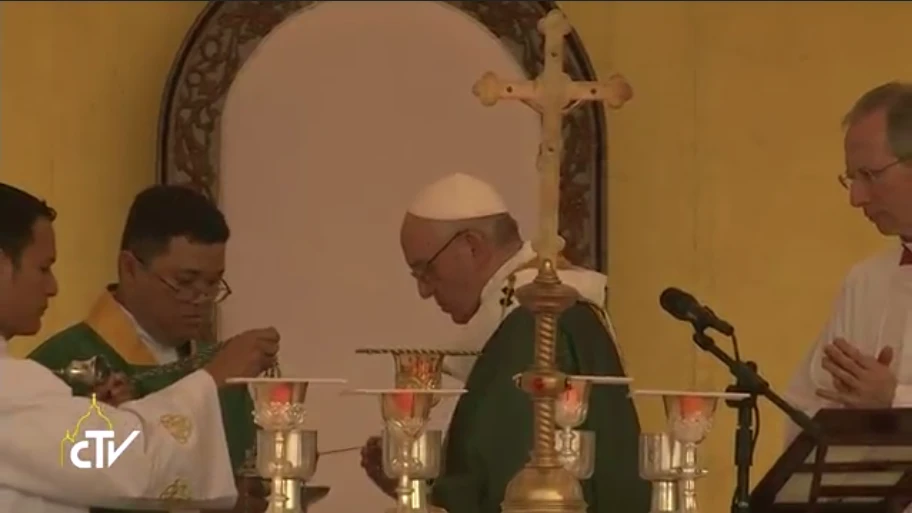
“I know that many in Myanmar bear the wounds of violence, wounds both visible and invisible. The temptation is to respond to these injuries with a worldly wisdom that … is deeply flawed. We think that healing can come from anger and revenge. Yet the way of revenge is not the way of Jesus,” the Pope said during his homily at Mass Nov. 29.

Christ “responded with forgiveness and compassion” when “hatred and rejection led him to his passion and death,” Francis reflected during the Mass, said at the Kyaikkasan Ground in Yangon, the largest city of Burma (also known as Myanmar).

“By the gift of his Spirit, Jesus enables us each to be signs of his wisdom, which triumphs over the wisdom of this world, and his mercy, which soothes even the most painful of injuries,” the Pope added.

Francis arrived in Burma Nov. 27, and has already met with military and government officials and with religious leaders. He will remain in the country until midday Nov. 30, when he will travel to neighboring Bangladesh.

Burma was ruled by a military junta for 50 years, and has only recently begun a transition toward democracy. International attention has focused recently on the Rohingya, a predominantly Muslim ethnic minority who have been denied citizenship and general persecution. In recent months, more than 600,000 Rohingya have fled the country for Bangladesh amid state-sponsored violence against them.

The country’s Christian minority (about one percent of the population) has also faced persecution from the government and the Buddhist majority. The US Commission on International Religious Freedom reported last year that Burmese Christians face discrimination, forced conversions, violence, and the desecration of churches.

Pope Francis’ words to the country’s Catholics have, therefore, a certain poignancy to them.

“Many of you have come from far and remote mountainous areas, some even on foot. I have come as a fellow pilgrim to listen and to learn from you, as well as to offer you some words of hope and consolation,” he told them.

Christ is “the ultimate interpreter of God’s mysteries,” he said. “Jesus did not teach us his wisdom by long speeches or by grand demonstrations of political or earthly power but by giving his life on the cross.”

“Sometimes we can fall into the trap of believing in our own wisdom, but the truth is we can easily lose our sense of direction. At those times we need to remember that we have a sure compass before us, in the crucified Lord. In the cross, we find the wisdom that can guide our life with the light that comes from God.”

The cross is also a source of healing, Pope Francis taught, exhorting them: “May we always have the wisdom to find in the wounds of Christ the source of all healing!”

Turning to the re-presentation of Christ’s sacrifice on the cross, Pope Francis said that in the Eucharist we “learn how to rest in his wounds, and there to be cleansed of all our sins and foolish ways. By taking refuge in Christ’s wounds, dear brothers and sisters, may you know the healing balm of the Father’s mercy and find the strength to bring it to others, to anoint every hurt and every painful memory.”

“In this way, you will be faithful witnesses of the reconciliation and peace that God wants to reign in every human heart and in every community.”

He noted with appreciation that the Church in Burma is already working “to bring the healing balm of God’s mercy to others, especially those most in need. There are clear signs that even with very limited means, many communities are proclaiming the Gospel to other tribal minorities, never forcing or coercing but always inviting and welcoming.”

The Pope commended the local Churches for offering “practical assistance and solidarity to the poor and suffering … regardless of religion or ethnic background.”

“I can see that the Church here is alive, that Christ is alive and here with you and with your brothers and sisters of other Christian communities. I encourage you to keep sharing with others the priceless wisdom that you have received, the love of God welling up in the heart of Jesus.”

Christ “will surely crown your efforts to sow seeds of healing and reconciliation in your families, communities and the wider society of this nation,” he said. “His message of forgiveness and mercy uses a logic that not all will want to understand, and which will encounter obstacles. Yet his love, revealed on the cross, is ultimately unstoppable.”

Pope Francis concluded his homily by invoking Mary, Mother of God, recalling that “she accompanies us at every step of our earthly journey. May she obtain for us the grace always be to messengers of true wisdom, heartfelt mercy to those in need, and the joy that comes from resting in the wounds of Jesus, who loved us to the end.”

“May God bless all of you! May God bless the Church in Myanmar! May he bless this land with his peace! God bless Myanmar!”

[…]