Report: Pope Francis affirms Church practice against admitting gay men to seminary

May 24, 2018 CNA Daily News 4

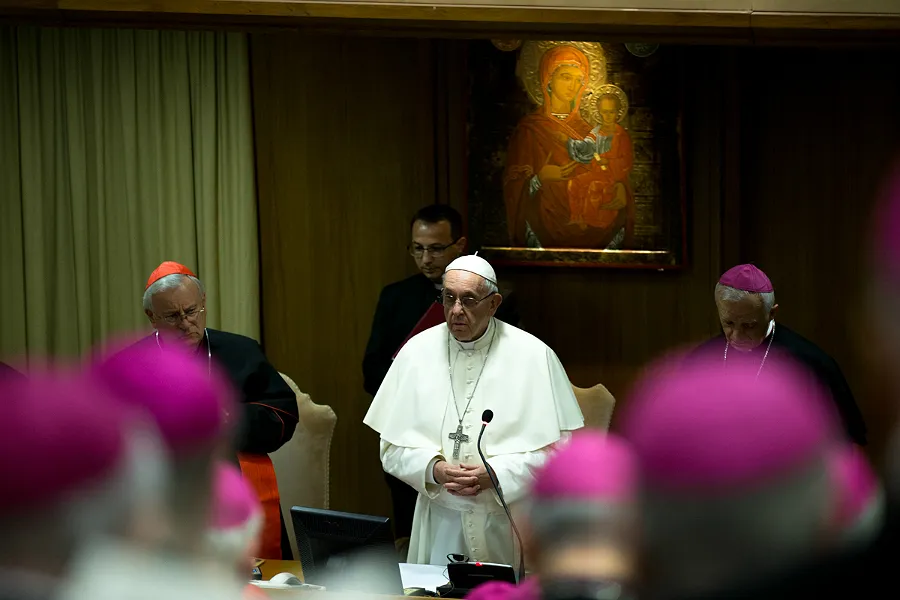
Vatican City, May 24, 2018 / 11:08 am (CNA/EWTN News).- In a closed-door speech to Italian bishops on Monday, Pope Francis reportedly spoke about the number and quality of seminary candidates, including concerns about their sexual orientation.

At the start of his May 21 audience with Italian bishops, Pope Francis voiced three areas of concern for the Church in Italy, the first of which was the lack of vocations.

Francis’ brief remarks on his concerns, which also touched on evangelical poverty and transparency and the incorporation of Italian dioceses, were televised; however, his discussion with the bishops afterward was not.

In his public remarks on vocations, Pope Francis lamented the culture of the provisional, of relativism, and of the dictatorship of money, which hinder young people from discerning consecrated life. He also proposed that Italian dioceses with an abundance of vocations lend some of their priests to those Italian dioceses lacking in priests.

But according to Italian media sites, in the discussion that followed the pope was more direct, telling the bishops to care more for the quality of seminary candidates than the quantity.

He reportedly touched on the topic of homosexuality, particularly when it comes to individuals with “deep-seated tendencies” or who practice “homosexual acts”, yet who want to enter the seminary.

In these cases, “if you have even the slightest doubt it’s better not to let them enter,” Francis said, because these acts or deep-seated tendencies can lead to scandals and can compromise the life of the seminary, as well as the man himself and his future priesthood.

Pope Francis’ comments were allegedly made during the opening May 21 session of the 71st general assembly of the Italian bishops’ conference. Several Italian news sites have reported on the pope’s comments, but they have not been confirmed by the Vatican or by the Italian bishops.

However, the pope’s statements on the issue of homosexuality and the seminary reflect the Church’s teaching on the topic.

In the 2016 edition of the Congregation for Clergy’s ratio on priestly formation, the dicastery had written that “in relation to people with homosexual tendencies who approach seminaries, or who discover this situation in the course of formation, in coherence with her own magisterium, ‘the Church, while profoundly respecting the persons in question, cannot admit to the seminary or to holy orders those who practise homosexuality, present deep-seated homosexual tendencies or support the so-called “gay culture”.’”

The ratio quoted from the Congregation for Catholic Education’s 2005 instruction “Concerning the Criteria for the Discernment of Vocations with regard to Persons with Homosexual Tendencies in view of their Admission to the Seminary and to Holy Orders.”

The instruction noted that those who practise homosexuality, present deep-seated homosexual tendencies, or support the gay culture “find themselves in a situation that gravely hinders them from relating correctly to men and women. One must in no way overlook the negative consequences that can derive from the ordination of persons with deep-seated homosexual tendencies.”

It distinguished those with deep-seated homosexual tendencies from those “with homosexual tendencies that were only the expression of a transitory problem – for example, that of an adolescence not yet superseded.”

Men with transitory homosexual tendencies could be admitted to seminary, the congregation wrote, though “such tendencies must be clearly overcome at least three years before ordination to the diaconate.”

The instruction drew, in turn, from the Catechism of the Catholic Church, a 1985 memo from the Congregation for Catholic Education, and a 2002 letter from the Congregation for Divine Worship.

Though Pope Francis has not addressed the topic publicly, he alluded to problems of homosexuality in seminary formation during a recent meeting with Chilean bishops.

In a letter written to the bishops which was leaked to Chilean media, the pope issued a sharp correction of his brother prelates for a systematic cover-up of clerical abuse in the country.

One footnote in the letter noted how abuses were not limited to just one person or group, but was rather the result of a fractured seminary process.

In the case of many abusers in Chile, Francis noted how problems had been detected while they were in seminary or the novitiate, but rather than expelling these individuals, some bishops or superiors “sent priests suspected of active homosexuality to these educational institutions.”

[…]

Reform bill the ‘first step’ to restorative prison justice, advocates say

May 24, 2018 CNA Daily News 0

Washington D.C., May 24, 2018 / 05:00 am (CNA/EWTN News).- The U.S. House of Representatives has passed prison reform legislation that would integrate faith-based programs into federal prisons to help prisoners prepare to successfully reenter society.

The First Step Act was authored by Reps. Doug Collins (R-Ga.) and Hakeem Jeffries (D-N.Y.), and has the goal of incentivizing prisoner participation in vocational and rehabilitative programs. Lawmakers approved the bipartisan legislation by a 360-59 vote on May 22.

“I’m thrilled to see such bipartisan support for the First Step Act,” said James Ackerman, president of Prison Fellowship, the largest prison ministry in the United States.

“We have a duty as a society,” continued Ackerman, “to implement a more restorative approach to criminal justice — one where people become healthier and more productive citizens when they return to society after serving time in prison then when they went into prison.”

The First Step Act calls for the implementation of individualized risk assessment interviews in federal prisons to better address each inmate’s personal needs, Prison Fellowship Vice President Craig DeRoche explained to CNA.

“For one person it, it might be addiction, for another it might be anger management and other issues to work through while they are incarcerated so that when they leave they are transformed and better suited for employability and success,” said DeRoche.

This has proven successful at the state level in places like Texas, where it has “reduced expense and it has transformed lives in restored families and healing communities,” according to DeRoche.

Prison Fellowship operates in 428 prisons throughout the country. Their staff have seen many prisoners lives transformed by their faith-based programming.

Tiheba Williams-Bain previously served time in a federal prison in Texas. She explained to CNA that the skill-building and faith-based programming that she participated in positively impacted her life.

“I took advantage of every opportunity that was accorded to me while I was in prison to help me get better,” said Williams-Bain.

“It helped me navigate through the system, as well as my own self-doubt and insecurities that I had about myself,” she continued.

 Williams-Bain added that rehabilitation requires more than programs available, saying “it comes from the mindset of the person that utilizes the programs.”

Prison Fellowship Senior Vice President of Policy and Advocacy Craig DeRoche said that it was only through Christ that he was able to recover from 29 years of addiction.

He said that is why he believes it is significant that the First Step Act “affirmatively states that faith-based programs will be welcomed into the prisons as a solution.”

“No person is beyond Christ’s touch and healing grace and offer of redemption,” said DeRoche.

“It doesn’t matter if it is a non-violent criminal or a low-level  or a violent criminal that has done horrible things, we’ve seen that Christ can make a person new again,” he continued.

The First Step Act will likely face opposition from both sides in the Senate, but it has President Donald Trump’s support.

At the White House Prison Reform Summit on May 18, President Trump said, “At the heart of our prison reform agenda is expanding prison work and the programs so that inmates can reenter society with the skills to get a job. We also want more mental health services so released inmates can cope with the challenges of life on the outside.”

The president continued, “Get a bill to my desk.  I will sign it.”


[…]

Church in Peru launches collection to help Venezuelan refugees

May 23, 2018 CNA Daily News 0

Lima, Peru, May 23, 2018 / 11:01 pm (ACI Prensa).- The bishops of Peru have launched a campaign to collect funds to provide for the basic needs of Venezuelan refugees living in the country.

The Peruvian bishops’ conference announced the collection will take place June 3, during the day’s scheduled Masses.

According to Caritas International, about four million people have left Venezuela due to the grave economic crisis marked by a major shortage of food and medicine under the socialist government of Nicolas Maduro, the president of the country since 2013. Maduro was re-elected May 20 in questionable elections.

Maduro is the hand-picked successor of socialist president Hugo Chavez.

The main destination of the millions of refugees is Colombia, along with other countries such as Peru, Chile, and Argentina.

The Center for Strategic and International Studies stated that the average Venezuelan lost about 24 pounds in 2017, in a population where almost 90 percent live below the poverty line.

The lack of medicine has caused an resurgence of diphtheria and an increase in measles and malaria, diseases that had almost been eradicated in Venezuela.

Cases of Malaria have skyrocketed while measles has claimed the lives of 26 children just in the Orinoco Delta area.

Venezuela closed 2017 with an inflation rate of 2,616 percent and a drop in Gross National Product of 15 percent. The International Monetary Fund forecasts inflation at 14,000 percent for 2018 which would be the highest index of inflation among emerging markets for this year and the next.


This article was originally published by our sister agency, ACI Prensa. It has been translated and adapted by CNA.

[…]

Your vote is the unborn child’s voice, pro-lifers say in Irish abortion debate

May 23, 2018 CNA Daily News 0

Dublin, Ireland, May 23, 2018 / 11:00 pm (CNA/EWTN News).- Ahead of Ireland’s abortion referendum on Friday, pro-life and pro-abortion rights debaters have squared off in a country where voters will be asked to remove constitutional protections for the unborn, known as the Eighth Amendment.

“What the government has proposed is an extreme law, stripping every right in the constitution for the unborn… taking away the right to life for the right to kill,” said Maria Steen, a speaker with the Iona Institute. “What the government is asking us to do is to become judge and jury over the lives of babies in the womb.”

The May 23 debate on Ireland TV3’s The Pat Kenney Show comes ahead of a May 25 referendum on whether to repeal the pro-life language in the Republic of Ireland’s constitution, which recognizes the equal right to life of mother and unborn child. The language dates back to a 1983 referendum passed with the support of 67 percent of Irish voters.

In the four-person debate, Ireland’s Minister for Social Protection Regina Doherty of the Fine Gael party claimed that abortion opponents failed to provide abortion alternatives and “haven’t been willing to look or support anything in 35 years.”

Doherty, who describes herself as “pro-life” despite her support for the repeal, charged that keeping the amendment means ignoring women in crisis, reported the Irish news site BreakingNews.ie.

A “yes” vote would remove the constitution’s pro-life language, while a “no” vote would preserve it.

In a March 2018 case that some have compared to the Irish Roe v. Wade, the country’s Supreme Court ruled unanimously that unborn children have no other rights except those guaranteed by the Eighth Amendment.

If the repeal vote is successful, Irish lawmakers are expected to propose legislation allowing unlimited abortion up to three months into pregnancy, and up to six months into pregnancy in cases where there might be risk to a mother’s physical or mental health.

About 3,000 Irish women travel to the U.K. for abortions each year. The procedure is largely illegal in Northern Ireland as well.

At one point in the TV3 debate, Independent Senator Ronan Mullen rejected the claim that there is evidence that mental health is valid grounds for abortion. He also cited a woman who was considering traveling to the U.K. for abortion, but then reconsidered.

“This woman told me ‘the time it took me to arrange an abortion in England is the time it took for me to change my mind’,” he said.

Doherty contended that the 72-hour waiting period in the draft legislation provides a period for women to reconsider an abortion.

Another debater, Colm O’Gorman of Amnesty Ireland, said “the Eighth Amendment has not stopped abortion. It has stopped some abortions, but it has forced others to continue pregnancies.”

Steen summed up her argument against repeal: “Women who need their health looked after deserve better than an abortion. We think this is a step too far. We all think taking the rights of all unborn children is fundamentally unjust.”

A Tuesday night debate on the show RTÉ Prime Time was a two-person debate between Minister for Health Simon Harris of the Fine Gael party and Sinn Féin Member of Parliament Peadar Tóibín.

“Wanted, unwanted. There are not two classes of people–we are all one. The child is the weakest individual. She has no voice.” Tóibín said, according to BreakingNews.ie.

Harris charged that opponents of the referendum sought to force rape victims to carry their pregnancies to term.

For his part, Tóibín cited his experience working with rape victims in County Meath.

“Meath will have legalized abortion in Meath before it has a rape crisis center,” he said.

Tóibín charged that repeal would allow a general practitioner with only six months of psychiatric training to decide whether a woman may have abortion on mental health grounds. He charged that repeal would mean abortion on demand.

The repeal effort is backed by Ireland’s major political parties.

Overseas involvement has also been a matter of controversy.

Financier and philanthropist George Soros’ Open Society Foundations and its pro-abortion rights grantees Amnesty Ireland, Abortion Rights Campaign Ireland, and the Irish Family Planning Association have run afoul of Irish political finance rules barring foreign funding of political campaigns.

Ireland is part of the foundations’ broader strategy against pro-life Catholic countries, according to a document reportedly hacked from the foundations and posted to the site DCLeaks.com.

“With one of the most restrictive abortion laws in the world, a win there could impact other strongly Catholic countries in Europe, such as Poland, and provide much needed proof that change is possible, even in highly conservative places,” said the foundations’ proposed 2016-2019 strategy for its Women’s Rights Program.

The internet giant Facebook has banned foreign-backed ads related to the Irish referendum, including small ad purchases from Irish-American pro-life advocates. Google has banned both foreign and domestic ads.

The latter move was seen as a blow to the Irish pro-life cause. The Save the 8th campaign’s strategy relied on intensifying its internet ad campaign in its final weeks, Pat Leahy, politics editor of the Irish Times, said in a May 10 analysis.

The Irish Times suggested that companies have become afraid that if voters reject the referendum, they will face blame and further scrutiny for allegedly influencing elections.

[…]

Foreign bishops respond to German intercommunion proposal

May 23, 2018 CNA Daily News 1

Philadelphia, Pa., May 23, 2018 / 06:04 pm (CNA/EWTN News).- Several bishops from outside Germany have critiqued a proposal to allow Protestant spouses of Catholics to receive communion in German dioceses under some limited circumstances, citing the proposal’s effects on their own local Churches.

The proposal has been championed by Cardinal Reinhard Marx of Munich and Freising, who announced in February that the German bishops’ conference would publish a pastoral handout that allows Protestant spouses of Catholics “in individual cases” and “under certain conditions” to receive Holy Communion, provided they “affirm the Catholic faith in the Eucharist”.

But the proposal was questioned by seven German bishops, who asked the Congregation for the Doctrine of the Faith whether the question can be decided on the level of a national bishops’ conference, or if rather “a decision of the Universal Church” is required in the matter.

When several bishops from Germany visited Rome May 3, an inconclusive meeting ended with the Vatican sending the Germans back, saying Pope Francis wants the bishops to come to an agreement among themselves.

Archbishop Charles Chaput of Philadelphia was pointed in his criticism of the proposal in an essay published May 23 at First Things, raising doctrinal concerns regarding what it would mean to allow these non-Catholics to receive the Eucharist.

Chaput explains that while bishops everywhere have disagreements, he believes the situation in Germany to be different due to both the “global prominence of the controversy,” as well as the doctrinal issues. He added that “What happens in Germany will not stay in Germany. History has already taught us that lesson once,” citing the effects of Martin Luther’s schism.

“The essence of the German intercommunion proposal is that there would be a sharing in holy communion even when there is not true Church unity,” writes Chaput, noting that there are serious difference between Protestant theology and Catholic theology, including debate over the divinity of Christ among some more liberal Protestants.

Chaput disagrees with the proposal, as it would fundamentally redefine what the Church is as well as who she is, given that the Eucharist “is the sign and instrument of ecclesial unity.”

The German proposal would, “intentionally or not”, then, be “the first stage in opening communion to all Protestants, or all baptized persons, since marriage ultimately provides no unique reason to allow communion for non-Catholics.”

Admitting Protestant spouses of Catholics to Communion would “adopt a Protestant notion of ecclesial identity” for the Catholic Church, in which only baptism and a belief in Christ would be necessary to receive. Chaput questions if the Protestant spouse would have to also profess belief in other sacraments, such as holy orders. If this were not the case, Chaput suggests that perhaps the German bishops do not believe this sacrament relies on apostolic succession, which would be a “much deeper error.”

The proposal also “severs the vital link between communion and sacramental confession,” he stated.

“Presumably it does not imply that Protestant spouses must go to confession for serious sins as a prelude to communion. But this stands in contradiction to the perennial practice and express dogmatic teaching of the Catholic Church, the Council of Trent, and the modern Catechism of the Catholic Church, as well as the ordinary magisterium. It implies, in its effect, a Protestantization of the Catholic theology of the sacraments.”

Chaput writes that the intercommunion practice would do nothing more than insert a lie into what should be a profound encounter with Christ.

“To insert a falsehood into the most solemn moment of one’s encounter with Jesus in the Eucharist — to say by one’s actions,’I am in communion with this community’ when one is demonstrably not in communion with that community — is a lie, and thus a serious offense before God.”

Cardinal Willem Eijk of Utrecht was critical of the pope’s request that the German bishops come to a consensus. Writing in the National Catholic Register May 5, Eijk said Pope Francis’ response was “completely incomprehensible,” as the doctrine of the Eucharist has not changed and cannot change, even with unanimity among a bishops’ conference.

“The practice of the Catholic Church, based on her faith, is not determined and does not change statistically when a majority of an episcopal conference votes in favor of it, not even if unanimously,” wrote Eijk.

Instead, Eijk says that he thinks Pope Francis should have been more direct to the German episcopal conference, and should have instead given them “clear directives, based on the clear doctrine and practice of the Church.”

Eijk’s comments were echoed by Archbishop Terrence Prendergast of Ottawa, who said May 23 at the Catholic Register it was “puzzling” that Pope Francis instructed Germany’s bishops to come to a unanimous decision on the issue.

“This kind of open communion is against Catholic teaching and from what I can see in non-Catholic congregations that follow a discipline of ‘open communion,’ it is also spiritually and pastorally unfruitful,” said Prendergast.

He noted that people in his local Church have already been asking about the German proposal.

Prendergast believes there should be more teaching on the benefit of attending Mass without receiving the Eucharist, as well as what it means “to be properly disposed and in the state of grace.”

“We need to invest more in receiving the sacraments worthily and fruitfully. This is true for the Eucharist, but also for Baptism and Confirmation,” Prendergast added.

“In Holy Communion we receive the Lord, and so, to receiving worthily, we need to be fully open to Him and connected to His Church, visibly and invisibly, institutionally and internally. That and nothing less is Catholic teaching.”

As a fellow Jesuit, Archbishop Prendergast also spoke to Pope Francis, thanking him “for reminding us that accompanying people through their lives, especially in dark times, is essential for being a priest.”

“We Jesuits always have to remember that most Catholics are not Jesuits — a fact we tend to overlook sometimes,” he added. “Our spirituality is not for everyone … For me, becoming a bishop was a real change, for then I had to recognize the whole spectrum of theologies, spiritualities, ministries and charisms present in the diocese entrusted to me. Through this I came to realize what a great gift doctrine is for the Church, enabling it to be one, holy, and catholic.”

The Code of Canon Law already provides that in the danger of death or if “some other grave necessity urges it,” Catholic ministers licitly administer penance, Eucharist, and anointing of the sick to Protestants “who cannot approach a minister of their own community and who seek such on their own accord, provided that they manifest Catholic faith in respect to these sacraments and are properly disposed.”

[…]