

 By
By 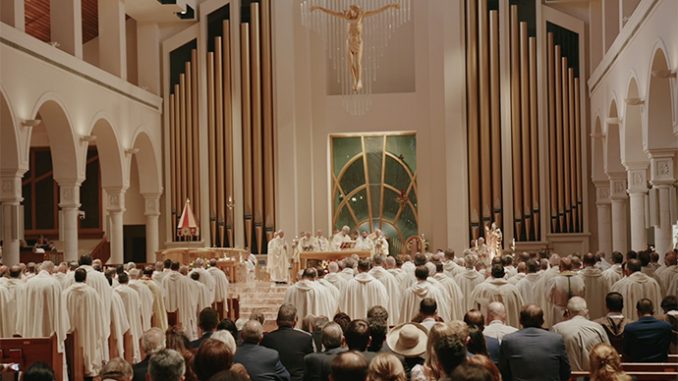
The bishops entrusted the nation to the love and care of the Sacred Heart of Jesus to accompany the country’s 250th anniversary.

ORLANDO, Florida — The U.S. bishops consecrated the nation to the Sacred Heart of Jesus on June 11, entrusting the United States to Christ’s merciful love during a solemn Mass as part of their spring plenary assembly.
“We gather not first to celebrate ourselves, but to consecrate, to entrust… and to place our whole nation into the Sacred Heart of Jesus Christ,” Archbishop William E. Lori of Baltimore said in his homily.
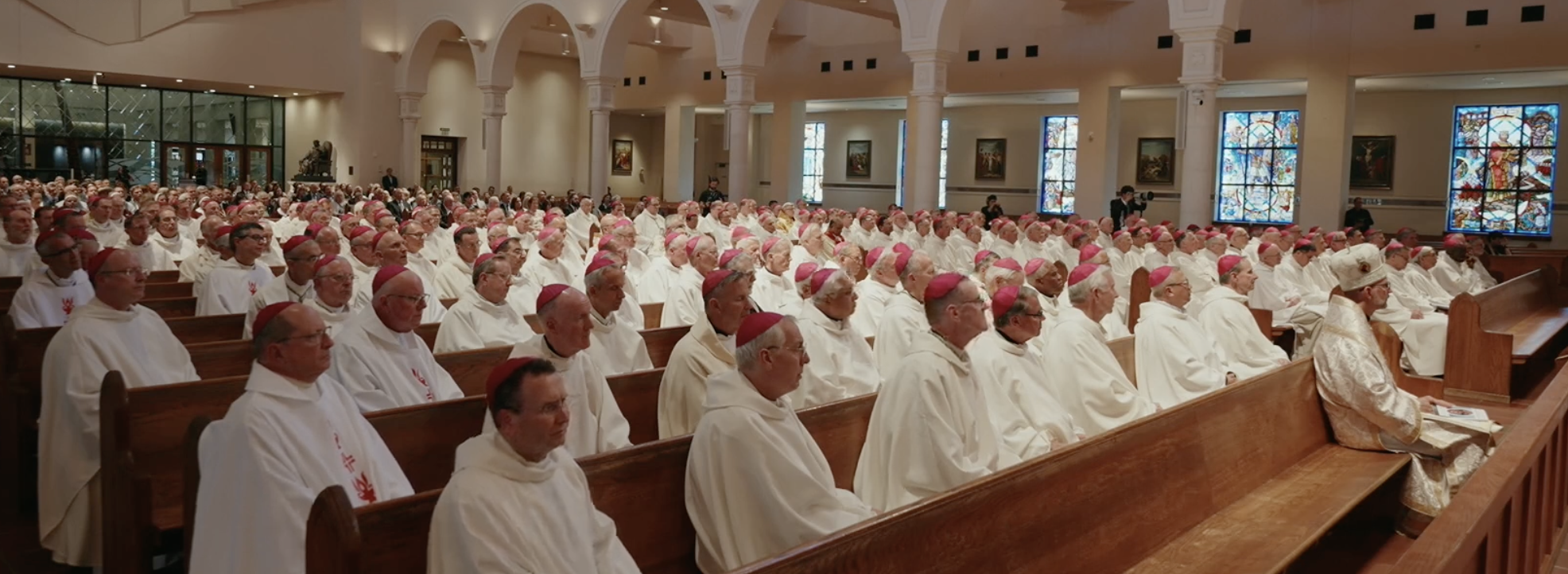
The liturgy took place on the final day of the U.S. Conference of Catholic Bishops’ spring plenary meeting, during the nation’s 250th anniversary year.
In the hours leading up to the Mass, bishops concluded their assembly with reflections that centered on the meaning of devotion to the Sacred Heart in contemporary life.
Archbishop Alexander Sample of Portland, Oregon, described the devotion as a response to modern forms of spiritual strain, including loneliness and the pressure to measure personal worth by achievement or failure. Drawing on Pope Francis’ encyclical Dilexit Nos, he said contemporary culture often unsettles identity itself.
“The Sacred Heart of Jesus answers that question decisively,” Sample said. “When we know that we are loved by Christ, we no longer need to build our identity on achievements or failures.”
He added that devotion to the Sacred Heart offers freedom from fear, self-centeredness, despair, and superficiality while also calling believers to bring that love into public life. “The world needs witnesses whose hearts resemble the heart of Jesus,” he said.
Archbishop Shelton Fabre of Louisville, Kentucky, reflected on the Sacred Heart as a source of communion within the Church, emphasizing that unity within the Church is not built on shared preference but on divine initiative and grace. He described the Church as “a brotherhood not created by personal preference, affinity, or ideology but by the providence of God and the will of Jesus Christ.”
Archbishop Bernard Hebda of St. Paul and Minneapolis pointed to the devotion as a path of interior renewal grounded in prayer and sacramental life. Citing St. John Henry Newman’s phrase “cor ad cor loquitur” (“heart speaks to heart”), he said the deepest encounter with Christ takes place in a personal, interior communion shaped by prayer and the Eucharist.
Shortly before the Mass, bishops spent time in Eucharistic adoration and benediction and venerated the relics of St. Margaret Mary Alacoque, the 17th-century French nun whose visions helped spread devotion to the Sacred Heart throughout the Church.
‘The Sacred Heart does not divide’
In his homily, Lori placed the consecration within the broader moral and spiritual tensions of Church and national life, framing it as an act of trust rather than achievement.
“To love as Christ loves is the true measure of Christian discipleship, and it is the true measure of our humanity,” he said.
He acknowledged that this measure has often not been lived out. “Indeed, it has sometimes obscured it almost beyond recognition,” he said, noting the reality of division, sin, and failure alongside moments of grace.
Lori said the act of entrustment is not an assertion of strength but an admission of dependence on mercy. “We cannot come to the heart of Christ while pretending we have no need of his mercy,” he said.
The future, he emphasized, cannot ultimately be secured by human systems or planning. “The future belongs to God, not to political movements, economic forces, or human plans,” he said.
He then described the Sacred Heart as the source of reconciliation itself, not merely a devotional image but a living reality that reshapes those who turn to it.
“The Sacred Heart does not divide, it reconciles,” he said. “It does not harden hearts, it transforms them. It does not simply invite us to receive love; it sends us forth to share it.”
Reflecting on the Gospel, he described Christ as fully entering the human condition with “a heart that has known joy and sorrow, friendship and betrayal, suffering and sacrifice.”
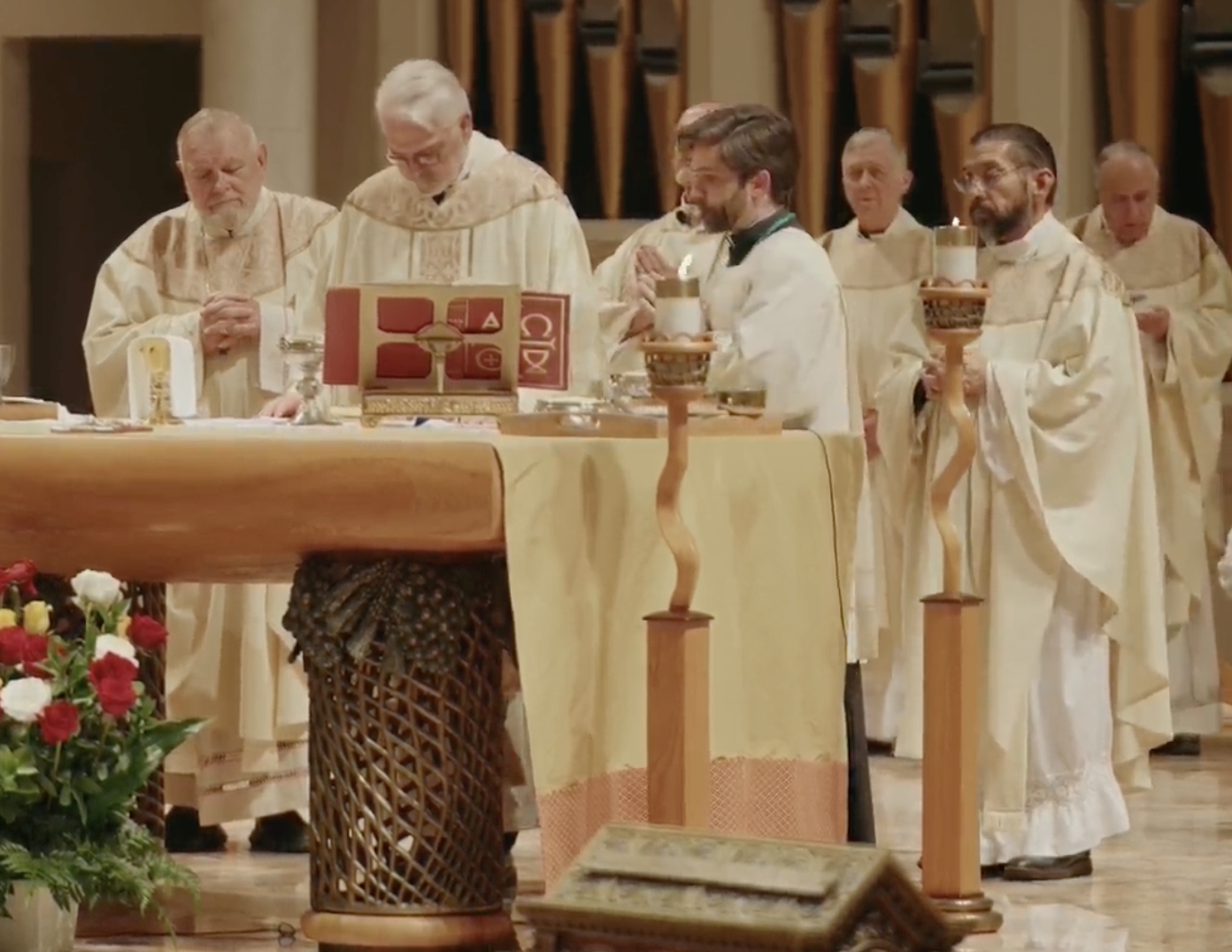
“The Sacred Heart reveals a savior who desires not merely our obedience, but our friendship,” he said. “Not simply our service, but our communion with him.”
That communion, he added, is meant to shape the whole of Christian life. “To remain in his love and allow that love to shape everything we do,” he said.
Prayer of entrustment
Following the homily, Archbishop Paul S. Coakley of Oklahoma City, president of the U.S. Conference of Catholic Bishops, led the solemn prayer of consecration, placing the moment within a wider historical and theological tradition.
He recalled that 127 years earlier Pope Leo XIII consecrated the human race to the Sacred Heart of Jesus, presenting the Orlando liturgy as a continuation of that same act of entrustment.
“In that same spirit, we now consecrate the United States of America,” Coakley said, noting that Christ “in his own blood has removed all divisions and made of many nations one people of God.”
He led repeated invocation throughout the prayer: “Most Sacred Heart of Jesus, have mercy on us.”
The consecration prayer addressed Christ as the “Desire of Nations and Center of History,” asking him to bless the United States, heal the nation’s wounds, and bring reconciliation, justice, and peace where they are lacking.
It also gave thanks for the blessings bestowed upon the country, affirmed the dignity of every person as a gift from the Creator, and made reparation for offenses against God and human dignity.
The prayer further asked that the Church in the United States be a visible sign of Christ’s presence in the world, pointing “all people to [his] infinite love.” It prayed for peace in families and communities, the reconciliation of broken relationships, the repair of injustices, and the healing of the nation through a deeper union with the Sacred Heart of Jesus.
‘A powerful moment in our national story’
President Donald Trump also issued a message marking the consecration, calling it “a powerful moment in our national story” and linking it to Bishop John Carroll’s post-Revolutionary consecration of the United States to the Blessed Virgin Mary.
He described the moment as part of a broader spiritual inheritance, noting that American history has long been shaped by public expressions of faith.
“As Catholic bishops consecrate the United States of America to the Sacred Heart of Jesus in this 250th year of our independence, we recommit ourselves,” he said, calling for renewed attention to the nation’s “spiritual identity and great civilizational inheritance.”
Trump called the consecration “a poignant reminder that America has always been guided by the loving hand of God,” framing it as both reflection and renewal during the semiquincentennial year.
If you value the news and views Catholic World Report provides, please consider donating to support our efforts. Your contribution will help us continue to make CWR available to all readers worldwide for free, without a subscription. Thank you for your generosity!
Click here for more information on donating to CWR. Click here to sign up for our newsletter.

Today you’ll likely hear from friends or even pastors: MEAT FRIDAY. Ok, maybe by a technicality in the current law, but by the spirit of the law, today should be at least a day of abstinence from meat and more likely a day of fasting and other mortification to make reparation to Jesus. Look at the OCIA 2024 ritual book. Catechumens are highly encouraged to keep the fast of Good Friday through Easter Vigil until after Mass. Imagine: Mother Church tells the unbaptized to fast for nearly 48 hours, yet pastors of souls tell us to sink our teeth into a juicy burger to honor the Most Sacred Heart (it’s not simply the Sacred Heart, but the feast Sacratissimi Cordi …). Today Our Lord calls us to reparation—not laxity. And that’s annually, but especially if we are consecrating our nation. How on earth can we consecrate while dishonoring the flesh of Christ on the day of the week dedicated to his holy death by gnawing on flesh unnecessarily?
“O God, Who in the Heart of Thy Son, wounded by our transgressions, dost mercifully vouchsafe to bestow upon us the infinite wealth of Thy love, grant, we beseech Thee, that revering it with meet devotion we may make a worthy reparation for our sins. Through the same Jesus Christ Thy Son Our Lord Who livest and reignest in the unity of the Holy Ghost, God, world without end.”
Deus, qui nobis in Corde Fílii tui, nostris vulneráto peccátis, infinítos dilectiónis thesáuros misericórditer largíri dignáris; concéde, quǽsumus, ut illi devótum pietátis nostræ præstántes obséquium, dignæ quoque satisfactiónis exhibeámus offícium.
Per eúndem Dóminum nostrum Iesum Christum Fílium tuum, qui tecum vivit et regnat in unitáte Spíritus Sancti, Deus, per ómnia sǽcula sæculórum.
℟. Amen.
O God, who hast suffered the Heart of thy Son to be wounded by our sins, and in that very Heart hast bestowed on us the abundant riches of thy love: grant that the devout homage of our hearts, which we render unto him, may of thy mercy be deemed a recompence acceptable in thy sight.
Through the same Jesus Christ, thy Son, Our Lord, Who liveth and reigneth with thee in the unity of the Holy Ghost, God, world without end.
℟. Amen.
Wow ❤️ love or hate Trump he is not scared to proclaim the love of Christ and encourage others to do so. Meanwhile in Canada it will be considered a hate crime to preach certain parts of the bible.
The consecration of the United States to the Sacred Heart of Jesus is more than a response to contemporary divisions. It is a pastoral act of trust, reminding us that the Church’s unity is found not in political solutions but in the Heart of Christ.
In this regard, St. Joseph offers a beautiful model for the episcopal ministry. The bishop, like Joseph, is entrusted with the custody of Christ’s mysteries and the care of His Body, the Church. St. Bernard of Clairvaux saw a profound harmony between St. Joseph and St. Thomas the Apostle: Joseph became the faithful witness of Mary’s purity, while Thomas became the witness of the Resurrection through Christ’s wounds.
The Sacred Heart brings these two witnesses together. The Heart formed in Mary’s womb under Joseph’s protection is the same Heart pierced on Calvary and shown to Thomas after the Resurrection. In a culture marked by confusion about identity, suffering, and truth, the faithful need both Joseph’s quiet fidelity and Thomas’s encounter with the wounded yet risen Christ.
By consecrating the nation to the Sacred Heart, the bishops point once again to the source of true unity and healing: the Heart that loved humanity unto the end.
Am I mistaken to think I hear King Jesus Christ speak from the Throne of GOD: “How can you dedicate yourselves to My Sacred Heart whilst you live and teach and promote disobedience to My Divine Commandments that were and are and always will be My every heartbeat?”
I hear you. It does seem strange to “consecrate” a multi religious people to your God no matter how strongly you believe. It reminds me of the LDS practice of baptism of dead relatives. Kinda performative and pointless .
Nice twist on the lyrics! But you might be surprised to learn who the real ‘rebels’ are today. As the philosopher Peter Kreeft once pointed out, the media stereotype has it completely backwards:
‘It’s a big lie; it’s pure propaganda… Only a believer in an absolute higher law can criticize a whole culture. He’s the rebel, the radical, the prophet who can say to a whole culture, “You’re worshipping a false God and a false good. Change!” That’s the absolutist; and that’s the force for change.’
In a world that fiercely demands conformity to secular materialism, standing up for the Sacred Heart isn’t about wearing a ‘ball and chain.’ It is actually the ultimate act of rebellion against the moral relativist status quo.
I’m so pleased someone knew the reference. Believe it or not, for many years I thought those were the lyrics .
Dear Dr. Martin, your objection touches the very heart of the matter: inconsistency and sin. However, Catholic theology teaches us that consecration is not a seal placed upon a holiness already achieved, but rather the beginning of a path of reparation.
As Father Giraud, a great apostle of this devotion, used to remind us, Marian consecration (according to the spirit of St. Louis de Montfort) is intrinsically linked to the figure of Our Lady of Reparation. If we consider that during the 19th century or at Fatima, Our Lady was already showing herself deeply sorrowful for the offenses inflicted upon the Heart of Jesus—at a time when religious practice was infinitely higher than it is today—imagine how much more we need to repair in our apostate era. Just to give you an example, in my own parish here in Venice, Italy, Sunday Mass attendance has dropped to a staggering 4%.
Jesus Himself said to Sister Lucia at Pontevedra: ‘Look at the Heart of your Mother… see how it is constantly pierced by offenses? And there is no one to make acts of reparation to heal it.’
The consecration of the nation by the bishops is a public act of reparation for the Commandments that are being trampled upon. It is the only way to invoke that grace of conversion which, as the theologian Garrigou-Lagrange explained, we cannot merit by justice (de condigno), but can only implore through mercy (de congruo) via the Immaculate Heart of Mary and the Sacred Heart of Jesus. We do not consecrate ourselves because we are worthy, but because we are in desperate need of being healed.
Dear Paolo Giosuè Gasparini, many thanks for your beautifully reasoned response. Much appreciated.
Good Catholics everywhere ask if we have any reason to think there’s a conscious intention by the bishops to make: “a public act of reparation for the Commandments that are being trampled upon”?
Especially since it’s they themselves who often lead the tramplers.
Sad, in this Age of Insincerity, when our Church leaders follow suite.
Always seeking to hear & lovingly follow The Lamb; blessings from marty
Dear Marty,
Thank you for your thoughtful reply. I think your concern is one that many faithful Catholics quietly share today.
If some bishops publicly call for consecration and reparation while at the same time appearing hesitant to defend certain moral truths with clarity, then it is understandable that people may question the sincerity of the gesture. Such concerns should not simply be dismissed.
Yet I would distinguish between the personal fidelity of those who perform an act and the objective spiritual value of the act itself. Throughout biblical history, God has often worked through weak, compromised, and even unworthy instruments. The efficacy of a public act of consecration does not ultimately rest upon the perfection of its ministers, but upon the mercy of the One to whom the consecration is addressed.
Perhaps this is precisely why reparation is so necessary. The consecration is not only for the sins of society at large; it is also for the sins, failures, and infidelities within the Church herself. In that sense, the bishops stand not only as shepherds but also as fellow penitents in need of the grace they invoke.
For this reason, I prefer to see the consecration as an invitation to prayer rather than a declaration that all is well. By uniting our own intentions to the act, we can ask the Sacred Heart to convert not only the flock but also the shepherds, beginning with each of us.
Blessings in Christ, Mary and Joseph.
What about name and shame the bishops who voted against this as well as those who abstained? Something is very rotten in the US hierarchy.
“No ball and chain no prisons remain, we’re the rebels of the Sacred Herat”
The consecration of the United States to the Sacred Heart is all well and good. But what of the consecration of Russia to Our Lady’s Immaculate Heart? Or is that too risky?
On a different note, Paulo Giosue Gasparini notes that mass attendance at his Venice parish is at 4%. I presume he means the Novus Ordo. Well, it is easy to explain. The NO may be technically valid (although Padre Pio said that the NO did not please Our Lord or Our Lady) but it does not sustain and as Protestantized and feminized as it is, it has nothing to offer men, and by that I mean real soldiers for Christ.
The Extraordinary form has more lace, incense and candles than a lady’s budoir making it far more “feminine” than not. You can prefer the EO but don’t denigrate the valid Mass of the Ordinary Form.
My esteemed brothers in Jesus,
I’m a 72 year young cradle catholic boy here and was instructed by the BVM nuns about the lives of the holy saints while I attended Catholic school. Over the course of my spiritual life I have read of many of the Church’s great saints and other blessed souls who offered their “Holy Consecration” of their lives to Jesus. And those saintly souls consecrations TO Jesus Christ as Lord and Savior, were ALWAYS the most beautiful and uplifting consecrations! We all know that and feel it when we read them. Why? Because they are HEAVENLY!
After I read our Bishops Conference “consecration” I wanted to vomit! That so called consecration was pathetic. Truly pathetic. And whoever came up with lame brain worldly consecration, that was more of a United Nations press release, should be fired. What a joke that piece of garbage of a consecration. There’s absolutely nothing in those words that would lead a soul to believe that our Catholic(?) Bishops know what it means to “Consecrate” anything to the Most Sacred Heart of Jesus!
Come Lord Jesus! Please return soon!
Dear JCALAS, thank you for your clarity. Your disgust with this latest example of national episcopal hypocrissy is shared by many, many good Catholics around the world. We are not stupid!
Evidently, immoral monsters have slimed their way into many leadership positions in The Church. Their hubris is simply stunning . . .
That, despite the excellence of so many of her priests, who by GOD’s grace have escaped the corrupt influences of their ‘seniors’. These wonderful priests, & many faithful lay people, are our hope for the future. Love them! Support them in every way!
Apologists [? salaried] – typified by the equivocating responses above of Venetian Paolo Giosuè Gasparini – have far less ability to mask gross ecclesial misfeasance with religio-sweet-talk in this day of open communication. We are not stupid! Ye olde trickes will not work today!
Wickedness is wickedness & no amount of holy-splaining can conceal it.
Let there be Light and more of it!
Ever in the grace & mercy of King Jesus Christ; love & blessings to all
At the end of one week the Consecration of the United States to the Sacred Heart. Now, if the moral crimes despoiling the nation could be turned around over the weekend, what then might the cultural and political profile of America look like on Monday morning?
Even St. Augustine gave us only the two mystical cities in the “City of God.”
Three points:
FIRST, as a point of departure for a platform or whatever, that counters the Marxist worldview, but that is not reducible to any ideology, we might consider the at-least theistic “’Portland Declaration’ born on the Western rim of Christendom” (the Western Humanities Institute, published in the National Review, Oct. 16, 1980, with additional German and Spanish versions).
Not to be dismissively classified, one of the key proponents, the Austrian Erik von Kuehnelt-Leddihn (1909-1999; author, world traveler, speaker of ten languages and reader of twenty), generally favored some sort of constitutional monarchy—but more broadly described himself all at once as “a rationalist, monarchist, liberal [original definition], and anarchist.”
SECOND, only a partial summary of the rich 26-point “Portland Declaration”:
“The Declaration emphasizes the personalistic supremacy of diversity [written in 1980] over identity-sameness, rejects horizontalism in favor of verticality, places Right over Left; it also understands the radical difference between men and women, the importance of the family, the loving friendship between the sexes, the separateness of state and society, the moral supremacy of authority over coercion, the principle of subsidiarity, and it rejects the centralization as well as the totalitarian Provider State” (“Leftism Revisited: From de Sade and Marx to Hitler and Pol Pot,” Regnery Gateway, 1990, p. 326)
THIRD, detectable in his several dense and massively documented works, Erik laments: the loss of elementary personal “loyalty” (a key ingredient found within some virtuous monarchies), the modern absence of real “statesmen” (of those who helped rebuild Europe after World War II, all were born in the very different world prior to World War I), the replacement of paternity by brotherhood or fraternity—”all leftist revolutions are expressions of parricide”); and proposes non-reactionary “conservatism” (not as an ideology but, instead, rooted in the habits and predispositions of a “gentleman”).
A far cry, this future from the techy savior AI.