No Picture
News Briefs

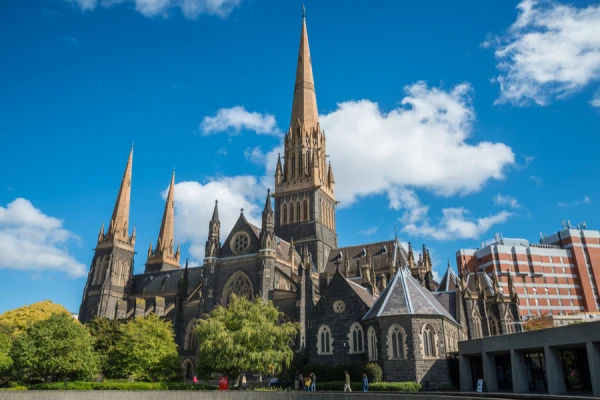
Melbourne cathedral vandalized after Cardinal Pell acquittal

April 8, 2020 CNA Daily News 1

CNA Staff, Apr 8, 2020 / 03:02 pm (CNA).- St. Patrick’s Cathedral in Melbourne was vandalized overnight Wednesday, hours after Cardinal George Pell was acquitted by Australia’s High Court of a sexual abuse conviction and released from prison.

The door to the cathedral was spray painted with a cartoon image of a devil, along with the message “ROT IN HELL, PELL.” Other doors were daubed with upside-down crosses, the words “NO JUSTICE,” “PAEDO RAPIST,” and “The law protects the powerful.” 

Archbishop Peter Comensoli of Melbourne told Australian media that while he was upset about the vandalism, he was “not entirely surprised.” 

“There remains such strong emotions around all of these matters,” Comensoli told Australian news network 3AW.

Images taken of the cathedral showed police in attendance and that at least some of the graffiti had been covered up with a black trash bag. 

<blockquote class=”twitter-tweet”><p lang=”en” dir=”ltr”>Church officials had covered up this graffiti “Rot in Hell Pell” at St. Patrick’s Cathedral with plastic . But revealed it to allow police investigators to examine it. 6pm <a href=”https://twitter.com/hashtag/7NewsMelbourne?src=hash&amp;ref_src=twsrc%5Etfw”>#7NewsMelbourne</a> <a href=”https://t.co/j3LlIJxwWs”>pic.twitter.com/j3LlIJxwWs</a></p>&mdash; NickMcCallum7 (@NickMcCallum7) <a href=”https://twitter.com/NickMcCallum7/status/1247673837942001664?ref_src=twsrc%5Etfw”>April 7, 2020</a></blockquote> <script async src=”https://platform.twitter.com/widgets.js” charset=”utf-8″></script>

A tricycle was tied to the fence of the monastery in a Melbourne suburb where Pell spent his first night of freedom after more than 400 days in prison. 

“I think everyone is going to continue to hold their own particular position on all of this,” said Comensoli, adding that he hoped “people in the cooler light of the evening will consider what the High Court judgment said and see that in its legal context.”

The director of the office of the Archbishop of Melbourne told Australian media that security around the cathedral would be increased in the following days to prevent further acts of vandalism. 

Pell was convicted in December 2018 of sexually assaulting two choirboys at the Melbourne Cathedral in 1996. On April 7, the Australian High Court unanimously ruled that the evidence presented during the trial would not have allowed the jury to avoid reasonable doubt and ordered Pell’s acquittal and release after more than 400 days in prison. 

The High Court’s Tuesday decision marked the end of a nearly three-year legal process which began in June 2017, when the cardinal was charged with several counts of sexual assault dating back decades. The majority of these charges were dropped before they could be brought to trial. 

Pell, who was most recently the Archbishop of Sydney prior to leaving Australia in 2014 for a position of Prefect of the Secretariat of the Economy, has returned to Sydney after his release from prison.

[…]

No Picture
News Briefs

Tornado tears roof from Pennsylvania church

April 8, 2020 CNA Daily News 0

CNA Staff, Apr 8, 2020 / 02:00 pm (CNA).- A Catholic church in the Diocese of Greensburg was among the buildings heavily damaged by a tornado in western Pennsylvania early Wednesday morning. 

Much of the roof of St. Mary of Czestochowa church was… […]

No Picture
News Briefs

‘Thank God I’m healing’: Cardinal with coronavirus sends Easter message

April 8, 2020 CNA Daily News 1

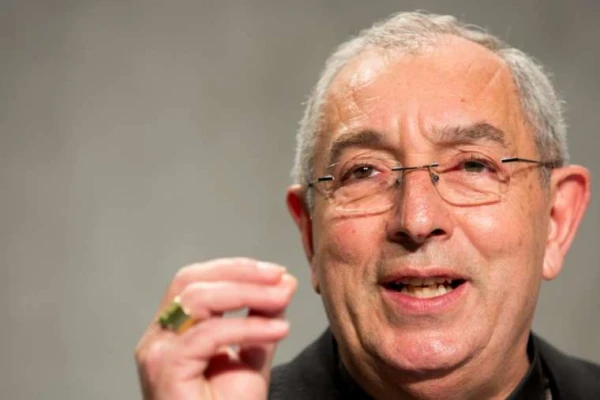
Vatican City, Apr 8, 2020 / 10:30 am (CNA).- The first cardinal known to have tested positive for coronavirus has released a message from hospital, thanking his flock for their prayers and saying he is recovering from the disease.

Writing from the Gemelli Hospital in Rome, where he was hospitalized March 30, Cardinal Angelo De Donatis said: “Thank God I’m healing and I should be discharged soon.” 

The cardinal, who is vicar general of Rome diocese, wrote in an April 8 message that he felt “supported and consoled by the prayers of all of you who have been close to me” during his ordeal. 

He said: “All my gratitude goes to the doctors, the nurses and all the medical staff of the Agostino Gemelli Polyclinic who are caring for me and many other patients, with great competence and demonstrating a deep humanity, animated by the sentiments of the Good Samaritan.”

He also thanked the pope for his prayers and support. While Pope Francis is the Bishop of Rome, the day-to-day leadership of the diocese is provided for by De Donatis, who enjoys broad vicarious authority delegated by the pope.

Referring to Matthew 26:17, where the disciples ask Jesus where they should make preparations for him to eat the Passover meal, the cardinal said: “Meditating on this question, in light of the experience of the disease, I seem to have clearly perceived how none of us can really prepare for Easter without recognizing that, in the first place, it is Jesus who is eagerly yearning to ‘do Easter’ with us.” 

“We only have to welcome the grace and enter with our life into the Paschal Mystery of Christ, ‘who died for our sins and rose again for our justification’. Let us allow the Lord, through His merciful love, to heal our infirmity and to console the sorrows we carry in our hearts.”

[…]

No Picture
News Briefs

Pray-At-Home: How two women were confirmed hours before NYC shut down

April 8, 2020 CNA Daily News 0

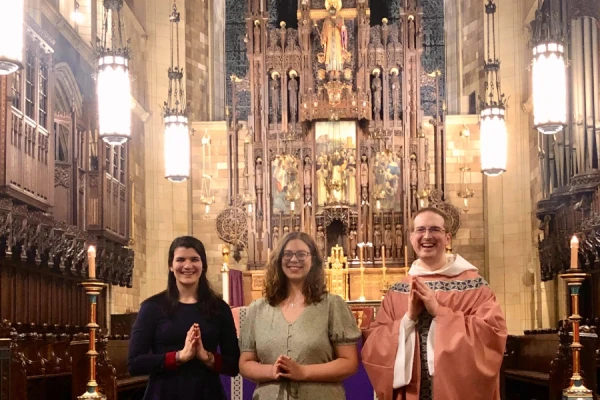
New York City, N.Y., Apr 8, 2020 / 04:00 am (CNA).- Charlotte Price and Ellen Rogers thought they would be getting confirmed together on April 11, the Easter Vigil, at St. Vincent Ferrer in Manhattan. They thought they would have a crowd of their friends with them, and they thought they would be able to celebrate immediately with their loved ones.

None of that happened.

Thanks to the COVID-19 outbreak in New York City, the Archdiocese of New York suspended the public celebration of Mass on March 14, meaning that the chances of an Easter Vigil liturgy a month later looked pretty slim. So the Dominicans who taught Price and Rogers’ RCIA classes did what they did best: improvised.

And that is how, over the course of one year of discernment, prayer, and RCIA, Price went from having never been to Mass to being confirmed at a private one; and from never knowing a religious sister to having an audience of 12 of them at her confirmation Mass.

Raised a Congregationalist in Massachusetts, Price, 34, found herself outside of any sort of religion for about two decades. Her journey to the faith took many twists and turns, but she eventually found herself at St. Vincent Ferrer, and emailing Fr. Joseph Martin Hagan, O.P., the newly-ordained priest who was in charge of RCIA.

Rogers’ journey to the Catholic faith was nearly the opposite of Price’s–she had always been religious, and had even attended Catholic Mass for years.

Raised an Anglican in Texas, Rogers attended the University of Dallas, where she began to feel the call to enter into full communion with the Church around the age of 19. About four years later, after moving to New York City last June, she began that journey in earnest, and signed up for RCIA at St. Vincent Ferrer.

Neither sought out St. Vincent Ferrer due to its connection with the Dominican Order–the church is the location of the headquarters of the Eastern Province–but both grew to appreciate the Dominican friars at the parish.

Rogers was told by a friend that St. Vincent Ferrer was “the most beautiful church in the city,” which prompted her to take a visit.

“I just fell in love with the liturgy and saw they had a big sign outside like ‘email for RCIA,’ and I said, ‘okay.’”

Price told CNA that before attending St. Vincent Ferrer, she did not know what a Dominican friar was, and thought the name  was a reference to the Dominican Republic.

“I was like, ‘is it gonna be in Spanish?’” she said, laughing. After learning that Mass was, in fact, celebrated in English at St. Vincent Ferrer, she began attending regularly.

The two both told CNA that their RCIA journeys went relatively smoothly–until the first cases of COVID-19 were found in the city and churches around the world began shutting their doors and suspending public Masses.

“I probably started thinking ‘this might not happen’ very early,” Price said. “I think I remember the first time I thought, ‘oh, this probably isn’t going to happen’ was Ash Wednesday. And at that point, everyone said I was being ridiculous.”

She said that she took the news of the likely cancelation of Easter Vigil very hard, particularly because she feared the possibility of dying without being confirmed, receiving the Eucharist, or going to confession.

“I was very upset,” Price told CNA. “I mean, I didn’t blame the Church or anything, but especially since I had a much longer period away from any church–like I spent 20 years probably not going to any church at all–so for me, I was like, ‘Oh, I finally figured it out,’ I finally said ‘yes’ to Christ, and now I’m not going to be able to even to join the Church.”

She said because she had read news reports about healthy people her age that were dying of COVID-19, she was particularly concerned about getting her spiritual affairs in order in case she contracted the virus.

“All of a sudden, my mortality is right there,” she said.

“Before, I was like, ‘I’m fine waiting,’” she said. “Whatever God has in mind. But then I was like, if I die, and I haven’t been confirmed, I haven’t gotten to confess my sins, I just absolutely do not want that to happen.”

Price quickly sprung into action, and arranged her first confession. Rogers soon followed suit.

When it became clear that New York was going to implement some sort of shelter-in-place directive, St. Vincent Ferrer moved quickly to accommodate as many people from their RCIA class as possible, but within the city’s guidelines regarding social distancing and canon law. Price responded to the email first, and was confirmed in a private Mass.

The audience was just six friends–the number she was told she could invite–and 12 members of the Sisters of Life, who “sang beautifully,” said Price.

Music, she explained, was one of the things that drew her to the Church, so the experience of getting a private choir at her confirmation Mass was “amazing.”

Fr. Hagan, who celebrated the Mass, preached a homily that was entirely about Price’s journey to the faith. Price took Mary, the Mother of God, as her confirmation saint.

Rogers, who was confirmed at a separate Mass with several others, took St. Catherine of Bologna as her confirmation saint.
Rogers told CNA that her first time receiving the Eucharist was “amazing,” even though it was extremely unusual. Due to archdiocesan regulations aimed at preventing the spread of disease, the candidates had to receive the Eucharist by intinction, which means that the Host was dipped in the Precious Blood before it was given to the communicant.

“All of us were kneeling in the first pew, and Father just came to each of us and brought the sacrament to us,” Rogers said.

“So we were still kneeling, and I will never forget the Precious Body being dunked in the Blood and then looking up and seeing it, and for the first time ever seeing the flesh and blood together and it had never been so real,” she said. “That is the literal flesh and blood of my Savior, and He had just never been so personal, and so real.”

As someone who was raised Anglican, and whose family is very involved in the Anglican communion—her brother is an Anglican seminarian–Rogers said coming to terms with the differences between the communion and rituals she participated in as a child and those in the Catholic Church was one of the hardest parts of her journey into the faith.

“I just decided, it is not for me to worry about anymore,” she said, but she continues to pray that her family will join her across the Tiber.

Both women told CNA that they cried at different parts of their confirmations. For Price, it was when she received the Eucharist. For Rogers, it was when she was reciting the Profession of Faith.

“There’s like a single sentence in the (Profession of Faith), ‘I confess and believe everything that the Holy Roman Catholic Church teaches,’ and it was just that, that one sentence that I could feel my voice trembling and just the single, like, soap opera tear down my cheek,” she said 

“And I was like, hold it together. Hold it together.”

One of the six people Rogers invited to her confirmation was Price, who called the experience “such a gift.”

At that Mass, “I could actually receive Communion for the first time like a normal Catholic,” said Price.

She does not yet know when she will be able to do that again.

The continued suspension of public Masses has not been easy for neither Price nor Rogers, but both said that they have taken immense comfort in their last-minute reception of the sacraments.

As someone who regularly attended Catholic Masses before she was received into the Church, Rogers said that she had been “surprised” by how it felt to watch live-streamed Masses as a freshly confirmed Catholic.

“There’s almost less distance now than there has been,” she said.

“Just the grace of having received the sacraments, and there’s of course longing and sorrow for not being physically present, but knowing that ‘I have received the sacraments. I am in a state of grace. I can recite the act of spiritual communion.’ There is this sense of ‘I am part of the universal Church,’ and that can never be taken from me.”

Price said knowing that she was “really part of a community now” has helped ease her feelings of isolation and loneliness.

“I mean, I’m an only child, but now I have brothers and sisters in Christ everywhere,” she said.

[…]

No Picture
News Briefs

Ponder Christ’s Passion amid the coronavirus crisis, pope urges

April 8, 2020 CNA Daily News 1

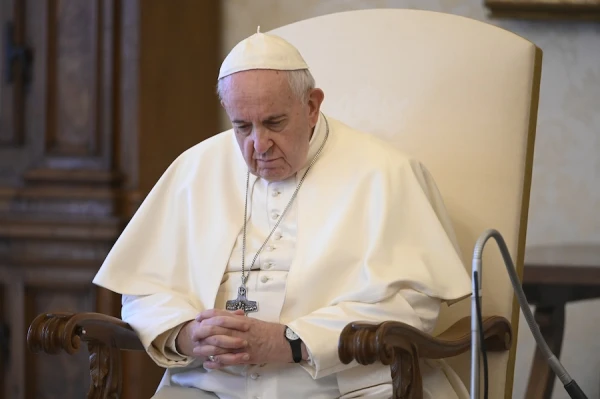
Vatican City, Apr 8, 2020 / 03:30 am (CNA).- Meditating on Christ’s Passion can help us as we struggle with questions about God and suffering during the coronavirus crisis, Pope Francis said at his general audience Wednesday.

Speaking via livestream due to the pandemic, the pope urged Catholics April 8 to spend time in Holy Week sitting in silent prayer before a crucifix and reading the Gospels. 

At a time when churches around the world are closed, “this will be for us, so to speak, like a great domestic liturgy,” he said.

The suffering unleashed by the virus raises questions about God, the pope noted. “What is He doing in the face of our pain? Where is He when everything goes wrong? Why does He not solve our problems quickly?”

“The account of the Passion of Jesus, which accompanies us in these holy days, is helpful to us,” he said.

The people acclaimed Jesus as he entered Jerusalem. But they rejected him when he was crucified because they had expected “a powerful and triumphant Messiah,” rather than a gentle and humble figure preaching a message of mercy. 

Today we still project our false expectations on to God, the Pope said. 

“But the Gospel tells us that God is not like that. He is different and we could not know Him with our own strength. That is why he came close to us, he came to meet us and precisely at Easter he revealed himself completely.”

“Where? On the cross. There we learn the features of God’s face. Because the cross is God’s pulpit. It will do us good to look at the Crucified One in silence and see who our Lord is.”

The cross shows us that Jesus is “He who does not point the finger at anyone, but opens his arms wide to everyone”, the pope said. Christ does not treat us as strangers, but rather takes our sins upon himself.

“To free ourselves from prejudices about God, let us look at the Crucified One,” he advised. “And then we open the Gospel.” 

Some might object that they prefer a “strong and powerful God,” the pope said.

“But the power of this world passes, while love remains. Only love guards the life we have, because it embraces our frailties and transforms them. It is the love of God who at Easter healed our sin with his forgiveness, who made death a passage of life, who changed our fear into trust, our anguish into hope. Easter tells us that God can turn everything to good, that with Him we can truly trust that all will be well.”

“That is why on Easter morning we are told: ‘Do not be afraid!’ [cf. Matthew 28:5]. And the distressing questions about evil do not suddenly vanish, but find in the Risen One the solid foundation that allows us not to be shipwrecked.” 

At morning Mass April 8, in the chapel of his Vatican residence, the Casa Santa Marta, Pope Francis prayed for those who were taking advantage of others during the coronavirus crisis.

“Today we pray for people who in this time of pandemic exploit the needy,” he said. “They take advantage of the needs of others and sell them: the mafia, loan sharks and many others. May the Lord touch their hearts and convert them.”

On the Wednesday of Holy Week, the Church focuses on Judas, the pope said. He encouraged Catholics not only to ponder the life of the disciple who betrayed Jesus, but also to “think of the little Judas that each one of us has inside of us”.

“Each of us has the ability to betray, to sell, to choose for our own interest,” he said. “Each one of us has the possibility of letting ourselves be attracted by the love of money, or goods, or future well-being.”

After Mass, the pope presided at Adoration and Benediction of the Blessed Sacrament, leading those watching around the world in a prayer of spiritual communion. 

[…]

No Picture
News Briefs

Bishops can do more to provide sacraments despite coronavirus fears, open letter claims

April 7, 2020 CNA Daily News 12

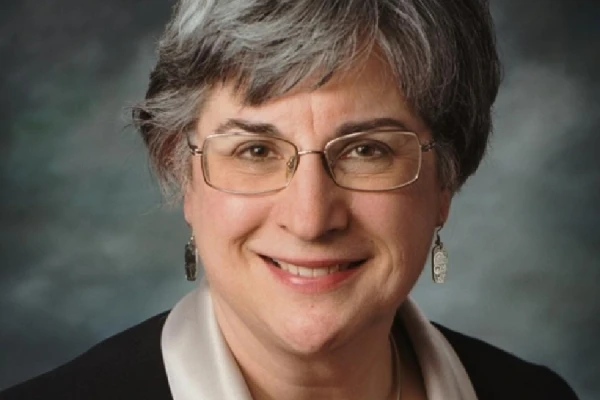
Denver, Colo., Apr 7, 2020 / 05:46 pm (CNA).- In the wake of the coronavirus epidemic, the nationwide shutdown of Catholic churches has halted regular Mass attendance and impeded access to other sacraments for the Catholic faithful. Now, some Catholics have endorsed an open letter asking the Catholic bishops to do everything possible to make the sacraments more available.

“We don’t absolutely need to have the Eucharist, but we want to be in the presence of the Eucharist, we want to have Mass said. We want adoration, we want processions, we want all these things,” she told CNA April 2, describing the goals of the open letter and its supporters.

“We’re putting our emphasis on the last rites, the Anointing of the Sick, and Mass and Adoration,” said Smith, a retired professor of moral theology at Detroit’s Sacred Heart Major Seminary. For her, the greatest concern is what she says is “the failure to work extremely hard to make certain that those who are sick and dying can receive the anointing of the sick.”

“Most concerning is the refusal by at least one bishop to permit his priests to give the sacrament of Anointing of the Sick,” Smith told CNA. “I am impressed with one order who offered to make it more available even to those who are not terribly sick. The sacrament does have the power to heal and strengthen.”

Amid the pandemic, some American dioceses have allowed pastors to administer some sacraments and devotions in conformity with government rules banning large assemblies of people. Some priests have implemented “drive-through” confessionals or “drive-in” Eucharistic adoration and benediction.

Some bishops have regularly livestreamed messages and Masses, or adore the Eucharist in public view on cathedral steps.

Other bishops have had a more cautious reaction. Some have locked all church buildings in their diocese, and have attempted to bar the administration of all sacraments except in danger of death, even if not required by law or public health recommendation to do so.

“The precipitous closing of the churches is very concerning.  In Rome within 24 hours after they were closed, they were reopened. In those places where the law has decreed that people must stay home, we should abide, but if churches can be open, they should be. Surely we can ensure that for private prayer and adoration, people can remain 6 ft apart,” Smith said.

“The one size fits all policy seems very wrong headed. In small rural communities with no outbreak of the disease, more freedom to gather should be permitted than in urban communities that are being devastated by the disease,” she added.

For backers of the open letter, more needs to be done for the laity.

“Bishops, we, your faithful flock, implore you to do everything you can to make the sacraments more available to us during this crisis. Something is terribly wrong with a culture that allows abortion clinics and liquor stores to remain open but shuts down places of worship,” the open letter says.

“While safety and cooperation with civil authorities is necessary, we must do everything we can to have access to what is essential for our spiritual lives. We should certainly not voluntarily deprive ourselves of the sacraments.”

Smith said the bishops’ response to the coronavirus pandemic has been about about “trying to protect human life,” and the letter endorsers “share completely” that goal.

“We don’t want anything to be done that isn’t following the guidelines,” she said.

The open letter encourages bishops to do everything possible t o provide some form of a public Mass, especially for the Easter liturgy, including offering it themselves.

It is unclear whether some gatherings, like “drive-in” Masses offered in parking lots while attendees sit in their cars, would comply with government bans on large public gatherings, a local bishop’s ban on public Masses, or public health experts’ recommendations on social distancing.

The open letter asks bishops to “demand that civil authorities permit events such as offering and attending a Mass in a parking lot, if they are currently prohibited.”

Smith said if a state or local government ban on large public gatherings includes people going to a parking lot in their car to hear Mass, “that has to be fought.”

“We want the bishop calling up the governor and the mayor and calling up the legislators and calling up whoever, and saying ‘No no no, this is freedom of religion that we have to be allowed to do’,” she said.

“We are not asking for anything that would put our neighbors in danger. All due precautions would be observed. How can a parking lot Mass where everyone drives there in their cars and stays in their cars and where there is no distribution of the Eucharist put anyone at danger? That is one of our chief requests to be put under consideration.”

“There is absolutely no way that this relates to the spread of the virus,” Smith told CNA.

Asked if letter organizers had consulted with public health experts on their proposals, Smith said:

“We didn’t consult any, although we have heard from many who have provided more good ideas on what can be done. We are not proposing anything specific but are asking the bishops to do everything they can to provide the sacraments within the parameters determined necessary by experts.”

Smith herself raised and then answered the question of whether organizers should have gone directly to the bishops. She said “it’s not possible.”

“They’re busy with meetings, and it’s hard to get through,” she said. “But if you do a petition that we hope thousands will sign, then I hope we get their attention.”

The open letter advocates that civil authorities recognize religious services as “essential services,” a move which some states have done amid stay-at-home orders.

Referring to emergency declarations’ distinction between “essential” and “non-essential” employees and businesses, Smith said she is concerned “the Catholic world does not seem to understand that it is simply wrong to concede that religious services are ‘non-essential’.”

“Yes, we can dispense with them as virtually everything can be dispensed with in certain conditions,” she said. “But the conditions we are in right now do not, at least as far as the experts tell us, require all that our bishops have done and have allowed to be done.”

In Smith’s view, “the bishops are missing in action in clearly responding to the spiritual needs of their people.” She acknowledged that almost all bishops are streaming Masses on Sunday, saying this is “a good thing” but “not the most important thing.”

While she has seen many priests doing “very innovative things” to make available the sacraments and ensure the spiritual needs of their people are being met, she others are not visibly doing enough. Some, she said, were “almost denying sacraments before they needed to.”

“We need bishops who are trying as hard as priests are to attend to the spiritual needs of people,” she said. “They are making decisions that impact our spiritual lives and we need explanations of them. We need them to tell us how we can keep our spiritual lives alive.”

The “We are an Easter People” open letter said that if the government prohibits priests ministering to the sick in the hospital or their homes, bishops should “make a personal and formal request of civic leaders to permit such ministry with assurances that all due precautions will be taken.” They should find ways for priests to provide the anointing of the sick, “especially to those at risk of dying.”

While priests who minister to the sick are encouraged to take precautions like wearing personal protective equipment, such equipment has been the subject of a nationwide shortage. Smith acknowledged the shortage and said health care professionals should have priority for their use. In many places, she added, there is not a shortage. She added that an increase in manufacturing could eliminate a shortage before long.

The open letter lists more than 20 project endorsers, including Catholic commentators, video bloggers and others. More than 24,000 internet users had signed the letter as of Tuesday afternoon.

Project endorsers include Thomas Farr, president of the Religious Freedom Institute; former abortion clinic manager Abby Johnson; Phillip F. Lawler, editor of Catholic World News; and Dr. Jennifer Roback Morse, founder and president of the Ruth Institute; Catholic speaker Mary Beth Bonnaci, a Catholic speaker; podcaster Matt Fradd; author and movie producer Steve Ray; and Daily Wire columnist Matt Walsh.

In mid-March 2020, after the coronavirus had begun to devastate Italy, Farr told CNA that bans on religious gatherings due to high rates of deadly infection can be justified, but may not target a particular religion or religion in general. They should be based on “overwhelming evidence,” with clear time limits.

“Speaking as a Catholic for whom the sacraments are not optional, and are necessary to health and welfare, however, I would hope that the Italian Church, or the Church in any jurisdiction would do everything it could reasonably do to make the sacraments available in ways that would be consistent with just authority,” Farr said.

“We invited people who have large followings in the Catholic community who would have an interest in having the sacraments and having their bishops explain their choices,” Smith told CNA.

One open letter endorser, Peter Kwasniewski, is an independent scholar who signed a 2019 letter accusing Pope Francis of heresy. Another endorser, YouTube video caster Patrick Coffin has expressed skepticism regarding of media reporting and the government response to the coronavirus.

In a March 28 YouTube video titled “The Truth About the Commie Virus,” Coffin discusses “media-fueled hysteria” and “hyperbole” about coronavirus models. They are “misleading, because they are incomplete,” he said in the video and its description. After presenting his interpretation of a medical journal article co-authored by Dr. Anthony Fauci, Coffin declared “We are burning the house down to kill a termite.”

A March 24 video from Coffin is entitled “Did Pope Francis Help Cause the Covid-19 Pestilence?”

Project endorsers have “a wide variety of views,” Smith told CNA. “They are endorsing us; we are not endorsing all their positions.”

Both expert opinion and public opinion about the coronavirus response have changed in recent months. Two separate surveys from a Public Agenda-USA Today-IPSOS and ABC News-IPSOS suggest a vast majority of respondents now support canceling large-scale events. Most Americans now say they are avoiding large gatherings or crowds, and a significant minority now say they avoid religious services.

The letter’s request, Smith told CNA “is one that helps us grow in the virtues that enable us to do all the good things we should be doing now. We should speak of our love for Jesus and our need for Jesus. Our belief that He is truly there in the sacrament and just being close to him is a powerful experience of intimacy with the divine.”


[…]