

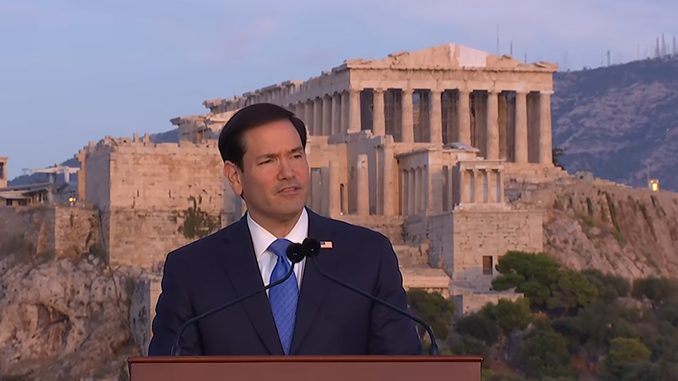
This past Wednesday, Secretary Rubio gave a widely viewed speech atop the Acropolis in Athens, largely focusing on the ancient Greeks’ contributions to Western civilization, then applying their lessons to the current geopolitical scene. Pundits, academics, and numerous X-cognoscenti came out with their red pens almost immediately: he left out this, he made that historical mistake, he was one-sided, and so forth.
It seemed that everyone with an opinion on the nature of the classical Greeks and of Western civilization immediately started grading the copy presented by Marco Rubio, college freshman.
But the speech was given by the U.S. Secretary of State, the Honorable Marco Antonio Rubio. And he gave a speech to a specific audience on the occasion of a state visit. Rhetoric 101 would indicate that those circumstances would enter the character and content of the speech, and Reading 101 would counsel pausing one’s judgmental impulse and asking a series of preliminary questions: Who, exactly, was his audience? What were his aims? How did he choose to go about speaking to them with those aims in mind? How much time did he have to speak?
Answers to those questions would shed light on various themes and emphases, as well as abrupt transitions or silences. Then one could ask the next question: on his own terms, was he successful?
A concentric circle of audiences
Even a quick perusal of the speech and a moment’s reflection indicate that Secretary Rubio’s intended audience was, in fact, several audiences. One can imagine them as a series of concentric circles. First, there was his immediate audience—members of the Greek government and diplomatic corps. He had just worked with them and completed a successful diplomatic mission, one that tightened the bonds of their alliance. Acknowledgement and gratitude were in order.
Then, more broadly, the Greek people. Since he was in Greece, he had the heightened attention of all the Greeks, both the political class and the citizenry. It would have been a missed opportunity not to take advantage of it. In this context, praising their heritage would be a no-brainer, indicating respect and admiration. Again, Rhetoric 101.
But if that was the only goal, it would be little more than diplomatic boilerplate—and the chosen setting would have been dramatic overkill, rather than constitutive of a message. Given the deliberately chosen spectacular venue, with the Parthenon visible in the background, more was clearly intended. This “more” included speaking about important matters to the Greeks, but going beyond them to include messages to friends and foes beyond the peninsula.
For Greece is part of a greater whole, most immediately the European Union, a bit more broadly, of Europe. Fellow Europeans—again, both members of officialdom and ordinary citizens—were also intended recipients of the Secretary’s Greek-focused words. What Secretary Rubio had to say to them concerned their shared status and fate as Europeans.
This wider European context sheds light on the limits of the Greek focus of the Secretary’s remarks. One can easily imagine alternative speeches in Paris, Berlin (he had already spoken in Munich), Rome, London, or Warsaw. These different settings and their immediate and national audiences would call for different emphases and history lessons. Again, Rhetoric 101. That the speech took place in Athens and was directed to a Greek audience helps make sense of the speech’s rather hyperbolic claims for the ancient Greeks and the relative short shrift given to other components of the West.
The short shrift, however, can be overstated, and the Greek claims are serious and well worth pondering.
Through a Greek prism, what did he say to both the Greeks and the broader European audience? He reminds them that they are all members of Western civilization. He warns that this unique and uniquely great civilization today faces dire threats and its members—individually, nationally, and collectively—face a fundamental decision: “today, we find ourselves at a crossroads.” The civilizational order to which they all belong and which has formed them deeply and profited them enormously is under attack from without and within. It is this fundamental two-part claim that informs and guides his rhetoric, even when speaking of Greece to Greeks.
It also brings to light his third intended audience: the enemies of Europe, America, and Western civilization. They are, in the course of the speech, put on notice: America sees you, and America is working day and night to fight you. It does so with unprecedented means of hard power, and it seeks to do so by rallying the countries and forces of the West to join the battle already underway. The diplomatic meetings in Athens were but one small part–a positive and instructive part–of a much wider campaign. The Secretary’s speech was designed to spell out their significance and amplify their results.
The Ancient Greeks, thumos, and Europeans today
Given his Greek audiences and setting, the Secretary emphasizes the ancient Greek contributions to Europe and the West. In so doing, he is guided by a complex judgment about Europe and the world “today” and therefore especially emphasizes in the Greek contributions what he judges Europeans are most in need of today: thumos, spiritedness, the psychic root of courage, daring, adventuresomeness, and the defense of one’s own. Thumos was, and always is, indispensable for the defense, as well as the development, of a civilization of human liberty and striving for excellence. The ancient Greeks knew this, practiced it, and taught it.
Therefore, the Secretary is not the first person to note the importance—in truth, the indispensable role—of thumos in the defense of liberty and civilization. Long ago, Aristotle observed that civilized liberty, understood as the self-government of free men bent on developing their humanity with excellence, required the arts of intelligence and the stout psychological disposition of spirited courage. Slavish peoples may be advanced in the arts, but, lacking spiritedness, succumb to despotism, while spirited barbarians, lacking the arts, could not achieve civilized or ordered liberty. This requires a political life and a certain sort of culture.
As the Secretary put it:
For the Greeks of antiquity, the pursuit of excellence was the very principle of man’s existence. They organized all of civic life around contest, ambition, competition: … The classical Greek city was an arena for great men to test and prove themselves.
A more recent philosophical author, Jacob Howland, confirms the Secretary’s general portrait: “Like all aspects of Greek public life since at least the time of Homer, this arena was structured as an agon, or competition.”
Following the lead of Plato and Aristotle, Secretary Rubio roots this hothouse of human ambition and world-historical flowering of human achievement within a part of the human soul:
The thumos, as the ancient Greeks called it – the fire of passion, strength, courage, pride – is the heart of great civilization.
“And,” he adds, “without it, nations will lose their will to fight, the will to strive, the will to survive.”
This is not just a lesson of history or a theoretical possibility:
Today, too much of the West has forgotten this quality. Over time, we in the West came to feel ashamed of the very things that made us exceptional. We felt embarrassed that our achievements set us apart from the rest of the world. … We no longer believed we deserved and had earned our greatness.
From this invidious contrast between then and now, one can see an important characteristic of Secretary Rubio’s rhetoric. With the same model, he can judge and shame, as well as instruct and encourage. More broadly, a bilateral relationship of the present West to its past is established, one not captive to progressive historicisms.
The Contemporary Greek Model
Fortunately, not all current Europeans fit the foregoing description, and the Secretary can hold them up as models to their fellow Europeans. In the first instance, he can praise and commend his hosts directly. “The people of this nation have proved themselves once again to be an indispensable friend to Europe and to the United States alike, on everything from energy to migration to defense, where Greece has been a model ally.”
The point is so important that the Secretary repeats it, again employing the term of “model”:
We have built a model of [bi-lateral cooperation] with our partners here in Greece. In our defense partnerships, in energy and technology, in our shared ambition to secure Europe’s borders from the threats of mass migration.
The ancient spirit is not extinguished in its native land, and therefore Greece once again can serve as a model and inspiration to the other nations of Europe.
Encouraged by this successful partnership, and by many “other signs,” including unprecedented increases in defense expenditures pledged the year before at the Hague, the Secretary expresses a hopeful belief about the future: “We believe that Europe can awaken from its long slumber and rekindle the fire that was lit here millenia ago.”
Western heroism
Some commentators, however, have taken the Secretary to task in connection with thumos, rightly pointing out that in the classic treatment of thumos in Plato’s Republic, Socrates insists that thumos needs to be guided and indeed governed by a form of reason–by a faculty he calls logistikos.
However, these same people fail to note that later in his speech, Secretary Rubio connects thumos with “heroism, honor, [and] duty” and says that “these are the qualities that would shape the Western moral imagination.” Thumos is necessary, but is not sufficient, to build and sustain, or rebuild, a civilization. One needs heroes and heroism, duty and loyalty. Like thumos, “[i]t is from the Greeks that the West inherited its sense of duty – an unbreakable loyalty to one’s code, one’s cause, one’s country.” In this connection, the Secretary ventures a general proposition:
Our heroes, the heroes of the West, are those who choose to remain faithful to their duty precisely when it is most difficult and painful to do so.
He then provides a list of heroes of the West that runs from Socrates and the 300 Spartans at Thermopylae to “the Christian martyr who refused to betray his faith to the patriot who gave his life for his country; from Saint Thomas More to the Battle of the Alamo, running through the immortal closing words of the Declaration of Independence of the United States, which says, “We mutually pledge to each other our Lives, our Fortunes and our Sacred Honor.”
He thus presents thumos as a guiding thread through the phases and iterations of Western civilization, the necessary support for its various components, religious and patriotic, to shine forth. One is reminded of Péguy’s linking of “heroes and saints” in the distinctive moral catalogue of the West. In any event, thumos is never considered as untethered from other goods.
As the references to the Alamo and the Declaration of Independence suggest, the American Secretary is keen to connect that thread and those components to America itself.
America and the Western spirit
Once again, keeping his eye on human peaks, he declares that
[t]he greatest Americans of every generation have carried the unmistakable features of their forefathers – born in Athens, formed by Rome, baptized in Christendom, hardened in the furnace of medieval Europe, endowed with the English genius for liberty, and then carried across the Atlantic to be reborn on the shores of a new world. In essential ways, America is an epitome of Western civilization.
More generally put:
[I]n America, that same tradition rediscovered itself [and …] became the site of a great revival of Western imagination and ambition. The Greek aspiration for new horizons became the American frontier spirit. Nor is that spirit moribund or inactive in America today. Under the Trump Administration, America has chosen to reach for new frontiers: in advanced manufacturing and super intelligence; in drones, weapons, and warfare; in chips, minerals, cyber, and every other domain of human possibility. To unleash our energy, to rebuild our factories, to return our astronauts to the moon and launch a new age of exploration in space.
A final lesson from the classical Greeks
All these initiatives (and others I omit) are rooted in a geostrategic vision and attitude, in which nation-states are the chief political agents, and there are “great powers,” “adversaries” and “rivals” in the world. One must think, prepare, and act accordingly. This is part of “the classical understanding of politics and of statecraft that the Trump Administration hopes to reclaim–reclaim not just for our country, but for the whole of our civilization.”
Those–whether enemy, rival or ally, or neutral party—who have seen the Trump administration reverse mistakes of previous administrations and take steps “to take back control of our critical supply chains, to reindustrialize our economy, to rebuild our defense, [and] to fight for dominance of the technologies and industries of the future” are informed in the speech about the thinking behind them. A plurality and hierarchy of goods and goals is laid out, moving from national defense to national supremacy in the technologies of war, from maintaining a distinct way of life to being a leader-member of an alliance of Western nations. National sovereignty is to be carefully protected, but also respected in others. And on that basis, mutually beneficial alliances are sought and welcomed, especially from those sharing the same civilizational values.
Greece can bear witness to this American volition, as can two northern nations, recent beneficiaries of “an unprecedented new agreement between the United States, Denmark, and Greenland – an agreement that will reshape the Arctic and bolster the security of all of NATO.” A geostrategic vision that recognizes “adversaries and rivals” does not ipso facto preclude friendship and cooperation; quite the contrary.
Success?
Above, we said that after taking pains to understand the aims and rhetoric of the Secretary in this widely publicized speech, one could raise the question, how successful was it on its own terms?
On one hand, it is too early to answer definitively, and time will tell. However, it provides its own criteria for judging what the future brings. Will European countries return to the spiritual sources that formed them? Will European nations recognize the threats to them, to their essential natures, and their historical vocations? Will they form alliances with like-minded countries to defend themselves, their values, and their sovereignty? Will they act in ways that one could recognize as “heroic”?
However, I would add a result that one could already put in the “successful” column. With this speech and his earlier speech in Munich, not to mention Vice President Vance’s more belligerent 2025 Munich speech, the Trump administration has put “Europe” and “the West” on the table for public discussion more than at any time in recent decades: for Europe, going back to 1989-91 and the collapse of Soviet Communism; and for the West, since, say, Samuel Huntington’s 1996 book on The Clash of Civilizations and the Remaking of World Order.
This has broadened and deepened a discussion often cast in terms of personalities, entrenched interests, and cosmopolitan fantasies. In particular, the speech at the Acropolis reminded its hearers and readers that the matter of what we are to do also implicates the questions: Who are we? What are we living for? And what are we willing to die for?
If you value the news and views Catholic World Report provides, please consider donating to support our efforts. Your contribution will help us continue to make CWR available to all readers worldwide for free, without a subscription. Thank you for your generosity!
Click here for more information on donating to CWR. Click here to sign up for our newsletter.


Leave a Reply