


With the completion of its 566-foot central tower this past February, the Basilica of La Sagrada Familia now holds the distinction of being the tallest church in the world. Earlier this month, Pope Leo XIV traveled to Barcelona to bless the tower, marking the structural completion of Antoni Gaudí’s masterpiece after 144 years of construction.
While global attention has rightly focused on this monumental achievement, few outside of Barcelona realize there is another basilica in the city that, in a sense, stands even closer to the heavens.
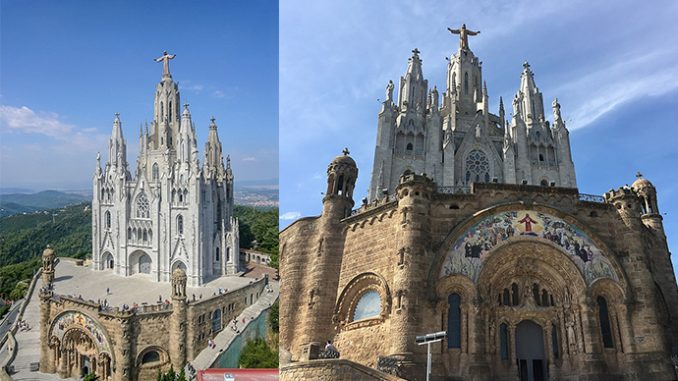
Perched atop the 1,680-foot summit of Mount Tibidabo rises the striking Expiatory Temple of the Sacred Heart of Jesus (Temple Expiatori del Sagrat Cor de Jesús)—a church whose very name proclaims its purpose.
Reparation lies at the heart of devotion to the Sacred Heart, celebrated throughout the month of June. So it is worth reflecting on this remarkable monument, which quite literally pierces the clouds above Barcelona as a lasting act of reparation.
The sheer effort required to construct such a basilica atop a steep mountain is staggering. What could have compelled the faithful of Barcelona to undertake such a feat? The answer is carved in marble above the high altar: IVSTVS PRO INIVSTIS—“the just for the unjust.”
The name Tibidabo itself carries a spiritual warning. It derives from the Latin phrase spoken by the devil during the temptation of Christ: tibi dabo—“I will give to you” (Lk 4:6). From a mountaintop, Satan offered Christ all the kingdoms of the world. Though Christ rejected the temptation, many Catholics in late nineteenth-century Barcelona feared their society was beginning to accept the evil one’s empty promises.
Secularization was spreading, and rumors circulated that a Protestant church and a casino might be built atop Tibidabo. Given the mountain’s commanding presence over the city, such developments were deeply troubling. It seemed unthinkable that symbols contrary to the Catholic identity of Spain should loom over Barcelona.
In response, a group known as the Board of Catholic Knights moved swiftly to purchase the land before such plans could materialize. At first, no one dared to imagine building a church on the summit.
Providence intervened in the form of St. John Bosco (1815-1888), the Italian priest and founder of the Salesians, who visited Barcelona around this time. Don Bosco had already begun constructing a church dedicated to the Sacred Heart in Rome in 1879, part of a broader movement encouraging devotion and reparation in response to the upheavals of modern Europe.
Just a few years earlier, the Basilica of the Sacré-Cœur had begun rising over Montmartre in Paris as an act of national penance following the French Revolution. Inspired by this same spirit, Don Bosco encouraged the faithful of Barcelona to consecrate Tibidabo to the Sacred Heart.
The land was entrusted to the Salesians, and in 1886, a small neo-Gothic hermitage was erected, ensuring that prayer would precede construction.
Work on the present basilica began in 1902 under the direction of architect Enric Sagnier (1858-1931). Transporting the immense quantities of stone required for the project became possible only with the construction of a funicular railway, still used today by pilgrims and tourists.
The crypt was completed in 1911. Built in a Neo-Byzantine style, it appears to emerge from the mountain itself, with its brown stone exterior and arched entrance. Inside, vibrant mosaics and tile-work cover the walls and ceilings, creating a richly adorned space that served as a place of worship while the upper church remained unfinished.
Construction of the main church began in 1915, its pale stone rising above the darker crypt. But progress came to a sudden halt in 1936 with the outbreak of the Spanish Civil War.
This devastating conflict pitted Nationalist forces against the Republican government and unleashed widespread violence. In Republican-held areas, the Church suffered intense persecution. By the war’s end in 1939, nearly seven thousand clergy and religious had been martyred, and countless churches, convents, and schools destroyed.
The Expiatory Temple did not escape this destruction. The large bronze statue of the Sacred Heart that once crowned the church was torn down.
Yet from the ashes of war came renewed resolve. Construction resumed as an act of reparation—not only for the broader sins of society but also for the violence and sacrilege that had scarred the nation.
The final phase of work concluded in 1961. Five towers were added to the facade, and most strikingly, the destroyed statue was replaced. Today, a 25-foot bronze figure of the Sacred Heart stands atop the central tower, visible across Barcelona—a powerful symbol of Christ’s enduring sovereignty and love.
Those who ascend Mount Tibidabo are rewarded with sweeping views of the city. From the basilica’s terrace—and even more so from the narrow stairways leading to the observation point at the statue’s base—visitors can take in a breathtaking panorama: the Mediterranean Sea, the Collserola mountains, and the sprawling city below. Rising among the rooftops, the towers of La Sagrada Familia can be clearly seen.
Inside, the basilica’s neo-Gothic interior is comparatively restrained. Light filters through rose windows, illuminating clean stone lines that draw the eye upward toward the octagonal dome. The simplicity of the sanctuary focuses attention on the crucifix above the altar, inscribed with the words “IVSTVS PRO INIVSTIS”
This phrase, drawn from the First Letter of St. Peter, expresses the mystery at the heart of Christian faith: “Christ also suffered once for sins, the just for the unjust, that he might bring us to God.”
Humanity, wounded by sin, owes a debt of justice it cannot repay on its own. Only Christ—the God-Man—can offer adequate satisfaction, which he does in and through his sacrifice on the Cross. Yet we are invited to unite our own acts of reparation to his perfect offering.
In the seventeenth century, Christ revealed his desire for such reparation through visions granted to St. Margaret Mary Alacoque. He lamented the ingratitude shown toward his love, symbolized in his pierced heart, and called for acts of devotion and atonement. From this call arose the Feast of the Sacred Heart and the practice of First Fridays.
The Expiatory Temple atop Tibidabo stands as a monumental response to that call. It is a testament to the faith, courage, and generosity of those who sought to offer “justice for injustice” in stone.
Especially in this month dedicated to the Sacred Heart, their example invites imitation. While few are called to build a temple of stone, all are called to build a living temple—through lives marked by faith, hope, and charity, offered in reparation for a world still in need of redemption.
If you value the news and views Catholic World Report provides, please consider donating to support our efforts. Your contribution will help us continue to make CWR available to all readers worldwide for free, without a subscription. Thank you for your generosity!
Click here for more information on donating to CWR. Click here to sign up for our newsletter.
Thank you for the beautiful article that highlights the main points about the marvelous temple on the mountain top focused on reparation to the Sacred Heart , gets blessed in its 144th year! Our times that can feed the spirit of impatience and hasty ill informed attitudes – even conflating the name ‘ Gaudi ‘ with gaudiness and related annoyance that it was taking all these years , to repent and instead have the reparative aspect of gratitude with the 144,000 and more that helped to build the temple & all who would be visiting and adoring The Father with our Lord in The Spirit for the good of all of humanity .
The heart tissue said to be of same structure as of the womb .The faith like a mustard seed to remove the mountains of evils and debts of our human family – how our Lord was making reparation from moment of His Incarnation of His mustard seed stage .
https://en.luisapiccarretaofficial.org/news/christmas-novena/54
May The Spirit help us to see the temple on every mountain top to raise our hearts in praise and adoration , to have a little taste of paradise here on earth as the topic of the recent talk of Mo. Gabrielle . FIAT !
https://www.youtube.com/watch?v=jmrjfFZNSwY