


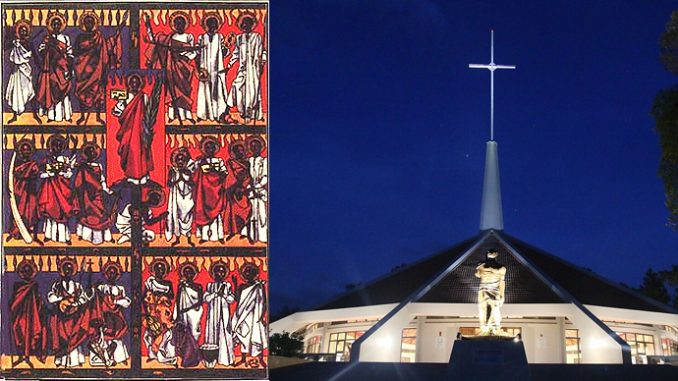
In the history of the Church, there have been many Christians who have been bluntly told that if they did not renounce their faith in Jesus Christ, they would be killed. But martyrdom is usually more complicated than denying an article of the Catholic Faith. That was certainly the case in nineteenth-century Uganda.
In the nineteenth century, European businessmen began to recognize the economic opportunities that could be found in Africa. As European nations gradually realized that Sub-Saharan Africa offered them a source of cheap labor and raw materials, the race to conquer and colonize African territory began in earnest.
It must be admitted that Europeans tended to treat the Africans like children, an attitude that saints like Italian missionary and bishop Daniel Comboni (1831-1881) publicly lamented. European nations began seeking control of different territories, which is why this period is sometimes called the “Scramble for Africa”.
On the other hand, Catholic and Protestant missionaries came to the African continent for a completely different reason: souls. Obeying Christ’s great commission, they wanted to spread the Gospel to people who had never heard of Him before. Muslims also began expanding their territories during this period.
The native leaders of central African kingdoms did not understand European history, European economic motivations, Christian evangelization, or the difference between explorers, soldiers, and missionaries. What they understood was that Europeans possessed weapons, medicines, and other goods, which they wanted.
In 1875, a British American explorer came to Buganda, the Bantu kingdom located in modern Uganda. He met the kabaka (ruler) of the Buganda, Mutesa I, and asked permission for Christian missionaries to enter his kingdom. Mutesa agreed.
Arab Muslims, English Protestant missionaries, and French Catholic missionaries thus arrived in Buganda, and each explained their beliefs to Mutesa and the members of his court. Each group made converts.
But the native pagan beliefs of the Bugandans were part of their culture, and those beliefs included the practice of polygamy. Islam’s toleration of polygamy led some men to become Muslims since it did not require them to put away their wives. Islam also tolerated pedophilia. Kakaba Mutesa was repulsed by the idea of circumcision, so he rejected Islam, but he pretended to side with each religious group in turn.

And then Mutesa died. After his death, a new leader was selected among Mutesa’s sons. Sixteen-year-old Mwanga was chosen to be the new kabaka.
A kabaka’s court typically included his many wives, family members, chiefs, and those he appointed to perform various tasks. Local chiefs regularly sent their young sons to serve as the kabaka’s pages, and those pages who demonstrated loyalty could hope to be rewarded with important positions as they grew up.
The Catholic and Protestant missionaries had already become familiar with Mwanga’s personality before he became the kabaka. They understood that he was young and inexperienced as a ruler. They worried most about his selfish, suspicious, and unpredictable behavior. They also knew that he was having sexual relations with the boy pages, that he sometimes drank too much, and that he smoked hemp.
In late 1885, a Protestant missionary told Mwanga that an Anglican bishop named Hannington was on his way to Buganda for a friendly visit. Mwanga became convinced that the bishop’s traveling route was meant to show the weakness of his kingdom’s borders. The missionary tried to explain that the trip was peaceful, and Mwanga pretended to agree. But he secretly sent a group of men to kill the missionary, along with all those who were traveling with him. When the news of the murders reached the court, Mwanga acted like he knew nothing about it. However, everyone knew the truth.
Twenty-five-year-old Joseph Mukasa Balikuddembe had grown up in the court of Kabaka Mutesa and was considered so trustworthy that he had been made the personal attendant of both Mutesa and Mwanga. He had become a Catholic, and he was deeply disturbed about the murder of the innocent clergyman and his companions, also recognizing that Mwanga’s actions would have consequences with the British. Joseph spent all night trying to explain to Mwanga that the murder had been wrong and that his father, Mutesa, would never have done such a thing.
Mwanga fumed over Joseph’s correction and the knowledge that his secret plans were not so secret. Mwanga also resented the fact that Joseph had chastised him in the past about having sexual relations with his pages. He probably realized that Joseph had sometimes sent the Christian pages away on random errands to protect them from Mwanga’s sexual propositions.
In Buganda, the kabaka was more than the head of state. He also wrote the laws, changed the laws, judged lawbreakers, and decided on all punishments. His household staff included executioners, who were called upon to torture and execute anyone who offended Mwanga, sometimes merely because Mwanga was in a bad temper. Although Mwanga had an older chancellor named Mukasa to advise him, the chancellor hated the Christians and manipulated Mwanga for his own purposes.
On November 15, 1885, the angry Mwanga publicly accused Joseph of disrespect and of trying to poison him. He ordered Joseph to be executed immediately. Without a word of complaint, Joseph repeatedly stated that he accepted that he was dying for his religion and forgave Mwanga. He was beheaded, and his body was burned to ashes.
One might think that the martyrdom of Saint Joseph Mukasa would have deterred members of Mwanga’s court from calling themselves Christians or even wanting to become Christians. Instead, dozens of people, particularly the young pages in Mwanga’s court, began coming to the Catholic missionaries’ tent at night to receive instruction about the Catholic faith so that they could be baptized. They wanted to be with God in heaven, and they were willing to die for that privilege. (Note that many also sought out baptism from the Protestant missionaries, but that is their story to tell.)
These conversions continued for months after Joseph’s death. The converts knew that Mwanga’s fickle nature could lead them to face death at any moment, but they were joyful to be Christians and were eager to outdo one another in living virtuously as followers of Christ.
In late May 1886, Mwanga found out that one of his pages had been teaching another page named Mwafu about Jesus Christ. Mwafu was Mwanga’s favorite. Enraged that Mwafu might refuse his sexual demands if the boy became a Christian, Mwanga took drastic action. He ordered the gates around his court to be locked that night so that no one could escape. Recognizing the danger, many of the Christian catechumens were secretly baptized.
The next day, Mwanga called all the pages into his court. He demanded that the Christians seat themselves on one side of the room, away from the others. He interrogated some of the pages to make sure no Christians were hiding. When he asked the seated group if they were all Christians, they replied that they were. “Are you unshaken in your resolve to remain Christians?” Mwanga asked. They replied, “Yes, quite definitely! … If you choose not to regard that as a crime, we shall be grateful to you, but we shall never cease to be Christians, whatever the outcome.”1
According to custom, when groups of people were condemned to death, they were sent to an execution site at Namugongo. Mwanga2 ordered most of the Christians to be sent to Namugongo, although he merely imprisoned and later freed others. The martyrs, ranging in age from thirty-six to fourteen, were tightly bound by their hands, feet, and necks, and painfully marched through the forest. The trip took days. According to custom, some of them were executed along the way, with their bodies left behind as a warning to others and as food for wild animals.3
On June 3, 1886, twelve men and boys, led by Saint Charles Lwanga, were greeted by shrieking, painted pagan executioners. The executioners had prepared a huge pyre to burn the victims alive. They expected the victims to be terrified, but the Christians instead encouraged one another and acted like they were on a great adventure. When the martyrs were placed in the flames, they prayed aloud until they died. The astonishing bravery—and even cheerfulness—of the Ugandan martyrs is remarkable in the history of the Church.
Twenty-two men and boys died as martyrs in Uganda during a fifteen-month-long period of persecution and are now honored as saints.
But why did they die? Contrary to contemporary narratives, they were not killed as collateral damage from colonialism.
While the moral teachings of the Church—particularly its repudiation of pedophilia—led a young, weak leader to initiate a bloody persecution, that is not the real reason they died as martyrs. Instead, they died because they believed a Christian truth that the rest of us too often take for granted: There is a God, and He is worth dying for.
Endnotes:
1 African Holocaust: The Story of the Uganda Martyrs, J. F. Faupel (New York: P. J. Kenedy & Sons, 1962), 151.
2 Mwanga was later forced into exile, returned to take power, was overthrown again, and was finally replaced as kabaka by his infant son.
3 One of the executioners killed his own son when he refused to renounce his Catholic faith.
If you value the news and views Catholic World Report provides, please consider donating to support our efforts. Your contribution will help us continue to make CWR available to all readers worldwide for free, without a subscription. Thank you for your generosity!
Click here for more information on donating to CWR. Click here to sign up for our newsletter.

Leave a Reply