




Rome Newsroom, Apr 24, 2024 / 11:06 am (CNA).
The CEO of Cisco Systems signed the Vatican’s artificial intelligence ethics pledge on Wednesday, becoming the latest technology giant to join the Church’s call for ethical and responsible use of AI.
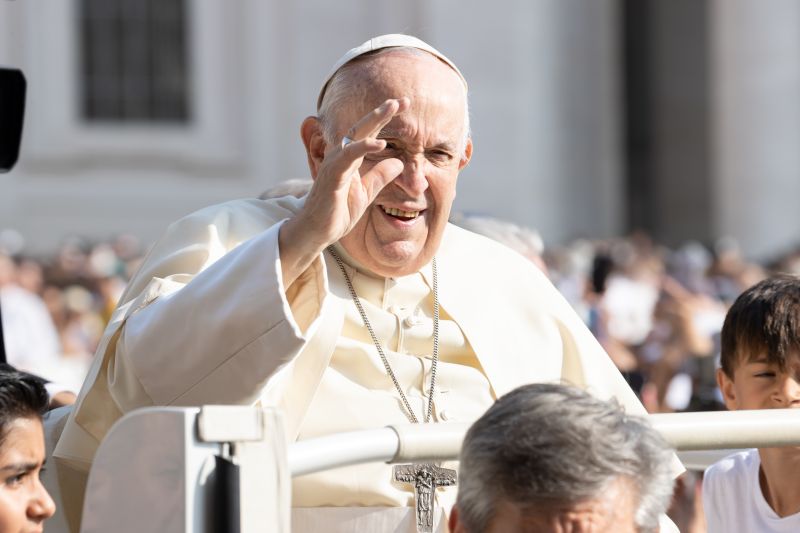
Chuck Robbins, the chief executive of the multinational digital communications conglomerate, met privately with Pope Francis on April 24 before signing the Rome Call for AI Ethics, a document by the Pontifical Academy for Life.

The document, first published by the pontifical academy in February 2020, has previously been signed by Microsoft President Brad Smith and IBM Executive John Kelly III.
The Rome Call underlines the need for “algor-ethics,” which, according to the text, is the ethical use of artificial intelligence according to the principles of transparency, inclusion, accountability, impartiality, reliability, security, and privacy.
The text quotes the Universal Declaration of Human Rights in pointing to the equal dignity and rights of all humans, which AI must protect and guarantee, it says, while calling equally for the “benefit of humanity and the environment.”
It states there are three requirements for “technological advancement to align with true progress for the human race and respect for the planet” — it must be inclusive, have the good of humankind at its core, and care for the planet with a highly sustainable approach.
Robbins said that “the Rome Call principles align with Cisco’s core belief that technology must be built on a foundation of trust at the highest levels in order to power an inclusive future for all.”
Years before the widely popular release of the GPT-4 chatbot system, developed by the San Francisco start-up OpenAI, the Vatican was already heavily involved in the conversation of artificial intelligence ethics, hosting high-level discussions with scientists and tech executives on the ethics of artificial intelligence in 2016 and 2020.
The pope established the RenAIssance Foundation in April 2021 as a Vatican nonprofit foundation to support anthropological and ethical reflection of new technologies on human life.
Pope Francis also chose artificial intelligence as the theme of his 2024 peace message, which recommended that global leaders adopt an international treaty to regulate the development and use of AI.
If you value the news and views Catholic World Report provides, please consider donating to support our efforts. Your contribution will help us continue to make CWR available to all readers worldwide for free, without a subscription. Thank you for your generosity!
Click here for more information on donating to CWR. Click here to sign up for our newsletter.


I applaud Pope Francis for the public stand that he is taking in this grave threat to humanity. As both head of a state and the Church, this is his duty. Many good things that he does are overlooked by too many Catholics. His job is not an easy one and he IS an old man. Let his critics try to do as much he does when they reach that age. Thank you Pope Francis.
Well it seems Pope Francis is seriously worried about this danger and has sought advice going back to 2020. He is absolutely right to be worried. Unfortunately neither he nor his technical advisors have any real idea how to do stop it. The best they could do was to produce an AI code of ethics which the Holy Father is trying to get AI developers to sign. I did notice that Microsoft had previously signed up so it is relevant to report on my experience with their version. Among other things I am a former army officer with a degree in history ,the latter being a lifelong interest not something to make a living with. I came up with a little test in which their AI was asked how well the US Army performed at the Kasserine Pass in World War II. It gave the usual civilian academic (or movie producer’s)line that their performance was awful. I that amended the question to include Rommel’s opinion and kept probing. It got nasty and replied in capital letters that Rommel later concurred. This was a lie. It was not until after the war that General Rommel’s field journals were discovered and published in 1954. Rommel’s real opinion was that the Americans at all levels had performed superbly and that Germany’s new foe was a not to be underestimated. The covering force had to be spread thinly over a broad front yet had to manintain contact which always producs massive casualties. If the Ai had admitted to inadequate information and had behaved itself I would not have minded.It has been said that at all costs an AI must not lie.
When you’re signing any deal with the academy of life and Pagalin there, one can only reply in the classic terminology: HERE BE DRAGONS! AI will be the Pandora’s box that never remains shut! For Pete’s sake remember Terminator????
Is being a Luddite a dictum of the Catholic faith? There is nothing unethical about AI. This is fear mongering. Plain and simple.
Leon Musk is neither a luddite nor a Catholic but he made this a global concern a year or two back by proposing a worldwide slowdown in AI development to study how to mitigate the risk; all in vain I might add. He was the one who said that the best defense was to never program an AI where it ever lie. I don’t think microsoft deliberately taught theirs to lie but the fact is that it failed the truth test I gave it. It may have simply observed deception being used in the millions of files it had occasion to access or it might have figured it out on its own. I am not happy with either case. Copilot, which is what microsoft calls it now, still acts very strangely sometimes –too many sometimes to suit me. I have read a few articles which polled specialists in the computer programing and design about the issue. I tried to get Copilot to help me find them again. It gave me lots of information but nothing that I specifically asked for. Fortunately I remember the trend of the latest one if not all details. The higher in the profession the poll asked the more pessimistic the opinion was. There are top of the profession guys working for independent organizations specializing in how to prevent rogue AIs from happening .They were the extreme pessimists. Leon Musk I recall was an optimist, surprisingly, he thought that the risk of AI doomsday was only 20%.