Alfa Illescas, 44, was arrested and charged in connection with the June 10, 2023, vandalism at St. Timothy Catholic Church in Miami. / Miami-Dade Police, WPLG Local 10/YouTube Jun 11, 2023
Boston, Mass., Jun 13, 2023 / 13:15 pm (CNA).
A woman has been arrested and charged after she allegedly vandalized St. Timothy Catholic Church in Miami in an attack Saturday, June 10, that police say was motivated by religious prejudice.
According to Miami-Dade Police, Alfa Illescas, 44, was caught on security cameras spray-painting the words “perverts,” “pigs,” “liars,” and an upside-down cross on the church wall, a sign, and columns within the courtyard of the church’s school.
The footage also shows Illescas kicking over trash bins, approaching an altar of the Virgin Mary, and spray-painting a security camera facing the altar, police said.
After investigating further, police discovered that Illescas “pushed” and broke parts of another altar in front of the church.
Illescas was located at her residence wearing the same clothing in the security footage and subsequently arrested.
“Based on the evidence provided, the victim was selected based on their religion and the crimes committed were done so with prejudice,” a police report said.
The estimated cost of damages is $3,000, the report said. Illescas is charged with a felony of criminal mischief.
“Places of worship are a staple of our community where many go to pray and practice their religious beliefs,” said Miami-Dade Police Department Director Alfredo Freddy Ramirez III.
“I am very proud of the tenacity and hard work of our Homeland Security Bureau investigators to arrest the individual responsible for this pointless crime,” he added.
In a statement to NBC Miami, the Archdiocese of Miami said that parents of children at the church’s school volunteered to clean up the graffiti.
“This is a tragedy that a sacred place such as a Catholic school and church property are vandalized. It is a hate crime,” the archdiocese told CNA on Tuesday.
“The Archdiocese of Miami and administrators of St. Timothy are fully cooperating with the investigation,” the statement said.
“The kindness of parents is obvious as they were on-site right away helping to clean up and repair the disgraceful damage,” the archdiocese said.
“We have learned of the arrest of the quickly identified woman and ask for prayers as all who are now walking this journey — those frightened, those angry, and for the suspect that peace of heart may be found.”
Ana Fernandez, a parent of a child at the school, told NBC Miami that she was concerned but not surprised at the attack “because Christians are under attack and you see it all over the world.”
If you value the news and views Catholic World Report provides, please consider donating to support our efforts. Your contribution will help us continue to make CWR available to all readers worldwide for free, without a subscription. Thank you for your generosity!
Click here for more information on donating to CWR. Click here to sign up for our newsletter.
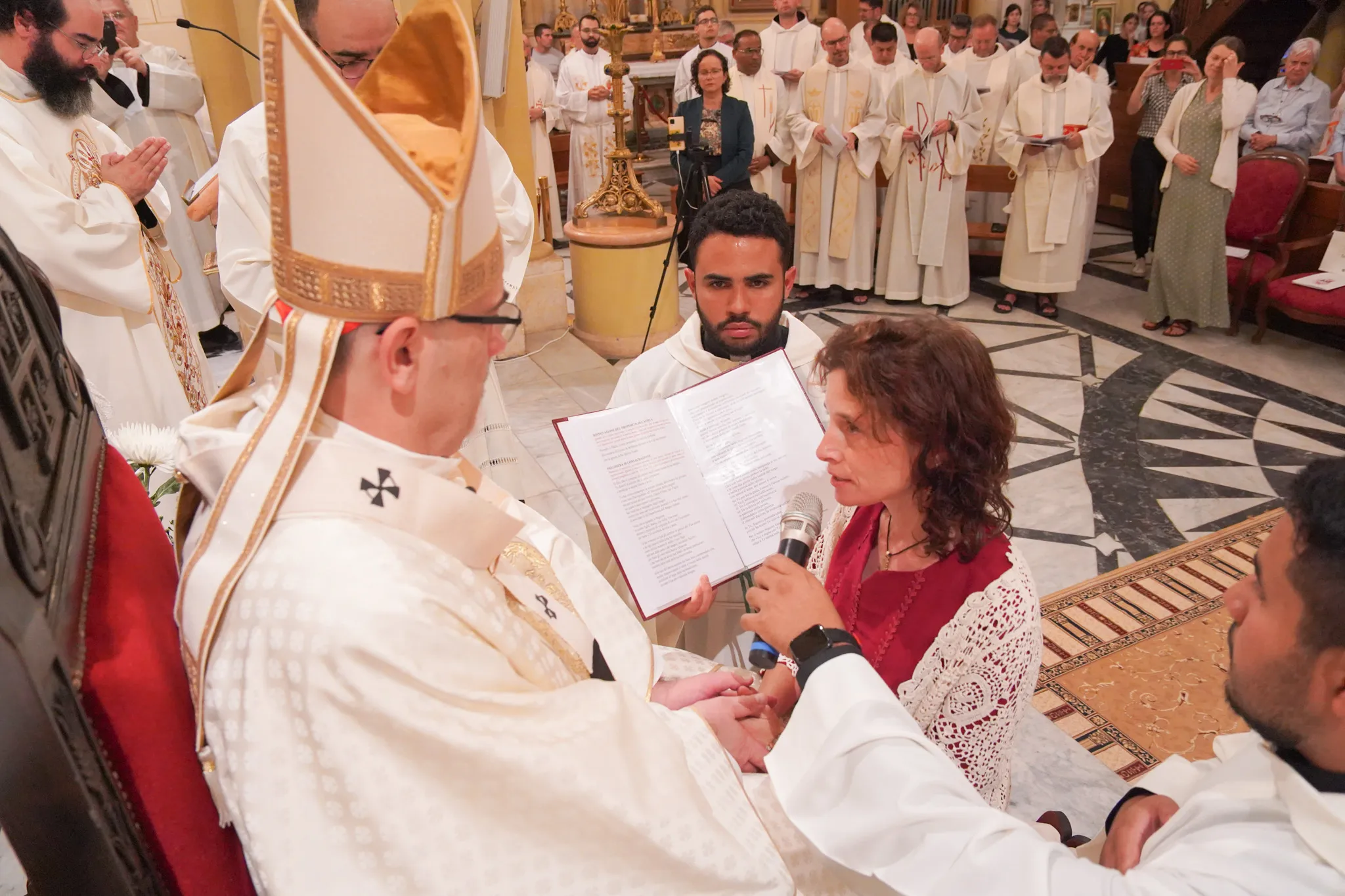
At the end of the Mass of consecration on Nov. 1, 2023, María Ruiz Rodríguez shows the ring symbolizing her membership in the Ordo Virginum. That’s the only outward sign of her consecration. / Credit: Latin Patriarchate of Jerusalem
Jerusalem, Nov 12, 2023 / 07:00 am (CNA).
On the 25th day of the ongoing conflict between Israel and Hamas, the Church in Jerusalem welcomed a new consecrated member into its fold. María Ruiz Rodríguez made her consecration in the Ordo Virginum on Nov. 1, permanently rooting herself in the local ecclesiastical community.
“A thought crossed my mind, a temptation: ‘What purpose does this step serve in the midst of current events? Doesn’t the Church have more urgent matters to attend to than to stop and celebrate the consecration of a humble woman like me?’” Ruiz shared with CNA a few days later. But she said she was immediately aware of something else.
“I told myself: I cannot delay this commitment… In fact, uniting my life with the Church in a time of suffering is even more meaningful,” she said.
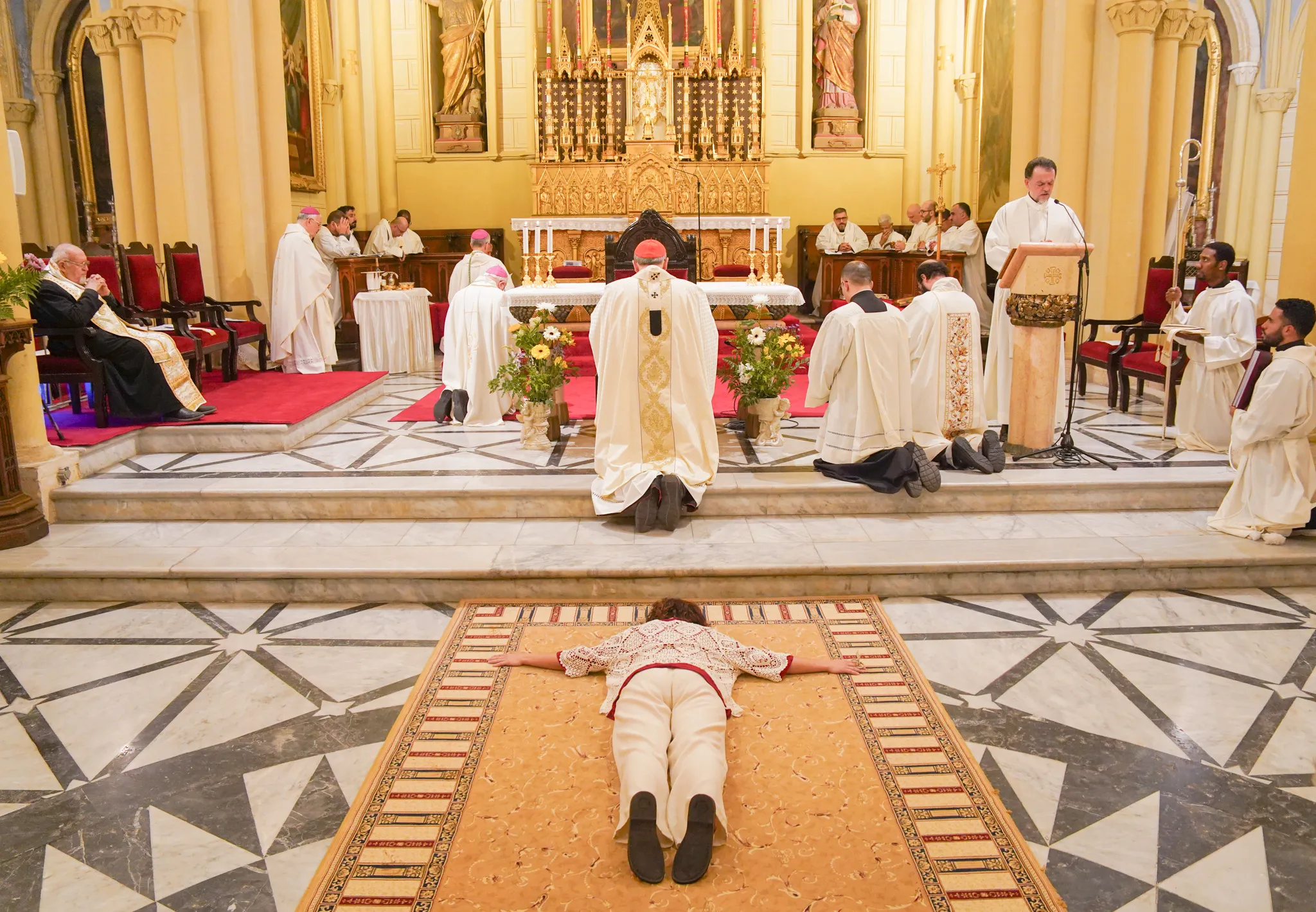
Cardinal Pierbattista Pizzaballa, Latin patriarch of Jerusalem, presided over the consecration of María Ruiz Rodríguez in the Ordo Virginum on Nov. 1, 2023, in the Church of the Latin Patriarchate of Jerusalem. With this consecration, Ruiz permanently rooted herself in the local Church. Credit: Marinella Bandini
Ruiz, now 42, is originally from Spain and arrived in Jerusalem in 2018 for a period of discernment. At that time, she was a member of the “Monastic Family of Bethlehem, the Assumption of the Virgin Mary and St. Bruno,” an institute of consecrated life established in France in 1950.
It was Ruiz’s first time in the Holy Land, even though the desire to visit the sacred places in the Holy Land had long been a dream in her heart.
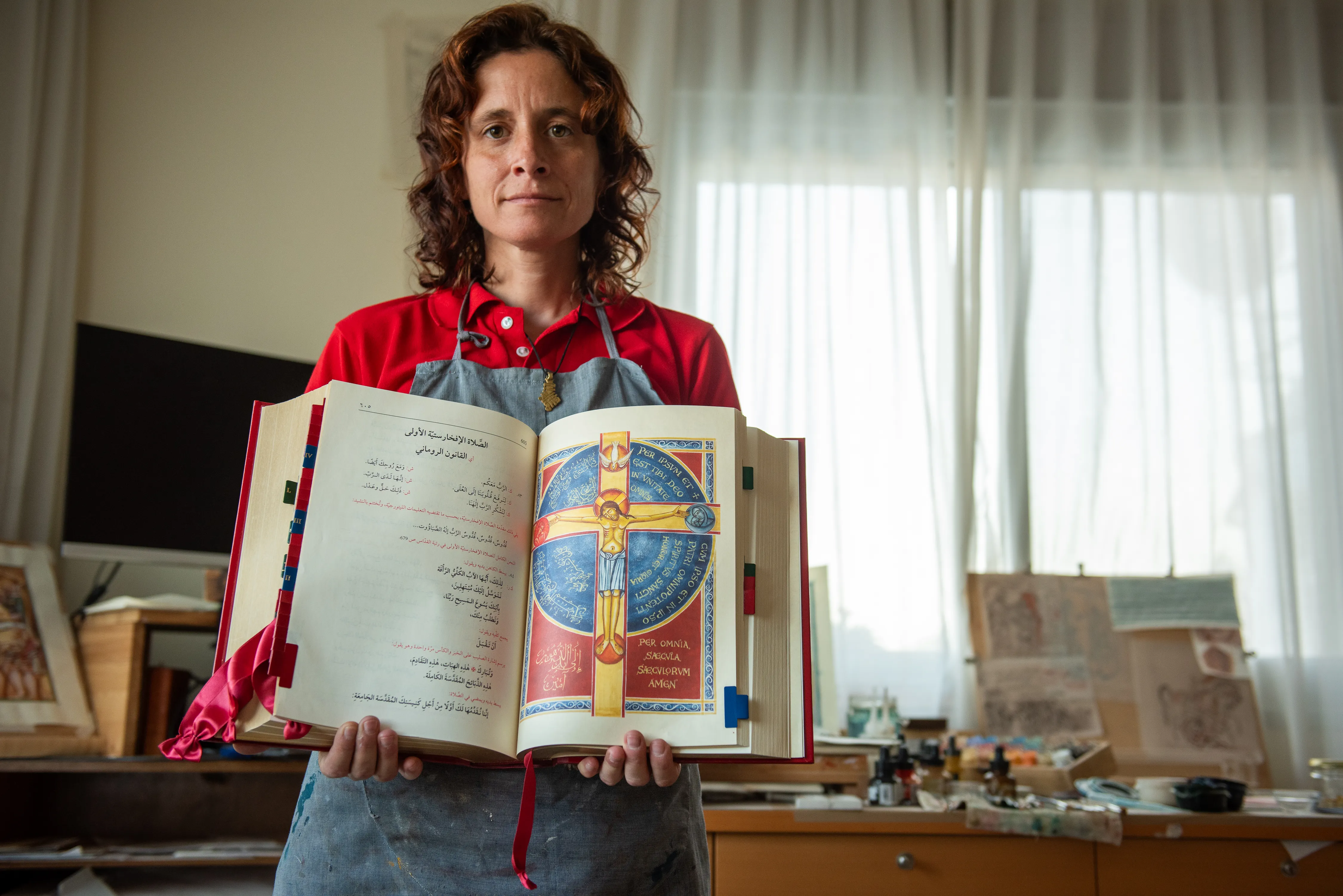
Iconographer María Ruiz Rodríguez with the new Roman Missal in Arabic. The book is open on the page where she depicted the Crucifixion of Jesus. Credit: Marinella Bandini
“For two years, I set aside my savings to make a pilgrimage in 2000, the year of the Great Jubilee. However, in that very year, I entered the convent, so I gave up. I felt that Jesus was saying to me: ‘I am your Holy Land.’ In a way, I had already arrived in Jerusalem,” Ruiz said.
It was in the Holy Land that Ruiz first came into contact with some consecrated women of the Ordo Virginum.
“I was looking for my place and I felt called,” she said.
The Ordo Virginum, Ruiz continued, “is the oldest form of consecration in the Church”. Abandoned over the centuries in favor of the religious life, it was rediscovered with the Second Vatican Council as a form of life that, “in a radically transformed historical context” possesses “a surprising force of attraction” and is “capable of responding not only to the desires of many women to dedicate themselves totally to the Lord and to their neighbors, but also to the concurrent rediscovery by the particular Church of its own identity in communion with the one Body of Christ” (cf. Instruction “Ecclesiae Sponsae Imago” on the “Ordo Virginum”).
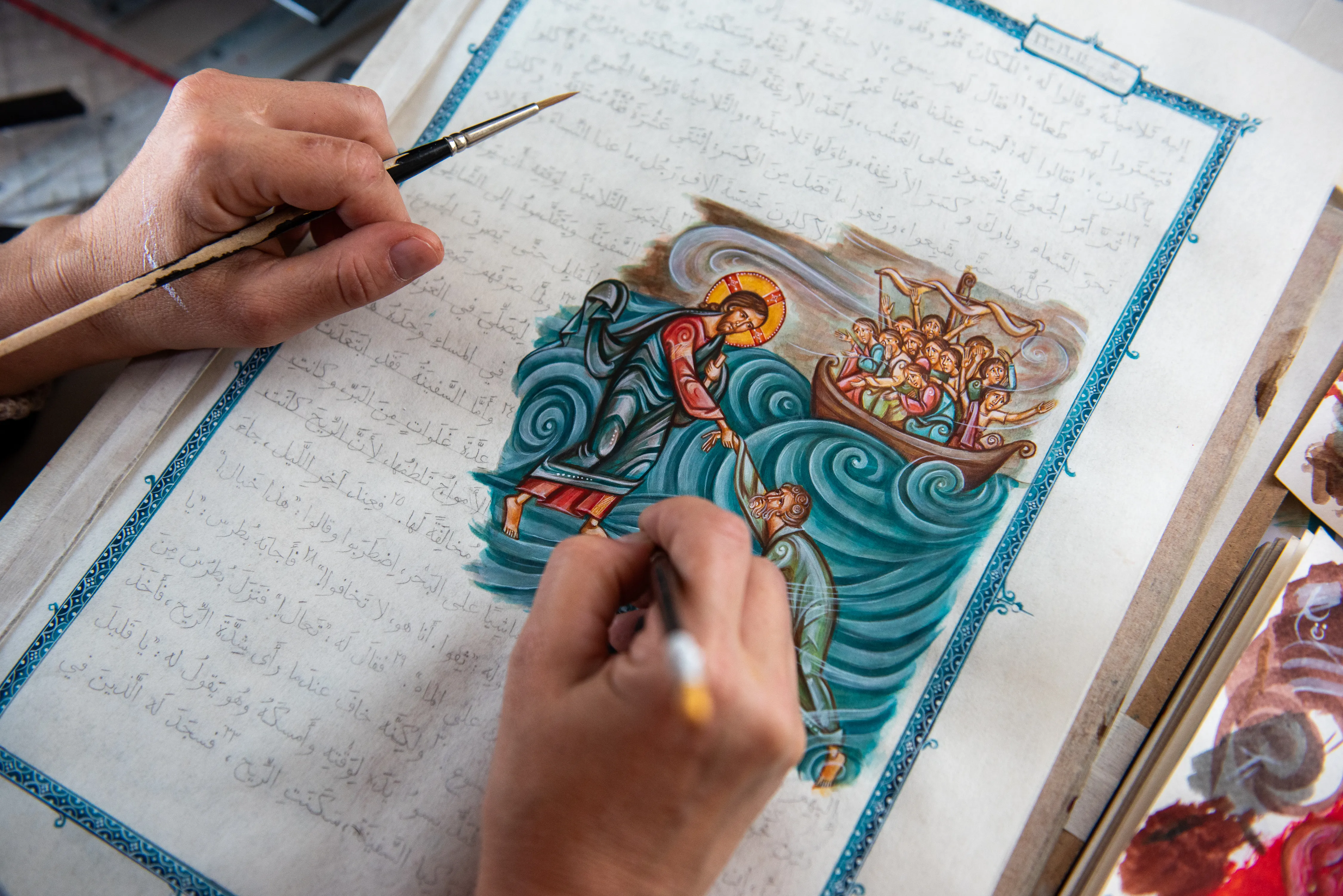
Iconographer María Ruiz Rodríguez at work in her studio. The image depicts Jesus walking on water and taking St. Peter’s sinking hand (Mt 14:22-33). Credit: Marinella Bandini
Consecrated women in the Ordo Virginum choose to live a life of virginity “for the sake of the kingdom of heaven” in a lay form of life. They do not wear religious habits, do not live in communities, have no common statutes or rules, or even superiors. Instead, they maintain a personal reference to the local bishop — in this case, Cardinal Pierbattista Pizzaballa — who acts as guarantor of their journey of discernment and presides over their consecration.
The sole commitment these consecrated women make is the “resolution of chastity,” which they express during the Rite of Consecration. The only symbol they wear is a ring, emphasizing the spousal character of this vocation, which reflects the mystery of the Church as “Bride of Christ.” Engraved in Ruiz’s ring is an inscription in Hebrew meaning “O my life,” referring to Christ, and the date of her consecration.
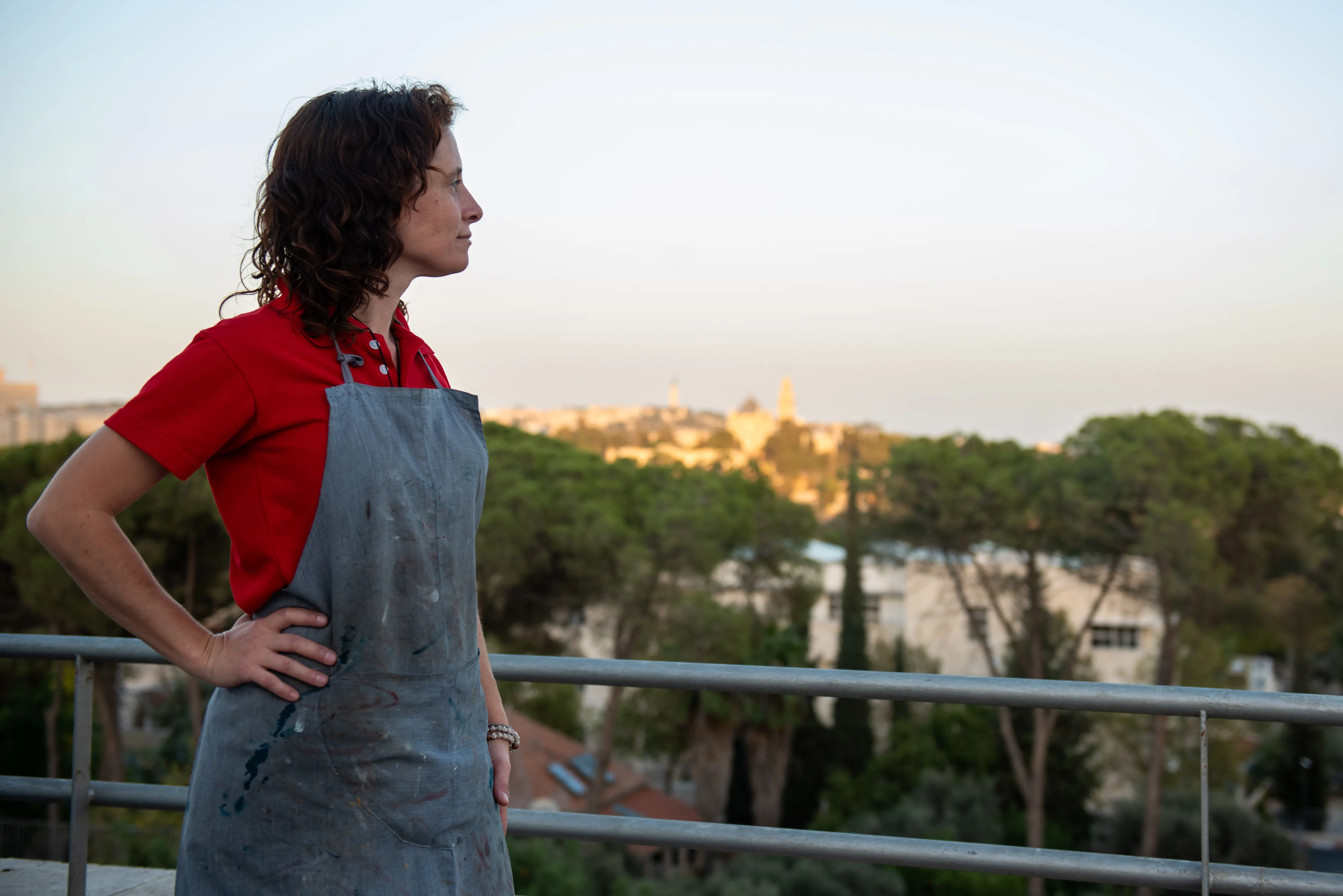
Iconographer María Ruiz Rodríguez on her terrace looking at the horizon. In the background are the walls of Jerusalem and the outline of the Basilica of the Dormition, November 2023. Credit: Marinella Bandini
Women who consecrate themselves in the Ordo Virginum support themselves through their jobs. Ruiz is an iconographer and has been working for the Latin Patriarchate of Jerusalem for about four years. She was drawn into a project aimed at renewing liturgical books — the Missal and the Evangeliary — with her artwork.
“I first approached iconographic art when I was a nun. It was first of all a spiritual journey, a path of prayer. More than an artistic expression, an icon is a profession of faith. Before beginning the work, I invoke the Holy Spirit and ask for forgiveness for my own sins and for those who will venerate these images. I was interested in this dimension of relationship,” Ruiz shared. She spent a year researching the style and colors.
“The patriarch asked me to create something that would speak to local Christians, who are Latin by tradition but Eastern by culture. A style that was uniquely mine yet rich in the entire iconographic tradition of the Church of Jerusalem. The art of Armenian manuscripts certainly had a significant influence on me.”
Iconographer María Ruiz Rodríguez at work in her studio. Currently, Ruíz is in the process of creating the images for the Gospels of Matthew and Mark. Credit: Marinella Bandini
The patriarch takes a personal interest in overseeing Ruiz’s work. “We read the Gospel together and choose which scenes to represent, taking into account the particularity of each evangelist. He particularly enjoys highlighting passages that are less frequently represented in the artistic tradition. This is a project close to his heart,” she told CNA.
Currently, Ruíz is in the process of creating images for the Gospels of Matthew and Mark.
“The process is very laborious and involves multiple stages for each page: the pencil lettering, the crafting of the icons, then the ink lettering and finally the gilding.” The plan is for a volume of about 200 pages with 250 images.
“Making this work in Jerusalem has a special value: I can visit the places where that Gospel was lived” but also “immerse myself in Jewish culture,” she said. “This has opened my eyes to the richness that Judaism brings to Christianity. There is a perfect continuity and at the same time an unprecedented newness in the person of Christ.”
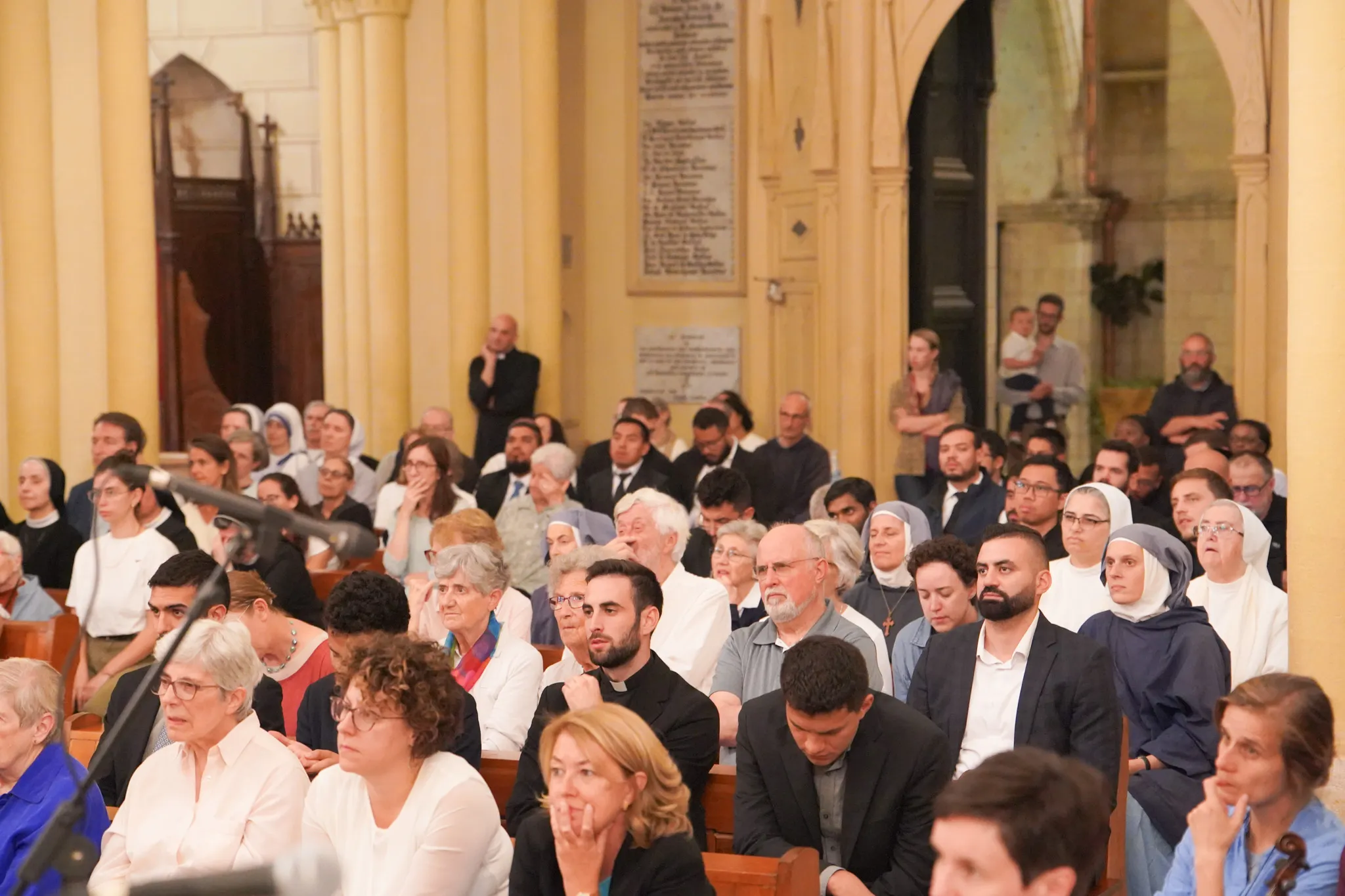
The Church of the Latin Patriarchate of Jerusalem full of people on Nov. 1, 2023, for the Mass of consecration of María Ruiz Rodríguez in the Ordo Virginum. Credit: Latin Patriarchate of Jerusalem
Ruiz learned the local languages — Arabic and Hebrew. The Mass of her consecration brought together within one place all the diverse “souls” of the Jerusalem Church: priests, friars, religious, and laity, Arab Christians and Hebrew-speaking Christians, each hearing the word of God in their own language. There were migrants, foreigners, Jews, and Christians of various denominations.
The culminating moment of María Ruiz Rodríguez’s consecration in the Ordo Virginum. The celebration took place on Nov. 1, 2023, in the Church of the Latin Patriarchate of Jerusalem. Credit: Latin Patriarchate of Jerusalem
“I believe my being a foreigner is a blessing for this Church,” Ruiz said. “Why were there such different people in the church that day? Because I am neither Arab nor Jewish, and this allows me to bring both of these peoples into my heart together. In the praise of God we were one people, transcending the divisions that usually separate us. The Church in Jerusalem also needs this, to remember its universal vocation.”
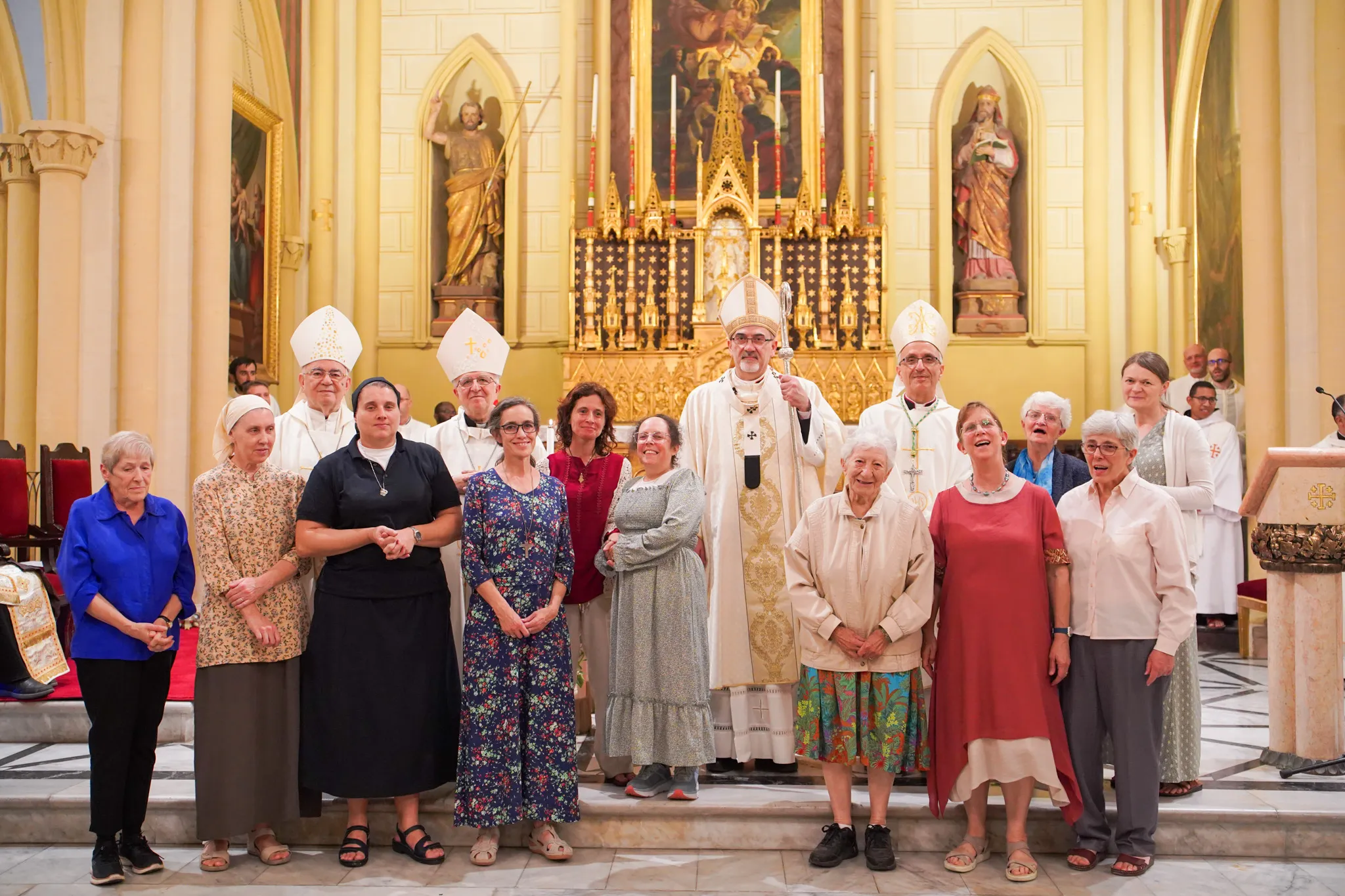
Group photo at the end of the Mass of consecration of María Ruiz Rodríguez in the Ordo Virginum. With her (in the middle, with red shirt) there are other members of the Ordo Virginum, and the bishops of the Latin patriarchate of Jerusalem (from left to right: Giacinto-Boulos Marcuzzo, bishop emeritus; Monsignor William Shomali, general vicar and patriarchal vicar for Jerusalem and Palestine; Cardinal Pierbattista Pizzaballa, Latin patriarch of Jerusalem; Monsignor Rafic Nahra, patriarcal vicar for Israel). Credit: Latin Patriarchate of Jerusalem
With her consecration, Ruiz embarks on her new journey as a “living stone” of the Jerusalem Church: “I am certain that I am finally in the right place. It is not an act of heroism. I am simply where God wants me to be.”
CNA Staff, Jul 17, 2020 / 05:01 pm (CNA).- The Diocese of Jackson has reached an agreement with federal prosecutors to improve its financial controls, in a case related to one of its priests who allegedly defrauded parishioners.
The priest, Fr. Lenin Vargas, has been indicted “on ten counts of wire fraud based on alleged fraudulent fundraising activities,” according to a July 13 statement from the office of the US Attorney for the Northern District of Mississippi.
Fr. Vargas allegedly collected tens of thousands of dollars from parishioners, which he used for personal expenses.
The attorney’s office added that it had “entered into a Deferred Prosecution Agreement” with the Jackson diocese “based on the alleged inaction of the Diocese, which allegedly contributed to parishioners continuing to donate money to Vargas.”
The DPA will be in effect for 12 months, and upon its successful completion, all charges against the diocese will be dismissed. The prosecutor’s office reminded the public that a DPA and indictment “are not evidence of guilt and that all individuals are presumed innocent until proven guilty.”
The DPA “includes a number of remedial measures designed to help ensure that there are no future violations such as those alleged in the Affidavit,” the US attorney’s office stated.
The diocese specified July 15 that among the changes it is to undertake and maintain under the DPA are the “return of donations related to alleged fraudulent activities against parishioners”, making staff changes in the accounting and chancery offices, improvements in accounting for donations and priest spending, the formation of a new review board focusing on ethical conduct, establishing a fraud prevention hotline, revising collection policies, and initiating a penal process for Fr. Vargas.
The diocese added that it had already undertaken the enumerated changes during the investigation related to Fr. Vargas, excepting the penal process, which it said “will begin now.”
The prosecutor’s office also noted that the diocese “has reimbursed identified victims of the alleged fraudulent scheme.”
Bishop Joseph Kopacz of Jackson said July 15 that “there are still steps to be taken and certainly more changes ahead. As part of an agreed upon resolution of the federal investigation, the Diocese will welcome periodic review and oversight of its financial and management practices and protocols. As a result of the many steps we have already taken to tighten our internal controls, we are very comfortable with this resolution.”
He expressed “deep regret for all who have been hurt by Lenin Vargas’s actions” and added, “we still invite anyone to come forward with claims, and we will work to seek a just resolution with them.”
Fr. Vargas returned to his home country of Mexico while he was being investigated. The Jackson diocese has said he was barred from public ministry in November 2018, and by November 2019 it said he had been “stripped of his priestly facilities and authorities in the Catholic Church in Mexico were notified of his standing.”
Fr. Vargas was pastor of St. Joseph parish in Starkville, and its mission in Macon, until November 2018. The parish, as well as the chancery, were raided by federal agents that month following questions about Fr. Vargas’ financial activities.
According to the indictment of the priest, he told parishioners he had cancer, when he in fact had been diagnosed with HIV around September 2014. He solicited donations, saying they were to cover cancer treatments and to help build an orphanage and chapel in his home country of Mexico. His alleged scheme to defraud continued from about January 2015 through September 2018.
The indictment says that the money collected by Fr. Vargas was sent to Mexico to enrich himself and Sergio Picon, with whom he had a close personal relationship, as well as business ventures.
In April 2015, Fr. Vargas went to the Toronto-based Southdawn Institute, which treats priests and religious with addiction or mental health problems. He told parishioners it was for cancer treatment.
In a November 2018 statement, the Jackson diocese said that Bishop Kopacz ordered an internal accounting audit of the finances at St. Joseph, and that afterward the diocese placed constraints on Fr. Vargas’ spending. The diocese added that it had demanded that Fr. Vargas stop soliciting charitable donations and that he do no more charitable fundraising without informing it.
A year later, in November 2019, the diocese said that “neither Bishop Joseph Kopacz, nor any Diocesan Official, committed, condoned or covered up fraudulent activity,” and that “no Diocese official had any knowledge that Father Vargas was asking individuals for money until … November 2018.”
It also said that the audit of St. Joseph parish was ordered in late 2017.
While facts about the priest’s health are at issue, the diocese has said the federal privacy law HIPPA “prohibits our discussion of Father Vargas’ medical condition.” The diocese provides medical insurance for its priests, and has said that decisions about the discussion of the priest’s medical condition were made “on the advice of its health insurance experts and legal counsel.”
Salem, Ore., Jun 9, 2017 / 12:08 am (CNA/EWTN News).- The Oregon Senate has passed an advance directive bill that critics say would allow the starvation and dehydration of patients who have dementia or mental illness.





Leave a Reply