



Editor’s note: This interview was first posted on December 6, 2022, and is re-posted in light of ongoing social media debates about whether or not Mormons are Christian.
There is something remarkably engaging about conversion memoirs. Among Catholics, the conversion memoir has become a prominent book genre in its own right. This tradition goes back many centuries. Among them are Saint Augustine’s Confessions, the autobiography of Saint Ignatius of Loyola, Scott and Kimberly Hahn’s Rome Sweet Home, G.K. Chesterton’s The Catholic Church and Conversion, Thomas Howard’s Evangelical Is Not Enough, as well as compilations like Surprised By Truth, Faith and Reason, or By Strange Ways.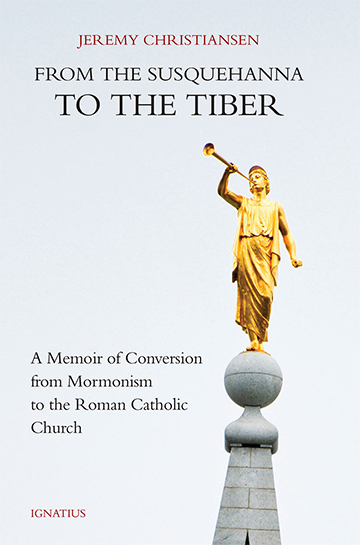
Most commonly, these stories chronicle the individual’s conversion from some form of Protestantism to Catholicism. Occasionally, one will encounter stories of conversion from Judaism (From the Kippah to the Cross) or Islam (From Islam to Christ), or even agnosticism (Dying to Live) or atheism (Something Other Than God).
Jeremy Christiansen’s From the Susquehanna to the Tiber: A Memoir of Conversion from Mormonism to the Roman Catholic Church (Ignatius Press, 2022) is a bright star in the galaxy of conversion memoirs. Christiansen recounts his formative years in the Church of Jesus Christ of Latter-Day Saints (colloquially known as the Mormon church), and then traces his struggles with that faith, recounting how that ultimately led him across the Tiber.
More than just a personal memoir, the book showcases the fruits of Christiansen’s scholarly labors, digging into the intricacies of Mormon history and belief, and thus can serve as a powerful apologetical tool.
Christiansen recently spoke with Catholic World Report about his new book, the influences on his conversion, and the state of the Mormon church today.
Catholic World Report: How did your book come to be?
Jeremy Christiansen: I had a number of conversations with people who were LDS and a part of my life, and they asked me, “Did you ever really have a testimony?” I was shocked anyone would ever ask that, because I believed in Mormonism deeply. My wife asked me the question, too. And so I sat down and started to write out, based on my remembrances and also the detailed journals I kept, the course of how I came to believe.
I don’t think anyone who looks at my life can sincerely doubt that I truly believed in the claims of the LDS church. They meant everything to me at the time.
CWR: I think it’s safe to say that you were a remarkably committed Mormon in your younger days. At the time, did you feel a confident assurance that Mormonism was true? Or were there any early cracks in the façade, so to speak?
Christiansen: When I was 18 or so, I had what seemed to me a profound experience in which I felt exactly what I had been taught all my life I needed to feel in order to know the Book of Mormon was true. I never had that experience before then. My faith was strong and intact throughout my life from that point onward, up until I was in my second year of law school when cracks started to form.
CWR: How much experience did you have with Catholicism while growing up?
Christiansen: Little to none. My parents were and are very tolerant, good people. They never instilled negative feelings into me about Catholicism, at least not consciously or explicitly. I just never had much of any interaction with Catholicism growing up, and what little I did was in teachings from the LDS church, some of which used to be very negative.
One of Mormonism’s “apostles,” a man named Bruce McConkie, wrote a famous treatise called “Mormon Doctrine” back in the 1950s. Initially, that book equated the Catholic Church with “the Church of the Devil” mentioned in the Book of Mormon. He had a fairly rabid anti-Catholic streak. And while the LDS church made him revise those inflammatory statements later, there is a heavy influence from them to this day.
My first experiences with Catholicism were in Argentina when I was on LDS mission, but even there it was minimal because faithful Catholics would not speak to us. It was not until I moved to the Washington, D.C. area in 2016 that I first met really devout Catholics.
CWR: What sort of role did your exploration of the early history of the Mormon church play in your conversion?
Christiansen: A huge role. St. John Henry Newman famously said, “To be deep in history is to cease to be Protestant.”
Well, multiply that by a factor of 100 for Mormonism. As soon as I had internally just opened up to even the possibility that my spiritual experiences in Mormonism may have been just my own emotions, it did not take long for historical reading about Mormonism to really convince me that Mormonism is not what it claimed to be.
CWR: Mormons consider themselves Christians, although their beliefs are anything but orthodox, Trinitarian Christianity. Did you consider yourself a Christian in your days as a Mormon? Do you think most Mormons consider themselves to be orthodox Christians?
Christiansen: I certainly considered myself a Christian as a Mormon. But by Christian, Mormons simply mean, “someone who purports to follow Jesus Christ.” The early history of Christianity and the import of those early councils is lost on most Mormons, who do not understand the context and controversies behind them sufficiently to understand why, generally speaking, the Nicene Creed is such a marker for who is and who is not a Christian.
I do think most Mormons today consider themselves Christians; I do not think they would use the term “orthodox.” But again, what they mean is that they try to follow their own understanding of Jesus Christ, not that they follow the teachings of traditional Christianity when it comes to the nature of Christ. In his Introduction to Mere Christianity, C. S. Lewis briefly addresses the question of what defines “Christianity,” and he settles on belief, rightly, because he notes that if it merely about doing good for trying to follow Jesus’ teachings, anyone is a Christian if they so self-identify.
CWR: Was Joseph Smith a charlatan, or simply misguided? And what about LDS church leadership since then: are these men knowingly leading people astray, or do you think they have honestly good intentions?
Christiansen: This is a really complex question. There are a few theories, each of which is plausible and has its strengths and weaknesses, about Joseph Smith.
One theory that I have found persuasive at times, is the “pious fraud” theory, advocated by scholar of early Mormonism, Dan Vogel. Vogel persuasively contends that accounting for all the evidence, it seems likely Joseph Smith, at some point, came to truly believe he was called of God and on a divine mission, but that he also thought it was perfectly acceptable to deceive people for a greater good. So, according to Vogel, Joseph Smith knew there were no real golden plates, but to convince people they were real so they would read the Book of Mormon he was working on “translating,” (because he thought it would bring people closer to God), he fabricated a set of fake plates that he kept under a sheet or in a box so that people could “heft” the object, thumb the metal leaves, etc.
One thing that is pretty undeniable is that Joseph Smith was incredibly comfortable not telling the truth. His practice of polygamy is rife with instances where he is publicly accused of it, he publicly and vehemently denies it, yet he was married to something like two dozen women at the time. At the end of the day, no one knows Joseph Smith’s heart but God.
As for the current LDS leadership, my own view is that it is likely a mixed bag. Are there people who are true believers? I have no doubt of that. Probably the majority are. Many were ignorant of a lot of early Mormon history until pretty recently, when the LDS church realized it had to deal proactively with the issue. But my own sense of human nature and study of contemporary Mormon history in the 20th century leads me to believe, firmly, that some do not actually believe.
But that should be unsurprising. Surely not every Catholic bishop possesses supernatural faith. There have been and will continue to be Catholic leaders who do not believe. I think the same is true with Mormonism, because it is full of humans. I don’t know about the current Mormon leadership on this issue, but I’m just saying that in Mormonism’s short 200 year history, including in the recent past, have there been people who do not believe but are nonetheless leading people to stay in the faith? Yes, that seems pretty obvious to me.
CWR: What do you hope people get out of this book? More specifically, did you write this book for Catholics to be more familiar with Mormon teachings and Mormonism’s problems, or for Mormons who might be struggling with their faith?
Christiansen: I wrote the book for both audiences.
I hope Catholics can learn to understand where Mormons are coming from, and I hope that Mormons, especially those who might be questioning their faith right now, will see the True, the Good, and the Beautiful in Catholicism.
If you value the news and views Catholic World Report provides, please consider donating to support our efforts. Your contribution will help us continue to make CWR available to all readers worldwide for free, without a subscription. Thank you for your generosity!
Click here for more information on donating to CWR. Click here to sign up for our newsletter.


To find Jesus Christ of the Holy Scriptures is our most important blessing. Truth unlocks knowledge. This is a wonderful story. May he be greatly blessed and a blessing to others.
Greetings from the Latter-day Saints. Although I am strong in my own faith and testimony I do appreciate that Jeremy and his family have continued faith in Jesus Christ. Most Latter-day Saints eho leave the Church usually become Atheist. Merry Christmas everybody.
Dear Allen:
It is good that you are reading CWR and commenting. Seeking God’s truth is a noble endeavour and there are blessings forever to those who find His salvation by means of the Bible.
It has been some years since I delved into the “Book of Mormon” and the “Pearl of Great Price” as well as some books and studies on the Church of Later-day Saints. In conversations with young Mormon missionaries, the conversations have been polite and these young men have been sincere in sharing their belief.
Joseph Smith struck me as a man of curiosity and desire to learn and propagate his ideas. Some of these thoughts can be very appealing to mankind, yet do they mirror the thoughts and direction that God gives to man? God encourages to test matters of faith for ourselves. It takes fortitude to assess our convictions and submit to God!
Are you willing to exercise your beliefs in light the Bible? Firmness in faith is belief tested, accepted or rejected. Why not bring a question or attestation to the discussion table?
1 John 4:1 Beloved, do not believe every spirit, but test the spirits to see whether they are from God, for many false prophets have gone out into the world.
2 Corinthians 11:13-15 For such men are false apostles, deceitful workmen, disguising themselves as apostles of Christ. And no wonder, for even Satan disguises himself as an angel of light. So it is no surprise if his servants, also, disguise themselves as servants of righteousness. Their end will correspond to their deeds.
2 Peter 2:1 But false prophets also arose among the people, just as there will be false teachers among you, who will secretly bring in destructive heresies, even denying the Master who bought them, bringing upon themselves swift destruction.
Matthew 7:15 “Beware of false prophets, who come to you in sheep’s clothing but inwardly are ravenous wolves.
Matthew 24:11 And many false prophets will arise and lead many astray.
Yours in the love that is Jesus Christ,
Brian
As a long time Catholic who regularly interacts with Latter-day Saints I would urge caution before assuming they are unfamiliar with our history. Latter-day Saints are not unlettered. Their scholars have dug deep into the writings of our Fathers to support their claims of an early apostasy that needed Restoration.
I would also caution them. I would say that the LDS do a terrific job of defending LDS beliefs and LDS history, with one exception. If they would apply the same rigor and genius to defending the Church of the first centuries as they do with their own restoration, they could rejoice in finding that the one true apostolic Church has endured from St. Peter to Pope Leo.
Finally, I would personally add that I appreciate their admirable commitments to their faith and their recognition that if the Church was foul in Luther’s day, reformation was inadequate. The Latter-day view of the visible church is much more viable in my mind than any thousand Protestant ecclesiologies.
Just my opinion…
Jeremy should dig deeper into the history of Christianity: He should look prior to the teachings and beliefs of Athanasius and Tertullian. He could find the true Christianity from the First Three Centuries: https://www.youtube.com/watch?v=7rV6gUipBu0
Good stuff.
With respect, I find it disrespectful for the author here, and the magazine, to not in the main refer to our Church by its authentic name: The Church of Jesus Christ of Latter-day Saints. We no longer identify by the nickname “Mormon” or “Mormonism,” and the Church in its style guide has respectfully asked that journalists not use it as a secondary or even “colloquial” reference. (See the October 2018 General Conference Address “The Correct Name of The Church” by President Russell M. Nelson.) I also refer you to an in-depth article I wrote on the name correction and the largely favorable reaction to it, titled “To Call Us By Our Name (A Reasonable Request in the Age of Authenticity)” that was published last February in Public Square Magazine.
Secondly, Christiansen says:
St. John Henry Newman famously said, “To be deep in history is to cease to be Protestant.” Well, multiple that by a factor of 100 for Mormonism. As soon as I had internally just opened up to even the possibility that my spiritual experiences in Mormonism may have been just my own emotions, it did not take long for historical reading about Mormonism to really convince me that Mormonism is not what it claimed to be.”
This idea, that to study the Church of Jesus Christ of Latter-day Saints’ history in-depth is to likely lose your testimony of its truth claims, is a false, very old canard.
I’ve been a lifetime student of the modern history of the Church and its foundational truth claims; I’ve been over all the same ground as the author, and not only has my faith been strengthened, but also my testimony and conviction of the restored gospel of Jesus Christ as well.
It’s a complete myth, even a trope, that the more academic you are, the more interest you have in Church history, and the deeper you delve, the more likely you are to lose your testimony. This has been disproven by thousands of academics and lay members of this Church who have had my same experience as they have explored Latter-Day Saint Church history in depth.
And the idea that emotions or feelings – in the case of Latter-Day Saints – are to be personally discounted in the receipt of revelation from God is to effectively close off the witness of the Holy Ghost, a witness I know that my Catholic friends very much believe in and cherish – as we do – and I honor them for it.
Regarding being “disrespectful,” can we please note Joseph Smith said the Lord told him Catholic and Protestant creeds were “an abomination.” That’s a bit of trivia for which no amount of Tabernacle Choir goodwill tours can atone. And every Mormon prophet from David O McKay on was fine with the moniker “Mormon.” Only under Nelson is it suddenly now taboo. And the reason many refuse to call the church by its preferred name is we don’t believe it actually IS the Church of Jesus Christ of Latter-day Saints. A difficult but unavoidable truth.
As for this
“This idea, that to study the Church of Jesus Christ of Latter-day Saints’ history in-depth is to likely lose your testimony of its truth claims, is a false, very old canard.”
Not necessarily.
See this:
https://aleteia.org/2014/06/19/a-former-heretic-on-trinity-sunday/
Oh yes it is – our Church encourages the in-depth study of its history, and always has. The deeper you go, the greater your faith becomes, that’s how it typically plays out – and thousands can confirm this is true.
Dear Michael:
Truth is the domaine of God. He speaks it (His declarations in the Bible) and He lives it (the example of Jesus Christ). The Book of Mormon is a departure from God’s word and consequently does not portray His enduring message. Two examples:
“The Book of Mormon teaches that little children are not capable of sin because they do not have a sinful nature (Moroni 8:8). In contrast, the Bible in Psalm 51:5 clearly teaches that we have sinful nature from birth: “Surely I was sinful at birth, sinful from the time my mother conceived me” (NIV). (This does not mean that those who die in infancy are lost.*)”
“According to a Book of Mormon prophecy (Helaman 14:27), at the time of Christ’s crucifixion “darkness should cover the face of the whole earth for the space of three days.” In contrast, the New Testament gospel accounts declare repeatedly that there was darkness for only three hours while Jesus was on the cross (Matthew 27:45; Mark 15:33; Luke 23:44).”
If a man follows the wrong path, how can he expect to reach his destination? All the same, is there anything in the Book of Mormon that is superior to what we find in the Bible? Readings of both suggests there is little concordance between the two.
Regards and blessings of wisdom,
Brian
Michael, I’m a Mormon from birth, missionary to Spain, Bishop, temple, done it all. I’m 70 now, but haven’t believed now for several decades. I attend Sacrament meeting with my wife, but limit my callings to the ward Santa Claus, which I faithfully have carried out now for 40 years. When people ask me why I don’t believe in any of the truth claims of Mormonism, I just say I read the Gospel Topics Essays posted on the Church Website and felt strongly that a true church would not carry such baggage.
Now, truth be told, my testimony evaporated back in the 1980’s, mainly sparked by considering the ramifications of the temple and priesthood ban on black people, but the posting of those Gospel Topics Essays saved me from spouting a whole lot of hot air unnecessarily. So, why did I leave the Church, while others stay? Well, I think it has to do with a person’s personality. I think I have a basic distrust of grand schemes, for one. Another, I think I trust my own decision-making processes over those of corporate bodies, e.g., I would never have come up with the temple and priesthood ban, left to my own devises, and so when the Church reserved itself, I realized that I hadn’t been personally responsible for my beliefs, and that that had huge, detrimental effect on my moral compass. Also, I think I have a distrust for human and animal mental faculties in general. To base a faith on an emotion strikes me as ill-advised.
So, I think it mainly has to do with personality. I say best of luck to all of us, and to do kindly to everyone, and not get too shook up about the ultimate questions. Of course, I could be wrong…
There is nothing in the Bible which mentions any angel with the name Moroni or Nephi, that Jesus and Lucifer are spirit brothers, or a man called Joseph Smith found hidden tablets
Joseph Smith meets the Bibles criteria for be being a false prophet who came with a different Gospel, and false prophets as Jesus warns “deceive many”
Matthew 24:11
And many false prophets shall rise and shall deceive many.
Galations 1:8
“7which is not even a gospel. Evidently some people are troubling you and trying to distort the gospel of Christ. 8But even if we or an angel from heaven should preach a gospel contrary to the one we preached to you, let him be under a curse! 9As we have said before, so now I say again: If anyone is preaching to you a gospel contrary to the one you received, let him be under a curse!…
The one thing members of the Catholic Church could learn from the Mormons is hospitality. If you go to a Mormon Church you are warmly and sicerely greeted and made to feel welcome. Most Catholic Church members ignore regular members but especially newcomers.
Amen to that, Mr. Alan.
I don’t pretend to understand Mormon theology but I definitely understand their hospitality, charity, & fellowship.
I have a dear Mormon friend I’ve known for decades. I had the pleasure of attending her churches monthly womens meetings. One night a month husbands were asked to stay home & watch their children so mothers could have fellowship & attend classes in useful things like First Aid, crafts, sewing, cooking, etc. I still remember what I learned years ago in the First Aid class taught by local EMT’s.
Never did anyone try to convert me nor did I hear anything negative about my faith or another denomination. Mormons also care for their own in practical ways, which is something we can learn from.
If you are going to Mass for “hospitality” and to be “warmly greeted”, you don’t know why you are there.
Spot on, Pitchfork. A strong sense of vibrancy and community is absolutely needed at and after Mass, but it’s not the sole purpose of attending Mass. It’s worship, not hangout time.
The difference between “religions” and unique “faith” in the very person of Jesus Christ suggests, to yours truly, some reflections (and a Summary) about both Mormonism and Islam:
FIRST, readers interested in the “pious fraud theory” by early scholar Dan Vogel, will be fascinated by the richly documented account known as the “Spalding Enigma,” researched by Wayne Cowdrey, Howard Davis and Arthur Vankick: “Who Really Wrote the Book of Mormon?”, Concordia Publishing House, 2005 (430 dense but engaging pages with an additional 130 pages of fine-print footnotes).
SECOND, as a reader of history—but not a historian—yours truly proposes a typology of frontier religions (not “faiths” in the above Christian sense) with Mormonism at one end of the spectrum (!) and Islam at the other end (!). Rejected by both is supernatural faith in the person of Jesus Christ as the gratuitous and physical Incarnation into universal human history.
THIRD, but for Mormonism there is no unambiguous and supernatural spiritual reality–the divine nature–and there are NO miracles. Rather, even God is an evolutionary outcome but located further down the conveyor belt than the rest of us. And for Islam, instead, everything (!) IS a miracle—the result of inscrutable and arbitrary divine intervention, such that any talk about human freedom (or even about the laws of nature) involves a “separate autonomy” from the autonomy of Allah “who alone is great”…and blasphemy. (Hence, infidels and jihad?)
FOURTH, other than this polar contrast, the parallels between the two religions are close. Examples: a folk hero marred by an early traumatic experience, angelic messaging [either Moroni or Gabriel], a mission to convert indigenous tribes, a correction of earlier apostasy (for Mormons under Diocletian, and for Muslims under the fractious Byzantines), monotheism decorated with multiple subordinate deities (Islam’s jinns) and with homologous polygamy, sola Scriptura (as even with one of the above commentators in this CWR thread), etc.
FIFTH, from the perspective of real human history, both Mormonism and Islam are (it seems to me), again, oppositely divergent departures from the spiritual Triune One who is both above the world, and within (!) human history because He has freely disclosed Himself into his own unnecessary Creation. (And divergent from the divine indwelling in the Mystical Body of Christ.) Benedict called this mystery of the Incarnation more than “astonishing” but “alarming,” and von Balthasar said “a collision.” This defining polarity between Islam and Mormonism is apparent in the writings of Elder Roberts who concludes with a hybrid (not two natures in one person) ‘non-sequitor’ that is opposite from Islam: “Thus, after centuries of controversy the simple truth of the scriptures which teach that man was created in the likeness of God—hence God must be the same in form as man [!]—was reaffirmed” (Elder B. H. Roberts, “New Witness for Christ” , Salt Lake City: George B. Cannon and Sons, 1875).
SIXTH, nevertheless, about interreligious dialogue and the real piety found among many members of natural religions, Pope Benedict clarified: “Equality, which is a presupposition of interreligious dialogue, refers to the ‘equal personal dignity of the parties’ [!] in dialogue, not to doctrinal content [!], nor even less to the position of Jesus Christ–who is God himself made man–in relation to the founders of the other religions” (Congregation for the Doctrine of the Faith, Dominus Iesus, 2000, n. 22).
SUMMARY: So, yes, with St. John Henry Newman and author Christensen, “”To be deep in history is to cease to be Protestant [or Mormon].” But further, in Catholic dialogue with non-Christians, what are the non-Christian presuppositions on the nature of “persons” in history and the meaning of dialogue?
Through a series of supernatural connections, my family and I became the target of an extremely motivated conversion attempt by the local Mormon Church. They brought all the leaders to our front door to introduce themselves. They were incredibly diligent in giving us information about Mormonism and its Christian roots. Videos, testimonies, meals, parties…they threw the proverbial book at us. It was incredible to watch. Our response was always the same. We very kindly asked that our discussion be limited to the Bible we both read… and they agreed. Then we quoted Hebrews 10:14
14 “For by a single offering he has perfected for all time those who are being sanctified.” The tense makes it clear that a Christian is eternally perfect by receiving the gift of Christ. We asked, “What have you got that we haven’t already gotten?” They could never answer that question. “Have you got what we’ve got?” comes next. Then, “Do you want what we have?” I have found this method of narrowing the debate and clrifying the issue to be extremely helpful in almost every encounter with false belief systems.
I was born and raised Catholic and I will die a Catholic. That said, I am reluctant to criticize the theology of other people’s religions. That is between them and God.
Now practice that detached indifference with respect to others’ bank accounts.
If they are going to speak on their religion in public, practice their religion in public, and seek to convert others to their religion, then their religion is not strictly between them and God.
One may reasonably refrain from criticizing something out of an understanding of one’s own ignorance, or the sense that the particular time or place is not appropriate or conducive for the effort. That does not hold for refraining from defending the truth in public out of the idea that it isn’t your business at all.
Catholicism started with St. Peter, St. Paul, and other early Christians, rendering some very pointed, very public criticism of the theology of other peoples’ religions. It has continued for 2000 years with many Saints doing the same. We are not a Church that holds itself segregated from others, but a Church that goes out to them, engages them, evangelizes them, and converts them. That includes engaging them through reason and historical facts.
Through a series of supernatural connections, my family and I became the target of an extremely motivated conversion attempt by the local Mormon Church. They brought all the leaders to our front door to introduce themselves. They were incredibly diligent in giving us information about Mormonism and its Christian roots. Videos, testimonies, meals, parties…they threw the proverbial book at us. It was incredible to watch. Our response was always the same. We very kindly asked that our discussion be limited to the Bible we both read… and they agreed. Then we quoted Hebrews 10:14
14 “For by a single offering he has perfected for all time those who are being sanctified.” The tense makes it clear that a Christian is eternally perfect by receiving the gift of Christ. We asked, “What have you got that we haven’t already gotten?” They could never answer that question. “Have you got what we’ve got?” comes next. Then, “Do you want what we have?” I have found this method of narrowing the debate and clarifying the issue to be extremely helpful in almost every encounter with false belief systems.
I also agree that early Church history is oft the doorway that leads to faith in the Church. When it comes to the Latter-day Saint people and conversion, I would strongly encourage those interested in sharing Catholicism with them, begin with love. It is what Catholics do best and it is the first tool of all evangelical work. Understand that inviting them to Church is a great option – particularly for significant holy days. The LDS are not accustomed to high church form, but they will be touched by beautiful hymns and the workings of the Holy Spirit.
These are a people accustomed to talking about Jesus Christ. Build on that and share stories of the Saints. They are meaningful and will bear fruit as you share those histories.
May I recommend two scholarly books for background on LDS beliefs? The Refiner’s Fire: The making of Mormon Cosmology, 1644-844 and The Mormon Jesus by John G. Turner.
Why these attacks on LDS? Perhaps they are theologically incorrect, but I like every Mormon that I have known.
Attacks? Seriously? And you’re an ex-Marine?
The online LDS apologists (using that term very loosely, as they don’t appear to know anything about history or theology) are whining about not being considered Christian. Well, they aren’t Christian. Facts are facts. Mormons are often lovely people. LDS theology and “history” is so bad, it’s impossible to satirize.
Carl, I appreciate your contributions and generally enjoy your comments. However, when it comes to discussing religious beliefs, hyperbole isn’t the best approach. As someone who has studied religion, I’ve had many interactions with people and scholars from various faiths, including Latter-day Saints, and your statement goes too far. While they don’t sponsor trained theologians as a group (it’s simply not part of their belief system) that doesn’t mean they lack academics who have studied theology, including Catholic theology (which I see as the foundation upon which others are built). You are a charitable person and a true disciple of Jesus Christ. Let’s aim to do better.
He isn’t saying Mormons are universally ignorant about what Catholic (or other) theology says, he’s saying the theology of Mormonism is stupid. It is. And it denies the Trinity and the exclusive divinity of God, rendering it non-Christian.
LDS are not “Christians” in the strictest sense of the word, but I am reluctant to criticize other religion’s theology. If we seek to convert others, the best way is via our personal example, rather than attacking their theology.
I have had many friends and coworkers who are LDS. We don’t engage in theological debate. Yes, some of the things they believe are strange, but I don’t care. I have too much personal baggage to be judging others.
Just from my experience with 2 Mormon friends, they sincerely believe they are Christians. Some fundamentalist Christians don’t believe Catholics are Christians.
Theology isn’t something we’re all experts in or have necessarily studied much.
One of my Mormon friends converted after a couple missionaries showed up on her doorstep. They talked about the importance of marriage & family, & traditional moral values. Her own Presbyterian church had caved on divorce, homosexuality, women preachers, abortion, inerrancy of scripture, etc., etc. She & her family didn’t convert based upon theology but on the values they & the Mormons both shared. And the mainline Presbyterians had deemed no longer valuable.
“Just from my experience with 2 Mormon friends, they sincerely believe they are Christians.”
And Bruce Jenner sincerely believes he’s a woman. So what?
” inerrancy of scripture”
Guessed they missed these verses.
Galatians 1
Douay-Rheims 1899 American Edition
7 Which is not another, only there are some that trouble you, and would pervert the gospel of Christ.
8 But though we, or an angel from heaven, preach a gospel to you besides that which we have preached to you, let him be anathema.
9 As we said before, so now I say again: If any one preach to you a gospel, besides that which you have received, let him be anathema.
Again, my friend & her family didn’t become Mormons because of LDS theology but because her own church had dropped the ball on biblical values. The mainline Presbyterians missed some important scripture verses, too. Or sidelined them at least.
Carl, real Marines are not described as ex-Marines. Once a Marine, always a Marine.
Source: a real Marine, who survived Tarawa and Hiroshima clean up detail, who came home and became a Grand Knight in his K of C Council.
I’ve heard that also from Marines, Mr. Pitchfork. Thank you for sharing it.
Interesting discussion on a subject I knew nothing about. It is good, though, that no one is being threatened with beheading for offending anyone’s prophet. The god in the holy book of a different religion, which the “magisterium” and the catechism of the CC (published after Vatican II…) tell us is the same god as that of Christians is a bit more stern on these matters. Here is that god speaking:
Fight against those who believe not in Allah, nor in the Last Day, nor forbid that which has been forbidden by Allah and His Messenger and those who acknowledge not the religion of truth [i.e. Islam] among the people of the Book [Jews and Christians], until they pay the jizya with willing submission, and feel themselves subdued. (Sura 9:29) Kill the mushrikun [unbelievers] wherever you find them, and capture them and besiege them, and prepare for them each and every ambush. (Sura 9:5) I will cast terror into the hearts of those who have disbelieved, so strike them over the necks, and smite over all their fingers and toes. (Sura 8:12)