

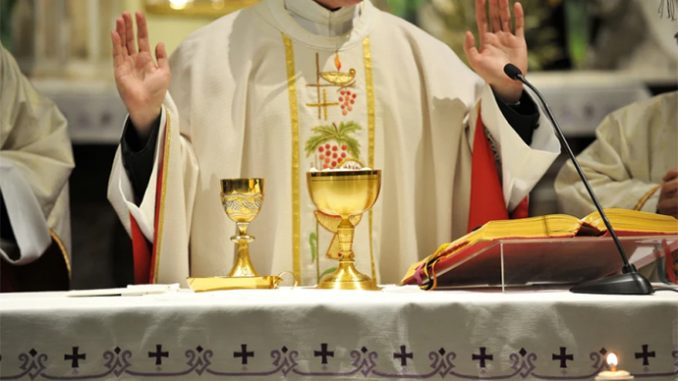
All of us, whether religious or not, long for transcendence because the human heart was made for it. By transcendence I mean the awareness of something greater than ourselves; something bigger than us. It’s that experience of something so beautiful, so powerful that words fail and our hearts are stirred. Perhaps you’ve felt this when gazing upon a star-filled night sky, or hiking the Ozarks, or entering a breathtakingly beautiful cathedral. Such natural experiences of transcendence are gifts that point us toward the transcendent God. God is wholly other—He is uncreated, infinitely holy, and beyond human comprehension. He is also far more unlike us than like us, and yet God made us in His image for relationship with Him. So, while the human heart longs for all kinds of encounters with something greater than itself, it yearns particularly for an encounter with the God of the universe.
Unfortunately, many things in today’s culture pull us in the opposite direction—to things smaller than ourselves. So much is reduced to the entertaining, the pleasurable, the useful. Of course, there’s nothing inherently wrong with the mundane and small. Such things make up the bulk of daily life and God designed it that way. But we run into problems when that is all we experience, and the only things our lives are focused on.
In contrast, the Catholic Faith is centered on the liturgy, which takes us out of the mundane and into the courts of heaven, into the splendor of the eternal! Every Mass is an encounter through God’s invitation into heavenly worship, through communion with Christ, and through our being sent forth into the world as missionary disciples to help others encounter God as we have.
In the Mass, God Invites Us into Divine Worship (Invitation)
That invitation begins the moment the liturgy starts, because the entire Mass is an encounter with Christ, who “is always present in His Church, especially in her liturgical celebrations.”1 We rightly tend to focus on Jesus, present in Holy Communion, but He is also present in the priest, in the Scripture proclaimed, in song, and in the assembled church. The entire liturgy is an encounter with Christ, which only later reaches its summit in Communion.
In the Holy Sacrifice of the Mass, we encounter Jesus, who then invites us into His own worship of the Father. As the Catechism of the Catholic Church explains, through Jesus, the Church “offers worship to the eternal Father… in which God is perfectly glorified and men are sanctified” (CCC 1089). But what is this worship that’s being offered?
Scripture tells us that St. John the Apostle had a vision of worship in Heaven, and it included the angels, saints, incense, song, and “a Lamb that seemed to have been slain” (Revelation 5:6). Jesus appears in Heaven as a victim because, as the eternal high priest, He offers His once-for-all sacrifice on the Cross to God the Father, perpetually interceding for us (see Romans 8:34).
It is in this very sacrifice of the Mass that the liturgy makes present “sacramentally” on the church’s altar, the crucified and risen Lord, thereby allowing us to participate in the heavenly offering of Christ to the Father! It’s no wonder that more and more young people are being drawn to the liturgy’s otherworldliness—it’s in the Mass that Heaven touches earth, and that the transcendent God becomes immanent. It’s there that the angels and saints join the earthly congregation as Christ draws us into His saving work and Heaven’s liturgy.
So, how do we participate practically? It’s not enough to attend Mass as passive spectators; rather we are invited to offer the Mass in union with the priest. After the readings, as the altar is being prepared, we can (and should) place ourselves on the altar, as well as our particular offerings—our works, joys, sufferings, failures, successes, families—anything and everything can be placed on the altar. Then, when Christ’s perfect sacrifice on Calvary is made present on that same altar, our imperfect offerings are taken up into His sacrifice, and presented to the Father in Jesus’ one perfect act of love.
Think about it this way. If you had been alive at the time of Christ’s crucifixion, and had been granted the immense privilege of standing underneath the Cross with Mother Mary, what would you do there? Just like Our Lady, you would surely unite your heart to Jesus’ Sacred Heart, joining your love to His perfect offering of love to the Father. The astonishing privilege of the Mass is that Christ gives us sacramentally this very opportunity, which none but a handful of disciples received historically.
And while all this talk about Calvary and sacrifice can seem a bit daunting, it is in truth a great joy for Jesus to receive our offerings of love and to have us partake in His perfect worship of the Father, just as it’s a delight for the Father to receive it. No mere creature could ever offer worship worthy of God’s infinite majesty, so Christ graciously includes us in His own perfect worship of the Father—precisely because He knows this is where our true joy and best means of sanctification lie.
Incredibly, God is not satisfied with this. He desires even more of an encounter, and so He comes to us in Holy Communion. Here God’s invitation reaches its climax, as He gives Himself to us in the Eucharist—Body, Blood, Soul, and Divinity.
In the Mass, God Gives Himself to Us (Communion)
The idea of Jesus giving us His flesh to eat was scandalous to his Jewish listeners, many of whom “returned to their former way of life and no longer accompanied him” after this teaching (John 6:66). And it remains unbelievable to many modern Christians who consider the Eucharist merely a symbol. But for Catholics, “The Eucharist is ‘the source and summit of the Christian life’” (CCC 1324) because it is our most intimate encounter with the Lord.
Jesus’ teaching is crystal clear: “For my flesh is true food, and my blood is true drink. Whoever eats my flesh and drinks my blood remains in me and I in him” (John 6:55–56)—when we receive the Lord in Holy Communion, we abide in Him and He abides in us.
During the Mass, when we hear the words, “This is my body,” and “This is the chalice of my blood”—through the priestChrist makes Himself truly present and offers to unite with us. As Pope Benedict XVI wrote, “In the Eucharist Jesus does not give us a ‘thing,’ but himself.”2 In other words, built into the Mass is a powerful encounter with the Lord, who offers us the most intimate relationship possible on earth.
Interestingly, Christ’s immanence in the Eucharist is itself an expression of His transcendence. Since Jesus is the eternal Son of God, He can be wholly present on thousands of altars simultaneously across time so that His one sacrifice can be made sacramentally present for the rest of human history. Since He is God, Christ can veil His infinite glory and give us His resurrected flesh to eat. God is so great that He can become small without ceasing to be great!
Now, let’s step back for a moment and ask why the God of the universe chose to encounter us under the humble appearances of bread and wine. It’s unexpected and almost embarrassingly material.
St. Thomas Aquinas explains, “It was fitting that God should provide man with a spiritual medicine by means of certain corporeal signs; for if man were offered spiritual things without a veil, his mind being taken up with the material world would be unable to apply itself to them.”3 God teaches us through material things precisely because we are a mix of the corporeal and spiritual, we are body and soul. Jesus’ parables are filled with concrete images—sheep, a sower spreading seed, wineskins, a prodigal son—because we ascend to immaterial concepts through material ones. Likewise, we better understand spiritual truths through the material—so when we are baptized into Christ, it is through water; when we are anointed in sickness, it is with oil; and when we are offered union with Christ, it is through changed bread and wine.
But God could’ve chosen anything material; why did He choose food? Perhaps the most obvious reason is that food nourishes us, and Jesus desires to nourish us body and soul. When we eat food, it becomes part of us. Yet when we receive the Eucharist, we don’t merely assimilate Jesus into ourselves—we are assimilated into Him. St. Augustine explains this mystery from Jesus’ perspective when he writes, “I am the food of the grown. Grow, and you shall feed upon Me. Nor shall you change Me into yourself like bodily food, but you shall be changed into Me.”4
Food also plays an important role in the Bible. Meals are used to establish friendship, peace, and offer hospitality. More importantly, meals are used to create communion through covenants.5 During the Last Supper, Jesus transformed the Passover into the New Covenant meal (see Matthew 26:28) and sealed that covenant with His sacrifice on Calvary. St. Paul expresses this truth when he asks, “The cup of blessing which we bless, is it not a participation in the blood of Christ? The bread which we break, is it not a participation in the body of Christ?” (1 Corinthians 10:16). When we receive the Eucharist, we truly share in Christ Himself—and all this through the ordinary (but changed) means of bread and wine.
With all this in mind, we might understandably ask: why does the Lord desire to be with us this much? It’s simple: because He loves us, and love desires union. Separation and division pains those who love each other and, in addition to coming to dwell in us through baptism, Jesus desires the union that can only come from being one with us in body and soul, however briefly. The Eucharist, our greatest moment of intimacy with the Lord on earth, anticipates our eternal and complete union with Him in Heaven.
The Lord also wants to be with us because He knows He’s the only one that can make us truly happy. St. John Henry Newman wrote,
man is not sufficient for his own happiness; he is not happy except the Presence of God be with him. When he was created, God breathed into him that supernatural life of the Spirit which is his true happiness; and when he fell, he lost the divine gift, and with it his happiness also. Ever since he has been unhappy; ever since he has a void within him which needs filling, and he knows not how to fill it.6
God alone can fill that void—and He is eager to fill it with His Real Presence—Body, Blood, Soul, and Divinity.
I want to recap the arc of salvation history in terms of God’s presence, because when we understand the progression, we can better appreciate just how blessed we are as Catholics. In Eden, Adam and Eve dwelt on “the holy mountain of God” (Ezekiel 28:14), where the Lord God walked about in the garden (see Genesis 3:8). They tragically commit humanity’s first sin and are expelled from God’s immediate presence. In fact, it isn’t until Moses leads the Israelites out of Egypt that God again abides on earth, this time in a moveable Tabernacle. Scripture stresses the continuity in God’s presence by using the same verb to describe God’s walking in the garden of Eden as God’s presence with the Israelites.7
After millennia, a small subset of humanity again has access to God’s dwelling—but much has changed. The previously open access to God in Eden has become restricted: God’s presence is mediated through Moses and, later, the Levitical priests. God is no longer directly accessible; the tabernacle has literal barriers because sin has created distance between God and men. Even more intensely, fallen humanity must approach with caution, obeying strict rules, since God’s all-holy presence is now dangerous for them. It is literally a matter of life and death: for, in the Old Testament, when on various occasions men disregard these commands, they are struck dead.8
Eventually, Solomon builds a permanent Temple in which God can reside, and like the tabernacle, the Lord’s glory fills it. Solomon’s Temple is world famous, and even foreigners come to worship—it’s a “house of prayer for all nations.” Despite this, access to God’s presence remains limited. Gentiles can only enter the outer court of the Temple—the Court of the Gentiles. Israelite women can go a little further in, to the Court of Women. Israelite men can go even further in, to the Court of Israelites. Only priests can regularly enter into the Court of Priests, though Israelites can go in when they offer sacrifice. And only once a year can the High Priest go into the Holy of Holies, the innermost sanctuary that was God’s earthly dwelling place. So even in the Temple, there are literally walls of protection between God’s presence and mankind, and only one man, once a year, can enter God’s dwelling.
Due to the Israelites’ sin, eventually God’s presence leaves the Temple, and it is destroyed around 587 BC. Though the Jewish people later construct a second Temple, God’s glory does not fill it. So, for about six centuries, though God is present in His Word, Law, and the Prophets, He is again not dwelling with His people.
But, as we know, God returns in dramatic fashion—not in a cloud-filled building but through the Incarnation of His Son, who comes to dwell among us. And now, instead of having to travel to Jerusalem to offer sacrifice, we can go to any of the world’s 223,000 parishes.9And when there, Jesus isn’t in a restricted area we can’t go into or see—He’s in the tabernacle, prominently placed in the church. The One who is Himself the true Temple now dwells in the tabernacle of every Catholic church. This is a major shift from the historical norm.
But going far further, through Baptism, the Holy Trinity dwells in us by sanctifying grace permanently, so long as we don’t commit mortal sin. Through our initial justification in Baptism, we are truly changed—made righteous, so that God can dwell within us, without fear of being struck dead. Even more shockingly, Jesus offers Himself to us in Holy Communion—His sacramental presence dwells in us for a quarter of an hour, every day if we so desire it! Still, a barrier remains—Christ is veiled behind the appearance of bread and wine to accommodate our weakness, since we cannot yet see God face to face and live (see Exodus 33:20).
In the Mass, God Sends Us Out (Mission)
After Communion, the Mass doesn’t just end; it commissions us to continue the Son’s work in the world through the power of the Holy Spirit. Encountering God through the perfect worship of His Son and receiving Jesus in the Eucharist, we are transformed and then sent out to share the Good News so others might encounter God as we have. As the Catechism explains, “‘The Church on earth is by her nature missionary since, according to the plan of the Father, she has as her origin the mission of the Son and the Holy Spirit.’ The ultimate purpose of mission is none other than to make men share in the communion between the Father and the Son in their Spirit of love” (CCC 850).
It’s not a job just for priests, religious, or lay missionaries. By virtue of our baptism, all of us have been commissioned to share the God who has been so exceedingly good to us. This entails following St. Peter’s admonition to: “Always be ready to give an explanation to anyone who asks you for a reason for your hope” (1 Peter 3:15).
I understand this to be two-fold: we should be ready with a brief version of the story of how the Lord has changed our lives, as well as prepared to give a short answer of why we believe intellectually that Jesus is God and founded the Catholic Church (apart from our personal experience of Him). In this way, we can help others encounter Christ via their hearts or heads. If you have just a 2 or 3-minute summary for each, you’re ready to share the Gospel. It’s really that easy.
When I was a newly ordained priest, I remember saying to my first pastor as I was walking out the door one time, “keep the faith.” He responded, “no, don’t keep the faith, spread the faith!”
The Holy Sacrifice of the Mass is our most intimate encounter with the Lord on earth. What we need now is to remember the entire Mass can be understood through the three aspects of invitation, communion, and mission, so we might more fully appreciate, experience, and desire to share this incredible blessing.
(Note: This essay was posted originally at What We Need Now and is reposted here with kind permission. It is adapted from a keynote given at the Diocesan Eucharistic Congress of Springfield-Cape Girardeau on August 15, 2026.)
Endnotes:
1 Sacrosanctum Concilium, #7.
2 Pope Benedict XVI, Sacramentum Caritatis, #7.
3 St. Thomas Aquinas, Summa Theologica III, Q61, A1, Respondeo.
4 St. Augustine, Confessions, Book 7, Chapter 10.
5 For instance, the covenant at Mount Sinai between God and the Israelites was sealed with a sacrificial meal (see Exodus 24:11), as was the covenant between Jacob and Laban (see Genesis 31:46).
7 “In Genesis 3:8, the verb hithallék (‘to walk’), used to describe God’s ‘walking to and fro’ in the Garden, is the same verb used to describe God’s presence in the Tabernacle: ‘And I will walk among you and will be your God, and you shall be my people’ (Lev. 26:12).” Steven C. Smith, The House of the Lord (Steubenville: Franciscan University Press, 2017), p87.
8 E.g., Uzzah, Nadab, and Abihu.
9 G-Catholic, “The Catholic Church in the World.”
If you value the news and views Catholic World Report provides, please consider donating to support our efforts. Your contribution will help us continue to make CWR available to all readers worldwide for free, without a subscription. Thank you for your generosity!
Click here for more information on donating to CWR. Click here to sign up for our newsletter.


Doesn’t the celebration of the holy Mass and our Communion with and through God, the Holy Trinity, call us not to just recognize the same during the Mass but also and especially in every moment of the gift of our life?
We recognize, in a very special manner and way, during the celebration of the Holy Eucharist during the prayer of the Mass that which we must live in each moment of our life.
Communion must not be merely “then”, at a particular moment held static in temporality. It must be the ever present and eternal “Now” of the unending presence of God, who is our life, in our life.
Faith, similar to theology, must be lived.
Yours in Christ.
I recall a fully-habited, pre-Conciliar nun telling my First Holy Communion class that with God there is no past, no future; everything is now. To know that intellectually is one thing; to live it experientially, quite another.
We need not wonder why there are so many vocations to the priesthood in Kansas. And, so few in some other locations.
Yes, to 223,000 Catholic parishes—and at the same time that the Mass is the renewal and extension (!) of the one and same and singular sacrifice of the historical Jesus Christ at the one time and place of Calvary: “body and blood, soul and divinity” (CCC 1374).
The (not a) sacrifice of the Mass…not a facsimile mass-produced, so to speak, as if on an assembly line.
And, yes, it is ourselves and the details of our lives that we offer—with no implication that the offering of the Mass by the ordained priest (as an extension of the bishop who is commissioned by Christ—not by the local assembly/congregation—through the Apostolic Succession) is in any way lacking without our “participation.”
The wording of the Mass is what’s happening (!) “through” the hands of the priest, not through our seemingly multi-“ministry” production. The Mass is categorically more than a building-site “project Church.”
Nebraska!
seven new priests for the Catholic Diocese of Arlington on Saturday, June 6, 2026, at the Cathedral of Saint Thomas More. [1] (https://www.arlingtondiocese.org/vocations/ordinations/), [2] (https://www.arlingtondiocese.org/2026/06/06/ordinations-to-the-priesthood-june-6-2026/)
Arlington. Large percentage of federal contractors, employees.
“For my flesh is true food, and my blood is true drink. Whoever eats my flesh and drinks my blood remains in me and I in him”.
As Bishop Conley infers we received the real presence of the living God Jesus Christ. Can there be greater intimacy? Insofar as the recipient there cannot regardless of his interior disposition to that truth.
Cyril of Alexandria argued against a residual Arianism that the flesh of the Virgin given to her divine son in the womb did not confer the risen Christ in reception of the Eucharist. Patriarch Nestorius of Constantinople suggested it did not. Patriarch Cyril contested that it did.
Today we celebrate the Feast of the Birth of Mary. She was born without the stain of original sin. It’s held that she was saved from the blemish of original sin by Christ’s passion and resurrection. Although this specific woman was mysteriously prefigured from all eternity by God the father prior to the fall of man in the Garden of Eden. It is more correct to say that she was withheld from original sin, although the second Person of the Trinity always and beyond time prefigured his passion and resurrection.
In that context we may also say his saving act included Mary, his mother.
Father Conley’s essay could be rendered into poetry or a symphony. It is that beautiful.