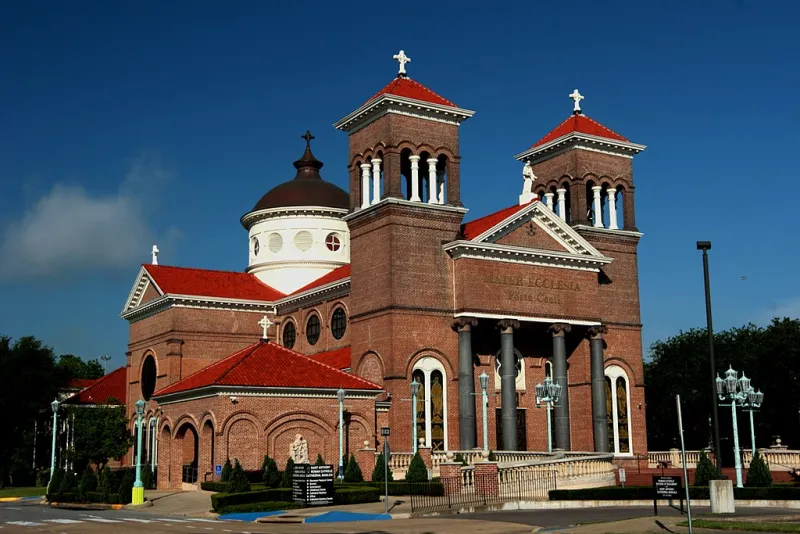
Saint Anthony Cathedral Basilica in Beaumont, Texas. / Crichardson1776 via Wikimedia (CC BY 3.0)
Beaumont, Texas, Dec 21, 2021 / 16:19 pm (CNA).
Six priests from the Diocese of Beaumont died this year, including three who were in active ministry at the time of their death. The diocese is hoping to increase the number of vocations as well as to bring in priests from other dioceses to help ease the strain on the clergy.
“With the loss of 6 priests, it’s been very difficult. And they happened so close together, it’s really kind of unbelievable and I haven’t quite had time to process it,” said Fr. Shane Baxter, Rector of Saint Anthony Cathedral Basilica, to Beaumont’s 12 News Now.
Fr. Delphyn Meeks, 80, was the first Beaumont priest to die in 2021. He died Feb. 11. In August, the diocese lost three priests: Msgr. William “Bill” Manger, 87; Msgr. Ken Grieg, 80; and Msgr. James Vanderholt, 88. Manger died on the 2nd, followed by Grieg on the 8th, and Vanderholt on the 11th.
Causes of death were not given for Meeks, Manger, Grieg, or Vanderholt, but obituaries did note that Manger, Grieg, and Vanderholt had recently began hospice care.
Manger was the pastor of St. Anne in Beaumont at the time of his death. Meeks, Grieg, and Vanderholt were retired from active ministry. Grieg was the first priest to be ordained in the Diocese of Beaumont following its establishment in 1966.
In November, Fr. Duc Duong died on the sixth at the age of 63 as a result of Covid-19. Three weeks later, on Nov. 22, Fr. Luong Tran died at 63 following a medical emergency.
Duong was the parochial vicar of Infant Jesus Catholic Church in Lumberton and at St. Mark the Evangelist in Silsbee at the time of his death. Tran was serving as pastor at Our Lady of Sorrows in China and as the judicial vicar of the diocese when he died.
The Diocese of Beaumont has 48 parishes, and many priests are assigned to multiple parishes.
“We have so many parishes and only so many priests, so we’re doing our best to take care of all the spiritual needs of our people,” said Baxter. “We have faith that they’ve gone to a better place but we’d really like them here. that part of me would like them here and miss them.”
Bishop David Toups, who has led the diocese since June 2020, said that the diocese will be forced to reshuffle some of the parishes to make up for the decline in the number of priests.
“Our priests are so generous with themselves, it’s obviously our vocation, our call from God is to give ourselves to our parish communities,” Toups told 12 News Now.
In spite of the sadness, Toups believes his diocese has the potential for a bright future.
“The good news is long term, we’re working very hard throughout the Catholic diocese to recruit, to encourage, young men thinking about priesthood,” said Toups.
He is encouraging his flock to “pray for vocations, support the wonderful priests that we do have, and to be understanding of this time, which is challenging.”
If you value the news and views Catholic World Report provides, please consider donating to support our efforts. Your contribution will help us continue to make CWR available to all readers worldwide for free, without a subscription. Thank you for your generosity!
Click here for more information on donating to CWR. Click here to sign up for our newsletter.
The Supreme Court of the United States, Oct. 7. 2022. / Public Domain
Washington, D.C. Newsroom, Dec 13, 2023 / 12:24 pm (CNA).
The Supreme Court announced on Wednesday that it will once again consider a high-stakes abortion pill case that coul… […]
Over a year after the earthquake that hit Syria and Turkey in February 2023, restoration of Aleppo’s Church of St. George has been completed. / Credit: Abdul Kareem Daniel
Aleppo, Syria, Apr 23, 2024 / 14:15 pm (CNA).
This year’s feast of St. George was a particularly joyful one in the Syrian city of Aleppo, especially for the Melkite Greek Catholic community.
The church is reopening its doors after undergoing restoration due to damage from a February 2023 earthquake. Additionally, Archbishop George Masri of the Melkite Archdiocese of Aleppo and its environs will celebrate his golden jubilee.
The celebrations took place during the visit of Patriarch Joseph Absi, the current patriarch of the Melkite Greek Catholic Church, who presided over the Divine Liturgy in the restored church on the evening of April 23. The evening before, there was a procession along Holy Bible Street followed by vespers.
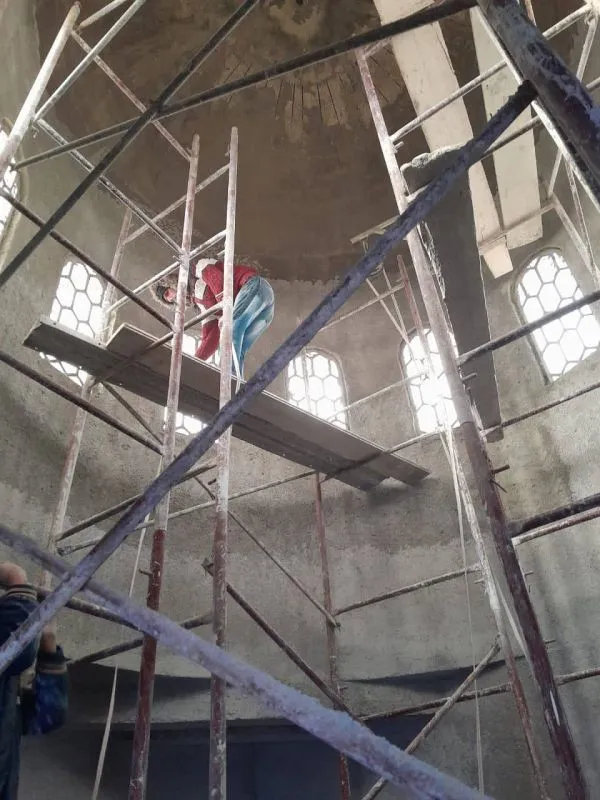
Restoration of the Church of St. George in Aleppo after the February 2023 earthquake. Credit: Father Fadi Najjar
In an exclusive interview with ACI Mena, CNA’s Arabic-language news partner, Father Fadi Najjar, principal of Providence Private School, which is adjacent to and belongs to the church, explained that last year’s earthquake caused cracks in the church walls on both the right and left sides, allowing rainwater to leak inside. The exterior facade was also shattered, with falling stones damaging the stairs.
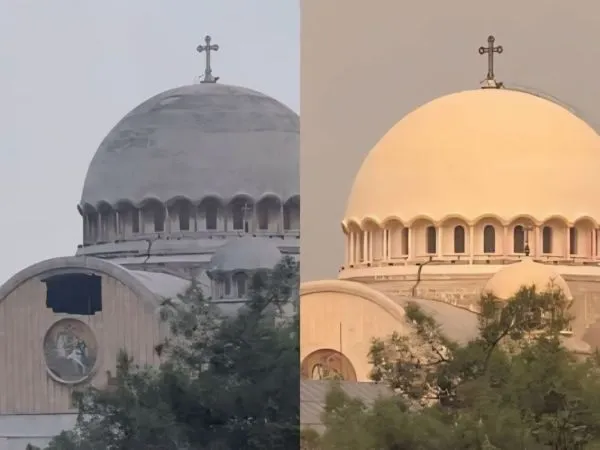
“The first step was removing the loose stones from above to protect people, especially since the church hall had sheltered the displaced for over a month, providing meals,” Najjar explained. “The restoration then began, taking about a year under Archbishop Masri’s direct supervision. The cracks were sealed, the exterior facade restored, the interior repainted, the stone polished, and new stairs built.”
Regarding Providence School, Najjar said that classroom walls had also cracked while sanitation systems were damaged. “We didn’t just restore the school. Rather, we began a complete renovation, taking advantage of the summer vacation. In five months, the building rose beautifully from the ashes,” he explained.
“New classrooms are being opened, the language lab revived, bathrooms added, as well as a TV/cinema hall, playroom, and aerobics studio. About 150 seats will be restored, walls repainted, floors polished, and stonework whitened — all thanks to funding from the Salla charity. Aid to the Church in Need covered the church’s restoration costs,” he added.
The Church of St. George in Aleppo before and after the restoration work. Credit: Joseph Nono
Najjar revealed that Masri strongly supported the school’s renovation, expressing deep appreciation for the contractor, engineer Joseph Nono, who was entrusted with both the church and school projects.
Notably, Absi’s Aleppo visit included stops at the Dar Al-Nahda Music Institute under artist Shady Najjar’s direction and a dinner for men and women named after St. George born between 1960 and 1980. He has also planned a tour of Aleppo’s Old Square.
This article was originally published in ACI Mena, CNA’s Arabic-language news partner, and has been translated and adapted by CNA.
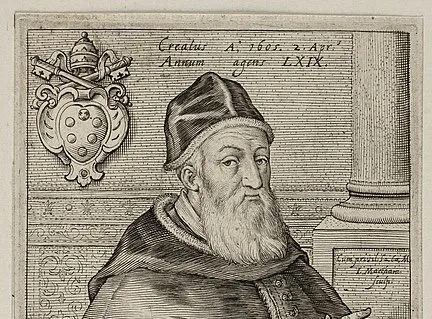
Jacob Matham’s portrait of Leo XI, who reigned April 1-27, 1605. / public domain
Denver Newsroom, Sep 18, 2022 / 14:00 pm (CNA).
Blessed John Paul I did not serve as Roman Pontiff for long, but 10 other popes had shorter pontificates than he did. Their stories are a microcosm of the history of the papacy. Some were friends of saints and worked for the good of the Church, while the qualifications of others might be a bit questionable. Through all these more or less flawed men who sat in the Chair of Peter, the Catholic Church teaches that the connection to St. Peter and his profession of faith in Christ endures.
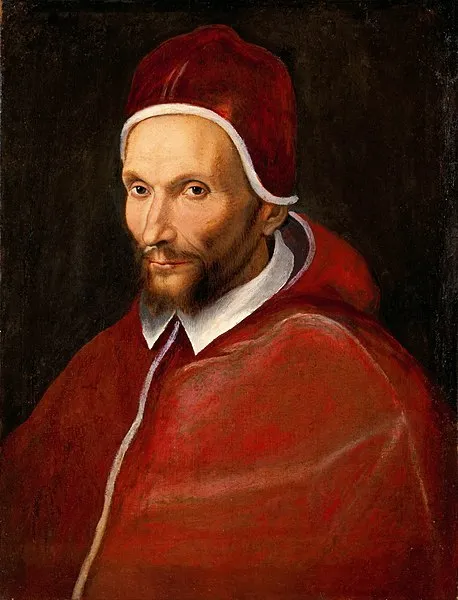
Urban VII was pope for 13 days, Sept. 15–27, 1590.
He was born Giambattista Castagna at Rome, the home city of his mother. His father was of Genoan nobility. His uncle was a cardinal, whom he served at points during his long career in the Church. He held doctorates in civil and canon law.
Castagna worked in government and diplomacy on behalf of the papacy, which at the time held civil power over parts of Italy. He led several commissions during the Council of Trent and helped organize the military alliance against the Ottoman Empire, according to the New Catholic Encyclopedia. He was appointed archbishop in 1553 and became a cardinal in 1583.
He had a reputation for genuine piety, intelligence, and ability to govern.
Jacopino del Conte’s portrait (c. 1590) of Urban VII. public domain
After his election as pope, he made sure to address the needs of the poor in Rome. His initial plans included expanded public works to employ the poor.
As God’s providence allowed, he did not have time to do much more than plan. He died of malaria at the age of 69. In his will, he left his personal fortune to support poor girls.
Celestine IV reigned for 15 days, Oct. 25–Nov. 10, 1241.
The future pope was born Goffredo da Castiglione in Milan. He spent time with the Cistercian religious order and was a cardinal bishop of Sabina. He was a nephew of Pope Urban III. He was already in poor health when he was elected, at a time when the papacy was a center of political conflict between backers and opponents of Holy Roman Emperor Frederick II.
Boniface VI reigned for 16 days, April 11–26, 896.
He was born in Rome. Not much is known about this pope, though records indicate that during his life he was canonically deprived of holy orders on two occasions: the first time as a subdeacon, and the second as a priest. His irregular past caused controversy over his election, the New Catholic Encyclopedia says.
Theodore II reigned for 20 days in December 897.
Another little-known pope, it is said that his clergy loved him, that he loved peace, and that he lived a life of chastity and charity to the poor. He came to power soon after a low point of the papacy. Pope Theodore annulled the acts of the “Cadaver Synod,” which had put on trial the corpse of his predecessor, Pope Formosus. He recovered the dead Roman Pontiff’s body from the River Tiber and gave it a proper burial. He also reinstated clergy who had been forced to resign.
Sisinnius was pope for 21 days, Jan. 15–Feb. 4, 708.
This pope was born in Syria. His health troubles included disabling arthritis, and he was unable to feed himself. The papacy was responsible for the military defense of Rome at this time, with Lombards invading from the north of Italy and Muslim armies advancing from the south. Sisinnius ordered the walls of Rome to be reinforced as his first act, the New Catholic Encyclopedia says. Before he died, Pope Sisinnius ordained one priest and consecrated a bishop for Corsica.
Marcellus II was pope for about 22 days in April and May, 1555.
He was born Marcello Cervini, at Montefano in Tuscany. Like the sainted Pope Marcellus of the fourth century, he kept his baptismal name as his papal name.
His father worked under several pontificates as a scribe and secretary.
Before Cervini was elected pope he served various roles as a secretary to popes and cardinals, including work to correct the Julian calendar. He was actively engaged with the “New Learning” of Renaissance humanism. He served as protector of the Vatican Library and helped improve and expand its collection. Cervini served the Vatican at the time of its response to the Protestant Reformation. He was a president at the Council of Trent, which continued through his short pontificate.
He gained a reputation as a Church reformer and had hoped to pursue this path during his papacy. He was not consecrated a bishop until the day after he was elected pope.
Pope Marcellus reputedly became sick from overwork during the celebrations of Holy Week and Easter, and the illness turned fatal.
The Missa Papae Marcelli of Giovanni Pierluigi da Palestrina was composed in his honor.
Damasus II reigned for 24 days in July and August, 1048.
This pontiff was named Poppo. He was born in Bavaria and was of German extraction. He served as Bishop of Brixen in Tyrol, in what is now western Austria.
Popes at the time could be nominated in an unusual manner. Pope Damasus II was named by Holy Roman Emperor Henry III. The pope, however, soon died of malaria.
Pius III was pope for 27 calendar days, Sept. 22–Oct. 18, 1503.
He was born Francesco Todeschini in Siena. He was the nephew of Pope Pius II, a famous Renaissance-era pope. His uncle took him into his household and became his patron, allowing the young man to add the pontiff’s family name Piccolomini to his own last name.
Francesco studied canon law. His uncle named him to become administrator of the Archdiocese of Siena and later made him a cardinal-deacon.
The future Roman Pontiff had a reputation of living an upright life as a cultured, gentle man, the New Catholic Encyclopedia reports. He took part in several conclaves of his time, including that which elected Alexander VI.
His service to the papacy included several diplomatic appointments to Germany, France, and Perugia.
Francesco’s own papal election took place amid ruling Italian families’ disputes over control of Rome and included an unsuccessful power play by the Borgia family.
Pius III was known to be in poor health. At the time of the papal coronation he was already suffering from a diseased leg, which developed into a septic ulcer. He died at the age of 64.
Leo XI was pope for 27 days, from April 1–27, 1605.
The Florentine-born Alessandro de Medici was a member of the famous Medici family. He was grand-nephew to Pope Leo X. He sought to become a priest from an early age, but because his mother objected he was not ordained until after she died, according to the New Catholic Encyclopedia. He served as an ambassador to Rome on behalf of Tuscany, before he began to advance in the Church. He would eventually become a bishop, then archbishop of Florence, before being named a cardinal.
He served as a papal legate to France and was head of the Congregation of Bishops.
Among his great friends was St. Philip Neri, founder of the Oratorians.
He was elected pope at the age of 69 and became sick almost immediately.
Benedict V served as pope for 33 days, May 22–June 23, 964.
He was born in Rome and had a reputation for great learning.
He reigned at a time of great turmoil in the Church. Holy Roman Emperor Otto I had interfered with the pontificates of his predecessors. The emperor had forcibly deposed a pope and installed his own nominee on the See of Peter. There were rival claimants to the papacy under Benedict V and Otto again interfered, laying siege to Rome and taking the pope away from Rome by force. Benedict either renounced the papacy or was forcibly deposed. He lived in exile in Hamburg for another year.
John Paul I served as Roman Pontiff from Aug. 26–Sept. 28, 1978, 33 calendar days.
His beatification on Sept. 4 renewed attention to his life. He had a reputation for humility and for teaching the faith in an understandable way.
The future John Paul I took part in the Second Vatican Council and was named patriarch of Venice.
As a cardinal, Luciani published a collection of “open letters” to historic figures, saints, famous writers, and fictional characters. The book, “Illustrissimi,” included letters to Jesus, King David, Mark Twain, Charles Dickens, and Christopher Marlowe, as well as Pinocchio and Figaro, the barber of Seville.
He was the first pope to have two names. He took his papal name from his immediate predecessors, Sts. John XXIII and Paul VI.





Leave a Reply